Entering the conversation on jobs

I have a posting up at The Conversation into which I was very happy to join. It’s been titled, Rudd’s Job Plan Misses the Mark which pretty well says what it says. I have received two emails from possibly the only two people who have read it which I will reprint here, the first very nice, the second not so. But let me start with the more positive of the two. He begins with a quote from the article:

“There was a time when the idea of a job was related to some piece of work that someone wanted done. A job was not a thing in itself but related to the creation of value within some enterprise. One therefore didn’t create jobs as such. What one did was create an economic environment in which one of the limits on production was the amount of labour available.” Correct. And such a time shall come again: this Saturday.

I think that myself. A long hard slog but the repair will begin almost immediately on Saturday night. But then there was another email, not as positive and upbeat as the first.

You have to wonder what happens to the well-studied and diligent Keynesian-leaning student at the RMIT economics department. I think perhaps they are aiming for the ‘Melbourne’ school to take a bronze medal behind Austria and Chicago. The problem is the quality of their ‘research’ versus the aggressive muscularity of their conclusions. We seem to go from assertion to conclusion without the need for any messy, you know, tested hypotheses. Today’s instalment is case in point – lots of assertions without any empirical evidence that a slightly higher uptick in unemployment has anything to do with industrial relations policy. Of course business wants more skilled workers at a lower cost, but when have they not wanted this? For years we have heard dire warnings from the Melbourne Austrians – stagflation, hyperinflation and economic depression. A strike out on all 3. I have said it before – a fund manager investing on the basis of their predictions would be in the street selling pencils from a cup about now. And for all their failures, we continually hear their platitudes as if it’s the dernier cri – not as proven and miserable failures.

A Keynesian-leaning student in my hands, if they understood the theory, would get an A, if they also understood the rest. We do not indoctrinate unlike those who are part of the C+I+G faith-based community. But I must say that anyone who can still think Keynesian economics has anything to offer in the current environment really is not into evidence-based policy making it would seem to me. The point I have made all along is that given the way we have tried to engineer an upturn through deficits and higher public spending, the labour market will never gel and recovery will never become self-sustaining. But he at least did think we were the bronze medal holder after Austria and Chicago. I’d take that.

But as for selling pencils on the street, my walk to work takes me past my own high street and then along Swanston Street. The empty shops for rent make a dismal sight and we have had a continuing increase in public spending and debt since our present government took office. None of this is a surprise to me although I find it deeply depressing. I wonder if it’s a surprise to my correspondent and the rest of the Keynesian brigade who make up 90% of the economics profession, or do they not even notice how badly their economic advice has turned out to be.

Another Comment: And now there is this:

This article seems to assume we are a manufacturing economy, which we aren’t. In fact, only about 8.6% of people are employed in manufacturing, and we are basically an importing economy and we export raw materials. If everyone’s wages were cut, it is unlikely to increase manufacturing job numbers much at all, although it might reduce consumption per person. In terms of overall consumption, we are basically consuming ourselves to death by growing our population through immigration.

Did I say cut wages? It was the farthest thing from my mind. What I wanted was unregulated wages so that no one was ever priced out of a job because of some arbitrary minimum imposed on the labour market. We have a minimum wage of something like $35,000 a year. Really, how insane is that! It cuts out of the job market all of those people who could be productive at say $30,000 who if they were working would add to our output and make the economy stronger as well as themselves somewhat better off. On those immigrants, however, if they are coming in and absorbing our productivity without contributing anything back, then he has a point although to say we are consuming ourselves to death is going too far. But that immigrants without workplace skills who contribute less than they consume are a drain on our wealth, this is obviously true almost by definition. Only a Keynesian who thought that their adding to demand without adding to supply promotes growth could believe such nonsense, but there are no end of such people and you find them everywhere.

And one last one and we’ll stop here: My impression is that he thinks I am not all that reliable a commentator but at least he is spreading the message around. Very nice to see I am being read.

This is rather tame stuff from Dr Kates. However people who enjoy this article may enjoy Catallaxy Files where he supplies his readers with more red meat.

“The interview with Tony Abbott on Andrew Bolt brought out just what I admire about Tony Abbott so much” http://catallaxyfiles.com/2013/08/25/a-philosopher-pm/

“Who does this remind me of?: Eleven signs you are dating a sociopath ” [The answer is Rudd I believe] http://catallaxyfiles.com/2013/08/29/who-does-this-remind-me-of/

“The real question is who are these 49% that the polls say still intend to vote for Labor? Unimaginable really. But I do have an article at Quadrant Online that looks at the election as we enter into our first full day. And what I discuss is the nature of the ballot with the natural constituency of a Labor party made up of those who live by the words they use rather than the goods they produce, those who work for governments at every level (including those crony capitalists) and those who live off the plundering of incomes by the state.” http://catallaxyfiles.com/2013/08/06/the-49/ – It appears plunderers of the states doesn’t include university lecturers, just people like nurses and police and other such leeches. [Wonder why he thinks these people vote Labor.]

Kates on Makeup-Gate: “It is impossible to imagine just how abrasive a personality Kevin Rudd must actually be if you have not experienced it yourself. But here is the testimony of someone who has:” http://catallaxyfiles.com/2013/08/22/it-aint-over-till-its-over/

Come on Dr Kates, tell us what you really think – it is so much more entertaining.

These people lack a sense of irony and of shame.
Don Argus on Say’s Law

There is literally only a single economics text in the world that will tell you that for public spending to create jobs – any spending for that matter – it must be value adding. It is obvious and really only common sense but it is also a long-suppressed truth that is bringing us to ruin across the economies of the West. In the old days it was commonly understood that demand is constituted by supply, that to increase demand across an economy you first had to raise the level of value adding supply, a notion all but gone from economics since 1936. But here, picked up at Andrew Bolt, is Don Argus saying what is never normally said. Andrew’s heading is “Argus: this debt is dangerous, and bought us trash”. Exactly so!

The problem is that Australia’s debt accumulation did not deliver the optimal returns. There has been little infrastructure investment through the so-called boom, and remedial measures undertaken like stimulus cash payments and pink batts do not produce any ongoing return…

But one could conclude we have an emerging problem in this country that sizeable projects have not been subject to rigorous, publically disclosed cost-benefit analysis. The NBN is the most notable example of this, and the Government appears to have gone to great lengths to conceal its Budget impact.

Argus’s entire article can be found here.

Economics and history

This from Scientific American, a brief article with the title, “Is Economics More Like History than Physics?” The conclusion:

Economics, especially the macro kind, has history-like aspects. Its narratives might be woven with data, but not everything that counts can be counted. It must deal with different kinds of change that (to paraphrase Shakespeare) were never dreamt of in our physics. Perhaps this limits economics to moderately reliable maxims.

It’s clear enough that you cannot do economics without history but history is not what economics is.

TA on IR – seeking fair and just arrangements

To continue on the theme of industrial relations as discussed below, let me bring this in from the AFR today (p 12). Tony Abbott intends to rein in penalty rates using the existing IR system. These are actual quotes from Abbott with the bit in bold the statement highlighted by the AFR:

Governments of all persuasions have brought submissions to the Fair Work Commission.

The important thing is that these things will always be decided by the independent umpire.

The Fair Work Commission that this government established and this government staffed will be the independent umpire which decides all these things under an incoming Coaltion government.

I accept that businesses are under pressure and I would like businesses and their workers to come to the kind of fair and just arrangments that will maximise employment and maximise pay.

Music to my ears. This is how it needs to be done by a Coalition government. And BTW if you haven’t listened to Alan Jones in the post below you really should.

Wages based on productivity – there’s a new world dawning

A quite seismic story in The Australian today and one that makes me think that in government the Coalition plans to be there for a long time. The obsession with trying to rid us of our unique industrial relations system may be waning and not before time. Instead, we have evidence that the intention is to use the existing structure in a more creative way. The story is titled, Coalition to police wage claims, and the first two paras say most of what needs to be known:

THE Coalition has vowed to crack down on ‘excessive’ wage claims by forcing ‘lazy’ employers and unions to prove they have engaged in an ‘appropriate discussion and consideration of productivity’ before above-inflation pay rises are approved.

Opposition workplace relations spokesman Eric Abetz said yesterday unions pursuing agreements allowing for annual pay rises of, for instance, 5 per cent should be required to show to the Fair Work Commission that they had ‘genuinely discussed’ productivity with their employer before the deal is approved.

Hard to do, glory be, it will be hard to do. But putting productivity back into the equation where unions are involved in wage negotiations is a major step in the right direction.

Further comment: I am apparently one of those free market economists who actually has an interest in institutional structures. I am also a Burkean conservative in that I think that the “bank and capital of nations” is a standard from which we should only deviate slowly and with caution. And finally, I don’t want Tony Abbott to be the third Prime Minister in our history to lose his seat while his government is voted out because of their policies on industrial relations.

I wrote an article for Quadrant some time back on this, “A Free Market Defence of Industrial Tribunals“, where I point out why the institutional structures we have are a benefit for conservative governments if properly understood and appropriately managed. It’s not the system that’s the problem, it’s the unions and they are a massive problem. For comparison, the industrial relations system of Singapore was based on the system in Western Australia.

It’s union power ruthlessly used, that needs to be dealt with. The idea that we could have what no one has – an industrial relations system free from legislative rules – is a non-option. We have unions and they have power and they will use that power to bludgeon employers for wage increases that threaten our productivity. The madness of the decision yesterday on apprenticeships will, typically, be sheeted home to the Fair Work Commission and not to the current government that sought the change. A government in which half its front bench are union leaders is a government that will cause economic harm.

So what should you do? Get rid of the Fair Work Act, ensure that workplace decisions are determined at the workplace but also make sure that the system put in place is not only fair to all parties but is seen to be fair. If that makes no sense to some people, we will just have to agree to disagree. But if you are interested, read my Quadrant article. We can then continue the conversation after that.

And in this I am mindful of the commotion that this proposal has caused within the Coaltion. Andrew Bolt discusses this under the heading, A good Liberal idea shut down in a day. An election to win. If trying to raise productivity at the workplace by leaning into union power is no longer a vote winner – that is, if the community no longer has any idea how living standards are raised – then this country no longer has any idea on which side their bread is buttered. I don’t believe that but I’m not running the campaign.

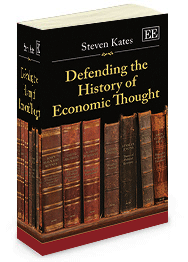
Defending the History of Economic Thought

defending the history of economic thought

My Defending the History of Economic Thought has just been released. As an author, possibly the most interesting part about writing a book is to find the text saying things you had never thought about yourself until you came to write them down. This book is more exceptionally like that than any of the others I’ve written. This is how the text on the back of the book would have read had there been more room:

The aim of this book is to explain the importance of the history of economic thought in the curriculum of economists. Most discussions of this kind are devoted to explaining why such study is of value to the individual economist. It is, of course, but that is not the main point of this book. This book reaches out past the individual to explain the crucial role and importance of the history of economic thought in the study of economics itself. As the book tries to explain, without its history at the core of the curriculum, economics is a lesser subject, less penetrating, less interesting and of much less social value.

It is the orientation that historians of economics give to economics in general that may be its great value. The mainstream is continuously challenged because historians of economics keep bringing other perhaps wrongly neglected economic traditions into the conversation.

The sad reality is that almost no economist being educated today has detailed knowledge of the people who built the ideas found in their texts nor do they know how those ideas evolved. Worse yet, they know almost nothing of those ideas no longer found in our modern texts, many of which had once been central in economic discourse but which have since been moved onto the back shelf for no better reason than because they are no longer part of the mainstream. This book explains not just why anyone who wishes to understand economic theory must understand the history of economics but also, and much more importantly, why the history of economic thought must be preserved as a core component within the economics curriculum if economic theory is to progress.

This fascinating and thought-provoking book will prove invaluable reading for academics, researchers, lecturers and students across the expansive economics field.

The details on where to get a copy of the book may be found here.

The Ten Pillars of Economic Wisdom

The Ten Pillars of Economic Wisdom
By David R. Henderson

1. TANSTAAFL: There ain’t no such thing as a free lunch.

2. Incentives matter; incentives affect behavior.

3. Economic thinking is thinking on the margin.

4. The only way to create wealth is to move resources from a lower-valued to a higher-valued use. Corollary: Both sides gain from exchange.

5. Information is valuable and costly, and most information that’s valuable is inherently decentralized.

6. Every action has unintended consequences; you can never do only one thing.

7. The value of a good or a service is subjective.

8. Creating jobs is not the same as creating wealth.

9. The only way to increase a nation’s real income is to increase its real output.

10. Competition is a hardy weed, not a delicate flower.

Numbers 4 and 9 are core elements of Say’s Law.

The Stimulus that Made Australia Far Worse Off than if Nothing had been done at All

I have an article at Quadrant Online where you don’t get to choose the heading and which is called, The bill comes due for Rudd’s quack cure but does truly get to the heart of the matter. Every so often, I’m sure, a government will actually spend money in a sensible way and legitimately take credit for some positive outcome that hastened things a bit if left to the private sector. Governments are still dining out on their achievement with the Snowy River in the 1950s as if that is the typical outcome to be expected from public expenditure. But in the sixty or so years since it is hard to come up with great expenditure achievements by governments. I’m sure there are some outside the roads and airports variety but I just can’t think of any offhand. The Pink Batts, School Halls and NBN expenditures are more typical of what you get from government.

But let me draw your attention to the conclusion of this article which discusses the actual reasons for Australia’s soft landing which followed the same recession found everywhere else on the globe. Such nonsense to argue that we avoided recession but that’s the myth. My own take on what made things better list the following:

As for the reasons that the downturn here was not as bad as it has been elsewhere, there are four parts to the explanation that I can see.

There is firstly the extraordinary fiscal situation the government inherited. We not only had no deficit, we actually had no debt. Australia was the only country in the world not to have any public debt whatsoever, a situation that it is almost impossible to imagine returning any time soon.

There was then the mining boom built on the back of the Chinese stimulus. That has gone, in large part because the Chinese must now themselves deal with the problems that their own stimulus created in their own economy. But we have added to our own slowdown in mining through a series of policies that have made miners more reluctant to invest in Australia.

Third, our banking system was almost entirely untouched by the financial crisis which spread internationally due to the ownership of various toxic assets generated in the US financial system. Our banks were fine, so Australia had no problems of this kind to overcome.

And lastly – but this will make little sense to most people – the RBA kept interest rates up rather than pulling them down. No quantitative easing in these parts with the result that the national savings we generated were used more productively than elsewhere. You can’t stop governments from squandering what they squander, but at least the private sector was kept on the straight and narrow.

Interestingly, there is an article in The Australian today which touches on this same question. David Crowe has an article titled, The stimulus we didn’t really need which lets Rudd off easy. The title should be “The Stimulus that Made Australia Far Worse Off than if Nothing had been done at All” or something along those lines. Interesting, there is a four point discussion of the same thoughts I wrote up at QoL in which Warwick McKibbin mentions China and our banking system’s strengths, but then mentions the fall in the dollar which I have my doubts about and then this one extra.

Because where we differ is over interest rates. Sure they were brought down during the GFC although only late in the day but then they were raised again and then again and then kept relatively high. Those low interest rate Keynesian types will be the ruin of us all. Thankfully our RBA governor didn’t buy into any of it.

Infrastructure and the private sector

From The Wall Street Journal on the private sector and the provision of infrastructure. By the time you get to the end you wonder why we ever let the government do anything.

For almost five years now, President Obama has been making the argument that government “investments” in infrastructure are crucial to economic recovery. “Now we used to have the best infrastructure in the world here in America,” the president lamented in 2011. “So how can we now sit back and let China build the best railroads? And let Europe build the best highways? And have Singapore build a nicer airport?”

In his recent economic speeches in Illinois, Missouri, Florida and Tennessee, the president again made a pitch for government spending for transportation and “putting people back to work rebuilding America’s infrastructure.” Create the infrastructure, in other words, and the jobs will come.

History says it doesn’t work like that. Henry Ford and dozens of other auto makers put a car in almost every garage decades before the National Interstate and Defense Highways Act in 1956. The success of the car created a demand for roads. The government didn’t build highways, and then Ford decided to create the Model T. Instead, the highways came as a byproduct of the entrepreneurial genius of Ford and others.

Moreover, the makers of autos, tires and headlights began building roads privately long before any state or the federal government got involved. The Lincoln Highway, the first transcontinental highway for cars, pieced together from new and existing roads in 1913, was conceived and partly built by entrepreneurs—Henry Joy of Packard Motor Car Co., Frank Seiberling of Goodyear and Carl Fisher, a maker of headlights and founder of the Indy 500.

Railroads are another example of the infrastructure-follows-entrepreneurship rule. Before the 1860s, almost all railroads were privately financed and built. One exception was in Michigan, where the state tried to build two railroads but lost money doing so, and thus happily sold both to private owners in 1846. When the federal government decided to do infrastructure in the 1860s, and build the transcontinental railroads (or “intercontinental railroad,” as Mr. Obama called it in 2011), the laying of track followed the huge and successful private investments in railroads.

In fact, when the government built the transcontinentals, they were politically corrupt and often—especially in the case of the Union Pacific and the Northern Pacific—went broke. One cause of the failure: Track was laid ahead of settlements. Mr. Obama wants to do something similar with high-speed rail. The Great Northern Railroad, privately built by Canadian immigrant James J. Hill, was the only transcontinental to be consistently profitable. It was also the only transcontinental to receive no federal aid. In railroads, then, infrastructure not only followed the major capital investment, it was done better privately than by government.

Airplanes became a major industry and started carrying passengers by the early 1920s. Juan Trippe, the head of Pan American World Airways, began flying passengers overseas by the mid-1930s. During that period, nearly all airports were privately funded, beginning with the Huffman Prairie Flying Field, created by the Wright Brothers in Dayton, Ohio, in 1910. St. Louis and Tucson had privately built airports by 1919. Public airports did not appear in large numbers until military airfields were converted after World War II.

No matter where you look, similar stories come up. America’s 19th-century canal-building mania is now largely forgotten, but it is the granddaddy of misguided infrastructure-spending tales. Steamboats, first perfected by Robert Fulton in 1807, chugged along on all major rivers before states began using funds to build canals and harbors. Congress tried to get the federal government involved by passing a massive canal and road-building bill in 1817, but President James Madison vetoed it. New York responded by building the Erie Canal—a relatively rare success story. Most state-supported canals lost money, and Pennsylvania in 1857 and Ohio in 1861 finally sold their canal systems to private owners.

In Ohio, when the canals were privatized, one newspaper editor wrote: “Everyone who observes must have learned that private enterprise will execute a work with profit, when a government would sink dollars by the thousand.”

In all of these examples, building infrastructure was never the engine of growth, but rather a lagging indicator of growth that had already occurred in the private sector. And when the infrastructure was built, it was often best done privately, at least until the market grew so large as to demand a wider public role, as with the need for an interstate-highway system in the mid 1950s.

There is a lesson here for President Obama: Government “investment” in infrastructure is often wasteful and tends to support decaying or stagnant technologies. Let the entrepreneurs decide what infrastructure the country needs, and most of the time they will build it themselves.