The real question is why they didn’t see it coming

The title is Obamanomics: R.I.P. and the data are nothing no one knows:

The previously bullish Fed finally and openly acknowledged that sluggish growth is the long term new normal for America. Secular stagnation is here to stay. The growth rate has limped out of the 2008-09 recession at a 2 percent pace now for seven years. The Joint Economic Committee of Congress tells us a normal recovery gives us about 3.5 percent growth and the Reagan and JFK booms were closer to 4 percent. So the GDP today thanks to President Obama is about $2 to $3 trillion smaller than it should be. This is roughly the equivalent of losing the entire annual output of every business and worker in Michigan, Ohio and Indiana combined.

And on and on he goes. If you elect your own version of Chavez, none of this should come as a surprise. But it is not that they didn’t see it coming, they have no lens through which to make sense of what is going on. How ridiculous is this:

The lesson of the Fed under Ben Bernanke and now Yellen is that easy money is no economic solution to this decade-long malaise. As economist Larry Kudlow puts it: “The Fed can print money, but it can’t create jobs.” Our central problem now is not with our monetary policies. It is severe regulatory and tax drag.

Of course it’s with your monetary policies and your fiscal policies and your regulatory policies and your tax policies. They are blinded by their own economic theories, and it is apparently not suicidal for Hillary to say that her intention is to carry on where Obama left off.

Anti-capitalism is a form of hate speech that has caused the deaths of hundreds of millions

I have been reading David Solway’s The Problem with Hate Speech which has brought this to mind. It is about how the left is doing what it can to make arguments contrary to its own beliefs illegal by transferring the normal expression of one’s own opinion into forms of hate speech, which is then made against the law. His article concludes:

If we do not speak our minds, or prefer to huddle under a canopy of pietistic complicity, as many do, we will awaken one day soon to find our freedom of expression even more severely compromised than it now is—or worse. Indeed, “microfascism” has a way of morphing into macrofascism. The upshot is that we will have reaped the bitter harvest of our cowardice, and an ironic form of justice will have been served.

If ever there has been a belief system that has led to the death and misery of more people than the various forms of socialism that have been tried and are still being tried, I do not know what it is. Venezuela stands before us today as a living dying example of how rapidly a society can be devastated by socialist leaders, and even while the example has been there before us, something like a quarter of the voting population of the richest and freest country that has ever been have been following Bernie Sanders – their own Hugo Chavez – and sincerely wish to see him become president of the United States.

Socialism is not the welfare state. It is not trying to assist the disadvantaged and the poor. It is not trying to lift the fallen and comfort the afflicted. It is a desire to run an economy from the centre, to steal the property of the capitalists and make everyone better off by making the most economically illiterate people in a society its political leaders.

In which socialist experiment has this not followed as night follows day: Venezuelans Ransack Stores as Hunger Grips the Nation.

Venezuela is convulsing from hunger.

Hundreds of people here in the city of Cumaná, home to one of the region’s independence heroes, marched on a supermarket in recent days, screaming for food. They forced open a large metal gate and poured inside. They snatched water, flour, cornmeal, salt, sugar, potatoes, anything they could find, leaving behind only broken freezers and overturned shelves.

And they showed that even in a country with the largest oil reserves in the world, it is possible for people to riot because there is not enough food.

This is from The New York Times, and therefore you might think the evils of anti-capitalism are at least being exposed. Not a bit of it. The entire article is purely descriptive. There is not a sentence in it that lays blame on anyone for the catastrophes being described. It is not entirely certain that anyone among the reporters at The New York Times actually knows. This is the only part of the story that tries to explain a thing:

Economists say years of economic mismanagement — worsened by low prices for oil, the nation’s main source of revenue — have shattered the food supply.

Sugar fields in the country’s agricultural center lie fallow for lack of fertilizers. Unused machinery rots in shuttered state-owned factories. Staples like corn and rice, once exported, now must be imported and arrive in amounts that do not meet the need.

The reporter cannot even bring himself to name the particular form of “economic mismanagement”, not even so much as to describe it as the guaranteed fruits of an anti-capitalist, socialist government. And there is no doubting that this has added to the socialist death toll, as described by this story from a month ago in the same journal of record: Dying Infants and No Medicine: Inside Venezuela’s Failing Hospitals. And they are not dying, they are actually dead.

Doctors kept ailing infants alive by pumping air into their lungs by hand for hours. By nightfall, four more newborns had died.

“The death of a baby is our daily bread,” said Dr. Osleidy Camejo, a surgeon in the nation’s capital, Caracas, referring to the toll from Venezuela’s collapsing hospitals. . . .

“It is like something from the 19th century,” said Dr. Christian Pino, a surgeon at the hospital.

The figures are devastating. The rate of death among babies under a month old increased more than a hundredfold in public hospitals run by the Health Ministry, to just over 2 percent in 2015 from 0.02 percent in 2012, according to a government report provided by lawmakers.

The rate of death among new mothers in those hospitals increased by almost five times in the same period, according to the report.

And what does this reporter say about the causes of such horrors? Does he explain that this is the natural consequence of following a socialist policy?

“This is criminal that we can sit in a country with this much oil, and people are dying for lack of antibiotics,” says Oneida Guaipe, a lawmaker and former hospital union leader.

But Mr. Maduro, who succeeded Hugo Chávez, went on television and rejected the effort, describing the move as a bid to undermine him and privatize the hospital system.

“I doubt that anywhere in the world, except in Cuba, there exists a better health system than this one,” Mr. Maduro said.

Can we lock up anti-capitalists for their hate speech, their insanity, their ignorance, their murderous beliefs? No we can’t and, of course, we shouldn’t and there is no chance that we will. Nevertheless, anti-capitalist rhetoric remains at the centre of political discourse in the West. It is the most lethal belief system on earth and you can find it not just on street corners but in every legislative body across the world.

There is no winding back Keynesian economics other than through Say’s Law

I gave my presentation on “Classical Economic Theory and Supply Side Economics” on Friday and from my perspective it could not have gone better. And what made it work for me is that I heard things that have helped me clarify in my own mind what needs to be stated with the greater emphasis. There were a few things that came out, but let me deal with the most important which you will not be surprised to find is about how to explain the problem of Say’s Law and why it is important.

So let me state it again: Say’s Law means, quoting Keynes, that it is “impossible for effective demand to be deficient”. In spite of the existence of recessions and frequent periods of high unemployment, if you understand Say’s Law then you understand that the problem is never a deficiency of demand. It may look that way to you and to many producers. Businesses may feel grateful that government spending helps sell what might otherwise have sat on the shelves. It is why Keynesian economics has a plausibility that has allowed it to survive its constant failures for seventy years and counting.

Nevertheless, if you cannot state and explain why recessions are never caused by demand deficiency (a general glut as it was once known), you cannot in my view even begin to refute Keynesian theory. You can argue that the economy works in some other way and can go up hill and down dale with counter-explanations. But unless you can and do make the statement that “demand deficiency does not cause recessions”, then you can never overturn Keynesian economics because you have not engaged with the other side which says that recessions are caused by demand deficiency. As long as it is universally accepted that recessions are caused by a deficiency of demand – as long as we continue to teach that Y=C+I+G and that more G will lead to more Y – it will remain impossible to explain why a demand stimulus will only make matters worse. The only argument then is to point out each time a stimulus has been tried that it has failed. But unless you make it your aim to explain why that is, there is no winding Keynesian economics back.

The problem goes deeper. Public spending in almost all circumstances is seen as creating growth and jobs. The NBN is such a catastrophe yet is hardly ever given its due credit as a vast open drain on Australia’s wealth and our standard of living. From Henry Ergas today:

By the time it was booted out of office, NBN Co’s revenues were 91 per cent short of the 2011 corporate plan’s objective, while operating expenses, calculated net of payments to Telstra and Optus, were running at twice the levels the plan envisaged.

In terms of actually building the network, the number of premises to which fibre was effectively available was 89 per cent below the plan’s target. And as a wave of disputes with contractors ground deployment to a halt in four states, the NBN looked well on its way to being dead before arrival.

This is just seen as more G leading to more Y leading to more jobs. You cannot use any part of modern macro to explain just how harmful this is to the national economy. If it adds to demand, it is all to the good. So I say to you that unless you can explain why the NBN is a catastrophe in spite of all of the “demand” it creates – something neither Malcolm nor Bill are able to do – you are unable to understand how an economy actually works.

Seminar on supply-side economics is classical economic theory

This is a trial run for a paper I will be delivering next month, first at Freedomfest in Las Vegas and then at the Chinese Economic Society Australia meeting in Cairns. Supply-side economics is classical economics. If you are going to understand the first you can only do it by understanding the second. The details:

You are warmly invited to School of EFM Research Seminar presentation by our Associate Professor Steve Kates. Your host is Dr Ananta Neelim.

Title: Political Economy in Crisis: Were the Classical Economists Right After All?

Abstract: There are, generally speaking, five streams of macroeconomic thought that compete for allegiance in the modern world.

  • Keynesian which comes in many varieties all of which argue recessions are due to failure of aggregate demand and which deny the validity of Say’s Law
  • New Classical based on rational expectations but with no embedded theory of recession
  • Austrian which typically ignores aggregations, where activity is driven by marginal utility and which builds a theory of recession based on structural imbalances caused by financial dislocation
  • Marxist and other forms of socialist theory whose aim is to centralise economic decisions and whose main focus of analysis are exploitation of the working class and concern with inequality
  • Classical which emphasises the supply-side of the economy, focuses on the role of the entrepreneur, sees recessions as due to structural imbalances which may come from a variety of causes and explicitly incorporates Say’s Law.

The aim of the paper is to argue that economic theory reached its deepest and most profound level in the writings of the late classical economists which flourished over the period from the publication of John Stuart Mill’s Principles in 1848 through until the publication of John Maynard Keynes’s General Theory in 1936. The paper will discuss the classical framework and contrast this approach with the alternatives that today compete for the allegiance of economists.

Date: Friday 17 June 2016

Venue: RMIT University Building 80, Level 11 Room 9 – 445 Swanston Street between Franklin and A’Beckett Streets

Time: 10.30am-12.00pm; Seminar runs 11.00am to 12.00pm

Morning tea will be served at 10.30am. If you would like to come, please RSVP through email esther.ng@rmit.edu.au

Say’s Law – a short course

Steven Kates presents the Ludwig von Mises Memorial Lecture at the 2010 Austrian Scholars Conference. Includes an introduction by Joseph T. Salerno. The ASC is the international, interdisciplinary meeting of the Austrian School, and is for scholars interested or working in this intellectual tradition. Held at the Mises Institute, Auburn, Alabama, March 11-13, 2010.

Understanding the nature and importance of Say’s Law is the single most important issue in economics today. If you don’t understand it, you cannot understand what is wrong with modern macroeconomic theory and policy. Here is Keynes in 1936 explaining why Say’s Law is false and has to be replaced. Just because he doesn’t use the words “Say’s Law” should not distract you from what was his central point. Here he calls it “Ricardo’s doctrine” but it is to reject exactly this that is at the centre of The General Theory.

“The idea that we can safely neglect the aggregate demand function is fundamental to the Ricardian economics, which underlie what we have been taught for more than a century. Malthus, indeed, had vehemently opposed Ricardo’s doctrine that it was impossible for effective demand to be deficient; but vainly. For, since Malthus was unable to explain clearly (apart from an appeal to the facts of common observation) how and why effective demand could be deficient or excessive, he failed to furnish an alternative construction; and Ricardo conquered England as completely as the Holy Inquisition conquered Spain. Not only was his theory accepted by the city, by statesmen and by the academic world. But controversy ceased; the other point of view completely disappeared; it ceased to be discussed. The great puzzle of Effective Demand with which Malthus had wrestled vanished from economic literature. You will not find it mentioned even once in the whole works of Marshall, Edgeworth and Professor Pigou, from whose hands the classical theory has received its most mature embodiment. It could only live on furtively, below the surface, in the underworlds of Karl Marx, Silvio Gesell or Major Douglas.” (Keynes 1936: 32)

That is exactly right. No classical economist ever used the notion of deficient effective demand because every one of them thought of it as utterly fallacious. This is John Stuart Mill in his Principles of Political Economy trying to explain – in 1848 – how inane Keynesian economics is. The Keynesian fallacy was a very old story by the time it became mainstream economic theory, which it remains to this day.

The point is fundamental; any difference of opinion on it involves radically different conceptions of Political Economy, especially in its practical aspect. On the one view, we have only to consider how a sufficient production may be combined with the best possible distribution; but, on the other, there is a third thing to be considered—how a market can be created for produce. . . . A theory so essentially self-contradictory cannot intrude itself without carrying confusion into the very heart of the subject, and making it impossible even to conceive with any distinctness many of the more complicated economical workings of society. [Mill 1848: Book III – Chapter XIV – final para]

That is Keynesian theory, “how a market can be created for produce” which we now describe as raising aggregate demand. Every mainstream economist from the 1820s right through to the publication of The General Theory agreed with Mill, and with no exception. You have lived through the disaster of the stimulus packages that followed the GFC which have been a failure in every single instance. Isn’t it time you perhaps began to consider that Say’s Law is maybe after all a valid principle of economic theory and Keynesian economics is just as fallacious as Mill and every other classical economist thought it was?

I have a book coming out in August, What’s Wrong with Keynesian Economic Theory?, which includes six of the world’s greatest Austrian economists. They all know perfectly well that Keynesian economics is pure nonsense that will with certainty rot out your economy from the inside. But it required me to put together such a collection when such articles should have been flying off the presses from the very start of the stimulus in 2009. Why this has been left up to me remains a puzzle even for myself, but that is how things happen to be.

Is Austrian economics a form of supply-side theory?

I am finishing off a paper on supply-side economics, which I argue is only represented by classical economic theory, and is not fully embodied in Austrian theory since its focus is on marginal utility as the central driver of activity. It is also a problem – to me, anyway – that Austrian theory does not incorporate Say’s Law, again because it is demand-side driven. Your thoughts would be welcome on this, as well as on this passage from the paper:

In the modern versions of Austrian economics, the approach often taken is to reject all interventions in the market and to leave the market to fulfil its role in allocating resources without government involvement. This is not a necessity within the theory itself, but as noted by Holcombe, is to a large extent the political preferences of those who focus on Austrian economic theory.

“Economic purists might argue that Austrian economics and libertarian politics are completely separate, but casual observation confirms that self-proclaimed members of the Austrian school tend to have more libertarian political views than the general population. This connection follows from the idea that the economy and society more generally, is a self-regulating complex system that is the result of human action but not of human design, and that attempts to intervene in that system are likely to result in negative unintended consequences.” (Holcombe 2014: 108)

Yet this is not entirely consistent with the views of Mises himself, who was more “classical” in his approach, or at least was in some of his earlier writings.

“If government buys milk in the market in order to sell it inexpensively to destitute mothers or even to distribute it without charge, or if government subsidizes educational institutions, there is no intervention. However, the imposition of price ceilings for milk signifies intervention.” (Mises [1929] 1977: 20)

I completely agree with Mises [1929] on this, but I wonder if that would still be part of the approach of an Austrian economist today.

Political economy at its finest

This is A Strategy For Fiscal Conservatives written in Canada but applicable just about anywhere. Let me start with the first two of six and you will get the idea.

#1. Never cut anything

Conservative parties take a lot of grief for being cold-hearted because they have the audacity to attempt a scaleback of government largesse. Too often the media jumps on every small spending cut with all the alarm of a nuclear war breaking out. Even when Harper tried to scale back the rate of increase to healthcare funding, it was played out like a massive cut to services.

This also instills fear among anyone working in a job associated with government funded departments. Riling up the union-class crowd isn’t worth the political capital. As Ryan Rados mentioned in his recent article, slowly cutting and threatening the CBC only leads to more aggressive bias. Why incite it?

By never cutting anything you aren’t putting yourself in the awful position of trying to explain to voters why you’re cutting what you’re cutting. The go-to-phrase with never cutting anything is, ”We haven’t cut anything!” All the leftist hyperbole is destroyed when you can honestly make a statement like that.

#2. Freeze things you actually want to cut

Inflation is your friend. If you want to make cuts, just make freezes instead. Then you can honestly say, “We haven’t cut anything!” and your critics will have to explain inflation to a population that will instantly get bored with trying to understand inflation.

A budget freeze amounts to a 1-2% cut every year that the freeze is in effect. Relatively painless and slowly, but surely, effective.

(Added bonus? Standing in front of a microphone saying, “We haven’t made cuts to anything!”)

You don’t have to do it in a single year. And my own addition is to hack into spending throughout the public service where no one votes conservative and no one else will mind.

From Small Dead Animals.

Facts be damned

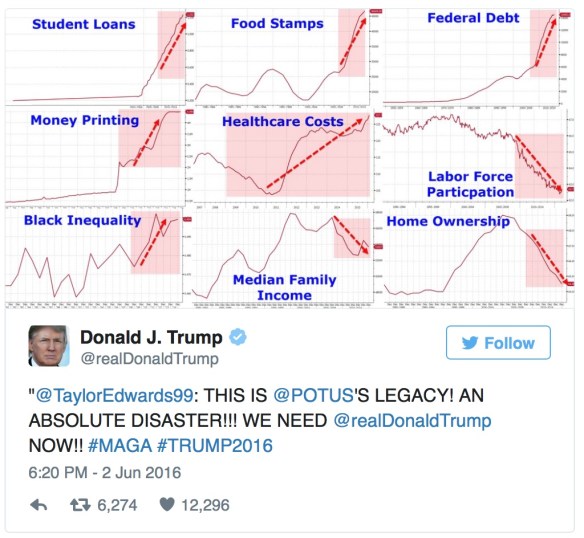
trump economic tweet

Obama said the economy is great, thanks to him, and Trump therefore tweeted the above sets of data which the Washington Post then fact checked. The result: WashPost’s Bump ‘Fact-Checks’ Trump’s Retweeted Obama Economy Charts: Facts Win, 9-0.

Readers can rest assured that despite [The Washington Post‘s] pitiful efforts, the chart-containing tweet which Trump retweeted still stands tall. Trump struck out the Obama-supporting side on nine pitches, er, charts. Bump doesn’t even have a clue that this is objectively the case.

The charts in the retweet are based purely on facts. Each clearly indicates in its red-shaded area what has happened during Barack Obama’s presidency, Each shows that the trends presented have gotten worse under Obama.

You would actually think these journalists would prefer to see the economy run well than have a Democrat in the White House. In fact, they just don’t care. They will continue to lie and mislead to protect the Obama legacy, such as it is, and to get Hillary elected in spite of everything. It is all politics all of the time, and facts be damned.

Interest rates and economic growth

Low interest rates kill off economic growth. Australia has maintained high rates over most of the period since the GFC, and even with the recent cuts our rates remain higher than the international standard. And how are we going?

The Australian economy is expanding at a much stronger clip than anticipated, with one analyst saying the latest GDP figures put doomsayers firmly in the corner as expectations of another rate cut were trimmed.

Meanwhile, back in the US of A, the land of near-zero rates: Shock Report on Jobs Signals Obama Economy Is on Brink of Recession.

If you step back and look at the whole business sector, a case can be made that the United States has been in a mild business recession for as much as a year, if not longer.

Take business fixed investment in equipment, software, plants, buildings, and so forth. This has been slowing for six straight quarters. It even went negative in the first quarter on a year-on-year basis. . . .

Core capital goods, including orders, shipments, and backlogs, have turned negative over the past three months and across the past year. This is a proxy for business investment, and it’s not a good omen.

Finally, the closely watched ISM reports for manufacturing and services are barely above 50. In other words, they point to the front end of a recession. On the manufacturing side, key indicators like production and employment are below year-ago levels. New orders are flat. On the services side, the overall index is below year-ago levels, as is employment and new orders.

The entire article is incoherent to an exceptional extent. In fact, economic policy is incoherent to an exceptional extent. But if you are looking at incoherence, this part of the Australian story is hard to beat:

JP Morgan chief economist Sally Auld questioned the [Australian] growth indicators and expects the RBA to cut rates to a new record low in August.

She said domestic final demand, which is the total amount of spending in the economy, only rose by 0.1 per cent in the quarter and 0.9 over the year.

Ms Auld said all price indicators in the quarterly release were very weak, vindicating the Reserve Bank’s decision to cut rates to 1.75 per cent last month.

“The headline GDP numbers are going to continue to be flattered by very strong net exports. Which will mean that GDP looks good, but it’s not the sort of growth that actually generates any inflation for you,” she said.

She wants inflation! Inflation is apparently good for growth. These people will ruin us yet. With Glenn Stevens gone, there is no certainty that we any longer have a steady hand on the monetary tiller. A rate cutter Glenn was not, but I suspect that even though they all watched him operate, and can see his success before their eyes, they are now going to bring rates down. Mistake, mistake, mistake if they do. If you would like to understand what’s wrong with artificially lowering rates, you would have to go back to economic texts written a hundred years ago or more, unless you would like to read my own, which is about to go into its third edition next year.

Delusional thinking is kind of like deceiving yourself

When I use the word delusional, there is nothing necessarily psychotechnical about it. So I went to the most authoritative source I could find, and this is what it says on Google:

Delusional comes from a Latin word meaning “deceiving.” So delusional thinking is kind of like deceiving yourself by believing outrageous things. Delusional thoughts are often a sign of mental illness, but the word can also be used more loosely to describe behavior that is just not realistic.

So perhaps this is only delusional in a loose sort of way:

President Barack Obama on Wednesday delivered a fervent appeal for a Democratic successor, wading deeper into the race to replace him even as his party has yet to produce a presumptive nominee.

Without mentioning any presidential candidates by name — Democrat or Republican — Obama lambasted what he said were economic myths peddled by the GOP, insisting any clear-eyed assessment shows the country better off now then when he took office.

The GFC began and ended during the presidency of George W. Bush. Again from Google:

The financial crisis of 2007–08, also known as the global financial crisis and the 2008 financial crisis, is considered by many economists to have been the worst financial crisis since the Great Depression of the 1930s.

Obama became President in January 2009. All the hard work had been done. He had the easier job of building the American economy back up. If he thinks things are better now than on the day he took over, I know which meaning of delusional I would choose.

And when you have decided about economic policy, let us move onto how well he thinks he’s done on medical care and peace in the Middle East. You might also find this interesting which is a CNN report on the speech in which the following video is taken. Guess which bit is never mentioned.

I might just further add that this has been up all day at Drudge, very unusual, and still has had only 757,071 hits. The reach of conservative-leaning media is small. Obama is such an embarrassment but they might still elect Hillary. And if the media has its way, they will.