
Misleading indicators

unemployment rate genuine

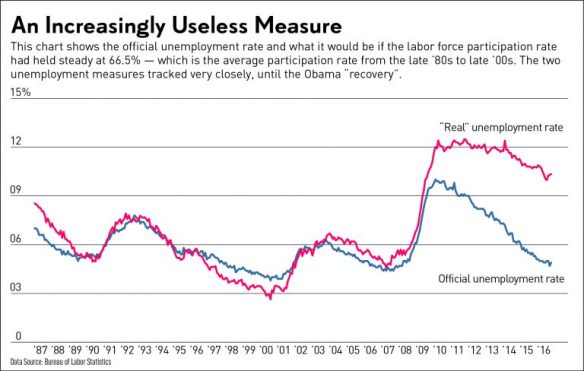
Counting the number of unemployed has always depended on who you include and who you leave out. And to be unemployed you must want a job and be looking for a job. If you are no longer looking even if you would like a job, then you are no longer officially unemployed. Which gets us to the statistic above from this article: It’s Time To Dump The Unemployment Rate. Begin with this:

The July jobs report was a good one, and the unemployment rate held steady at 4.9%, which in the past would have been sure signs of a robust economy. So why is the country in such a bad mood?

An unemployment rate below 5% is a relatively rare thing. Only twice before in the past 40 years has it dropped that low — once in the late 1990s during that economic boom, and again briefly in 2006-2007.

Yet unlike before, there is little joy in Mudville today. Instead of confidence and optimism, there is only malaise.

So look at the “real” unemployment rate in the chart. What is real about it is that it is measured based on a constant participation rate. It adjusts for the fact that people might drop out of the labour force because they have given up hope of finding a job. To quote from the article:

Put simply, what’s happened is that the official unemployment number has grown increasingly useless as a reliable economic indicator, for the simple reason that millions of people have simply quit looking for a job. Since the unemployment rate is based only on those who are actively looking for work, the more people who drop out of the labor force, the lower the unemployment rate becomes.

Up until 2010 that didn’t matter much, since the “labor force participation rate” was relatively steady. But during the Obama “recovery,” that’s changed. As the economy has slogged along for the last seven years, millions of non-elderly workers have given up looking for jobs entirely.

Employment stagnating in just the same way as has GDP. And this is with the supposed stimulus of continuing budget deficits and interest rates at zero. And all economists can think to do is to increase public spending and find some way to contrive to lower interest rates even more.

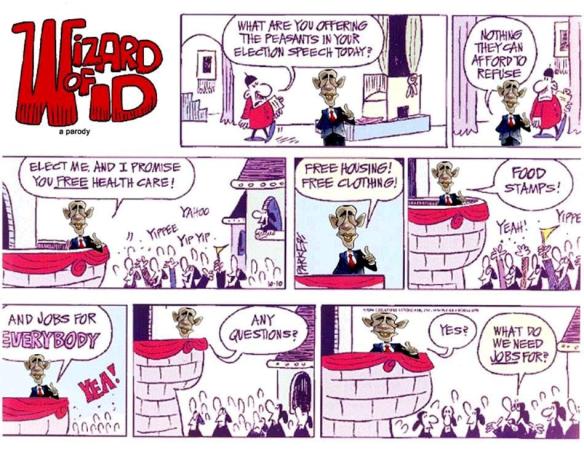
It would be a lesson to us all if only we knew what the lesson was

From A Socialist Les Miserables in Venezuela but picked up at Instapundit. It is, of course, virtually never in the media since it exposes the disastrous result of running an economy on socialist “principles”. But what I find far more remarkable is that even where it is reported, the reporters can never explain what has gone wrong. It’s not that they know but won’t say. It is because they literally do not know what has gone wrong.

A mob of starving people advanced on the presidential palace chanting, “We want food”. They were met by soldiers and police dispatched by the tyrant from his lavish palace decorated opulently with a golden sun, giant rock crystal mirrors, sparkling chandeliers and towering oil portraits.

The scene wasn’t 19th century France, but 21st century Venezuela.

And if you are wondering why you haven’t seen it on the news, it’s because Venezuela is a Socialist disaster area that was once being used as a model by the left. Now it’s a place where the vast majority of people can’t afford basic food staples and a third are down to two or fewer meals a day.

Obama laughed and joked with deceased monster Hugo Chavez, who handed him a copy of the anti-American tract, “Open Veins of Latin America” that had even been disavowed by its own author. Obama called the book a “nice gesture”, but Eduardo Galeano, its author, had told an audience that the left “commits grave errors” when in power.

Venezuela, once a wealthy oil state, where the doctors offering “universal health care” have no medicine and starving people loot government stores looking for food, is yet another example. 50 people are dead in the latest food riots. Their graves are yet another “grave error” of the left.

Obama has not appeared too concerned at the meltdown in Venezuela. Unlike Syria, there are no threats of intervention to remove Maduro, Chavez’s successor, and the rest of the leftist regime illegally clinging to power while slaughtering Venezuelans, smuggling drugs and aiding terrorists.

When Hugo Chavez was killed by the wonders of Cuban medicine, a remedy that American leftists recommend to others while they obtain the best private health care for their own ailments, Obama offered a vague statement of support calling Chavez’s passing, “challenging”.

It was certainly that.

But the question remains, what did they do wrong? It will have to remain a mystery, I’m afraid even as something like a quarter of American voters wanted to make Bernie Sanders president.

What if Keynesian macro really is junk science?

You heard it here first, and since then you have heard it often. The “stimulus” will slow recovery and artificially low interest rates will only make things worse. Since none of this will be explained to you in almost any economics text written anywhere in the past 80 years, it is hard to work out why all this spending and low rates seems to have done nothing of value. But at least there is now some recognition that things are not working out. First this from CBS in the US [!]: Let’s face it — the U.S. economy is going nowhere fast.

They are two of the scariest words in the English language, often heard as the engine room is starting to flood or the parachute fails to deploy: “Don’t panic.” And that was the message among economists trying to make sense of how it is, exactly, that the U.S. could be slowing, when most forecasters had expected it to be speeding up by now.

Time to lower the lifeboats? Not quite. But the economic seas are starting to look ominously rough. Let’s consider why the situation is worrying.

First, it is clear that the economy is much weaker than we thought. As Deutsche Bank economists note, over the past four quarters the non-consumer portion of the economy, notably businesses (you know, the ones that hire people), has grown at a rate of -0.2 percent. That’s recession territory.

A number of economists are now also ratcheting back their forecasts for full-year growth to less than 2 percent, or what many experts think is the economy’s “stall speed.”

Second, history shows that a downturn that starts on the “production” side of the economy [which is where they all start], such as business investment, almost always ends in tears for consumers. Economist Charles Gave of investment advisory firm Gavekal notes that only once since 1958 (in 2012) has the non-consumer part of the economy contracted without that period later being understood to have been part of an official recession.

Meanwhile, here in Australia:

The RBA moved amid worries that there was too much idle ­capacity in business and the labour market, leading to very low inflation and the weakest wage growth on record.

“Given very subdued growth in labour costs and very low cost pressures elsewhere in the world, this is expected to remain the case for some time,” bank governor Glenn Stevens said after yesterday’s meeting.

Keynesian macro is junk science but if you are in government doling out the spending, nothing could be nicer. I have just finished a paper to be delivered at the start of next month which is a critique of modern macro from a classical economic perspective. It never fails to astonish me how the economics of John Stuart Mill and Henry Clay lay everything open, while the Keynes-Samuelson aggregate demand story has never worked on a single occasion.

A BIT OF ADDED COMMON SENSE: I don’t know how such a sensible article ended up on The Conversation, but there you are. It is Phil Lewis discussing Is the concept of ‘helicopter money’ set for a resurgence? It no doubt is since there is a never-ending supply of bad ideas to try before you actually have to do something hard that works. This is from his article:

The various “stimuluses” have been going on now for eight years with little or no discernible effect on economic growth [At least no discernible positive effect – SK]. This is hardly surprising given that growth entails adding value to inputs to produce goods and services people want at prices they are willing to pay.

Value adding is best done by the private sector and cannot arise from wasteful government expenditure, accumulating debt or printing money. Growth (and jobs) can only arise from value adding activities and government policies which facilitate this such as reducing debt, promoting free trade, reducing restrictions on business and labour market reform.

This is hard to do and far more difficult than easy options such as printing money, which explains why neither side of politics appears to have the stomach for real reform.

Economy going nowhere so RBA cuts rates just for something to do

For the record, the RBA is now as useless as the rest of the central banks of the world. This is from Glenn Steven’s statement today. I have highlighted the best bits, the ones that show how dead in the water the economy is:

In Australia, recent data suggest that overall growth is continuing at a moderate pace, despite a very large decline in business investment. Other areas of domestic demand, as well as exports, have been expanding at a pace at or above trend. Labour market indicators continue to be somewhat mixed, but are consistent with a modest pace of expansion in employment in the near term.

Recent data confirm that inflation remains quite low. Given very subdued growth in labour costs and very low cost pressures elsewhere in the world, this is expected to remain the case for some time.

I will only add that so long as we have a Prime Minister and Treasurer who think the NBN represents good policy and will contribute to growth, we will be living in an economy that is going nowhere.

Supply-side economics in China

I am back in Australia in the technical sense that I may be found at the Chinese Economic Society Australia meeting in Cairns but it was a long flight from Las Vegas, most of which was spent reading Donald Trump’s The Art of the Deal. More on that later but let me tell you about CESA and my presentation. Although I presented the paper at Freedomfest, with its focus on the failure of Austrians to take on Keynesians with all the venom they deserve, the paper was written for the Chinese who have become interested in supply-side economics. Although Keynes remains dominant in China, as he is everywhere (and you are kidding yourself if you think he’s not), the Chinese are interested in alternatives, with supply-side economics their own specific area of interest. And as I argue, you cannot find a supply-side model outside the classical economics of John Stuart Mill and Henry Clay. Here’s the list of modern schools, in a highly aggregated way:

Classical
Marxist/socialist
Keynesian (which includes monetarists)
New Classical
Austrian

Only classical specifically incorporates all of the elements needed for clarity in economic thought: the entrepreneur, value adding as the core concept, Say’s Law, a complete rejection of demand as a macro variable, and a theory of recession based on disorder within the structure of production. And I have to tell you that I have had one of the best receptions to a presentation of mine ever. I should also add that my presentation in Las Vegas was attended by the great George Gilder, co-inventor of supply-side economics with Art Laffer during the Reagan Revolution. We need to do it again, but interestingly it seems as if the Chinese are now way ahead of the game.

Austrian economists and Keynesian economics

I’m here at Freedomfest which is the annual meeting place in the United States for all of the political groups on the right. I am part of that strand of conservatives which is well represented but is hardly even a plurality. My paper, however, is about an issue that I think of as extremely important, have raised it often but never really received an answer that satisfies. And the issue is why do Austrians virtually never take on Keynesian economics. This was as much as admitted by Israel Kirzner in his brilliant biography, Ludwig von Mises (ISI Books, 2001: 160).

Ludwig von Mises adopted a vigorously dissenting stance towards this Keynesian economics. Although he rarely offered frontal rebuttal to Keynesian theory, his contributions to the topic dealt with in this chapter constituted a well-developed (if implicit) basis for his rejection of Keynesianism.

My argument is that it is only classical economists who had crafted their theories to deal with Keynes since it was they who had fought off Malthus and demand deficiency during the general glut debates of the 1820s, whereas Austrian theory had been designed to refute Marxist theory but also was itself constructed on a demand-side focus based on marginal utility. And while Marxism has not gone away, the crucial battles in our time deal with the Keynesian theory of deficient aggregate demand.

Can you explain what went wrong with the Venezuelan economy?

I have been at an economics conference today which brings the following to mind. I tend to hang out among economists who want to see the end of the basic “neo-classical synthesis” approach to the way we teach economics, which is something I dearly wish for myself. But unlike the others, I find the combination of Keynesian macro and marginal micro so poisonous to clear economic thought that my aim is to see economics move back towards the theoretical approach of the great classical economists who you can find from the publication of John Stuart Mill’s Principles of Political Economy in 1848 through to Henry Clay’s Economics in 1916.

But for those I’ve been dealing with, today’s mainstream isn’t radically left wing enough and are continuously looking to replace what we have with some kind of far-left monstrosity.

I have therefore begun to ask the question, what is there in the way you would teach economics that would assist the government of Venezuela to understand what has gone wrong in their economy? You know, they have no answer. They don’t even try to explain what great insights they have or would offer. We are in dangerous times in so many ways, and this loss of economic understanding about what makes an economy work is not anywhere near the bottom of our list of problems.

I’m so old I remember when the left was against globalisation

globalisation riots in seattle

From The New York Times even: Obama Will Need His Oratory Powers to Sell Globalization. But what about this: 1999 Seattle WTO protests.

1999 Seattle WTO protests, sometimes referred to as the Battle of Seattle or the Battle in Seattle, were a series of protests surrounding the WTO Ministerial Conference of 1999, when members of the World Trade Organization (WTO) convened at the Washington State Convention and Trade Center in Seattle, Washington on November 30, 1999. The Conference was to be the launch of a new millennial round of trade negotiations.

The negotiations were quickly overshadowed by massive and controversial street protests outside the hotels and the Washington State Convention and Trade Center, in what became the second phase of the antiglobalization movement in the United States. . . . The large scale of the demonstrations, estimated at no less than 40,000 protesters, dwarfed any previous demonstration in the United States against a world meeting of any of the organizations generally associated with economic globalization (such as the WTO, the International Monetary Fund, or the World Bank).

I haven’t read the fine print, but I can only assume that globalisation no longer has any serious relationship to the spread of capitalism and free trade.

Trade occurs when your goods are cheaper than theirs and their goods are simultaneously cheaper than yours

GWB’s Secretary of the Treasury has endorsed Hillary Clinton for President. Mostly known for falling to his knees in front of Nancy Pelosi to beg her to pass his bailout. A globalist clown and clueless in the way only a merchant banker can be. But it is this in particular that I wish to bring to your attention.

Paulson insists that “it’s wrong to tell the American people” that we achieve economic success by “walling ourselves off from the remaining 7 billion people and the markets they represent”.

This is the mentality that has caused modern economics to descend to the economic stupidities of the Mercantilists. A favourable balance of trade, and the import of gold, was the aim of every government. The aim was to sell and bring in gold. The value of the rest of the world’s economy to Paulson, and I suppose quite a few others, is that they will buy what you produce. I suppose it is true that you can only buy from others if you first sell. But that is not the point he is making. It is the selling that is the benefit. Exporting is what they think makes you wealthy.

So let me point out that the reason to export is to import what you cannot produce as cheaply as others. It is not done to create jobs, which will be created in any case. And it is not done to build up foreign exchange, which is economically useless unless it is spent.

Because the fact is that unless they buy from you they cannot sell to you. If the people you trade with are as crazy as Paulson, they will break their necks to sell and trade will go on without anyone having to do a thing. Without deliberately raising tariffs and other forms of protection, I wonder how it is even possible to wall off the US economy, or any economy, from everyone else. If your goods are cheaper than theirs, and their goods are simultaneously cheaper than yours – which is the paradox of trade how both can happen at the same time – trade will just go on without anyone else having to do a thing.

You might actually go into the link to see just how hopelessly out of it the people at the top of our economic tree are.