How to forecast the direction of an economy

I have just come across a paper I wrote in the 1990s that has continued to subsist on the net: The Construction and Use of Coincident Indicators Based on the Data Contained in Business Surveys. It remains alive since it was a paper I presented to the OECD which has meant that it still has a lingering life out there in the net.

It’s not as if I don’t remember the paper, which I do. The OECD even took action based on it, and began to pay more attention to business surveys along with the usual consumer confidence surveys which I thought then (and to the extent I still think about such things still do) as utterly useless in trying to stay on top of the business cycle. The article begins:

Knowing how well an economy is performing is a far more difficult task than it often appears to be. There are so many aspects to economic conditions that it can be extremely difficult to gauge with any sort of precision our actual position at any given moment in time.

There is also the problem that for most of the major activity measures, such as the level of national output or the rate of investment, official figures are at the minimum three months out of date on the day they are published, and even then, if we are to identify an actual trend, the data may well be half a year old before one can infer that the direction of the economy has changed.The National Accounts are the most comprehensive measure of economic activity available within any economy. They are also the most watched measure because they bring together into a single framework all the different aspects that make up the total level of economic activity.

Yet aside from the delay in having such data published there is also the “noise” that surrounds the figures each time they are produced. Because the National Accounts are a complex array of different features of the economy, the underlying direction of economic activity is often obscured. That this is the case is widely understood which is why a slowdown in a single quarter is never taken as in itself evidence that the economy is indeed slowing. The random factors which affect the measurement of not just the total level of activity but also each of the individual components make it impossible to draw any hard and fast conclusions about economic conditions from quarterly shifts in national accounting estimates.

The rest of the article presents my approach to keeping up with the direction of an economy. This is the conclusion to the article:

The kinds of series that can be developed from business surveys allows such surveys to be used in a more systematic way than at present. They provide information that is timely and because of the form of construction provide an indication of the strength of the current trend in economic activity.

The accuracy of the barometer over the past not only provides strong evidence that it will continue to provide genuine assistance in measuring the strength of the economy, but it also demonstrates the value and accuracy of the business surveys which lie beneath. These surveys provide comprehensive data on the condition of the economy and do so far earlier than any other source.

Although official statistics provide a series of partial indicators on the level of various aspects of the economy, they do not provide a full range of indicators on conditions overall. It is why business surveys are so important to the stability of an economy because they provide virtually immediate information on current conditions available from no other source. But they provide information only to those who are attuned to the messages they send. One obviously cannot react to every fluctuation in business surveys as they, in company with official statistics, have a random component which will suggest strength where there is none, or weakness when the economy is strong. However, over time, these are a critically important measure of the health of an economy that the barometer allows for presentation in a more systematic way.

And because the barometer is focused on the private sector, and is not obscured by data from non-market activities, it provides a more concentrated view of current economic conditions. The strength of this barometer lies in the basis of its collection. The views in such surveys are those of the chief executives of businesses. These are the decision makers across the economy and it is they who determine the level of output, investment and employment.

These surveys tap into a different form of data from those found in official statistics since they seek from those who make these decisions an indication of the decisions they are in the process of making. This is information of the most crucial kind and the results of such surveys deserve to be listened to closely. The Business Barometer systematises the views of those who own, operate and manage firms. They therefore provide the data necessary for policy making in a form that is easy to understand and which can be incorporated into the official family of major statistics used for assessing economic trends.

Alas, the problem with the Business Barometer was that it was too accurate. It annoyed Treasury and the Reserve Bank at the time since there we were, this miserable business association, able to accurately foretell turning points in the cycle. I will just leave this out there just in case someone might see this and think they might give it a go. 


Economists are the last people you should ever ask to design an industrial relations system

Went out to dinner a few nights ago and out of nowhere found myself in an argument about industrial relations. Having been involved in one National Wage Case after another, even having presented the employer economic submission on a number of occasions, after having written many others before that, this was an issue close to my heart. And here is my central conclusion having represented employers in so many forums over so many years:

The free market system depends for its survival on providing buffers between buyers and sellers and between workers and employers.

Leaving such matters “to the market” as it is often put is certain to end in some kind of socialist/anarchist revolution which would not be long in coming. The notion that someone who successfully manages a business enterprise is in any way evidence that such a person is actually in any way morally superior is absurd. They may put their own capital at risk, or perhaps it is the capital they have borrowed that has been put at risk, but beyond that, there is no evidence of superior virtue and moral authority of the entrepreneur. There must therefore be laws and regulations in place to create industrial peace as best as a community is able.

That there must be some kind of wage setting process in place has been discovered by every market economy that has ever existed. No one agreed with me, but what’s new about that?

These were then my morning-after thoughts following this conversation. The central issue was whether Australia’s system of conciliation and arbitration, which embeds a minimum wage adjustment process, is consistent with good economic theory and practice. That virtually no economist thinks this is true only shows what a useless preoccupation economic theory has become.

———————
Tampering with the employer-employee relationship that leaves employees without any recourse to the actions of employers will not work anywhere. And I am conservative enough to recognise that a system that has evolved over more than a century embeds within it all kinds of features that no one can identify but which make it work out there in the real world.


The market system depends for its existence on institutions that buffer the relationships between businesses and their customers and between employers and their employees. This is the Australian system.

So let me begin. Even more than ever I was reminded that economists know almost nothing worth knowing about the practicalities of running an economy, and this is shown in spades in their thoughts, such as they are, about industrial relations. The last thing that will work is “to leave it to the market” where union power exists, and where socialist trouble makers are to be found at every turn. So I did the tiniest bit of research when I came home, and was amazed I still remembered where to look, given that I have not been personally involved in any of this for eighteen years.

The Fair Pay Commission

First there was The Fair Pay Commission. How did I even remember its name? And what a name! It might as well have been “The Just Price Commission”. Australia’s IR system was in its origins designed “to prevent and settle industrial disputes” that ranged beyond the compass of a single state. Being fair to both employers and employees was obviously a necessary ingredient if it were to function, but that was not its purpose. The aim was to provide a structure to encourage industrial peace.


“Fair pay” is not a market principle. Do economists nowadays discuss “fair” prices? The discussion of The Fair Pay Commission at the link is a generally sympathetic account, andgets the story mostly the way I remember it. There we find under the heading “2006 decision”:

On 26 October 2006, the Commission handed down its first decision. The Commission’s media release stated: The Australian Fair Pay Commission today announced an increase of $27.36 per week in the standard Federal Minimum Wage and in all Pay Scales up to $700 per week. This covers just over one million Australian workers who rely on the Commission’s decisions for adjustments in their wages.

The Commission also awarded an increase of $22.04 per week to all Pay Scales paying $700 per week and above, or more than $36,000 per year, representing another 220,000 workers, about 2% of the workforce.

In hourly terms, the Australian federal minimum wage increased to $13.47 per hour (for workers on pay scales of less than $700 per week), with effect from 1 December 2006….


Many commentators were surprised the Commission’s first decision was so generous. For example, the Australian Council of Trade Unions had asked for a minimum wage increase of $30 per week.

An absurd decision which virtually granted the entire ACTU claim in full. “Surprised” is not the word for such an extravagant decision based on nothing whatsoever, and certainly neither on economic sense nor industrial need. And just for the record, let me mention who were the members of the FPC who had made this decision.


The inaugural chairman of the Commission was Professor Ian Harper and there were four commissioners: Hugh Armstrong, Patrick McClure AO, Mike O’Hagan, and Honorary Professor Judith Sloan.

Work Choices

Work Choices was the name given to changes made to the federal industrial relations laws in Australia by the Howard Government in 2005, being amendments to the Workplace Relations Act 1996 by the Workplace Relations Amendment (Work Choices) Act 2005, sometimes referred to as the Workplace Relations Amendment Act 2005, that came into effect on 27 March 2006.

This is how it is described.


In May 2005, Prime MinisterJohn Howard informed the Australian House of Representatives that the federal government intended to reform Australian industrial relations laws by introducing a unified national system. WorkChoices was ostensibly designed to improve employment levels and national economic performance by dispensing with unfair dismissal laws for companies under a certain size, removing the “no disadvantage test” which had sought to ensure workers were not left disadvantaged by changes in legislation, thereby promoting individual efficiency and requiring workers to submit their certified agreements directly to Workplace Authority rather than going through the Australian Industrial Relations Commission. It also made adjustments to a workforce’s ability to legally go on strike, enabling workers to bargain for conditions without collectivised representation, and significantly restricting trade union activity.

I was also long gone from involvement with the system by then so just watched from the sidelines. This is where it ended up.


WorkChoices was a major issue in the 2007 federal election, with the Australian Labor Party (ALP) led by Kevin Rudd vowing to abolish it. Labor won government at the 2007 election and repealed the whole of the WorkChoices legislation and replaced it with the Fair Work Act 2009.
The FWA was a disaster and I did a lot of work on trying to overturn it working with various IR organisations. Not mentioned, for some reason, is that not only did Labor win, but John Howard lost his own seat, the only time other than in 1929 this had happened, which also happened to be the only previous occasion when a government had tried to get rid of the Federal industrial relations system. Lots of detail at the link, but this is where it comes down to.


The Australian Government stopped using the name “WorkChoices” to describe its industrial relations changes on 17 May 2007. Workplace Relations Minister Joe Hockey said the brand had to be dropped due to the union and community campaign against the WorkChoices laws. “It has resonated because it has been the most sophisticated and articulate political campaign in the history of this country.” The ACTU countered that the name may have changed but the laws were the same. The Government did not rename the brand, but did launch a new advertising campaign that did not refer specifically to WorkChoices.

And the political washup.

Howard’s successor as leader of the Liberal Party, Brendan Nelson declared that his party has “listened and learned” from the Australian public. He also declared that WorkChoices was “dead” and would never be resurrected as part of Coalition policy, and called on Rudd to move quickly to introduce draft industrial relations legislation. Former IR minister Joe Hockey said the laws “went too deep” but were introduced with “the best intentions”. “As I said yesterday and I’ve said since election day, WorkChoices is dead, and there is an overwhelming mandate for the Labor Party’s policy of tearing up WorkChoices,” he said.And from the sidelines:

Former Prime Minister John Howard broke his post-election silence in March 2008 by attacking Rudd’s industrial relations policy while defending WorkChoices.

Tampering with the employer-employee relationship that leaves employees without recourse to the actions of employers will not work anywhere. And I am conservative enough to recognise that a system that has evolved over more than a century embeds within it all kinds of features that no one can identify but which make it work out there in the real world. 

The market system depends for its existence on institutions that buffer the relationships between businesses and their customers and between employers and their employees. This is the Australian labour-relations system. No one will think of dismantling it any time soon. There may well come a time, but it won’t be in any time soon. 

Say’s Law its history and meaning

And if you are interested in the print version:

Kates, Steven. 2010. “Why Your Grandfather’s Economics was Better than Yours.” Quarterly Journal of Austrian Economics, Vol 13, No. 4.

There just seem to be some ideas that make sense to people who have never been instructed to understand why they are wrong. That was the point of Say’s Law among the classical economists, to teach economists that demand deficiency and underconsumption had nothing to do with the business cycle or unemployment. And now, we have gone the next step into Modern Monetary Theory where it is no longer even pretended that the money spent by governments has to be related to incomes earned in producing some good or service for others to buy. The lack of terror even amongst economists over the “Build Back Better” potential explosion in wasteful, non-value adding public spending in the United States is what we now find ourselves in the midst of. 

Measuring the level of economic ignorance

Came across this today, Economic Growth, an article published by the Reserve Bank of Australia. The RBA was doing no more than trying to explain how statistical agencies around the world measure economic growth which is published as a figure as Gross Domestic Product – GDP. The increase in the size of this figure between periods is supposed to be the measure of how much an economy has grown during that time. It is one more artefact that has come down to us from the disastrous introduction of Keynesian economic theory.

The level of economic ignorance as a result of Keynesian theory is fantastic with this a particularly stunning example. I have discussed this in both of my more recent books, my Free Market Economics (2017 – 3rd edition) and then again in my Classical Economic Theory and the Modern Economy (2020. Y “is identically equal to” C + I + G + (X – M) [ written  Y ≡ C + I + G + (X – M) ] which is the basis for calculating GDP in the national accounts. It is an identity, which means that Y is defined by C + I + G + (X – M).

  • Y is Gross Domestic Product
  • C is the measure of Consumption
  • I is the measure of Private Investment
  • G is the level of Government Spending
  • X – M is the difference between the level of exports (X) and imports (M)

This is in contrast with Y = C + I + G + (X – M) – notice the equal sign – which is the fundamental equation of Keynesian economics. This tells you that if any of the elements on the right side of the equation rise, then the level of Y will also rise, which has led to the idiocy of arguing that raising the level of Public Spending will raise the level of economic output. As the equation shows, higher G must as a matter of arithmetic lead to a higher level of Y.

This is utterly imbecilic and ought to be seen as deeply shameful to the economics profession. But such is as it is.

To see this discussed in my Free Market Economics, see Chapter 9 on “Measuring the Economy” and in my Classical Economic Theory, see pages 181-182 on “The Relationship between Keynesian Theory and the Measurement of GDP”.

Virtually no one, alas, gets it. I often used to point out to my classes, who also did not get it, that there is no comprehensible meaning for the growth in GDP between say 1895 and 1920, during which time our economies were electrified, the automobile was introduced, the cinema was invented, we introduced radio, we began to travel using aeroplanes, we mechanised agriculture and so much more besides.

And, of course, at the heart of the flaws in GDP is the role of government spending which seldom if ever actually constitutes an increase in the real level of output per individual. The construction of wind farms are just one more example of government unproductive spending that appears like growth in the way we calculate output, only in this case it is worse since we don’t even allow for the coal-fired power plants we have knocked over at the same time.

This is ignorance on stilts and the RBA once again emphasises how little they understand. That I hear how our GDP has supposedly risen over the most recent period even as so many of our businesses have been driven out of business and we are restricted all over the place in what we can buy or the places we can travel to, reminds me again how primitive economic thinking really is. We actually understand less today than John Stuart Mill did about the economy in 1848.

Thomas Sowell and me

Thomas Sowell and I share many views in common but what may matter most to me anyway is both of us have written books on Say’s Law and classical economic theory. These are listed on his wikipedia page.

  • 1972. Say’s Law: A Historical AnalysisPrinceton University Press
  • 1974. Classical Economics Reconsidered. Princeton University Press. 

These were mine:

Say’s Law and the Keynesian Revolution: How Macroeconomic Theory Lost its Way [1998]

Classical Economic Theory and the Modern Economy [2020]

I recommend all four books, but you will have to forgive me for being partial to my own. Sadly, however, our economic perspective is shared by only a very small minority of the economics community but at least it is shared with Thomas Sowell. I might add we have also both written introductory economic texts. This is his:

This is mine: 

Free Market Economics, Third Edition An Introduction for the General Reader [2017]

I absolutely recommend both, but mine does have more diagrams which I think makes following the text easier.

As for our political perspective, we are on virtually everything absolutely on the same page. There may be differences since there always are, but they would not be that large and only he and I could actually tell what they are since they are so small that you would really have to get into the nitty gritty to isolate where those differences are.

We have even met one time, many years ago, even took him out to lunch. Very memorable (for me). One of the great conservative authors of our time.

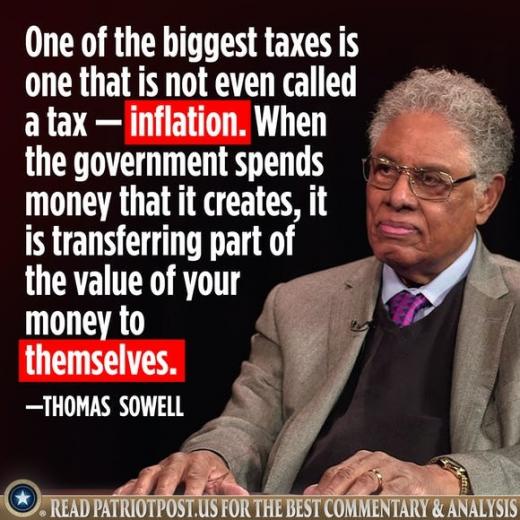
Below are a series of quotes from Sowell that have been sent to me by a friend [my thanks to Tony] that I think are worth passing along to everyone else.

“Why are we made to be bouncers?”


Here’s something unexpected: Dymocks hires security after jump in assaults on staff over COVID rules

A popular bookshop in Melbourne’s CBD has been forced to hire security guards to guard its main entrance after employees were attacked by customers refusing to follow Victoria’s COVID-19 rules, with one worker being pushed down an escalator.

Pretty gruesome story, but perhaps a lesson here about what really matters to those who have been kept in lockdown. Why are liquor stores open to the public generally  but not book stores? You can’t even go to the library unless you are vaxxed. As one of the co-owners of Dymocks is quoted as saying:

There was a big divide between essential services and non-essential retail when it came to enforcing the restrictions, with authorities putting less of an onus on essential businesses to follow the rules.

“We are booksellers, we are not security guards. Why are we made to be bouncers?” Mrs Traverso said.

“It’s one week into this mandate. People are just not able to cope with it. They are just sick of it. We are nearing 92 per cent fully vaccinated. Enough is enough. Just give up those stupid mandates.”

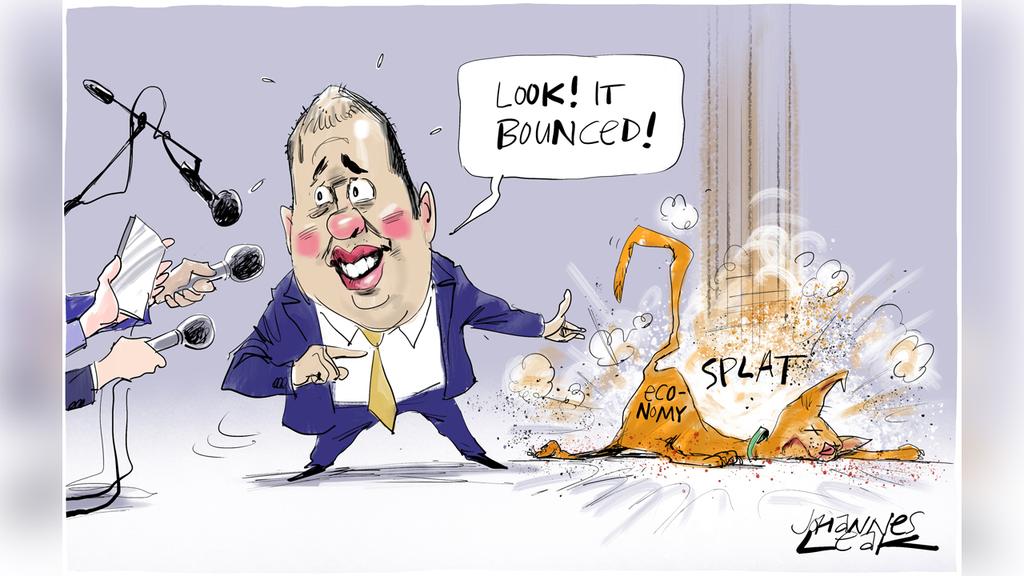
And speaking of bouncers.

Johannes Leak Commentary Cartoon for 02-12-2021

Version: Commentary Cartoon  (1280x720 - Aspect ratio preserved, Canvas added)

COPYRIGHT: The Australian's artists each have different copyright agreements in place regarding re-use of their work in other publications.

Please seek advice from the artists themselves or the Managing Editor of The Australian regarding re-use.

Of course, the supposed rebound in the economy does not quite tell the story since business costs to monitor who comes in and who does not may look like an increase in economic activity to a statistician but it’s not in any way an improvement in our living standards.

It’s always the supply side that matters

Two charts plucked from many others at THE GEEK IN PICTURES: THE USUAL SUSPECTS. These should be self-explanatory, but if not, given the way things are going, their relevance will soon be widely appreciated.

And.

Also, this from the comments.

I run a business that requires me to order material from China about twice a year. For fifteen years the shipping costs have been about $4,500 for me to get a container from my factory to my business. I just wrote a check last week for $23,500 for freight for a single container.

Supply chain issues

We are surrounded by Keynesian economists which means we are surrounded by economists who do not have the first clue about how an economy works. Keynesian – that is, modern – theory is entirely a demand-side idiocy with any notion of how an economy knits together utterly left out. Which is why I found this so inane: Joe Biden Appears to Sneer at Americans’ Intelligence: Questions Collective Ability to ‘Understand’ Supply Chain Issues

Biden promised to try and “explain to the American people” what supply chain issues America faces, telling the attending press representatives who “write for a living” he is yet to witness a reporter “explain supply chain very well.”

“This is a confusing time,” Biden stated.

Economists once upon a time did focus on the structure of supply, as Austrian economist still do. Now, not one in a thousand ever goes into the role of the supply-side in understanding the way economies work.

Meanwhile, back in Victoria, let me return to that story run in the middle of the weekend: Andrews government accused of blurring budget figures. Let me put up a second tranche from the article:

“Crucially, four-year forecasts in the budget are not sufficient to show when the government expects net debt to peak or stabilise,” the report found.

“This has increased in importance given the layering of the long-term economic and debt impacts of the Covid-19 pandemic with larger transport infrastructure projects.

“Recent Victorian budgets have not presented a transparent and cohesive fiscal framework.

“Components are spread throughout the budget papers, and are vague, making objective assessment of performance difficult.”

The report is set to spark major concerns over the openness of the Andrews government and its financial management with budget forecasts expecting net debt to climb to a record high $156bn by 2024-25, or 20.3 per cent of the state’s economy, significantly higher than the government’s 12 per cent target. The report’s release follows concerns by a number of MPs about the government’s budget process and is set to lead to calls for an overhaul of the way the government reports its financial position. One political source told the Sunday Herald Sun the budget figures were simply not transparent.

“The spin is in overdrive,” one source said. “The budget papers aren’t doing the best to tell Victorians what’s going on.

It’s not as if the financial disasters overtaking Victoria are invisible. They are just ignored, and with Keynesians the only brand of economists anywhere to be seen, we will continue forward as we are until we hit the wall. But at some stage they are going to have to come for your money since they are no longer able to get if from the Chinese Belt and Road bankruptcy provisions.

Same thing everywhere in the US with its $1.2 trillion “infrastructure” bill. Biden laughing at economic ignorance is just one of the many ironies of the moment, as endless workers are being shunted from their jobs because they are unwilling to take the vax.