
Not even near peak stupid

wind-production

The text that came with the chart is unsourced but quite interesting:

The blackout of the entirety of South Australia is a poignant lesson as to why wind power is nonsense.

You will hear from a whole heap of truth deniers trying to protect the eco-crucifix industry by saying that the blackout had nothing to do with the fact that Labor has made South Australia completely reliant on renewable energy for its power.

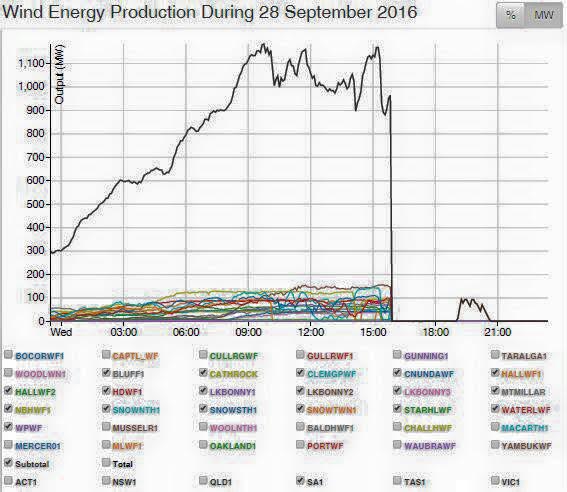
But the cold hard fact is that the knockout of a transmission tower would not have stopped power being generated by a decent network with reliable coal-fired baseload power. What knocked out the power was the fact that every wind turbine powering South Australia ceased to operate as soon as wind speeds reached a critical level. They cannot produce power when there isn’t enough wind and they can’t produce power when then there’s too much wind. The proof: this graph showing wind power energy production in South Australia yesterday.

Thank God we aren’t reliant on those useless, bird-chopping wind turbine monstrosities here in Queensland.

I have now seen this South Australian story told round the world but in a way that suggests that this is just one of those really idiotic things that happened one time in some out of the way place in Australia. Really only mentioned for a laugh. Yet the people who did this are everywhere and wherever you find them they really are incapable of seeing and understanding cause and effect, but are filled with emotion about some remote possibility 50 to a 100 years from now. Unfortunately there is worse to come before it is better.
Man-made disaster

Here is a presentation I will make sure I get to: Masculinism, global warming and ‘man-made’ disasters: Towards a profeminist environmentalist response. Here is the blurb:

In the wake of disasters and other environmental destruction, recent attempts have been made to develop eco-masculinities, many of which simply encourage men to commune with nature, or seek to minimize feminist critiques by finding redeeming features in traditional masculinity. Against this backdrop of debates, this paper explores what profeminist masculinity studies brings to addressing men’s ecologically destructive practices. While the causal relationship of climate change to natural disasters is contested, people’s vulnerability to “natural” disasters clearly relates to economic, cultural and social relations, including those shaped by gender. Further to that, a variety of eco-feminisms are considered which draw connections between patriarchal social structures and ecological destruction. While some eco-feminist literature is criticized as essentialist, contemporary versions of eco-feminism recognize that the greater responsibility of men for environmental catastrophies is due to the social construction of masculinism, intersected by social divisions between men. Masculinism, and the technological rationality that flows from it, has furthermore become a mindset for environmental management, which does not address the causes of environmental crises. Environmental sustainability may even appear to threaten masculinism and hegemonic masculinity, though environment movements are often seen as a supportive context for non-hegemonic masculinities and progressive practices by men. This theoretical discussion reflects on how different forms of profeminist subjectivities lead to resistance to global warming and environmentally destructive policies, and how men can change their subjectivities and practices to construct a more sustainable world.

And this is the bio of the presenter:

Bob Pease is Professor of Social Work at the University of Tasmania, Australia. He has published extensively on masculinity politics and critical social work practice, including four books as single author and twelve books as co-editor. His most recent books include: Undoing Privilege: Unearned Advantage in a Divided World (Zed 2010), Men and Masculinities Around the World: Transforming Men’s Practices (co-editor, Palgrave 2011), Men, Masculinities and Methodologies (co-editor, Palgrave 2013), The Politics of Recognition and Social Justice: Transforming Subjectivities and New Forms of Resistance (co-editor, Routledge 2014), Men, Masculinities and Disaster (co-editor, Routledge 2016) and Doing Critical Social Work Practice (co-editor, Allen and Unwin 2016).

There is no more pressing need than seeing Malcolm leave Parliament

Damn the deficit, full speed ahead. Prime Minister Malcolm Turnbull tackles climate change, disaster mitigation at ASEAN Summit:

THERE is “no more pressing need” in the region than climate change, Prime Minister Malcolm Turnbull has told Pacific leaders in Micronesia.

Mr Turnbull announced $300 million to help the Pacific “manage climate change and improve disaster resilience”.

The Prime Minister landed in Pohnpei on Friday for his third round of regional talks — having visited Hangzhou in China for the G20 and Vientiane in Laos for the Association of Southeast Asian Nations (ASEAN) summit.

“Over the next four years we’ll provide $300 million to Pacific island countries including $75 million for disaster preparedness. This is an additional $80 million on the current levels,” he said.

Mr Turnbull also said Australia would ratify the Paris climate change agreement this year or early next year.

“We will ratify it as soon as parliamentary processes allow … Its ratification is not controversial,” he told the Pacific Island Forum in Pohnpei.

Via Andrew Bolt who points out there is a sucker born every minute, except that in this case it’s not even his own money.

Thoughts on leaving China

The only people who look for green solutions are people who have never worked a day in their lives. Spending a week in Shanghai has reminded me of all of the labour-saving devices we in the West take for granted. Manual labour of the most exhausting kind is found at every turn, you see people bicycling huge piles of goods, carrying things we would put on a delivery truck. It is a time-warp remembrance of what things must have been like for us a generation or two back.

The cruelty and profound ignorance of the Global Warming mob remains a scandal. These people basically intend to deprive everyone of the enormous advantages that electricity and the internal combustion engine have provided. They sit in their air-conditioned offices, paid for the cushiest jobs, providing nothing of value to the world. Meanwhile those in developing economies – the ones they wish to deprive of the power we take for granted – live at a standard of living fantastically below the level the bottom quartile of our societies not just take for granted, but feel shortchanged that their ability to consume is not higher than it is.

I am also more amazed than ever that Shanghai works at all. A population greater than the whole of Australia’s in an area about the size of Melbourne must be a logistical nightmare. It wouldn’t work at all if everyone had a car. They will get richer, but they will have to abandon their government-owned enterprises which will take a long time, since the unemployment they would create would be impossible to deal with. But having listened to and spoken with China’s greatest Mises-Hayek scholar, eventually they will move in the direction of Singapore and Hong Kong. Markets work, and the Chinese understand this. Meanwhile, we in the West are centralising our economies more than ever. Which calls this to mind.

Come writers and critics
Who prophesize with your pen
And keep your eyes wide
The chance won’t come again
And don’t speak too soon
For the wheel’s still in spin
And there’s no tellin’ who
That it’s namin’
For the loser now
Will be later to win
For the times they are a-changin’.

The wheel, my friends, is still in spin as it always is. Between Hillary and Merkel, and those of the same mentality who may come after, there is no telling what things will be like by mid-century.

Meanwhile, looking forward to being back in Australia in the morning.

He’s over the top

trumpmcdonalds

UPDATE: Adding the picture above which comes with this: To Celebrate Winning 1,237, Trump Eats McDonald’s, Has Diet Coke. Been there myself. I’ve often said the worst thing about my children growing up is that I no longer have an excuse to go to McDonald’s. It is still an incongruous picture which must have some intended meaning but one that eludes me for the moment.

In the news today: Trump reaches 1237. And so now he begins to say what he really thinks:

Trump, whose support from North Dakota national convention delegates put him over the top for securing the party’s nomination earlier in the day, told the crowd he’d eliminate regulation he says is killing the fossil fuel industry as well as be favorable to additional pipeline projects and exports of American oil.

Thunderous applause greeted Trump’s declaration that in his administration there’d be an “America-first energy plan.”

“We will accomplish a complete American energy independence,” Trump said. “We’re going to turn everything around. We are going to make it right.”

And in a related story from The Japan Times: Trump sends shivers down spines of nations trying to solidify global warming pact. Here I agree there is reason to worry, or there is if you think global warming is a genuine problem. Future generations are going to look back at us in amazement. So more of the Trump effect on policy:

The talks in Germany to flesh out December’s historic global climate deal are probably not at the top of Donald Trump’s agenda this week.

But the diplomats from 196 nations huddled in Bonn are keenly aware of the fact that the “The Donald” is now within spitting distance of the White House — and it is making a lot of them nervous.

It is not hard to see why.

The last Republican standing in the U.S. presidential race has described climate change as a hoax perpetrated by China to gain competitive advantage in manufacturing over the US, an eccentric theory even among climate skeptics.

More recently, he said he was “not a big fan” of the Paris Agreement, the fruit of two decades of stop-and-go (but mostly stop) wrangling between rich and developing nations.

“I will be renegotiating those agreements, at a minimum,” Trump told Reuters in an exclusive interview last week, betraying an unfamiliarity with the U.N.’s consensus-based process.

“And at a maximum I may do something else.”

Let ’em worry

From The Japan Times: Trump sends shivers down spines of nations trying to solidify global warming pact. Here I agree there is reason to worry, or there is reason to worry if you think global warming isn’t the greatest con job in human history, which it is. Future generations are going to look back at us in amazement. Meantime:

The talks in Germany to flesh out December’s historic global climate deal are probably not at the top of Donald Trump’s agenda this week.

But the diplomats from 196 nations huddled in Bonn are keenly aware of the fact that the “The Donald” is now within spitting distance of the White House — and it is making a lot of them nervous.

It is not hard to see why.

The last Republican standing in the U.S. presidential race has described climate change as a hoax perpetrated by China to gain competitive advantage in manufacturing over the US, an eccentric theory even among climate skeptics.

More recently, he said he was “not a big fan” of the Paris Agreement, the fruit of two decades of stop-and-go (but mostly stop) wrangling between rich and developing nations.

“I will be renegotiating those agreements, at a minimum,” Trump told Reuters in an exclusive interview last week, betraying an unfamiliarity with the U.N.’s consensus-based process.

“And at a maximum I may do something else.”

Go for the max, I say, aim for the absolute full wreckage. So one more round from the report, just to cheer us up:

The prospect of a Trump presidency precisely at the moment when nations are inching toward ratification of the delicately balanced deal sends shivers down the spines of negotiators here.

When asked what worried him most at this stage, Seyni Nafo, climate ambassador for Mali and president of the Africa Group, snapped: “Trump winning the election.”

Ah, the global begging bowl will be taken away, or at least this one.

The snow job of Kilimanjaro

From An Inconvenient Review: After 10 Years Al Gore’s Film Is Still Alarmingly Inaccurate of which there is more along the same lines as this:

One of the first glaring claims Gore makes is about Mount Kilimanjaro in Africa. He claims Africa’s tallest peak will be snow-free “within the decade.” Gore shows slides of Kilimanjaro’s peak in the 1970s versus today to conclude the snow is disappearing.

Well, it’s been a decade and, yes, there’s still snow on Kilimanjaro year-round. It doesn’t take a scientist to figure this out. One can just look at recent photos posted on the travel website TripAdvisor.com.

In 2014, ecologists actually monitoring Kilimanjaro’s snowpack found it was not even close to being gone. It may have shrunk a little, but ecologists were confident it would be around for the foreseeable future.

“There are ongoing several studies, but preliminary findings show that the ice is nowhere near melting,” Imani Kikoti, an ecologist at Mount Kilimanjaro National Park, told eturbonews.com.

“Much as we agree that the snow has declined over centuries, but we are comfortable that its total melt will not happen in the near future,” he said.

And even then when the film came out I recall being told that the snow levels had been affected by the felling of trees at the base of the mountain. Al Gore is himself the very embodiment of why the scam keeps going. Whatever may be the truth, what is undeniable is that he has made an absolute fortune from it.

Gore’s been harping on global warming since at least the late 1980s, but it wasn’t until 2006 he discovered a way to become massively wealthy off making movies about it and investing in government-subsidized green energy.

As for the rest of us, Denmark Slashes Wind Power Subsidies to Curb Runaway Power Costs. Australia, much of which is built on a foundation made of coal, has energy prices at near enough the same level. For a bit more, you can go here.