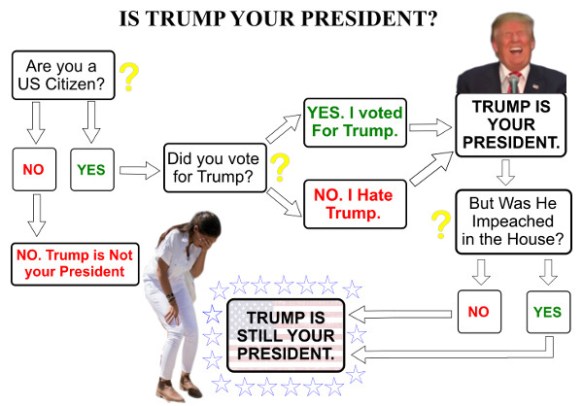
Donald Trump will speak on behalf of Delta House

This was picked up from Steve Hayward at Powerline: TRUMP VERSUS DEAN WORMER. He writes:

Trump as head of Delta House is actually a lot more accurate than the people who did this parody may realize. And I expect his second inaugural parade might resemble the Animal House version, too, as he ramrods the Deep State lined up on both sides of Pennsylvania Avenue.

A bit too premature for me to be picking the result of the election in November, but why not be an optimist? And if you are not familiar with this scene from the greatest movie of my generation (well not quite), here it is.

Learned ignorance page after page

Went into a bookshop today and went to the politics section and this was a part of the selection of what I found. There must have been around a dozen books on American politics, that were all were desperately anti-Trump and with many of them turned towards us potential readers to ensure we saw what there was.

Nothing will apparently educate the “educated”. Their ignorance is invincible. Their shallowness knows no depths. The incapacity to learn from actual real world experience is capacious. It is truly frightening how much they don’t know about so much, but worse, the extent to which they will close their ears and eyes to alternatives.

I find it the same in discussing economics with many of these so-called experts. The American economy may never have prospered as it now is. Jobs numbers are increasing while real wages at the bottom of the income distribution are rising for the first time in decades.

PDT foreign policy is another area where one success follows another. I am sickened at the thought that Iran could just blow an airliner out of the sky. Seriously, whose side are they on? It’s not yours.

Hayek was a John Stuart Mill classical liberal

This is an exceptionally interesting article, that needs to be considered among us on the right side of the political ledger: F.A. Hayek & Social Justice: A Missed Opportunity and a Challenge. They argue that Hayek’s views were left incomplete, but what’s worth, because they do not conform to some commonly accepted modern version of conservative thought, Hayek is being abandoned by those who ought to turn to him for sound advice. Start here which is where the authors start with a critique of Hayek by Professor Edward Feser:

Dr. Feser argues, of “economism”:

This subjectivism about value has great utility when our focus is merely on satisfying the material needs and wants people actually happen to have. Hayek’s purely procedural conception of just action, however, effectively treats value subjectivism as a completely general principle of social organization. The rules that govern capitalist societies must not treat any of the diverse ends people happen to have as objectively better or worse than any other. To acknowledge that there is some objective fact of the matter about what people ought to want, or some standard of value independent of the market, would open the door to justifying interference with the choices of economic actors, and thereby destroy the price mechanism.

This is the point that Professor Feser makes which I happen to agree with:

This subjectivism, Dr. Feser contends, is an acid that will eat away at capitalism itself: “If there is no standard of good apart from what people happen to want, how can Hayek complain if what they happen to want is an egalitarian redistribution of wealth, or freedom from religion and traditional family arrangements?”

But this was no more Hayek’s position than it was John Stuart Mill’s. It is the modern libertarian position as best I understand it, but it is not the view of we classical liberals. I think this is an absolutely valid criticism.

This is what they conclude from the book they are discussing:

Hayek does not have an “objective notion of the good as such” when it comes to the substance of a society (or at least a large and complex society). But it is not clear he was entirely subjective about justice or even that he would necessarily limit it to the personal sphere. Even with regard to the distribution of goods, he is not averse to the idea that there are “smaller scale orders in which it is possible to distribute goods on the basis of various interpretations of justice, taking into account effort and need.” They argue that Hayek did have a conception of an objective nature to justice in the personal and even business realm, explaining, for instance, how “an employer should determine employees’ wages according to known and intelligible rules and that it should be seen that all employees receive what is due to them.

That could just as easily have been said by Mill. There are no absolute criteria available from any source that will lay down what the answers to these issues is, but must emerge through a process of trial and error as events are examined over time and in different circumstances. Freedom sits at one pole and justice at the other, but these are only words until attempts are made to transform such ideas into practice. What the authors see as “the Great Forgetting” which they blame on Hayek’s “incompleteness” is their own failing because they see the answers in some libertarian set of principles which Hayek did not accept.

The Battle of Warsaw 1920

From The war that saved Europe from Communism, from a hundred years ago. Here’s the conclusion from a book written by the English ambassador to Poland at the time the battle took place.

Had the Poles “failed to arrest the triumphant advance of the Soviet Army at the Battle of Warsaw, not only would Christianity have experienced a dangerous reverse, but the very existence of western civilisation would have been imperilled.”

Just as the Battle of Tours “saved our ancestors from the Yoke of the Koran”, he concluded, had the Poles “failed to arrest the triumphant advance of the Soviet Army at the Battle of Warsaw, not only would Christianity have experienced a dangerous reverse, but the very existence of western civilisation would have been imperilled.”

Just as the Battle of Tours “saved our ancestors from the Yoke of the Koran”, he concluded, so the Battle of Warsaw saved Western Euro
had the Poles “failed to arrest the triumphant advance of the Soviet Army at the Battle of Warsaw, not only would Christianity have experienced a dangerous reverse, but the very existence of western civilisation would have been imperilled.”

Just as the Battle of Tours “saved our ancestors from the Yoke of the Koran”, he concluded, so the Battle of Warsaw saved Western Europe from “a far more subversive danger – the fanatical tyranny of the Soviet.”

Here’s the movie with subtitles:

Not to mention the Battle of Vienna, 1683.

The future will be nothing like we can imagine it today

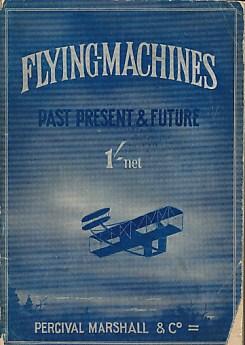
Image result for percival marshall flying machines

I have just picked up a second-hand copy of a third edition of Percival Marshall’s Flying-Machines – Past, Present & Future, as pictured above. Near as I can tell it was published around 1909-1910 and found it utterly fascinating, since every book is written in the present and tells us quite a bit about the time when it was just a newly published text and hardly anything else. What intrigued me most of all was the emphasis given to conjectures about the future. Here are the last three lines of the book:

The experience of the present development of the art of flying, and opinions expressed by aviators, seem to predict that aerial navigation will be the safest of all forms of mechanical transit. Many flights have been made after sunset, practically in the dark. Mr Cody has flown in moonlight, showing that flying machines can be used at night.

In 1909 even flying at night was only a conjecture, a possibility, an aspiration. The author was confident but could hardly be certain. It seems now, just as it was then, that as we try to look ahead, we cannot actually see very far at all. All one can say with certainty is that the future will be nothing like we can imagine it today.

Cover text comments revised

I am very grateful for the comments on my previous post, ‘Classical Economic Theory and the Modern Economy’ cover text comments, thoughts and suggestions sought with special thanks to Gerry on how to begin the text, which was also the point raised by Tim Neilson. However this is the length they are looking for. This is now my second draft.

‘Classical Economic Theory and the Modern Economy’

If you are interested in how economic theory became the wasteland it has become, this is the book you must read.

It starts with two premises: First, that economic theory reached its deepest level of understanding in the writings of John Stuart Mill and the classical economists of his time, and then, secondly, the author of this book has understood Mill and has accurately explained what the classical school of the late nineteenth century wrote. From these premises, this then follows.

To have any hope of understanding how an economy works, and how modern economic theory became the dead end it has become, this is where you must begin.

The classical economists, and John Stuart Mill in particular, lived through the Industrial Revolution, saw its astonishing economic transformation before their eyes, and explained, so others could understand for themselves, how their prosperity had been created through the emergence of the market economy.

Classical economics was entirely a supply-side theory.

Mill, the greatest utilitarian philosopher of his age, refused to use utility as anything other than a minor element in his theory of value. Mill explicitly and emphatically denied any role for aggregate demand in the creation of employment. In reaching these conclusions, there was no disagreement among the entire mainstream economics community of his time.

First through the Marginal Revolution of the 1870s, and then through the Keynesian Revolution of the 1930s, the entire edifice of classical theory has been obliterated and made virtually incomprehensible to anyone educated in modern economics. From a classical perspective, modern theory is Mercantilist trash.

This book explains why that is and how to understand the classics as they were meant to be understood.

From the comments, I can see that this business about utility among the classical economists is extraordinarily difficult to accept. Of course no one will produce anything that they do not believe they can sell, and no one will buy things that do not satisfy some need or desire.

Perhaps this will provide a clearer understanding which is taken from the text of the book. The heading in bold is my assertion, the quote that follows is by D.P. O’Brien from his 1975 Classical Economics Revisited which was such a tour de force that a second expanded edition was published thirty years later, in 2005. He says throughout his book many of the things I say myself, with only this difference, if it is a difference, that I believe the classics were right about what they wrote where he is only reporting.

The Classical Theory of Value was Not Based on Utility Although Mill was Himself a Utilitarian
“Mill advances a ‘cost of production’ theory of value…. He was not a subjective value theorist…. He treated utility as merely a condition of value.” (p.96)

Both Marginal Utility and Aggregate Demand are demand-side theories that completely divorce an economist from thinking in relation to supply. There is much more to it, but there are no easy points to score against Mill over his cost of production approach to value. He has 17 elements in his overview of the theory of value with this the second:

II. The temporary or Market Value of a thing, depends on the demand and supply; rising as the demand rises, and falling as the supply rises. The demand, however, varies with the value, being generally greater when the thing is cheap than when it is dear; and the value always adjusts itself in such a manner, that the demand is equal to the supply.

This is pretty well all that is taught about supply and demand today and I doubt most economists know much more than that, although we now have diagrams and pages of terminology to explain it all (e.g. “price elasticity of demand” or the distinction between “demand” and “quantity demanded”).

Mill’s first proposition, by the way, is that value is entirely a relative concept. The classics were not trying to explain just the temporary price of the moment, but how the relative price structure across an economy is determined. That is a much much more difficult question and I doubt most economists today have much of a handle on it assuming it is even brought to their attention. It is also a much more important issue than mere price determination of a single product in isolation from the rest of the economy.

For those interested in a classical approach to economic theory, there is the third edition of my Free Market Economics. I think of it as Mill’s Principles for the twenty-first century. It is, unfortunately, absolutely unique.

What would a film critic know about the movies?

As it happens, we went to see the film just last night: ‘Parasite’ Named Best Picture by the National Society of Film Critics. First let me say it was the most watchable film I have seen in a long time. Then let me say it was the most morally incoherent film I have seen in a long time. I will add no spoilers. Will only say it’s worth your time. It was as watchable as the new Starwars is dull beyond imagination. Modern PC has not caught up with Korea while Starwars was so Hollywood that almost from the first second I could tell where the film would end, as it did. You most definitely cannot say that about Parasite. There is even talk that it might win Best Picture at the Academy Awards so others seem to see its moral centre, but that’s Hollywood for you. You’ll have to see the film to know what I mean.

And if you’ve seen Parasite, please include nothing that gives away the story in the comments.

Comments, thoughts and suggestions welcome

You may have noticed my lack of regard for modern economic theory which the following might help you understand more clearly. This is the draft of the cover text for the book I have just completed and sent off to the publisher. Comments, thoughts and suggestions would be welcome. My disdain for Keynesian economics I have discussed on many occasions. My attitude to “marginal” analysis I mention far less often which is why certain passages below are highlighted in bold.

‘Classical Economic Theory and the Modern Economy’

The book starts with two premises: First, that economic theory reached its deepest level of understanding in the writings of John Stuart Mill and the classical economists of his time, and then, secondly, the author of this book has understood Mill and has accurately explained what the classical school of the late nineteenth century wrote. From these premises, this then follows.

If you are to have any hope of understanding how an economy works, and how modern economic theory became the dead end it has become, you will need to read this book.

The classical economists, and John Stuart Mill in particular, lived through the Industrial Revolution, saw its astonishing economic transformation before their eyes, and explained, so others could understand for themselves, how their prosperity had been created through the emergence of the market economy.

Mill, the greatest utilitarian philosopher of his age, refused to use utility as part of his theory of value. Mill explicitly and emphatically denied any role for aggregate demand in the creation of employment. In reaching these conclusions, there was no disagreement among the entire mainstream economics community of his time.

First through the Marginal Revolution of the 1870s, and then through the Keynesian Revolution of the 1930s, the entire edifice of classical theory has been obliterated. From a classical perspective, modern economic theory is Mercantilist trash nonsense. If you are interested in how economic theory became the wasteland it has become, and wish to understand the classical theory no one any longer has the slightest clue about, this is the book you must read.

If you are interested in understanding all this more completely, you will have to read the entire book when it is finally published sometime this year.

Donald Trump jokes

I’ve just finished a quite interesting book on jokes from behind the Iron Curtain: Hammer And Tickle: A History Of Communism Told Through Communist Jokes. It looks at the jokes themselves; the evolution of these jokes as communism aged and new leaders took over; it looks at the different kinds of jokes told in different communist countries; it examines the fate of those who told such jokes and the difference in the fate of those who made such jokes depending on who was the leader of the Party; it asks whether such jokes helped the communists consolidate power or whether they helped bring communism down; it looks into the difference between telling anti-Nazi jokes in Nazi Germany versus telling anti-communist jokes in communist countries; it asks about the psychology of those who told such jokes and whether they helped relieve tensions; and much else. But I will say this, some of I found really funny. This is my favourite.

Khrushchev is walking through the Kremlin, getting worked up about the Soviet Union’s problems, and spits on the carpet in a gesture of disgust.

“Behave yourself, Nikita Sergeyevich,” admonishes the aide. “Remember that the great Lenin walked through these halls!”

“Shut up,” responds Khrushchev. “I can spit all I like here; the Queen of England gave me permission!’

“The Queen of England?”

“Yes! I spat on her carpet in Buckingham Palace too, and she said, ‘Mr Khrushchev, you can do that all you like in the Kremlin if you wish, but you can’t behave like this here …'”

Easy to see this one added to the Donald Trump canon and now that I have pointed it out, I expect it to be.

I therefore thought I might have a look at what passes for Donald Trump jokes. And google all you like, there really is not much although there was this: Donald Trump Jokes. None were funny but I did like this:

Where’s Donald Trump’s favorite place to shop?

Wall-mart!

Mere pun though it is, it seems appropriate. At least it’s policy-related and almost entirely a joke that could only be told about Trump. The rest are re-treads, never specifically about anything related to Trump himself and his policies, but are almost entirely forms of insult than anything with any associated wit or insight. The most interesting part to me about the communist jokes was that the ones that became acceptable were those directed at the failures of communism relative to the promises that had originally been made. Lots like that. The way to end up in the gulag was to tell jokes about actual party leaders, especially Lenin and Stalin. Very few like that.

As for Trump jokes, there was also this from Quora: What’s the best Donald Trump joke you ever heard? I don’t know if you can link from here but I read through as many as I could bear – there are at the present 2566 of them. For myself, I found them unbelievably tedious, almost entirely retreads from other contexts and other politicians. Not witty and not fun. Might help Democrats and other socialists relieve their tension but not funny. See for yourself if you can bear it. And because it’s Quora, there was not a single pro-Trump joke I came across.

It would be mind-numbing to go through the lot but this one had 12.1k upvotes. It is an old joke which I actually quite like which I heard long before and about someone else, not sure it wasn’t an Irish joke to begin with. I won’t put it down in full. It’s a shaggy dog story in which the President secludes himself from everyone and as the Secretary of this or the Secretary of that comes to see him to deal with some emergency he sends them packing because he is so busy. Finally:

Sanders open the door slowly and finds a disheveled unshaven Trump sitting at his desk with a big grin on his face. On top of his desk is a completed 30-piece puzzle of the New York skyline.

Sanders doesn’t know what to make of it.

Trump leans back triumphantly in his chair and says. “I’ve got something for your next press conference…” Sarah takes out her notebook.

“You see that puzzle?” Trump asks pointing at his desk. “Well, the box says ‘3 to 7 years’ and me, I finished it in JUST 6 DAYS!”

I would be interested if anyone has a really good Donald Trump joke, either for him or against him. Meanwhile there are lots of jokes about the Democrats I do find funny. E.g.

Maybe I’m just not looking in the right place.