FME 2nd ed

I am very happy to report that I have received the following from the RMIT College of Business:

Research Excellence Award for Best Book by an Academic

The book is, of course, my Free Market Economics: an Introduction for the General Reader. It’s not the new Samuelson though it should be since it’s a tonne better and will teach you a lot more of what’s useful about how economies work than any of his 21-and-counting editions ever did. I wrote my book to show how useless any economics text built around a Keynesian frame of reference actually is. And as I point out, since there is nothing else like it when I thought the financial crisis would lead to a glut of such books, I really do have this terrain to myself. The sad thing, though, is that I do have this terrain to myself since no one else seems to want to invade this space. How this can be I will never understand.

But please do let me also note that I received this award on the same day I signed the contract for a second edition which I hope to have at the publisher by the middle of next year. There is some demand, at least, so there is a niche for what I have to say. Not a lot I feel I need to add or change but there will be some things. For any of you who have read the first edition – which has sold a similar number of copies as the first edition of The Wealth of Nations – if you have any suggestions about how the book might be improved or extended, please email me at this address:

sayslaw@hotmail.com

And please use the subject line: FME 2nd ed. Let me thank in advance anyone who is able to help for their kind assistance.

The best shower scene since Psycho

We have just gone to see To Rome with Love, the latest Woody Allen film and if you are one of those types who cannot stand Woody Allen films then don’t go to see it. But if you normally do like his films then you should absolutely should. [Rotten Tomatoes: Critics 44% / Audience 48%]. Of course it’s funny and the non-existent plot is only there as a scaffolding on which to hang out a bunch of jokes, so don’t expect to have the meaning of life brought to your attention (for that you have to see Crimes and Misdemeanors).

But this part was novel. The character played by Allen is in many ways a conservative and the conservatism is not played for laughs. Woody is himself a figure of fun and you do get to laugh at him but none of the laughs are related to his conservatism. Very unexpected and means nothing at all. But it made the experience of seeing the film even better than it would otherwise have been.

Your first time – in sequence

It’s not often an Australian innovation will conquer the world especially in politics but we do seem to have had a first. Many in America are giving the laurel to Vladimir Putin but unless there is a more ancient contender, the true innovator was our own Sarah Hanson-Young. And the innovation is to have been the first to come up with the idea of your first vote as a woman equivalent to your first experience of making love. A pathetic disgusting idea, it is true, but SH-Y may have provided an Australian first. So let’s begin here with an ad put out by the Greens in the 2010 Australian election.

Revolting and repulsive it may be but let us be fair. It was also fresh and new, and so far as we know had never been tried before. It was also written by a pair of blokes who are named at the end, Mike Clay & Tyler Freeman-Smith. You have to wonder about the “gender” of the writers of the scripts for the other presentations now found below, or perhaps you don’t.

But never mind. Let’s move forward to the next in the sequence, an ad that was run this year and posted on Youtube in February 2012. It is an ad for Vladimir Putin and was run as part of the Russian election campaign. I cannot vouch for the Russian but the idea is unmistakeably the same.

I like the touch with the fortune teller. Who else would you go to for election advice?
And the Tarot card with Putin’s picture is a piece of genius. It is good to see such deep thought and consideration having gone into making so momentous a decision.

But now we have a version of this already twice warmed election idea being released by Obama in the United States. The same conception as in the ads by SH-Y and Putin but now designed for an American audience. The star is a young actress who would apparently be recognisable amongst her own demographic cohort. She is 26 so its been three election cycles since the first time she had personally cast a ballot assuming she voted in 2004 and 2008. But I guess the first time for something so important is hard to forget, although the kinds of thoughts she brings to the argument wouldn’t have had much relevance back when John Kerry was running for president. But let’s not worry about logic. This is about something far more transcendent.

So there you are. From Sarah Hanson-Young to Vladimir Putin to Barack Obama. That is, from the Australian Greens to the former head of the KGB to the Democrat president of the United States. An Australian innovation in how to guide young girls into the right way to vote for the first time. I would think these ads are making fun of young girls and tries to make them look like a bunch of simpletons, but what do I know? It’s an idea Made in Australia. Makes you proud to be an Australian.

Inherit the Wind Farm – Mann made global hilarity

Mark Steyn has been begging Michael Mann to sue him for defamation and bless my soul he has now gone and done it. Mann is the climate scientist who invented the “hockey stick” model of global warming. Here is the notice of his intention to sue taken from Mann’s facebook page. This is how it starts:

Today, the case of Dr. Michael E. Mann vs. The National Review and The Competitive Enterprise Institute was filed in the Superior Court of the District of Columbia. Dr. Mann, a Professor and Director of the Earth System Science Center at Pennsylvania State University, has instituted this lawsuit against the two organizations, along with two of their authors, based upon their false and defamatory statements accusing him of academic fraud and comparing him to a convicted child molester, Jerry Sandusky. Dr. Mann is being represented by John B. Williams of the law firm of Cozen O’Connor in Washington, D.C.

Dr. Mann is a climate scientist whose research has focused on global warming. In 2007, along with Vice President Al Gore and his colleagues of the Intergovernmental Panel on Climate Change, he was awarded the Nobel Peace Prize for having ‘created an ever-broader informed consensus about the connection between human activities and global warming.’

Nevertheless, the defendants assert that global warming is a ‘hoax,’ and have accused Dr. Mann of improperly manipulating the data to reach his conclusions.

A hoax? Manipulating data? What an idea! The discovery process will be absolutely fantastic. It will be our modern version of the Scopes trial. Kind of like Inherit the Wind Farm. This may be the biggest mistake in going to court since Oscar Wilde.

“In countless ways one of the best introductions to economics ever written”

I would also strongly recommend Steven Kates’ Free Market Economics. An Introduction for the General Reader which is in countless ways one of the best introductions to economics ever written; and this assessment includes amongst other things the author’s superb ability to put economics into perspective in terms of the history of economic thought.

I keep going back to this fantastic book. Lucidly written, it can be read with tremendous gain (to students of economics of any level, beginner to advanced scholar) in a few days, maybe even in just two days. At the same time, it is so substantial as to invite countless returns for further appreciation.

As a person strongly influenced by the Austrian school (including its post-Misesian anarchist wing), what gives me a special kick is the fact that the author, who ‘heretically’ recognises a substantial role for government and the state, offers an accurate and brilliant account of a free economy.

Of course, this places Kates much closer to (the great Austrians) Mises and Hayek than to the anarchist successor school, whose anarchist stance I do not share at all, while recognising the school’s considerable intellectual achievments.

I hope Georg Thomas won’t mind my retrieving his kind and generous comment from the thread that followed my putting up a reading list in the history of economics the other day. And I hope you won’t mind if I say that this is how I think about the book myself.

Moreover, the book is, in my view, unique. It explains everything found in an introductory text on economics but in no chapter is its explanation the same. Everything is saturated in the role of the entrepreneur and builds from the crucial importance of uncertainty.

It never assumes there is no government, but instead assumes that there is and that this government will make laws and regulations that are sometimes a net benefit but are also usually the very reason economies underperform and all too frequently fall into recession.

It explains value added across an entire chapter. The fact of the matter is that without understanding value added properly it is impossible to understand good policy from bad. And so far as I know, this book is unique in explaining this crucial part of economic reasoning at the introductory level.

In teaching supply and demand it assumes no one can ever know where either of those curves actually is, a very different way of thinking about markets. The traditional form of marginal cost pricing is shown to be an inane framework that provides no insight into how either prices are set or volumes determined. Instead it explains the margin as the dividing point between the present and the future which the farther into one looks, the less that one can know anything relevant about what is going to take place.

It disdains Keynesian economics even while explaining modern macro, showing why it is an insulting form of nonsense, and I might add, is the only book to my knowledge anywhere to do so. If you know of another written within the last forty years, you must let me know.

Instead, it explains prosperity and recessions using the classical theory of the cycle which was based on a proper understanding of Say’s Law. It is definitely, and I do mean definitely, the only place in the world you can find out about Say’s Law and how Keynes mangled its interpretation leaving the world’s economies in the mess they are in with no theoretical guidance system with which to find our way out.

And as the title makes clear, the point of the book is to explain why there is no other means to manage an economy than through the free market which is not the same as laissez faire.

How to Get the Book

The book is available in paper from the Edward Elgar catalogue for £23.96. And if you would like to read it in an electronic format, this is where you should go which is taken from the Elgar website:

http://www.ebooks.com
http://www.books.google.com/ebooks
http://www.google.co.uk/ebooks

View our ebooks that are with Dawsonera
View our ebooks that are with EBL
View our ebooks that are with Ebooks.com
View our ebooks that are with MyiLibrary
View our ebooks that are with EBSCOhost
View our ebooks that are with Ebrary
View our ebooks that are with Google

Here is the link to the google ebooks in the UK where the price is a mere $A29.00.

Atlas Shrugged II – the trailer

Rotten Tomatoes has it at an unheard of zero percent from its list of critics. Audiences give it a 65% which given the biases of the normal movie going public (say 30% ALP, 5% Green and the rest rational) means for those of our persuasion, a movie not to be missed. You only must hope that some money making capitalist dog distributor will actually bring it over. Never did see Part I. Must get a DVD player.

Thanks to Gab for bringing it up in the open thread.

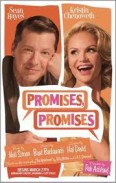
Promises, promises

We went to see Promises, Promises the other night which from its title may sound as if it’s in some way related to politics but unless you think a story of adultery and a woman trying to take a man from her husband has something to do with politics, it isn’t really. It is based on the 1960s film, The Apartment, about a fellow trying to work his way up the corporate ladder by letting a number of executives from his business use his apartment for liaisons with women, the main pairing being the head of the department who has promised his latest fling that he will leave his wife. And while the stage production is done tongue and cheek and played mostly for laughs – it is a musical with its feature song, “I’ll Never Fall in Love Again” – I found the morality of it quite disturbing since the one person who is portrayed to have been the innocent, almost no more than a bystander, was that other woman who knowingly and with malice aforethought took up with a married man and was specifically carried along by his false promise that he was about to leave his wife and children to be with her. She instead ends up with the man who has loved her from the start in a storyline that is intended to be seen as an uplifting finale which only reminds me how our communal moral compass has shifted and the shifting can be traced back, as with the film, to the 1960s.

There was a time when no one who behaved as that woman did would have been seen as anything other than a moral vacuum and not to be trusted under any circumstances. How the world does change. By the way, Shirley Maclaine played that young woman in the original movie version of The Apartment. It’s quite remarkable how similar she looks to Julia Gillard.

Come back Wall Street – all is forgiven

I did my duty by going along to every one of the post-GFC Gordon Gekko greed-is-good films I could find to watch the slagging of the capitalist system in movies made by capitalists, guided as they were by the profit motive in the story lines they chose to portray. I therefore continued this form of psychological abuse by going out to see Richard Gere in Arbitrage which co-stars Susan Sarandon, itself a very bad sign of plot points to come. And I will confess to being reluctant to go but went only because it was described as a “thriller” which is my wife’s favourite kind of film.

What follows is not a recommendation to go see the film for yourself, although I also do not wish to deter you. It gets 85% by the critics at Rotten Tomatoes but only 73% by the audience. On IMDB the audience gives it a 6.9. I would go with the audience at both RT and IMDB which seem to have it about right. It’s not Gone with the Wind.

But why I mention the film at all is because the Richard Gere character is portrayed in a positive way and in all the wheeler dealer stuff which we are manipulated by in the story and in the characterisations, we are made to want Gere to succeed. Gere is no villain – not in the ordinary sense anyway – and while it is hard for me to tell for sure, I would almost think he is meant to be the All American Boy Makes Good. The moral still comes out that devoting your time to such horrid areas of work such as making money is bad for your family relations, but Gere is crafted to show a net surplus of positive virtues.

And just for interest, when I looked the film up the on these movie sites, it is the only one ever to have used the word “arbitrage” in its title. I’m not entirely surprised but it is notable that the term is considered neither so obscure nor so offputting that it can now be used in the title of a film designed for a mass audience.