Roger Scruton on Ken Minogue

This is Roger Scruton in The American Spectator discussing Ken Minogue:

READERS OF THIS magazine will know that conservatism has been going through a dark time in Britain. Since the premiereship of Margaret Thatcher, the state has expanded relentlessly to take control of just about every aspect of civil life. The media, the universities, and the schools have adopted a soft-left orthodoxy that allows little room for dissent. And the fundamental values on which the conservative vision of society is based—national sovereignty, social continuity, political freedom, and Christian heritage—havebeen condemned and in some measure criminalized by the European machine, without the faintest sign of resistance from our politicians. The same politicians have assumed the right to violate and impose arbitrary changes on our way of life: opening our borders and our national assets to the rest of Europe, redefining marriage and the family without respect for popular opinion, and generally treating our heritage of individual freedom and bottom-up law as a dispensable eccentricity. The things we value are being swept away. But where do we find the people who argue our case? Of course, we had Mrs. Thatcher’s glorious interlude. But she was first and foremost a politician, not a thinker. And the long march of the left, through the institutions of our society and through the brains of its members, continued under her watch.

Of the few intellectuals who stood against the trend and articulated their reasons for doing so, none was more important than Kenneth Minogue, who died on June 28 at the age of 82. Ken was born in New Zealand and educated in Australia. He came to England in 1955 and taught political science, first at the University of Exeter and then, from 1959, at the London School of Economics, where he was a pupil and friend of Michael Oakeshott. Ken enjoyed public debate and was a passionate advocate of the conservative cause. He had the returning colonist’s love for the old country, and a poignant sense of its fragility. But he was also an articulate theorist, who had studied Marxism and its effects, and who saw more clearly than any other political scientist of his generation that the greatest danger presented by socialism was not the expansion of the state but the advance of ideology. By softening the brains of the intellectual class, ideology prepares the way for the statist machine far more effectively than any army. It is a substitute for thought, one that is designed to make thinking impossible.

IN HIS BOOK Alien Powers, published in 1985, Minogue turned Marxism on its head. He showed that the theories of Adam Smith, David Hume, and Adam Ferguson, which Marx dismissed as “bourgeois ideology,” provide the real foundations for social science. The categories of Marxist thought—class, exploitation, oppression, surplus value, capitalism, socialism, communism, and all the dusty, cobweb-covered terms that were the substitutes for observation in the political science departments of British universities—are adopted because they rationalize resentment and provide impenetrable walls of pseudo-thought that are immune to refutation. Minogue took those categories apart. He argued that the classical economists were the true social philosophers, who understood the place of free association in the development of institutions, and the nature of liberty as a moral and legal idea. And he showed the way in which the Marxist categories had poisoned political theory in the British universities. This was not a wise career move for someone employed by one of those universities; but it encouraged and inspired people of goodwill and good sense.

In other books, Minogue expounded the case for classical liberalism, and showed that the tradition that ran from Hume and Smith, through Burke and Tocqueville, to Oakeshott and Hayek, was one of the treasures of our civilization. It is difficult for an American to appreciate how bold it was to go public with this message in the Britain of the 1970s and 1980s. It was not just that Minogue invited the contempt of his colleagues: He found himself shouted down and threatened on university campuses and routinely castigated by the pundits for his articles in the press.

Thanks to his command of English prose and his refined English drinking habits, Minogue belonged to a circle of articulate conservative journalists that included Peregrine Worsthorne, Peter Utley, and Colin Welch. Those writers valued his immense knowledge and culture, and encouraged him to go public with his unfashionable ideas. He played his part in defining and propagating the message of libertarian think tanks like the Institute for Economic Affairs; he was an active member of the Conservative Philosophy Group; he was one of the leading lights in Encounter, the magazine that set out, under Melvin Lasky, to create an alternative voice to the establishment left; and he wrote beautifully and persuasively in the Daily Telegraph, the (London) Spectator, the Salisbury Review, and the Times, as well as in this and other American journals, in ways that both enlightened and entertained his conservative readers. In many ways he was a model of the conservative activist. He was not in the business of destroying things or angering people. He was in the business of defending old-fashioned civility against ideological rage, and he believed this was the real meaning of the freedom that the English-speaking peoples have created and enjoyed. In defense of civility he could be provocative. But it was characteristic of the Britain in which he lived, whose institutions he defended in so heartfelt a way, that his civility was regarded by the left as a kind of aggression.

Ken Minogue was unlike other academic conservatives I have known—unlike Oakeshott in particular—in that he willingly and enthusiastically joined the battle. I knew Ken from the many occasions when we would find ourselves signed up to this or that initiative, institution, or campaign that we both believed in. He did not think, as Oakeshott seemed to think, that conservatism was too sophisticated an outlook to dirty its hands with politics. He did not think that we should rise above the stream of history in a posture of angelic detachment. On the contrary, he was an inspiration precisely because he thought that the conservative vision is true, and that, because it is true, it must be advanced and defended.

Of course, it must be defended with decency. But for Ken Minogue, decency was not just a way of doing things, but also the point of doing them. Like Oakeshott, he recognized that the conservative vision does not define itself by what it seeks to achieve, but by its way of achieving it. His philosophy was a philosophy of the passage through: not where you go, but how. And if this led him, in his last work, to be skeptical of democracy, this is surely understandable. The idea of the state as a benign father figure, who guides the collective assets of society to the place where they are needed, and who is always there to rescue us from poverty, ill health, or unemployment, remained in the foreground of politics in Britain. And it has remained there because people vote for it. Minogue did not merely vote against it. He spoke, thought, and acted against it too. Not surprisingly, therefore, he was hated by all the right people. These days, that is the best that we can hope for, so long as we are also, as Ken was, loved by the right people too.
A kinder, gentler fascism

George Orwell’s 1984 has just been removed in secret from Amazon’s Kindle. It’s not an attempt at censorship as such, merely a problem with copyright. But as this article points out, there is a problem all the same:

Thousands of people last week discovered that Amazon had quietly removed electronic copies of George Orwell’s 1984 from their Kindle e-book readers. In the process, Amazon revealed how easy censorship will be in the Kindle age.

It will be a kinder, gentler fascism but we’ll get used to it assuming we are not used to it already.

From Catallaxy on 18 July 2013.

A judicious presentation

I am at Mark Skousen’s Freedomfest in Las Vegas which brings together all the groupings on the right in the US. With a core that is solidly libertarian, it ranges across most of the various other groupings. Economically it is solidly Austrian. Not being a libertarian and not being an Austrian makes me decidedly on the left so far as present company is concerned but it could not be more congenial. It’s Catallaxy writ large with 2200 attending. Every casual conversation over a cup of morning coffee is a revelation. I tend not to know who’s who here in the States so the pleasures of getting to know such people is ongoing.

Today, however, there was an experience of a different kind. The award for best book of the year was given to George Gilder’s Knowledge and Power which has only just been published. I didn’t even know it existed but thought I would have a word with the author since we have a number of interests in common, one in particular and long standing. So I joined the knot of people around him when he turned to me out of the blue and said, “You’re Steve Kates. Your book is all over the bibliography.” I have now bought his book and while my name is not all over, he did write this in an endnote in relation to the General Glut debate:

A judicious presentation of the debate appears in Steven Kates, Say’s Law and the Keynesian Revolution: How Macroeconomic Theory Lost its Way.

Since he has been writing on Say’s Law even longer than I have, I could hardly ask for anything more. I’m only at the start of his book but it ought to surprise no one that he and I see pretty well eye to eye on most of the basic issues of economic theory. The conversation will be continued in the morning.

From Catallaxy 12 July 2013.

Unwarranted fallacies and delusions

The Trades Hall at the corner of Victoria and Lygon Street has a book fair this weekend which I went along to with everyone else at ten to eleven just as it opened. On again on Sunday if you’re in Melbourne.

But the real reason I mention it was because I picked up an 1873 first edition of Herbert Spencer’s The Study of Sociology for $4 which is a bargain but nothing exceptional. They are on Abebooks for around $US50. But really, what was fascinating to me was found on the very first page which I here quote. He is discussing how even the intelligent and educated end up holding absolutely ridiculous opinions:

Now, as then, may be daily heard among other classes, opinions just as decided and just as unwarranted. By men called educated, the old plea for extravagant expenditure, that ‘it is good for trade,’ is still continually urged with full belief in its sufficiency. Scarcely any decrease is observable in the fallacy that whatever gives employment is beneficial: no regard being had to the value for ulterior purposes of that which the labour produces; no question being asked what would have resulted had the capital which paid for the labour taken some other channel and paid for some other labour. Neither criticism nor explanation modifies these beliefs. When there is again an opening for them they are expressed with undiminished confidence. Along with delusions of this kind go whole families of others. [p1-2]

What words he uses! “Unwarranted”. “Fallacy”. “Delusions”. Yes, yes. All that and more. And do I not know for myself that “neither criticism nor explanation modifies these beliefs”. You just cannot stop people believing that extravagant expenditure is good for trade and jobs no matter how often reality shows them it is a belief that is simply untrue. He goes on:

People who think that the relations between expenditure and production are so simple, naturally assume simplicity in other relations among social phenomena. Is there distress somewhere? They suppose nothing more is required than to subscribe money for relieving it. On the one hand, they never trace the reactive effects which charitable donations work on bank accounts, on the surplus-capital bankers have to lend, on the productive activity which the capital now abstracted would have set up, on the number of labourers who would have received wages and who now go without wages—they do not perceive that certain necessaries of life have been withheld from one man who would have exchanged useful work for them, and given to another who perhaps persistently evades working.

And the same paragraph continues:

Nor, on the other hand, do they look beyond the immediate mitigation of misery. They deliberately shut their eyes to the fact that as fast as they increase the provision for those who live without labour, so fast do they increase the number of those who live without labour; and that with an ever-increasing distribution of alms, there comes an ever-increasing outcry for more alms. Similarly throughout all their political thinking. Proximate causes and proximate results are alone contemplated.

But this is the bit I like the best. Just think of blaming recession on a deficiency of aggregate demand and you will see why this appeals to me as much as it does:

There is scarcely any consciousness that the original causes are often numerous and widely different from the apparent cause; and that beyond each immediate result there will be multitudinous remote results, most of them quite incalculable.

By coincidence, there was a resurrected article yesterday on the Mises Daily website that had been written by Henry Hazlitt in 1969 which was posted under the title, From Spencer’s 1884 to Orwell’s 1984. I will merely repeat two of the quotes from Spencer that Hazlitt had chosen but the entire article is quite worth the read. Firstly Spencer in 1884 complains about the increasingly intrusive regulations that are becoming worse by the year:

Regulations have been made in yearly growing numbers, restraining the citizen in directions where his actions were previously unchecked, and compelling actions which previously he might perform or not as he liked; and at the same time heavier public burdens … have further restricted his freedom, by lessening that portion of his earnings which he can spend as he pleases, and augmenting the portion taken from him to be spent as public agents please.

And then he note that governments are reducing self-reliance by inserting themselves into what had previously been left to individuals to deal with on their own:

The more numerous public instrumentalities become, the more is there generated in citizens the notion that everything is to be done for them, and nothing by them. Every generation is made less familiar with the attainment of desired ends by individual actions or private agencies; until, eventually, governmental agencies come to be thought of as the only available agencies.

How to teach the history of economic thought

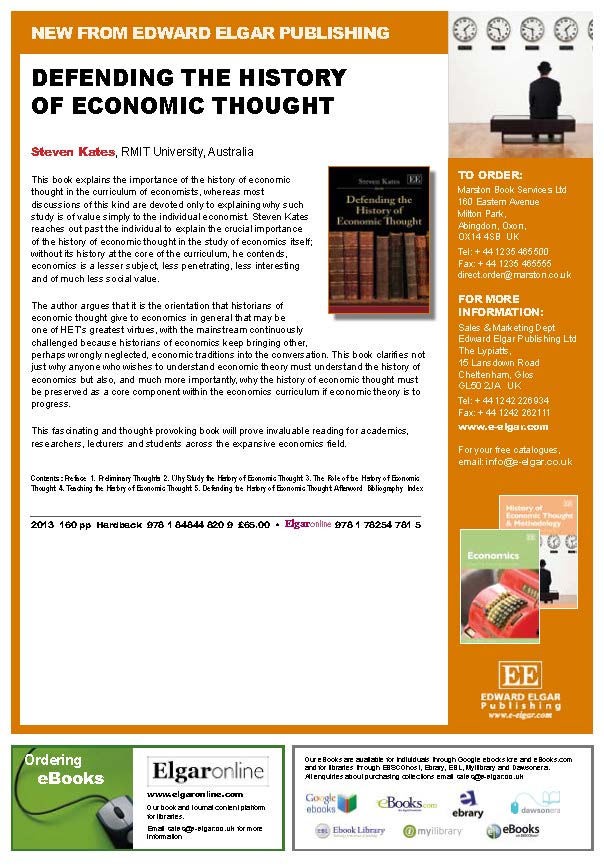
I am actually becoming hopeful that my Defending the History of Economic Thought, which will be released at the end of July, may turn out to be a very useful book. Each time I have gone over it myself, I have found it surprisingly filled with nice ideas about the value and role of the history of economic thought to economists. And it’s because I started from a different question than most others: why does the subject matter of economics need the history of economic thought to be taught to economists. Anyway, the following question was posted by Howard Baetjer Jr at the Austrian website the other day:

Dear Austrian list members,

I get to teach History of Economic Thought next term! I’m eager but ignorant and looking for guidance.

  • What textbook (if any) should I use?
  • What outside readings should I assign?
  • If you have a syllabus that has worked well for you, would you share it with me and let me copy freely, giving you credit on my syllabus for what I take from yours? (Steve Horwitz did this for me years ago for Money and Banking; it has been immensely valuable.)
  • Do you have any particular approach to recommend?

I am very much aware of Larry White’s The Clash Of Economic Ideas; I’m reading it now, loving it, and almost finished. Peter Boettke’s Living Economics is next on my reading list:

  • Would you recommend that I use one or both? If so, along with a standard textbook or not?
  • Any sage advice for me as embark on these unfamiliar seas?

I would appreciate any suggestions, comments, warnings, recommendations of any kind. I’m not good at reinventing wheels.

Gratefully in advance,

Howie

And here is my reply:

It is good to see history of economic thought still on the curriculum. My Defending the History of Economic Thought is being published next month by Edward Elgar in which I devote a chapter to discussing how I think HET ought to be taught. And the approach I discuss is not just to use a modern HET text and then look backwards from today but to use actual mainstream textbooks of the time to explore how a typical economist would have looked at the various economic issues back then. As an example, one might choose a series of contemporary textbooks such as McCulloch 1825, Mill 1848, Taylor 1913 and Samuelson 1948, each of which can now be purchased in a cheap edition, and then examine various themes such as the notion of market adjustment, their theory of monopoly, their theory of value, the business cycle, or whatever else might be of interest to compare how these were approached in different eras. Looking only at the great names and the great discoveries has an interest of its own. But if you are also interested in understanding how economists looked at the world during different periods of time, this is the approach I would adopt. The book is out next month but if you are interested in a copy of the chapter on teaching HET, just let me know.

And the funny thing is that there is probably no other subject whose history can profitably be taught in that way. The controversies are still alive and almost no issue is ever settled for all time. A very funny subject, economics.

Behind the shock machine

I had actually studied the Milgram experiment before I was randomly chosen to participate in just such an experiment while an arts student at the University of Toronto. And I have always wanted to know how others had reacted to having been part of this experiment so now I will be able to find out. It is one of the main reasons ethics approval is now required and I can tell you that anyone who conducted these experiments ought to be hunted down and their licence to practise psychology withdrawn. This is the text of an article titled, How many people really went through with the Milgram Experiment? by Esther Inglis-Arkell:

We’ve all heard of the infamous Milgram Experiment, in which subjects, with a little pressure from an authority figure, participated in a process that they believed shocked someone to death. But did far fewer people than reported actually go through with it?

The Milgram Experiment is arguably the most famous psychology experiment in the world – probably because bad news travels fast, and it has some very bad news regarding all of humanity. It seems that sixty-five percent of us would torture a human being to death if an authority figure asked us to. For those who don’t know, the Milgram experiment involved subjects coming in and hearing that they would be participating in a memory-improving experiment. A person in the next room – connected via intercom – would be tested on their memory, and the subjects would be in charge of giving them ever-increasing shocks when they screwed up. The person was actually an actor, and not hooked up to anything, but would scream in pain as the shocks got worse. If the actual experimental subject objected to shocking the person, the experimenter would give them more and more menacing orders to continue with the experiment. At last the “line” would go quiet, making the subjects believe that they’d murdered someone.

Although some people considered the experiment a positive experience, and one subject corresponded with Milgram for years and credited the experiment for making him a conscientious objector, others were traumatized. One woman was prodded into participating by her roommate, who turned out to be the one being “killed” in the other room. One hopes that, after the experiment, either the murderer or the psychologist moved out. The Milgram experiment prompted psychologists to call for more exacting standards regarding human experimentation.

The results overshadowed the ethical standards. It appeared that sixty-five percent of people would torture someone to death, if pressured to do so. The results made their way into both psychology and cocktail party conversation. But were they correct? At least one woman doesn’t think so. Gina Perry, for her book, Behind the Shock Machine, traced as many participants in the Milgram experiment as she could, and re-examined the notes of the experiment. Milgram claimed that seventy-five percent of the participants believed in the reality of the experiment, but Perry puts the number at about half. The change makes a big difference in the results. The people who didn’t buy that they were actually shocking people were far more willing to increase the intensity of the shocks. They wanted to know how far the experimenters would go in the ruse, while the experimenters were wondering the same thing about them. Those that believed that they were shocking people were much more likely to keep the shocks down low. While Perry still thinks about a third of the people would crank up the shocks even if they believed, that’s a big drop in overall percentage. While no one can deny that people can do some terrible things, perhaps, overall, people are neither as evil or gullible as we imagine.

Should one teach Marx as part of HET?

David Henderson had the following blog post today at Economic Liberty

On a short blog post today, Daniel Kuehn, preparing to teach an undergraduate course in the history of economic thought, writes:

I wish I could completely skip Marx… does that make me a bad person? I suppose I shouldn’t. A few in the department would probably be miffed too if they found out.

First, Daniel, it doesn’t make you a bad person. Indeed, my respect for you just rose from what was already a reasonably high level.

Second, that reminds me of a true story. My friend Chris Jehn, while a Ph.D. student in the University of Chicago’s economics program in the late 1960s or early 1970s, took a course in the history of economic thought from the late George Stigler. Many people might have forgotten this, or perhaps never knew it because George was known mainly for his work in industrial organization and regulation, but the history of thought was one of George’s passions and it was an area in which published a lot in the 1940s and 1950s.

Back to the story. The first day of class, Stigler handed out a pretty comprehensive syllabus and started going over it in class. A student with a foreign voice raised his hand. ‘Yes,’ said Stigler (and if I could do the voice in this blog, you would hear a reasonable imitation of Stigler’s distinctive voice.)

‘Professor Stigler, I see that there is nothing on the syllabus by Karl Marx. Why is that?’

Stigler paused and then answered: ‘Marx was a lousy economist.’

So this was my comment on whether or not Marx should be taught as part of an HET course:

My Defending the History of Economic Thought is about to be published next month by Edward Elgar. In it I devote a chapter to discussing how I think the history of economic thought should be taught with one of the main points I make being that Marxist economics should not be. HET in my view is either about how the economics we find in our texts evolved through time into what we see. Or is it about how the mainstream of the profession answered particular economic questions during different periods of time in the past. In neither case would I think that the inclusion of Marxist economic theory would be relevant.

It’s not whether Marxist theory is good or bad economics but whether it fits into the point of an HET course which is to understand the evolution of mainstream economic theory.

Prelinger archive

The Prelinger Archive seems to be a vast storehouse of old footage from ancient days. It has come t light because The Atlantic has put up a video from 1961 on what they have titled, no doubt ironically, The Wonderful World of Capitalism.

The problem is a Keynesian problem. The goods and services can be produced but how are we going to get people to buy the volume of output that can now be produced. The answer is marketing which is to be the saviour.

It is also somewhat noteworthy that the portrayal of this vast outpouring of goods and services was put together at the very end of the Eisenhower administration, at the very moment that Kennedy and Johnson would start the unwinding process of this productive miracle.

Melbourne in 1910

It’s Melbourne, all right, but so different world. Will it be just as familiar in 2110? It will have to be the folks then who will decide but there will be a lot more images for them to look back on.

The only serious surprise in these pictures was that when they flashed up “Federal Parliament” they showed the Victorian Parliament Buildings. I had thought that the first Parliament was in the Exhibition Building but I guess after that they moved to Spring Street. And I also loved the front open seats on the trams. Must have been the perfect place on a summer afternoon, not so good perhaps in winter.