Missing da Vinci shows up after 500 years

da vinci painting

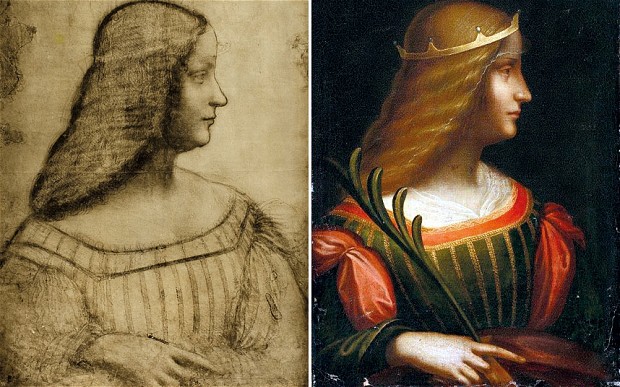
It obviously hasn’t been sitting in a bank vault for 500 years but that’s where it was found. They had always had the sketch. Now they have the painting that came with it.

After seeing the drawing he produced, the marquesa wrote to the artist, imploring him to produce a full-blown painting.

But shortly afterwards he embarked on one of his largest works, The Battle of Anghiari on the walls of Florence’s town hall, and then, in 1503, started working on the Mona Lisa.

Art historians had long believed he simply ran out of time — or lost interest — in completing the commission for Isabella d’Este.

Now it appears that he did in fact manage to finish the project — perhaps when he encountered the aristocrat, one of the most influential female figures of her day, in Rome in 1514.

Whatever, whenever, it is an amazing picture and even in profile she does have that smile.

How Babe Ruth hit 60 home runs

This is such a fantastic story about that month of September 1927 in which Babe Ruth from nowhere came to hit 60 home runs in a single season. It’s titled Babe Ruth’s Summer of Records and written by Bill Bryson who makes everything come alive. Just one section as a sampler but read it all:

Pitching carefully (as you might expect), Hopkins worked the count to 3 and 2, then tried to sneak a slow curve past Ruth. It was an outstanding pitch. ‘It was so slow,’ Hopkins recalled for Sports Illustrated seventy years later at the age of ninety-four, ‘that Ruth started to swing and then hesitated, hitched on it and brought the bat back. And then he swung, breaking his wrists as he came through it. What a great eye he had! He hit it at the right second—put everything behind it. I can still hear the crack of the bat. I can still see the swing.’ It was Ruth’s 59th home run, tying a record that less than a month before had seemed hopelessly out of reach.

The ball floated over the head of the right fielder, thirty-seven-year-old Sam Rice, who is largely forgotten now but was one of the great players of his day and also one of the most mysterious, for he had come to major league baseball seemingly from out of nowhere.

Fifteen years earlier, Rice had been a promising youngster in his first season in professional baseball with a minor league team in Galesburg, Illinois. While he was away for the summer, his wife moved with their two small children onto his parents’ farm near Donovan, Indiana. In late April, a tornado struck near Donovan, killing seventy-five people. Among the victims were Rice’s wife, children, mother, and two sisters. Rice’s father, himself seriously injured, was found wandering in shock with one of the dead children in his arms; he died nine days later in the hospital. So, at a stroke, Rice lost his entire family. Dazed with grief, Rice drifted around America working at odd jobs. Eventually he enlisted in the navy. While playing for a navy team his remarkable talents became apparent. Clark Griffith, owner of the Washington Senators, somehow heard of this, invited him for a trial, and was impressed enough to sign him. Rice joined the Senators and in his thirties became one of the finest players in baseball. No one anywhere knew of his personal tragedy.

I just love baseball stories which are different from the stories associated with any other sport. But the greatest book of them all is The Glory of their Times which I read young, either showing that from the very start I had an interest in ancient times or perhaps even bringing me to my interest in them.

Beyond Betrayal

No book has ever frightened me as much as this. The only thing wrong with reading it is that you find yourself so surrounded by impossible odds that it seems there is no way you can go that isn’t in the wrong direction. Trying to fix things is as bad as just leaving them alone. If I were to write this up, these are the elements that would go into the story.

1) Ronald Radosh’s review of American Betrayal was so scathing I knew it had to be worth reading. He is a leftist plant who is so patently not on our side that the only wonder is that he is not universally recognised for who and what he is.

2) My own background living with my father who was a lifelong dedicated communist. I grew up understanding that the international communist conspiracy does not require everyone to receive a set of instructions to tell them what to do. They merely have to understand what the rules are and from then on they can be left on their own to play their part as they interpret it.

3) Reading the book which has been a dispiriting experience. Maybe I should just stop reading long books since they take so long but I do think it was the content.

4) What’s the content? When we were in New Orleans in 2010 I found for $3 a book titled The Politician by Robert Welch. Welch was the central figure in the John Birch Society which was this ultra-looney group on the far right when I was growing up. If you wanted preposterous then they would supply it. But between then and now my politics have moved from the left where they were then to the right where they are now. But even as I picked it up, my expectation would be that I am dealing with beyond the pale. Instead, I found Welch to be as moderate and reasonable as one could want, fully understanding who he was and how he would be viewed by others and portrayed by his enemies. He just took up the fight because he knew what he knew and could see no alternative but to try to do what he could to fix things. For what it’s worth, I still think Welch is looney and his views extreme but that he saw communism as a mortal enemy of freedom is to his credit.

5) And what Diana West writes across 400 pages might be summed up in a single sentence from The Politician.

The American people have not yet waked up to the clear evidence that Harry Hopkins, instead of being the fumbling half-mystical dogooder for which they took him, was one of the most successful Communist agents the Kremlin has ever found already planted in the American government, and then developed to top-level usefulness.” (217-218)

Diana West’s book is about Harry Hopkins, his role as a Stalinist agent and the influence he had over Roosevelt. It’s much more than that but on its own that is more than enough to make you see the world in a very different way. Weird even to write this down but it is the very implausibility that makes this an idea worth pondering. Radosh certainly had no arguments that would counter what West wrote.

6) In a nutshell, with Hopkins literally (as in actually, he really was) living in the White House during World War II, virtually the whole of American policy and strategy was designed with one purpose in mind – to allow the Russians to expand their grip on the rest of the world. Both the tyrannies of Eastern Europe after the war and the communist takeover in China were caused by these agents of influence who set American foreign policy and determined the allied war strategy. She may be wrong but she does tell an incredibly plausible story that fits with everything I already know. And if it is true, you can hardly see how an enemy this powerful can ever lose. I take the same view as Whittaker Chambers, we are on the losing side.

7) All of which West ties to the present struggle with Islamic jihad where those within our political elites who you would think ought to be alerting us to the dangers of letting down our guard are instead conspiring with the Islamists to create a world in which the rest of us will come under their sway. I cannot understand why they would do it but there seems too little evidence of resistance and plenty of evidence of collaboration.

8) As with Communism, the only saving grace in the end is just how repulsive the Islamic enemy is. But if the fifth column is as relentless and as well placed as the communists were (and are) I do not see how this can be overcome. Hence depressing but I do not wish to be so defeatist. But it’s a war that now that I see the dimensions of makes me tired and fearful. It also makes everything else seem so minimal.

Maybe I’ll be more rested tomorrow but tonight it has gotten right on top of me.

The Ministry of Truth and the new media

This is from the Wikipedia post on The Ministry of Truth. In Orwell’s 1984 workers within the Ministry are actual government employees and oddly that’s the bit Orwell got wrong. Yet had he actually predicted what really has happened it would have been seen that step too far, farfetched beyond endurance. Nevertheless, there they are, the journalists of the world, free conscripts to our various media organisations, some even run under free enterprise principles, who will lie, deny and distort, do whatever it takes, to shield their leftist cult leaders from all criticism. But aside from that failure to predict to the very last measure of accuracy, everything else has taken place as Orwell predicted almost to the letter. In place of Newspeak the language is now the language of PC, the politically correct. Speak outside of its confines, you will be spotted the moment you say a word.

The Ministry of Truth is Oceania’s propaganda ministry. It is responsible for any necessary falsification of historical events. The word truth in the title Ministry of Truth should warn, by definition, that the ‘minister’ will self-serve its own ‘truth’; the title implies the willful fooling of posterity using ‘historical’ archives to show ‘in fact’ what ‘really’ happened. As well as administering truth, the ministry spreads a new language amongst the populace called Newspeak, in which, for example, truth is understood to mean statements like 2 + 2 = 5 when the situation warrants. . . .

The Ministry of Truth is involved with news media, entertainment, the fine arts and educational books. Its purpose is to rewrite history to change the facts to fit Party doctrine for propaganda effect. For example, if Big Brother makes a prediction that turns out to be wrong, the employees of the Ministry of Truth go back and rewrite the prediction so that any prediction Big Brother previously made is accurate. This is the ‘how’ of the Ministry of Truth’s existence. Within the novel, Orwell elaborates that the deeper reason for its existence is to maintain the illusion that the Party is absolute. It cannot ever seem to change its mind (if, for instance, they perform one of their constant changes regarding enemies during war) or make a mistake (firing an official or making a grossly misjudged supply prediction), for that would imply weakness and to maintain power the Party must seem eternally right and strong.

I am not the first to notice this, of course, but it is always astonishing to come back to it again and see once more just how accurate Orwell was. Apply the above to each of the following – Bengahzi, Syria, the IRS, Obamacare – and you will immediately see how uncanny this statement is given Orwell published 1984 in 1948 and not just last year.

Not coming soon to a theatre near you

This is a trailer for a film that will be coming out in the US in a couple of months that deals with the mega-mess being created by the Federal Reserve. It is titled, Money for Nothing which seems to be a horror film in the genre of crony capitalism meets the Fed.

The reason lower interest rates are not a cure for an economy in recession, of course, continues to elude the economists’ fraternity because they cannot help believing that the problem is not enough demand so that their only cure is more spending. But watch the trailer. Charles Plosser’s perfect comment – “printing money doesn’t produce goods and services; it doesn’t hire people” – exactly captures what needs to be understood but which almost no one with a standard education in economic theory ever seems to comprehend. Yet what I find pleasing is that even though virtually no one is taught these things, the logic eventually dawns on some people that production must precede the purchase. In this case, it was the Chairman of the Federal Reserve of Philadelphia. Such ideas must rule him out as the next Bernanke. Still, there must come a time when the Fed will stop printing money and what will happen then is what I suspect this film is about.

[My thanks to JA for sending me the link to the trailer.]

Betraying Diana West

Since reading M. Stanton Evans’ Blacklisted by History and then Ronald Radosh’s highly negative review I have mistrusted Radosh to the point where I can only think of him as a far left socialist plant here on the right. Radosh, from the deepest of leftist motivations, wrote a book about the Rosenbergs in which he was hoping to defend them but was compelled by the evidence to conclude that they actually had been Soviet spies. Unexpectedly for him but not for me, his friends on the left immediately drove him out and would no longer associate with him. No principle of his had changed, only the people who were now willing to talk to him. Thus under the my-enemy’s-enemy-is-my-friend principle that if you are shunned by the left then you must be something else, the assumption has grown that he is one of us. But from everything he has written this is so obviously untrue it only amazes me he is not so utterly discredited that no judgment of his is ever accepted amongst ourselves.

Radosh has done the same again in a review of Diana West’s American Betrayal which was published in Front Page Magazine where you would hope for better. West has now replied at Breitbart in an article titled, The Rebuttal – Part One which presumes there will be at least one more section to come. You can read her reply for yourself – long and detailed – but here are the reviews of her books that were put up on the Amazon website:

“Diana West masterfully reminds us of what history is for: to suggest action for the present. She paints for us the broad picture of our own long record of failing to recognize bullies and villains. She shows how American denial today reflects a pattern that held strongly in the period of the Soviet Union. She is the Michelangelo of Denial.”– Amity Shlaes, author of Coolidge and the NYT bestseller The Forgotten Man: A New History of the Great Depression

“This explosive book is a long-needed answer to court histories that continue to obscure key facts about our backstage war with Moscow. Must-reading for serious students of security issues and Cold War deceptions, both foreign and domestic.”– M. Stanton Evans, author of Blacklisted by History

“If you haven’t read Diana West’s “American Betrayal” yet, you’re missing out on a terrific, real-life thriller.”– Brad Thor, author of the New York Times bestsellers Black List, Full Black, and The Last Patriot.

“What Diana West has done is to dynamite her way through several miles of bedrock. On the other side of the tunnel there is a vista of a new past. Of course folks are baffled. Few people have the capacity to take this in. Her book is among the most well documented I have ever read. It is written in an unusual style viewed from the perspective of the historian—but it probably couldn’t have been done any other way.”—Lars Hedegaard, historian, editor, Dispatch International
“Her arguments shred our preconceived notions of twentieth century history.”—Jeff Minick, Smoky Mountain (NC) News

“American Betrayal is a monumental achievement. Brilliant and important.”–Monica Crowley

“Diana West’s new book rewrites WWII and Cold War history not by disclosing secrets, but by illuminating facts that have been hidden in plain sight for decades. Furthermore, she integrates intelligence and political history in ways never done before.”–Jeffrey Norwitz, former professor of counterterrorism, Naval War College

“Enlightening. I give American Betrayal five stars only because it is not possible to give it six.”–John Dietrich, formerly of the Defense Intelligence Agency and author of The Morgenthau Plan: Soviet Influence on American Postwar Policy.

If it is endorsed by M. Stanton Evans, the one person more likely than anyone to know whether this kind of book is on the hunt or not, it is a book that is worth your time although by the time you are through you will wonder whether the betrayal continues to this day and where its gangrenous tentacles now reach.

David Horowitz Replies: This is the reply at FrontPageMag that leaves me unsatisfied. I don’t know what Horowitz is afraid of but he should mistrust Radosh. Unless he has read the book himself and decided that her misjudgments are seriously unacceptable, he should not be policing such a debate in such a heavy handed way. The first of the comments after Horowitz’s very brief remarks captures the issue:

I read West’s book, as well as the one by Evans and Omerstein, Stalins Secret Agents. Both complement each other, and West made a reasonable case, even if some parts of her work lapsed into speculation. She was clear about that, however. Hopkins appears condemned by the facts to have been a Stalinist agent, either that or FDR was, and was instructing him to do what he did. Whatever the truth, massive help was given to the Soviets by FDR, and more than just Dodge trucks via Murmansk. America helped Stalin on many factors, and West exposes them, unmercifully. Did FDR deserve mercy? Not if half of what West dug up is true, and I say more than half is true, and well documented. Her facts mirror those of Evans and Omerstein.

This ‘debate’ between West and Horowitz has lost focus, and should return to the “search for truth” which is always the first duty of good scholarship. it has now become something more bitterly personal. The acid being thrown around seems to be far greater than any mere disagreement on the facts.

I admire both West and Horowitz. How about you both take a cooler, and get back to debating the facts about the many Soviet spys and communist betrayers in FDRs administration, and how that connects to the modern very similar situation.

This, then, is the second comment:

David,

I have just one question for you, what the heck were you thinking when you let Ron Radosh talk you into this nonsense?

And please don’t deny it because I know Radosh talked you into this. You have already admitted that it was Radosh who first called to alert you to the ‘mistakes’ in Diana West’s book and the folly of the initial review that was since removed, so anyone who can add 2+2 knows Radosh took you down this road in the first place.

That said, don’t you realize who you are in the conservative movement and on the anti communist right, as compared to Ronald Radosh?

Ron Radosh may be a big-shot in academic circles, but most grassroots conservatives couldn’t pick him out of a police lineup, not if there was a million dollars at stake, not if their lives depended on it, therefore Radosh has nothing to lose by alienating conservatives, he has nothing to lose by attacking Diana West just as he had nothing to lose when he attacked Stan Evans and Evans proceeded to clean his clock. Ultimately the only people Radosh is beholden too are the folks he encounters at think tanks and in the faculty lounge, that’s where his bread is buttered and none of this stuff alienates that crowd, and he knows it, so he risks absolutely nothing by going after West or Evans, viciously or otherwise.

You, on the other hand, are an icon in the movement with a direct connection to grassroots conservatives. Prior to this, had you asked the grassroots to contribute to this endeavor or that endeavor, the checks would come fast and furious because the grassroots trusted you and believed wholeheartedly that your causes were our causes. If you said ‘this is important too me’, most conservatives would automatically say, ‘then it must be important to all of us.’

Do you realize how rare that is and that its more precious than gold?

How many people in the movement have that kind of clout with the grassroots and why on earth would you do anything to damage that?

This is what I tried to explain to you weeks ago!

Heck, now you are calling West’s defenders an ‘army of kooks.’

Really David, is that where you want to take this now?

Think David, think long and hard about this, in fact I suggest you consider what your mentor, the late/great Reed Irvine, might have advised you here.

You knew Reed much better than I did, I know that you were like a son to Reed, I simply adored him from afar, but I find it hard to believe, knowing how much Reed cared about you, that he ever would have allowed the likes of Ron Radosh to talk you into this fools errand. I think he would have reminded you, right or wrong, Diana West is on our side and if you must correct some factual errors, do so in a constructive way, and say or do nothing to bring embarrassment on this woman, do not put her in a position where she can be abused and ridiculed by the left.

Just my opinion, for whatever its worth.

Alinsky and his rules for radicals

Alinsky’s Rules for Radicals are the playbook of the left. Alinsky, largely a nihilist himself, put together a set of rules on how to win power that contained not an ounce of policy. With the world not a perfect place and envy the single most powerful social force, he constructed guidelines on how to present a critique of others that have proven to be formidable in the midst of political debate.

What Alinsky would never have imagined is that the left would join forces with the media so that almost nothing said by a politician of the left is ever challenged in the popular press or network TV. For the left, it’s almost become too easy. The nature of the political battle for those with a more centralist and conservative perspective is now a minefield of potential explosives. If you are from a party of the centre or the right, these are rules you must know yourself, recognise and carefully think through how they can be dealt with since they will with certainty be used against you. In summary here are Alinsky’s rules but you should also read his book:

1) “Power is not only what you have, but what the enemy thinks you have.”

2) “Never go outside the expertise of your people.”

3) “Whenever possible, go outside the expertise of the enemy.”

4) “Make the enemy live up to its own book of rules.”

5) “Ridicule is man’s most potent weapon.”

6) “A good tactic is one your people enjoy.”

7) “A tactic that drags on too long becomes a drag.”

8) “Keep the pressure on. Never let up.”

9) “The threat is usually more terrifying than the thing itself.”

10) “The major premise for tactics is the development of operations that will maintain a constant pressure upon the opposition.”

11) “If you push a negative hard enough, it will push through and become a positive.”

12) “The price of a successful attack is a constructive alternative.”

13) “Pick the target, freeze it, personalize it, and polarize it.”

I have an article at Quadrant Online that looks at these rules in relation to Rupert Murdoch who is the great villain of the left for no other reason than that he can be effectively used as part of the last of the rules on personalising a target. Rudd has not a constructive thing to say in this election, representing a party with no runs on the board. Every major aspect of policy has deteriorated over the past six years and there is no reason to think they would get better if he were re-elected. The economy is worse, social cohesion has deteriorated, our borders are a sieve, living standards are falling and a series moonbat ideas in a host of areas have been endorsed. Yet what do we hear time and again, that this criticism is evidence of a press conspiracy by the Murdoch papers to see this government thrown out. Forgotten and seen as irrelevant is that these same papers, disastrously, sought to install Rudd in the first place in 2007.

How to deal with this rules-based criticisms is difficult but the first thing is for everyone to know these rules when they see them in action so that they can say, there they go again, using that same old tired Alinsky rhetoric. They bring up Murdoch, you bring up policy. Put the question straight, are you trying to change the subject from these policy failures of yours to the irrelevancy of who sells the most newspapers. Point out that they are trying to change the subject because sticking to the subject will only point up just how little they offer, how empty their policies are.

And let me just finish with a bit of context. In thinking about Alinsky and his rules, it is worth remembering this:

Hillary Rodham as a student at Wellesley in 1969, interviewed Saul Alinsky and wrote her thesis on Alinsky’s theories and methods. She concludes her thesis by writing,

‘Alinsky is regarded by many as the proponent of a dangerous socio/political philosophy. As such he has been feared, just as Eugene Debs or Walt Whitman or Martin Luther King has been feared, because each embraced the most radical of political faiths, ‘democracy.”‘

Alinsky offered Hillary a job upon graduation from Wellesley but she decided to attend Yale Law School where she met her husband Bill Clinton.

And then there’s this from that same source:

Obama taught workshops on Alinsky’s theories and methods for years and in 1985, he started working as a community organizer for an Alinskyite group called, ‘Developing Community Projects.’ While building coalitions of black churches in Chicago, Obama was criticized for not attending church and decided to become an instant Christian. He then helped fund the Alinsky Academy. Obama was a paid director of the Woods Fund, which is a non-profit organization used to provide start-up funding and operating capital for Midwest Academy, which teaches the Alinsky tactics of community organization. Obama sat on the Woods Fund Board with William Ayers, the founder of the, ‘Weather Underground,’ a domestic terrorist organization.

The fact is that irrespective of which side of politics you are on, you are not in the game unless you have made a study of Alinsky’s rules, understand its tactics and if you are on the conservative side of politics, thought through how you will deal with these tactics when they inevitably are brought into play by the other side.

Getting up at five

Some people really do change your life. This is an article by Robert Ferrigno whose life really was changed by Elmore Leonard, a great writer but an even more incredible person as this post by someone whose life was changed by Elmore Leonard can attest. A section from the article where we find the advice that Leonard offered. It’s a short article and it’s worth reading it all:

What time you get up? he asked me.

Seven, I told him. I have to be at the office by nine.

It was the same way at the agency, he said. You want to write a novel, you have to get up at 5. That way you have two hours every day to write before your normal day begins.

Five a.m.? I’m a night person, I said.

Mr. L. smiled again. Gave a little shrug.

Okay. I’ll get up at five.

You get up at five and you start work, said Mr. L., no messing around making coffee or buttering toast. You sit down and start writing. At 7 you stop, if you’re in the middle of a sentence, you stop, and then you make coffee, take a shower, have breakfast, whatever you normally do. You’re done working on the novel for the day. You do that every day and at the end of a year, you’ll have a novel. Then you send it out to an agent and you start on the next one.

Sounds just like Trollope.

Defending the History of Economic Thought

defending the history of economic thought

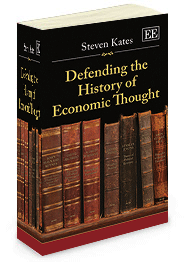
My Defending the History of Economic Thought has just been released. As an author, possibly the most interesting part about writing a book is to find the text saying things you had never thought about yourself until you came to write them down. This book is more exceptionally like that than any of the others I’ve written. This is how the text on the back of the book would have read had there been more room:

The aim of this book is to explain the importance of the history of economic thought in the curriculum of economists. Most discussions of this kind are devoted to explaining why such study is of value to the individual economist. It is, of course, but that is not the main point of this book. This book reaches out past the individual to explain the crucial role and importance of the history of economic thought in the study of economics itself. As the book tries to explain, without its history at the core of the curriculum, economics is a lesser subject, less penetrating, less interesting and of much less social value.

It is the orientation that historians of economics give to economics in general that may be its great value. The mainstream is continuously challenged because historians of economics keep bringing other perhaps wrongly neglected economic traditions into the conversation.

The sad reality is that almost no economist being educated today has detailed knowledge of the people who built the ideas found in their texts nor do they know how those ideas evolved. Worse yet, they know almost nothing of those ideas no longer found in our modern texts, many of which had once been central in economic discourse but which have since been moved onto the back shelf for no better reason than because they are no longer part of the mainstream. This book explains not just why anyone who wishes to understand economic theory must understand the history of economics but also, and much more importantly, why the history of economic thought must be preserved as a core component within the economics curriculum if economic theory is to progress.

This fascinating and thought-provoking book will prove invaluable reading for academics, researchers, lecturers and students across the expansive economics field.

The details on where to get a copy of the book may be found here.