Are we supposed to take this “woman” seriously?

Gavin McInnes reviews Ann Coulter’s !Adios America. This is how it starts.

Ann Coulter is a withered old hag who uses shock value to sell books. Look at her face. What is she, 40? And her hair? Come on. Are we supposed to take this “woman” seriously? Her latest incarnation of Mein Kampf says Adios, America on the front but should really be called Mexicans Are Human Garbage. I haven’t read it yet but the claims she makes in the book are as disgusting as they are outrageous. It all came out on a recent appearance of Fusion with Jorge (pronounced “Hor-jay”) Ramos. As the title implies, his show brings together all kinds of different cultures into a fun plate of multiculturalism that’s like fusion cuisine for the brain. (If you don’t believe diversity is our strength, check out all the cool restaurants in New York City. You can be served by a Somalian one day, a Turk the next, and a Glaswegian in between the two.)

“Ann, if you’re reading this. Show some humanity! We are a nation of immigrants. We stole this land from the Indians.”

Ramos appeared to be focusing on Hispanics throughout the episode he had Coulter on. It was a brilliant way to expose her irrational ramblings for what they really are: Shock Hate. I haven’t actually seen the entire episode but the Internet is rife with apt descriptions of what happened. The show started out with Ann being repulsed by a Hispanic woman of color who simply offered her a hug. After that, a documented boy from Honduras tried to reach out to her and open her eyes to the dangers of prejudice and Ann barked, “You’re not black so drop the racism crap.” Her hatred for Mexicans ran so deep, she couldn’t talk to any of the audience members. Ramos rescued them from her vile bile and bravely took her on himself. He told her America was becoming more diverse and she said, “more Mexican” is not more diverse. He asked her what her problem is with 11 million hard-working people and she said the number was 3 times that! She also said they’re not as nice as we think. “If you don’t want to get killed by ISIS, don’t go to Syria” she said before adding, “If you don’t want to be killed by a Mexican, there’s nothing I can tell you.” I mean, at this point you have to just give up. Even conservatives know the Hispanic crime rate is the same as that for whites. In her world, Mexicans don’t come here for a better life. They come here to murder people.

Ann, if you’re reading this. Show some humanity! We are a nation of immigrants. We stole this land from the Indians. Mexicans aren’t doing the same to us. They’re here to help us. Do you want us to put them all on a giant bus and send them home? Grow up!

You get the point. Now read the rest.

BTW: Here is Ann’s column about the interview.

My book launch

There will be few moments in my life as exquisite as Wednesday when Peter Costello* came up to the University to launch the second edition of my Free Market Economics: an Introduction for the General Reader. It was a rare moment when the political side of my life, the academic side and my recognition of the importance of classical economic theory were brought together all at once, and was a moment I could share with my friends and family.

I may sometimes give the impression that the book is mostly about Keynesian economics and macro which is not the case at all. That is why I started it out, but the oddest thing for me was to find that as I wrote each chapter, that I harboured views that are far outside the standard textbook treatment. This starts even before we get to supply and demand, but I promise you this, by the time you finish with supply and demand you will know you are in a different economic world. Of course, there are demand-side market forces that limit the price that can be charged for a product, and forces on the supply side that put some kind of lower limit on the price. But the notion that there is a single equilibrium price for a product where two lines cross on a two-dimensional plane is unsupportable by even the most casual empiricism. As I point out to my classes, the price of a cup of coffee, starting from the $1 at the 7-11, to prices four and five times higher that are charged, all within a mile of the front door of our building, ought to make you appreciate that there is something else. I do teach the traditional S and D analysis, but my students also are made to understand that prices are not set by these two curves, but by entrepreneurs who are making decisions about their optimal pricing strategy, given all of the forces of the market that surround them. And most importantly, I do not let them forget that the information in a demand curve can never be known by anyone, ever. It is strictly for teaching purposes. Entrepreneurs in the real world have to work these things out for themselves in real time.

But if I have a villain on the microeconomic side, it is the MR=MC analysis and diagram. If economics had gone out of its way to find some means to cloud minds about what goes on in markets, I don’t think they could have come up with anything worse.

mc equals mr

I teach Keynesian economics, of course, but I won’t teach that. You can find it discussed in my book, but it’s in an appendix. Over the years of teaching this diagram and the explanations that surround it, I found that after going through markets and then supply and demand, you would come to this and stop a class cold. Eventually some could draw the diagram and some might have seen the point, but there would not have been many. I do, of course, teach marginal analysis, but not like this. If you would like to see how I do it, as just part of the way this book is different from any economics book you know, Quadrant Online put up a few pages of the book under the heading Margin of Success.

As I said at the end of my presentation, there are three features of the book that I stress over and again: the role of the entrepreneur, value added and the crucial importance of uncertainty. Each is part of what must truly be understood by marginal analysis: entrepreneurial decision making in the face of the unknown future. And the point I make about the entrepreneur, as I said on the night, is that we now talk about market forces and the invisible hand, but the reality is that there is only one force that matters in a market economy, and that is the entrepreneur. And I don’t mean entrepreneur as in someone who innovates and causes change. I mean entrepreneur as in the captain of a ship in the midst of a storm a thousand miles from land.

_____

* For non-Australians, Peter Costello is the nearest equivalent we have to Ronald Reagan. He ran the economy for eleven of the best years economically this country ever had. Not only was the Asian Financial Crisis a non-event when every one of our major regional trading partners was in recession, but we ended up with 5-6% at the same time. And not only budget surpluses year after year, Australia was, until Labor took over, the only country in the world that had ZERO DEBT! The momentum given to the economy by Costello meant that we travelled through the GFC with hardly a ripple. Our problems have come since due to the debts and deficits Labor piled up. We will never see zero debt again in anyone’s lifetime, and will be lucky even to see our budget balanced any time this side of 2025.

Fear the ignorance

Supposedly an answer to Fear the Boom and Bust which you can watch here as an antidote. This has been put up at the History of Economics discussion thread, but the look on the face of the student at the start when he finds that Adam Smith wrote his Wealth of Nations in 1776 suggests he may not have found the most perfect launch pad. This has been posted by the chap who put the video together.

I thought that SHOE readers would like to know about a much anticipated reply to the Hayek-Keynes rap video. Here is “Fear the Economics Textbook (Story of the Next Crook): A Rap Video,” by Stephen T. Ziliak and the RU Ready 4Justice Collective at Roosevelt University, that is, students of economics and social justice studies.

The link he provides is here. The sound hasn’t yet been perfectly coordinated with the picture so here are the lyrics to help you follow along.

[Maya and Ben sing Refrain to “Wet Dreamz” beat by J. Cole]
I took my last look, at this textbook,/
Invisible hand, /story o’ tha next crook,/
I took my last look, at this textbook,/
Invisible hand, /story o’ tha next crook,/
So proud, so game, so orthodox,/
2
But ch’yer head’s in the sand, Prof,/
don’t blame da Nash box./
We read, we think, we write about it,/
But ch’you’re standin’ there lecturin’,/
n’ we’re worryin’ about it.
Took my last look, at this textbook,/
Invisible hand, /story o’ tha next crook,/
We read, we think, we write about it,/
But ch’you’re standin’ there lecturin’,/ n’ we’re worryin’ about it.
[Cyris sings Verse 1 to “Let ‘em Blow” by Chief Keef et al.]
Readin’ Greg Mankiw, /
Queue the conservative man’s view/
Supply, demand, invisible hand too /
Following these Ten Commandments he hands to you /
Hey kids, you understand what Econ really can do? /
These ain’t the pearly gates, Mr. Mankiw/
Just preachin’ on profit and Max U/
But where’s the vertical mobility?/
Masses are enslaved in poverty/Millions for your fat pockets see/
This poverty of nations ain’t so efficient/
Mainstream economists are mentally deficient/
Monotonous lectures despite student resistance/What works on the Blackboard but not
with existence/
3
Your crackpot theories plot all the wrong axes /
If you are the state we-Uber-killin’ all your taxis /
[Maya sings Verse 2 to “Let ‘em Blow” (Chief Keef et al.)]
Yo I say that with gritted teeth/
Admittedly, when it comes to justice and liberty/
You Ivy leagues just can’t compete, I pity thee/
So tell New Jersey fans we gonna need new Jersey’s man/
Cause you just stand in the stands lookin’ white wan/
Invisible hand doin’ nothing but hurting me/
Burnin’ me, doesn’t matter if it’s third degree/
Cause your economic policy causing nothing but poverty/
Death n’ destruction are all that I can see/
We need wealth for society, stop with the perjury/
You cheat, you steal, you lie through your pearly teeth/But today’s a new day and there’s a
brand new lesson to teach/
We’re turning over Ivy leaves as we stomp our feet . . . ./
[Pause . . . . then Maya concludes:]
I’m like Steve Nash, so check out this sweet pass/
[Maya and Ben sing Refrain to J. Cole “Wet Dreamz”:]
I took my last look, at this textbook,/
Invisible hand, /story o’ tha next crook,/
I took my last look, at this textbook,/
Invisible hand, /story o’ tha next crook,/
4
So proud, so game, so orthodox,/
But ch’yer head’s in the sand, Prof,/
don’t blame da Nash box./
We read, we think, we write about it,/
But ch’you’re standin’ there lecturin’,/
n’ we’re worryin’ about it.
Took my last look, at this textbook,/
Invisible hand, /story o’ tha next crook,/
We read, we think, we write about it,/
But ch’you’re standin’ there lecturin’,/
n’ we’re worryin’ about it.
[Eboni sings Verse 3 to “Let ‘em Blow” (Chief Keef et al.)]
Lesson one, it starts in a sympathetic fashion/
Government spendin’ can stop markets from crashin’/
You askin’, “where’s the money comin’ from?”/
It’s C+I and G and then we’re done some/
You see, it’s really not that complicated/
But steppin’ on the little guy ain’t the right way to make it/
You fake it, we take it, but it’s time to unionize/
Get ourselves organized, give the capitalists a huge surprise/
And begin the journey toward a social compromise/
5
Where the poor get more and the rich standby/
We fly, get high, and soar towards the blue sky/
Where moral sentiments replace demand and supply/
[Maya and Ben sing Refrain to J. Cole “Wet Dreamz”:]
I took my last look, at this textbook,/
Invisible hand, /story o’ tha next crook,/
I took my last look, at this textbook,/
Invisible hand, /story o’ tha next crook,/
So proud, so game, so orthodox,/
But ch’yer head’s in the sand, Prof,/
don’t blame da Nash box./
We read, we think, we write about it,/
But ch’you’re standin’ there lecturin’,/
n’ we’re worryin’ about it.
Took my last look, at this textbook,/
Invisible hand, /story o’ tha next crook,/
We read, we think, we write about it,/
But ch’you’re standin’ there lecturin’,/
n’ we’re worryin’ about it.
6
[Cyris and Erika sing and chant Verse 4 to “Let ‘em Blow” (Chief Keef et al.)]
It’s clear your markets are free of justice/
Looks like your supply curve needs some adjustments/
We need benevolence and sympathy in the mix/
These textbooks are corruptin’ our moral sentiments/
We need O.G.s in here, like Smith, Marx and Lerner/
Heterodox economics is the real table turner/
Get back to the real world, no catallaxy/
Spontaneous order, can’t put me in a Cadillac, see?/
Check Ferguson, Garner, and Rodney King too
People can’t work when they face black n’ blue!
[Prof Z raps Verse 5 to “Let ‘em Blow” (Chief Keef et al.)]
Dude from George Mason had a lot to say/
Not a whole lot o’ substance at the end o’ the day/
His message n’ beats are false an’ predictable/
Does he even teach his students about Rawls’s difference principle?/
We come from Roosevelt, yo, n’ we are the Lakers,/
Let’s get back to class now n’ forget all these fakers/
[Maya and Ben sing Refrain to J. Cole “Wet Dreamz”:]
I took my last look, at this textbook,/
Invisible hand, /story o’ tha next crook,/
7
I took my last look, at this textbook,/
Invisible hand, /story o’ tha next crook,/
So proud, so game, so orthodox,/
But ch’yer head’s in the sand, Prof,/
don’t blame da Nash box./
We read, we think, we write about it,/
But ch’you’re standin’ there lecturin’,/
n’ we’re worryin’ about it.
Took my last look, at this textbook,/
Invisible hand, /story o’ tha next crook,/
We read, we think, we write about it,/
But ch’you’re standin’ there lecturin’,/
n’ we’re worryin’ about it.
[Maya and Ben repeat first stanza of Refrain, with fade out . . .]
I took my last look, at this textbook,/
Invisible hand, /story o’ tha next crook,/
Took my last look, at this textbook,/
Invisible hand, /story o’ tha next crook,/ . . . . .

The lesson of history is that you often have to understand the lesson already before you can learn from it

As one of the veterans of the Viet Nam war/street-protestor division, I note that April 30th was the fortieth anniversary of the fall of Saigon. For me, the most memorable part of hearing the news was how despondent it made me. Deeper currents were stirring within me and I was on the turn towards who I am today. There is an interesting article today in The Australian on Five Myths about the Vietnam War. It had been a turning point, all right, and the residual remaining of newspaper anti-Western crusades and student ignorance matched against an arrogance rising to preposterous levels. In the spirit of what will get you is what you know that ain’t so, it is an article I recommend. It finishes with a genuinely important message:

It is regrettable that the Vietnam War has spawned so many myths that still adhere 40 years after the war’s end. Until we get the history of the Vietnam War correct, politicians and the educated public are likely to make bad decisions about the wisdom of intervention, and ­possible methods of involvement, in future military conflicts.

I might also mention that I have come across this quite interesting and valuable list of 10 books to celebrate the socialist holiday of May Day. I was speaking to someone of a different generation the other day about how influential Aleksandr Solzhenitsyn had been on my thinking and he said, Russian background notwithstanding, that he had never heard of him. With things being as they are, I can well believe it.

Of the ten-plus-one books listed, I have read nine. The Gulag Archipelago made the difference for me, and the others came after. History being of no interest in a post-modern world, these things are seemingly less important. Know thine enemy is, however, a useful notion. These books help, and the descendants of those these books were written to warn us against are everywhere.

Alan Moran – Global Warrior

alan moran climate change the facts

Since everyone else is discussing it, I cannot see why we should not as well, since the book was edited by a good friend and close colleague. This is from Mark Steyn, speaking for us all:

I’ve had a fun time out on the Earth Day airwaves talking about Climate Change: The Facts. That’s the new book featuring me and some of the world’s most eminent scientists on the state of the climate debate as we prepare to enter the third decade of the global-warming pause. And I’m thrilled to find that the book is currently Number One on the Climatology Hit Parade, ahead of Naomi Klein, Naomi Oreskes and any number of Naomis, and also Number One on the Environmental Policy Hot 100.

If this keeps up, in the forthcoming Mann vs Steyn trial I may call myself as an expert witness.

My sincere thanks to everyone who’s bought this important new book. The turn-of-the-century cartoon science of the hockey stick is over, and it’s time for climate science to make a new start.

Having edited books myself, it is both insanely finicky and ridiculously unrecognised given how many hassles there are. I just hope Alan won’t mind my putting him up in lights in this way, but it is an astonishing achievement.

Here is how you can get a copy of the book while helping Mark Steyn in his climactic battle against the forces of stupidity and deceit. And here is where you can buy the book through the IPA which was the publisher of this worldwide success.

You didn’t read the book and that’s all there is to it

From its very title – The post–WWII presidents made mistakes, but they were not pro-Soviet – I knew the article was about Diana West. And I also knew that its author, Ron Capshaw, despite what he says, has never read the book. Because whatever else West did or did not say, she never accused any American president of being pro-Soviet. And she most assuredly did not say it about FDR.

But what she did say was that Harry Hopkins, Roosevelt’s closest advisor, the man who constructed and oversaw the lend-lease program, almost certainly was. It’s a big difference, and if he had read the book he would have known this perfectly well.

But someone among the editorial staff at National Review must know, so the question really is why this latest shaft at West was let go.

If he or Radosh would like to deal with the accusations against Harry Hopkins and the mass of evidence West brings up, then get on with it. In the meantime, I do not believe they have read this book, or if they have, they must be the two persons least capable of reading for meaning I have ever come across in my life.

The bigger question that remains is why National Review will not let this issue go.

Academic publishing and policy

Someone wrote of nice review of my Defending the History of Economic Thought. So I wrote him back:

I am sorry that it has taken me so much time to write to you about your review of my book. But it was so excellent and added so much to what I had written myself, that I didn’t wish to just dash something off but preferred till I had time to sit down and write a more complete response. And till now, time has been in short supply. Yesterday, I read the review through for the third time and found it even more remarkable than when I read it the first time.

I naturally am very happy to find a positive review, which is rare enough at any time. But what completely stopped me was not only that we were absolutely on the same side on these issues, but that you had added much more to what I had originally written. I did indeed learn a great deal from reading what you wrote.

The most important part was your explanation of why there has been such a comprehensive turn from HET. As soon as I read what you wrote about the nature of the academic world today, and how the aim is publication of worthless articles in even more worthless journals, I could see exactly what you meant. It, of course, surrounds me here as well, since the pressure is put on all of us to publish. The result then is that the focus is not on whether we are furthering some policy debate, but whether we have made a point sufficiently different from someone else that will convince two referees and an editor that the points made are worth going into print. Whether any of it has relevance as a means to understand how an economy works, or whether there are any valid policy implications, is typically so far from anyone’s mind that it may not matter at all. I have had a policy background for most of my career and it has struck me far too often when I go through the journals that pass my way that there seems few if any useful conclusions to draw from most of the articles published. Having read your review, I can now see more clearly what is going on, and also can see more clearly what an obstacle keeping HET within economics must be to those who think of HET as an opportunity to write about some vacuous issue distantly related to some economist of the past.

The role of positivism is one that I had not considered before and will take some time to look into. You put “organised ignorance” in quotation marks so I wasn’t sure whether you were just distancing yourself from the sentiment, or whether it is a well-known quote that I had not come across before. But whichever it was, I was more than comfortable with the point. I now think of economic theory as an actual menace to good economic policy. I don’t know how much you know of my other work, but mostly I find myself lamenting the disastrous sets of policies that flow from our macroeconomic theories, and what I think of as even worse, the almost complete absence of any serious re-thinking about how to conceptualise the world, or how to fashion policies that will actually cause an economy to grow and employ.

But really, the changing nature of academic economics as a means to publish something is so bizarre that if this is really the way it is, we have become the Mediaeval Schoolmen we still laugh at. There is almost nothing we cannot gather data on and run a regression through the numbers. Whether human knowledge is thereby advanced is another story. I have to say that what you have described is a singularly depressing set of circumstances, but I cannot truly see in what way you are obviously wrong. I must merely hope that in amongst all of these publications that flow into the world each year, there is still good economics going on, and that somehow the best will rise to the top and be noticed.

If you knew Susie

My wife’s birthday is coming up but you’ll have to guess what her name is. Not quite as in the song – she’s an ENTJ – but no one does indeed know Susie like I know Susie. The song makes me happy inside, just as does Susie herself. The right spelling too. In full, Susie Kates.

Here are the lyrics as recorded by Eddie Cantor in 1925

I have got a sweetie known as Susie,
In the words of Shakespeare, “She’s a wow!”.
Though all of you
May know her too,
I’d like to shout right now;

If you knew Susie
Like I know Susie,
Oh, oh, oh what a girl!
There’s none so classy
As this fair lassie,
Oh, oh, oh my goodness what a chassis!

We went riding, she didn’t balk;
From the country,
I’m the one that had to walk!
If you knew Susie
like I know Susie,
Oh, oh what a girl!

Susie has a perfect reputation,
No-one ever saw her on a spree!
Nobody knows
Where Susie goes,
Nobody knows but me!

If you knew Susie
Like I know Susie,
Oh, oh, oh what a girl!
She wears long tresses
And nice tight dresses,
Oh, oh, what a future she possesses!

Out in public, how she can yawn;
In a parlour, you would think the war was on!
If you knew Susie
Like I know Susie,
Oh, oh what a girl!

She’ll spend Sunday praising The Lord,
But on Monday, she’s as dizzy as a Ford!
If you knew Susie
Like I know Susie,
Oh, oh what a girl!

I had a moustache, and trained it like a pup,
She’s got such hot lips, she kissed me once and burned it up!
If you knew Susie
Like I know Susie,
Oh-oh-oh-oh-oh , what a girl!

TRIVIA: Apparently Jolson disliked this song, possibly because it had been badly received by Broadway audiences for the show “Big Boy”, and he gave it to Eddie Cantor to record. “If You Knew Susie” became one of Cantor’s biggest hits and has ever since been associated with him. Jolson is reported to have told Cantor later, “Eddie, if I knew it was that good, I’d never have given it to you!”

And the real Susie:

IMG_1472

The worst possible question in economic theory – where will the money come from?

I went along to hear Joe Hockey talk about tax and the world in 2055, and while I understood the problem, I was underwhelmed by the analysis. It is one of the legacies of modern macroeconomic analysis, one of the absolute worst, to continually think in terms of money and not in terms of value added. This is one of the consequences of thinking in terms of aggregates which can only be denominated in money values. But once you sink into money as your mode of thought, you are almost never going to get your head around the problem, which is where will the capital stock come from, and how can we be sure that the capital we are building today is actually going to strengthen our economy over the longer term.

Money is all right as a means of thinking about accounting, which a budget basically is. It’s a balance sheet writ large. It is also why the central concern of those who don’t know any better is merely to try to balance the budget, as if money-in equals money-out is the issue.

The issue is resource use. All forms of production use up resources. Only some forms of production create more value than is used up. The only source of value adding production is the private sector. Governments virtually never create value, other than when they have a monopoly in the production of something, and even then it could inevitably be done better by the private sector. But if a government has a monopoly, they can create value, but the outcome is still far from being as productive as it might have been.

You need to divide all forms of production into three categories: wealth creating, welfare and waste. Only wealth creation makes you better off, and that is almost entirely the province of business. Welfare and waste are the province of government. And while I have no in-principle objection to welfare expenditure that doesn’t eat too deeply into the wealth-creation process, I have a large objection to welfare spending that does. Waste, of course, should be eliminated to the greatest extent possible. But if you are looking for a greater ability to spend on welfare, it is value creation that must come first.

As it happens, the only economics text in the entire world that truly examines and explains value added, outside of the typically useless discussions sometimes found in looking at the national accounts, is my Free Market Economics. If you know of another, feel free to let me know. If you don’t know of another, then you should read my book. It is only if policy makers understand value added properly, and are not muddling themselves up by thinking in terms of money, is there even a ghost of a chance they will get their policies right.

And if you don’t want to take my word for it, here is John Stuart Mill trying to say exactly the same, in Book I, Chapter V, Paragraph XVI of his Principles of Political Economy, the greatest book on economic theory ever written.

It is the intervention of money which obscures, to an unpractised apprehension, the true character of these phenomena. Almost all expenditure being carried on by means of money, the money comes to be looked upon as the main feature in the transaction; and since that does not perish, but only changes hands, people overlook the destruction which takes place in the case of unproductive expenditure. The money being merely transferred, they think the wealth also has only been handed over from the spendthrift to other people. But this is simply confounding money with wealth. The wealth which has been destroyed was not the money, but the wines, equipages, and furniture which the money purchased; and these having been destroyed without return, society collectively is poorer by the amount. It may be said, perhaps, that wines, equipages, and furniture, are not subsistence, tools, and materials, and could not in any case have been applied to the support of labour; that they are adapted for no other than unproductive consumption, and that the detriment to the wealth of the community was when they were produced, not when they were consumed. I am willing to allow this, as far as is necessary for the argument, and the remark would be very pertinent if these expensive luxuries were drawn from an existing stock, never to be replenished. But since, on the contrary, they continue to be produced as long as there are consumers for them, and are produced in increased quantity to meet an increased demand; the choice made by a consumer to expend five thousand a year in luxuries, keeps a corresponding number of labourers employed from year to year in producing things which can be of no use to production; their services being lost so far as regards the increase of the national wealth, and the tools, materials, and food which they annually consume being so much subtracted from the general stock of the community applicable to productive purposes. In proportion as any class is improvident or luxurious, the industry of the country takes the direction of producing luxuries for their use; while not only the employment for productive labourers is diminished, but the subsistence and instruments which are the means of such employment do actually exist in smaller quantity. [Bolding added.

I think my version is easier to understand, but this confusion of money with wealth causes endless damage. You may, of course, disagree with Mill and think that following the money is all there is to it. But it’s not, and if you wish to understand why, read Mill, or again let me suggest, the second edition of my Free Market Economics, especially Chapters 3 and 5.

Harriet Taylor as she would be today

harriet taylor up to date

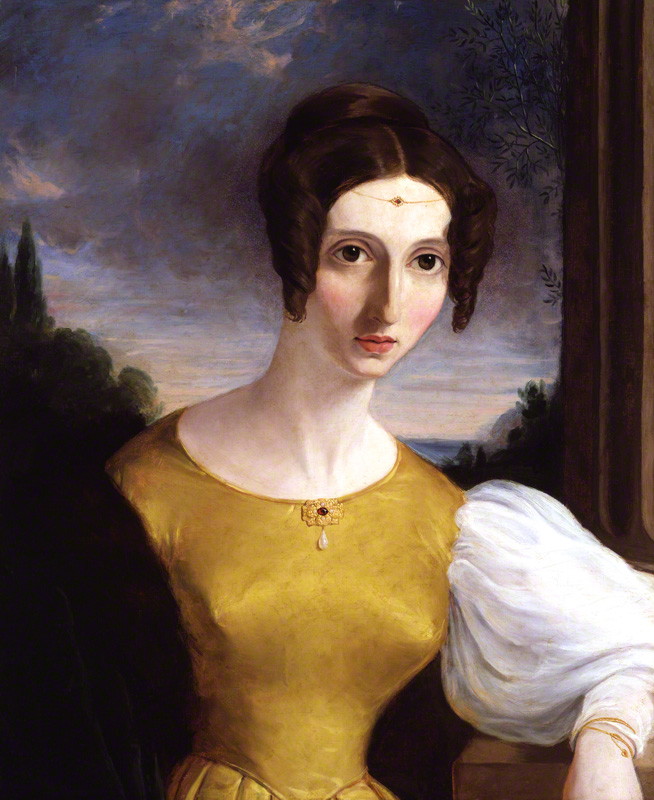
The picture has nothing to do with the story other than it was an ad on the New York Review of Books site where I was reading a review of Hayek on Mill: The Mill-Taylor Friendship and Related Writings (The Collected Works of F. A. Hayek) which has been edited by Sandra Peart and just released. Yet when I looked at the picture, I wasn’t sure that it wasn’t meant to illustrate the story. If Harriet Taylor were alive today, that is what she would be like. Below is what she was really like.

NPG 5489; Harriet Mill by Unknown artist

And while we’re at it:

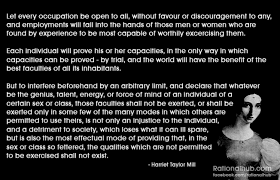
harriet taylor mill on feminism

This is what I think too, and perfectly stated.