People have been dying for a long time for a lot of reasons

The page above is taken from The Perpetual Almanack of Folklore for February 17 which shows, if you can read the print:

During the week which ended on this day in 1719, the following diseases and conditions proved fatal to the inhabitants of London.

Not all of them died, of course, but only some. And none of them died of Covid-19, unless it was Covid-1719. Meanwhile, back in the real world of modern life as we live it today, we have this: The cult of Dan — coming soon to a garbage bag on you.

A person from Melbourne’s CBD wears a garbage bag during their transfer to the Pullman Hotel in Albert Park. Picture: NCA NewsWire / Ian Currie

This is where we have progressed to today. I will end with a quote from John Stuart Mill which seems especially apposite:

“The only freedom which deserves the name is that of pursuing our own good in our own way, so long as we do not attempt to deprive others of theirs, or impede their efforts to obtain it. Each is the proper guardian of [their] own health, whether bodily, or mental or spiritual. Mankind are greater gainers by suffering each other to live as seems good to themselves, than by compelling each to live as seems good to the rest.”

We do not deserve the freedom we have been bequeathed and will soon lose it if we do not mend our ways assuming it has not been lost already.

I hope the death of Rush Limbaugh today is not a metaphor for much else that is going on.

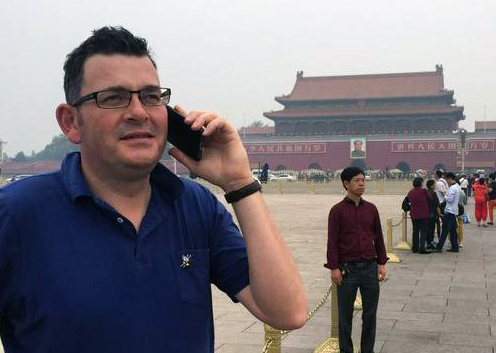
AND NOW TO ADD TO EVERYTHING ELSE THERE IS THIS: From Tony Thomas: Daniel Andrews’ Bad Case of China Envy. Read it through and see if our freedoms are not actually on the line. The accompanying picture really does say something worth thinking about.

“A perspective on the operation of an economy that has unfortunately entirely disappeared”

Here is a very nice review of my Classical Economic Theory and the Modern Economy in The History of Economics Review, written by Nathan Saunders, linked here. I can only say how grateful I am to find a review of the book written in sympathy with its aims and arguments. Here is his opening para:

The aim of Steven Kates’s latest book – Classical Economic Theory and the Modern Economy – is for readers to appreciate John Stuart Mill’s deep and broad understanding of economics along with the whole of the classical school from around the middle of the nineteenth century through to its final and complete disappearance with the publication of The General Theory in 1936. Moreover, Kates argues, it is our loss that we have primarily ignored the timeless principles embedded within classical theory. Presented between the covers are many arguments as to why Mill and his classical contemporaries should be front and centre within the economics discipline to this day. The following are five arguments from his book, presented in no particular order, with which I strongly agree.

He then goes through the five reasons why classical theory should be at the forefront of our understanding of how economies work. Of course the main reason is that modern economic theory, with its Keynesian demand management ethos embedded at every stage in the process, has never been able to provide a solution to a single economic downturn on even a single occasion since The General Theory was published. As discussed in the review:

Kates presents Mill’s fourth proposition on capital: ‘Demand for commodities is not demand for labour’. This proposition has not been refuted by the Keynesian revolution, nor by anyone else for that matter. Kates states: ‘The level of employment was unrelated to the level of aggregate demand … [and Mill] understood the errors embedded in any such attempt’ for policy-makers (221). Mill emphasized the harm embedded in such policies, an understanding that has disappeared, even as an issue to be debated. Mill kept all four of his propositions on capital pragmatic, commonsensical, and timeless. Moreover, Kates defends this momentous fourth proposition not only by drawing upon his knowledge of the history of economic thought, but also through a discussion of the many failed efforts to short-circuit recessions through increases in public spending.

Dead on. Let me recommend the book to you, but also might I suggest that you ask your local library to order a copy both for yourself to read along with others.

BTW the heading is taken from Nathan’s own text.

Rush Limbaugh 1951-2021

From The Indispensable Man – Rush Limbaugh, 1951-2021 which you should read through yourself. I quote this only because of the Australian connection.

Throughout his entire time on air, there were genius GOP consultants who, in reaction to any electoral setbacks, would insist that what the GOP needed to do was come up with a way to ditch Limbaugh. As I said on air many years ago: Really? For almost a third of a century, Rush’s audience was over half the total Republican vote. How many do all you genius “Republican reformers” bring to the table? I’ve recounted previously the first time I was asked to guest-host, back in 2006, when I happened to be down in Australia and the Prime Minister, John Howard, asked me to some or other event a day or two hence. And I politely declined, saying I had to get back to America to host The Rush Limbaugh Show. “I hear that’s a pretty big show,” said the PM.

“Yeah,” I replied. “Twenty-five, thirty million listeners.”

“‘Strewth,” said Mr Howard. “Rush has more listeners than we have Australians.”

Indeed. And all these GOP clever-clogs never explain, once you throw Rush and his millions overboard, what’s going to replace them.

Rush made a difference since he put things into context which is what we bloggers on the right also try to do but without the wit and the range of such a unique genius. Didn’t get to hear him often, but read him always and each day. A great loss.

AND NOW LET ME ADD THIS

Rush Limbaugh Changed America, another article also to be read through. But this really caught my eye:

The mob has grown more powerful, more accepted by elite institutions. I wrote and Rush read:

“To some, the Mob is a symptom of disenfranchisement, urban malaise or institutional hurt feelings. The Mob, after all, only awoke after a questionable police shooting in London. Excuses all, of course. Nothing justifies this behavior in nations built on the rule of law. Excuses are paralyzing those with the responsibility of enforcing the law, both in England and the United States.”

So sad. So true.

We’ve seen it all before, and Rush was reading the full piece, including the conclusion about the stakes:

Sir Winston Churchill understood this. ‘Civilization will not last,’ he said at the University of Bristol in 1938, ‘freedom will not survive, peace will not be kept, unless a very large majority of mankind unite together to defend them and show themselves possessed of a constabulary power before which barbaric and atavistic forces will stand in awe.’

Some of you agree with me that there are no coincidences.  For me, Rush reading the piece about the dangers of mobs burning down civilization, reading it to me while I was driving off to the other side of the world to fight Guam’s racially-discriminatory laws was no coincidence.  If nothing else, it made the 15-hour flight more significant.

Here we are, a decade later, and it has only gotten worse.  The voice that was our daily pilot is gone. Prayers for you, Rush.

It is hard to say exactly what needs to be said day after day in a way that attracts an audience. Indispensable men really are indispensable.

“We know our America First agenda is a winner”

Trump supporters refuse to concede the election loss during a rally near his Mar-a-Lago home in West Palm Beach, Florida. Picture: Getty Images/AFP

First this: Trump RIPS McConnell To Shreds In New Statement, which begins:

The Republican Party can never again be respected or strong with political “leaders” like Sen. Mitch McConnell at its helm. McConnell’s dedication to business as usual, status quo policies, together with his lack of political insight, wisdom, skill, and personality, has rapidly driven him from Majority Leader to Minority Leader, and it will only get worse. The Democrats and Chuck Schumer play McConnell like a fiddle—they’ve never had it so good—and they want to keep it that way! We know our America First agenda is a winner, not McConnell’s Beltway First agenda or Biden’s America Last.

Seems right to me. Compare and contrast these idiocies from Paul Kelly in The Oz: Conservatives must be brave, and deny fealty to Trumpism. First para:

Donald Trump is an enemy of constitutional democracy and a wrecker of political conservatism. Trump is now stamped with a brand that will last forever. His plan to remain a live political force means that conservatives in all countries, not just the US, will be forced into a critical decision. Will they have the courage and wisdom to repudiate Trump and reject his claims to lead conservative politics against the rising tide of progressivism? This question, obviously, is an agonising dilemma for the Republican Party. But it is not unique to the US. Trump’s appeal stretched across borders and impinged on conservative politics worldwide, including Australia.

Progressivism in modern political jargon means the socialism of the far left. Biden and the Democrats are credibly accused of stealing the election and Kelly can still write, “Donald Trump is an enemy of constitutional democracy”. And if you want to read genuinely mind-fogging idiocy, who can beat this?

This argument was best put by former Wall Street Journal editor-in-chief Gerard Baker last month. It’s true that Black Lives Matter engaged in violence, that Democrats promoted the false Russian collusion story, that the anti-Trump camp promotes fake news. But Baker said Trump’s behaviour was “uniquely and unforgivably iniquitous (and) cannot be excused by citing counterparts on the left”.

Precisely.

They never list just what it was that Trump did that was so terrible. If you don’t live in terror of what will come next during the years of Biden-Harris, you have the shallowest political mind imaginable.

Absurd forecasts remain a thing of the present

From the indispensable Donna Laframboise: That Laughably Wrong Climate Prediction is Now 21 Years Old. That should be enough in itself to discredit the entire business, but it’s not. So let me quote from her text:

The entire climate crusade rests on predictions such as these. It is because politicians believe scientists such as Viner that they’re determined to impose a low-emissions regime on the global economy.

That really ought to be the end of it but alas, as we know, none of the morons who continue to fret over global warming can be shamed out of their absolutely insupportable beliefs. They are determined to believe it to the end, partly because without it they would have nothing to believe of substance at all, and partly because it would be too embarrassing to admit how wrong they were. What to do remains a problem without a solution other than to keep making fun of such people as they cause their own cost of living to rise along with the rest of us. Yet I fear the obstinacy will continue until who knows when?

Covid and the political economy of mass hysteria

This is the best single article on the Chinese flu I have seen from anywhere and from anyone, and here it is by Adam Creighton in The Australian: Coronavirus lockdown lunacy is frying our minds. I hope my saying so doesn’t put the moz on him,* but let me take you to the text.

The west, and Australia and New Zealand in particular, are suffering mass psychogenic illness, where only sociology, psychology and the perverse incentives of large welfare states, can explain the ongoing obsession with COVID-19 and our medieval responses to it after almost a year of improved treatments and new information.

Great start, but it gets even better.

For three German and Spanish economists, it’s time to ask this question: have we forgotten the rationality that’s meant to define policymaking in advanced liberal democracies? Their new research paper, COVID-19 and the Political Economy of Mass Hysteria, lays out how our biological tendency to overreact coupled with a social and mass media that profit from panic, plus powerful welfare states, make mass psychosis likely, and hard to reverse.

It does seem that we are locked in with the lockdown mentality and the probability of reversal in the short-term seems very unlikely. We are in the grip of mass lunacy. To continue:

Some seriously weird behaviours have emerged…. Australia and New Zealand have incurred costs equivalent to a world war — and more than any other nation has — fighting a pandemic that has killed not even 1000 people, with a median age in the mid-80s, between them. And this is widely seen as brilliant.

What he means, of course, is that in reality we are collectively speaking utter fools.

Having insisted early last year that lockdowns were necessary to “flatten the curve”, rolling capital city “snap” lockdowns of millions of people have become the norm, at extraordinary economic, psychological and social cost, without a single person in ICU across either country.

Yet the hysteria goes on, and on.

The venerable Economist magazine even wrote last week that 150 million people would die (three times the number killed by the Spanish flu) from COVID-19 without strong government action, a claim breathtaking in its absurdity. Globally, 2.4 million people have died from or with COVID-19, yet every year other communicable diseases kill more. A death is a death, whatever its cause, yet the world is not shut down. It’s time our leaders started pouring cold water over an electorate that’s worked itself into a lather. Our leaders should level with voters that we can’t remain an open liberal society without incurring further deaths and cases from COVID-19. Let vulnerable groups be vaccinated, and let everyone else get on with their life. The three authors, at universities in Spain and Chile, argue that hysteria dissipates more quickly in nations that respect civil liberties, where the minority who wish to behave rationally “can just ignore the collective panic and continue to live their normal lives”, illustrating to the hysterical majority that they too can safely return to normal.

And if you are interested in the paper Adam cites, you can find it here: COVID-19 and the Political Economy of Mass Hysteria. This is the abstract. “Nocebo” means “detrimental effect on health produced by psychological or psychosomatic factors such as negative expectations of treatment or prognosis”.

In this article, we aim to develop a political economy of mass hysteria. Using the background of COVID-19, we study past mass hysteria. Negative information which is spread through mass media repetitively can affect public health negatively in the form of nocebo effects and mass hysteria. We argue that mass and digital media in connection with the state may have had adverse consequences during the COVID-19 crisis. The resulting collective hysteria may have contributed to policy errors by governments not in line with health recommendations. While mass hysteria can occur in societies with a minimal state, we show that there exist certain self-corrective mechanisms and limits to the harm inflicted, such as sacrosanct private property rights. However, mass hysteria can be exacerbated and self-reinforcing when the negative information comes from an authoritative source, when the media are politicized, and social networks make the negative information omnipresent. We conclude that the negative long-term effects of mass hysteria are exacerbated by the size of the state.

There will come a time when our generation will be seen as the biggest bunch of fools in the history of the world, even more inane than the folks who used to burn witches at the stake.

* For our non-Australian readers, “to put the moz on someone” is to jinx them. But here is the origin of which I had no idea. According to Meanings and origins of Australian words and idioms:

moz: put the moz on

To exert a malign influence upon (a person), to jinx. Moz is an abbreviated form of mozzle, which is derived from the Hebrew word mazzal meaning ‘luck’. It probably came into Australian English via German Yiddish speakers. Put the moz on is recorded from the 1920s.

Educating people about the victims of capitalism

This is from Quora: How can I educate people about the millions of victims of capitalism?

Great question, this is easy! [Answered by Paul O’Brien, CEO of MediaTech Ventures found in Austin, Texas.] Here’s his answer.

First.

Explicitly define capitalism:

An economic and political system in which a country’s trade and industry are controlled by private owners for profit, rather than by the state.

Right? We have to be clear about what it is if we’re going to then educate people properly about something.

Second.

List some countries in which the country’s trade and industry are controlled by private owners…

Singapore, Hong Kong, and New Zealand are the closest we can get.

Shoot, this isn’t as easy as I thought.

Okay, back up… according to the The Heritage Foundation, which reports on this stuff, those are the only 3 countries in which trade and industry are almost entirely controlled by private owners.

From there, the ranking of that control drops quite a bit, with Australia, Switzerland, and Ireland next. Then it slides pretty rapidly from there.

The United States, troublingly argued by many to have these capitalists and respective victims, is actually way down the list at about 17. And when I think about it, I can’t think any example of anything in the United States that is controlled by private owners – the government is involved in every aspect of business and trade.

Still, let’s roll with what we’ve found so far; we can only educate given the facts, right?

So, 3 countries to which to refer.

Third.

Explain what each of these countries and their capitalists do, that’s terrible.

1. Singapore. Singapore has been ranked as the top city in Asia in terms of quality of living according to global human resource consultancy, Mercer. Singapore is also regarded as the ‘Happiest country in South-east Asia’ according to the 2018 World Happiness Report .

[crepe]… this isn’t starting out so well is it?

Its sustained extraordinary performance has resulted in one of the world’s highest per capita incomes and solid rates of GDP growth.

Singapore is one of the world’s most prosperous nations, with a business-friendly regulatory environment and a very low unemployment rate.

okay okay… okay. Let’s move on.

2. Hong Kong. Hong Kong is a world financial center with low taxation rates and free trade. The city is connected by a well-developed but cheap public transportation system and offers extensive international travel connections for its large expat community. Adding its ease of doing business, the free public wifi, high safety rating.

[frack]…

The ongoing political and social turmoil has begun to erode its reputation as one of the best locations from which to do business, dampening investment inflows.

A ha! SEE!!!!! Atrocities.

no, no… wait a second… that’s because of the incoming government and the transfer of power of Hong Kong to China.

Okay, moving on…

3. New Zealand. Alright, we have to have something here! New Zealand… right? Come on. That country where Lord of the Rings was filmed. Seriously, where did they get all those Orc extras if not for it being a terrible place to live. Let’s take a look…

New Zealand ranks above the average in health status, income and wealth, environmental quality, personal security, civic engagement, housing, subjective well-being, education and skills, jobs and earnings, and social connections but below average in work-life balance.

seriously?!?! you gotta be kidding me…

Let’s move on to the forth step and really get this message across

Fourth.

Go to the other extremes and give the counter point. In order to effectively educate, we:

  1. define and explain
  2. Give valid examples
  3. Give counter examples

So, counter examples.

Bottom on the list of economic freedom where private owners retain the liberty to control what they do and decide how it works… That is, the places LEAST capitalist:

North Korea, Venezuela, and Cuba.

*sigh*

Okay okay, let’s give it the benefit of the doubt and work further up the list, increasingly toward countries with more private ownership and control of trade and industry…

Eritrea, Republic of Congo (isn’t that where they recently wrapped up a civil war?), Bolivia, Zimbabwe, Sudan (wait, as in the Darfur genocide?!), Sierra Leone, Liberia, Iran…

screw it, I give up.

Fifth.

You make your point in summation.

And it seems that what we’ve learned is that the victims of capitalism are the people who have lost capitalism to increasing governance, regulation, and control.

How can I educate people about the millions of victims of capitalism?

I’d proceed by educating thusly..

Throughout the world, hundreds of millions of people lack private ownership and control. As a result, capitalism is the victim and people caught living in countries where capitalism has been taken from them, live in poverty, war, in horrific health conditions, and without civil liberties and human rights.

You can aid people. You can make a difference.

We see through countries such as Hong Kong, that the sacrifice of private ownership, the loss of capitalism, leads millions to protest, often violently; fearful of falling under the same governance and economic circumstances of a place like China.

Countries such as Singapore, New Zealand, Ireland, and Australia, Switzerland to the surprise of many perhaps, are the counties we might admire, are they not? Countries with few, if any, victims; where people are healthy, thriving, and prosperous.

What’s the difference? These are countries in which government and public ownership and control of people is severely restricted. Private ownership of trade and industry is near paramount, and capitalism is protected.

Fight back the loss of human rights and fight for private ownership. Start saving millions who are suffering from capitalism being lost to them.

Genesis, a poem by David Solway


The Sun, Edvard Munch, 1909  

Genesis

                 I strongly believe in the existence of God, based on intuition, observations, logic, and also scientific knowledge.
                           —Charles Townes, inventor of the laser

The earth was without form, and void
and darkness was on the face of the deep.
And the Spirit of God hovered over the face of Nothing.
Then God said:
Let there be a zero-point field;
and there was a zero-point field.
And God saw the zero-point field,
that it was good.
And God said:
Let there be a quantum vacuum.
Let it fluctuate in ceaseless waves
in a rippling sea of quantum radiation.
And it was so.
Then God said:
Let matter be sustained
by the underlying sea of quantum radiation
for it is a force that opposes acceleration
and gives a body to things.
Let stochastic electrodynamics be the order of the day.
Let there be inertia.
Let matter be solid.
And it was so.
Thus God created an electromagnetic spectrum
and called it light
which was not the light of the sun, moon and stars
but the light of Creation.
And indeed it was very good. 

From The New English Review. Should also mention:

David Solway’s latest book is Notes from a Derelict Culture, Black House Publishing, 2019, London. A CD of his original songs, Partial to Cain, appeared in 2019.