So are they all, all honourable men

The question is whether Donald Trump is ahead beyond the possibility of fraud. As I noted at the start of the day, and have discussed for a long time, the election will come down to whether the President can win on the day beyond the reach of the ability for the Democrats to cheat their way to victory. If you watched the day’s play, then you will know that Joe Biden spoke at around half past midnight his time and the President did not respond until after 2:00 am in the morning. And the conversation that must then have gone was that the Republican high command told the President the he must follow along the lines laid out by Joe Biden, that the Republicans must show that we trust the system since the Democrats are all honourable men. To which the President said:

For Biden is an honourable man; So are they all, all honourable men.

And then came out and said to the rest of us what he no doubt personally believes, that the Democrats are trying to win the election based on fraud and deceit and that he does not trust them a single inch.

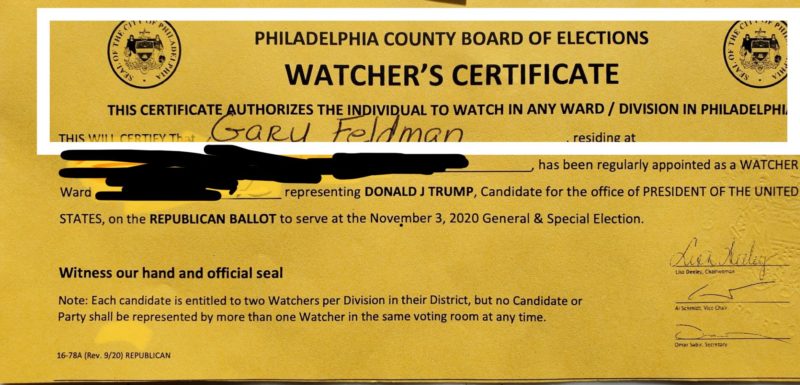
The video above was from just this morning and it relates to the crucial state of Pennsylvania. And maybe they really are honourable men. But for various reasons that have developed over the past four years the President does not believe they are and thinks that the Dems, if given a chance, will cheat their way to the presidency.

AND LET ME ADD THIS FROM INSTAPUNDIT:

OKAY, I’M SICK AND TIRED OF THIS AND I WANT TO CALL IT OUT RIGHT NOW: I don’t want to hear a word about Trump’s tone. I don’t want to hear a word about how he crossed a line. I DON’T WANT TO HEAR A WORD. Listen to me: On one side we have the left, who is running a barely alive candidate, and a woman with all the appeal of week-old fish and no accomplishments she can point to. Add to this they almost didn’t run a campaign, AND went to the point of not having offices in most cities. For months now, I’ve been looking at this and going “They have a coup planned. The fix is in.” And everyone told me oh, no, I was seeing things. Tonight we watched states called for Biden before votes were counted, while states that Trump has a solid lead in, stop counting. And if you need help seeing what’s before your eyes, the left has for weeks now claimed Trump was going to attempt a coup. How many years have you known they accuse you of what they’re doing? What are you? Stupid? Look, they are tainted by the previous failed coups, tainted by (most if not all of them) accepting money from Xi, and FYI China ALWAYS arranges for extra compromise for security, honeypots being their favorite, tainted even by association with Epstein. A second Trump term means a good chance that they go down hard and don’t get up again. ALL OF THEM from the left politicians to the so called “tech lords” are fighting for their lives. They’re cornered rats. There’s nothing they won’t do. And all we have against them is Trump. Stop calling Trump names. Put on your big boy or girl pants. They’re fighting for their lives. And we are too. Because — look at Venezuela — socialism kills.

A review of Alan Cromer’s Uncommon Sense: The Heretical Nature of Science

Most people believe that science arose as a natural end-product of our innate intelligence and curiosity, as an inevitable stage in human intellectual development. But physicist and educator Alan Cromer disputes this belief.

Cromer argues that science is not the natural unfolding of human potential, but the invention of a particular culture, Greece, in a particular historical period. Indeed, far from being natural, scientific thinking goes so far against the grain of conventional human thought that if it hadn’t been discovered in Greece, it might not have been discovered at all.


In Uncommon Sense, Alan Cromer develops the argument that science represents a radically new and different way of thinking. Using Piaget’s stages of intellectual development, he shows that conventional thinking remains mired in subjective, “egocentric” ways of looking at the world–most people even today still believe in astrology, ESP, UFOs, ghosts and other paranormal phenomena–a mode of thought that science has outgrown.

He provides a fascinating explanation of why science began in Greece, contrasting the Greek practice of debate to the Judaic reliance on prophets for acquiring knowledge. Other factors, such as a maritime economy and wandering scholars (both of which prevented parochialism) and an essentially literary religion not dominated by priests, also promoted in Greece an objective, analytical way of thinking not found elsewhere in the ancient world. He examines India and China and explains why science could not develop in either country.

In China, for instance, astronomy served only the state, and the private study of astronomy was forbidden. Cromer also provides a perceptive account of science in Renaissance Europe and of figures such as Copernicus, Galileo, and Newton. Along the way, Cromer touches on many intriguing topics, arguing, for instance, that much of science is essential complete; there are no new elements yet to be discovered. He debunks the vaunted SETI (Search for Extraterrestrial Intelligence) project, which costs taxpayers millions each year, showing that physical limits–such as the melting point of metal–put an absolute limit on the speed of space travel, making trips to even the nearest star all but impossible.

Finally, Cromer discusses the deplorable state of science education in America and suggests several provocative innovations to improve high school education, including a radical proposal to give all students an intensive eighth and ninth year program, eliminating the last two years of high school.


Uncommon Sense is an illuminating look at science, filled with provocative observations. Whether challenging Thomas Kuhn’s theory of scientific revolutions, or extolling the virtues of Euclid’s Elements, Alan Cromer is always insightful, outspoken, and refreshingly original.

Anyone who supports a public works program because it will create jobs knows nothing about how an economy works

There is this grand distinction between an individual borrower and a borrowing government, that, in general, the former borrows capital for the purpose of beneficial employment, the latter for the purpose of barren consumption and expenditure.— J. B. Say

If there is anything that exposes both economists and politicians as economic frauds it is where they argue that public sector spending creates jobs. This is the great Keynesian lie. Job creation programs have never on any occasion created an increase in jobs, not once, not ever. Anyone who thinks otherwise is as wrong as it is possible to be about how an economy works.

Keeping this in mind will prevent you from falling into the Keynesian trap which has infused the whole of mainstream economics. Keep an ear open for carriers of this disease since it is everywhere and on all sides of politics. No one any longer knows any better. Let me go through two recent publications, one a book I wrote, and the other an article by Per Bylund at the Mises Institute. First my own which is mostly, but not entirely a reprint of the first third of the book’s opening chapter. The book is Classical Economic Theory and the Modern Economy and the article at Quadrant is titled, What Classical Economists Knew that Modern Economists Do Not. The book is about a lot more than just what’s wrong with modern macro, but that is a substantial part of it.

The article at Quadrant is taken from the opening chapter of the book where I try to explain why anyone should pay attention to what I have written since it really is odd to be arguing that the whole of economic theory is utterly wrong, but that is what I have done. I describe how I came upon John Stuart Mill and the economics the mid-nineteenth century England, how I discovered “Say’s Lw”for myself, how because of the work I was doing at the time how I had instantly understood the point Mill and his contemporaries had been making, and how thereafter, in every test of the classics versus the moderns, that classical economics would unfailing forecast what would happen.

Why anyone should believe that public spending at the direction of political leaders will automatically create value and growth is one of those things that has entered into how economics is taught. The more you think about it, the more incredible the idea ought to be, but onwards it goes. Here again, as inane as Keynesian theory is, the science has long been settled. I only recommend the article and the book if you would like to see the antidote to the economics version of global warming. Keynesian theory is a scam and a hoax, but trillions of dollars are made through the application of Keynesian policies because everyone believes it. If you read what I wrote, you will merely have the satisfaction of understanding how you are being defrauded by governments. Nothing can ever be done about, I suspect, but you will at least understand what is going on.

Per Bylund’s article at Mises is titled, More Spending Does Not Drive More Employment which is more direct but reaches the same conclusion. Here is what he is denying:

It is almost universally asserted today that consumer spending drives employment. This thesis gives support to the general Keynesian idea that government should “stimulate” the economy when it is suffering from a recession, whether it is through fiscal or monetary policy.

At the core, the idea is that if spending on goods and services goes up, then more people are needed in their production. And, as a consequence, more people are able to get jobs, earn a wage, and thus buy goods and services. In other words, it doesn’t matter if government wastefully increases spending — even if it is borrowed money — because the economic wheels start turning and as growth picks up we’ll be able to deal with debt, deficits, and so on.

He absolutely gets the point. Read his entire article. Again, the value is merely to understand the world in which you live. Nothing can be done, but there is some satisfaction in understanding what is being done. Not necessarily a lot of satisfaction, but at least some.

What the American election is about

The election, in spite of the media, the Russian collusion story, the Mueller investigation, the impeachment at the start of the year, the criminal conspiracy by the upper levels of American security agencies would not even be close were it not the the Chinese flu. Covid was the issue that made the Democrats competitive. I do not say it was invented by the Democrats or the Chinese, but once it arose, everything else went into deep background and the issue became Donald Trump’s handling of the virus. I am not sure Biden has made any other major claims than that he will fix the problem and bring Covid to an end. And while from the start, I have thought of Trump as recognising that the entire enterprise was designed to take him down, he has played the pandemic with a straight bat. He has done everything he can to protect the community from the spread of the virus, has made massive efforts to create medical resources to protect those who become ill, and has done everything possible to develop vaccines to bring the pandemic to an end.

The Democrats have, of course, done all they can to place the blame on his head which has gone some way towards sliding voter sentiment in Biden’s direction but not all the way. Trump has done everything possible, including catching the disease and then recovering from it, to demonstrate his bona fides in regard to the pandemic. But he has also made it always his aim to open the economy as quickly as possible. No one could have done more to limit the harm Covid has caused, but he has also done as much as possible to open the economy as quickly as possible. Republican and Democrat states have taken different directions, with Florida an example of the Republican approach with New York being the Democrat example. Voter attitudes will be the difference on the day.

But there are other issues. Why should one vote for Joe? Few seem to think policy detail matters since they are hardly discussed. So far as policy goes, it’s perfectly clear that the Dems take the following positions:

  • all in for the green new deal;
  • favour “free” healthcare;
  • extensive and expanding welfare payments;
  • promise unlimited rights to abortion right through to the ninth (tenth) month;
  • open borders;
  • ending America’s European cultural and political tradition;
  • identity politics;
  • the confiscation of guns;
  • expanding the role of the Supreme Court to enact outcomes that are too difficult to legislate, and
  • favour socialism as an economic ideal.

But other than in narrow and infrequent moments of clarity, none of this is ever said just like that because it would kill off votes, since to be for any one or two of these will alert people who are against any of the others. And vice versa from the Republican side. In contrast, the Republicans, and Donald Trump in particular, are in favour of:

  • a comprehensive public health care system in which costs nevertheless constrain access (as it must always do but which is kept as a secret);
  • maintaining carbon-based fuels at the core of the supply of energy;
  • legislated rights to abortion with the limitations specified;
  • limits to welfare, with an emphasis on earning one’s own way in the world;
  • climate change scepticism but while fully in favour genuine conservation (we are conservatives);
  • border protection;
  • Western civic tradition as our guide to political legitimacy;
  • a defence of Israel and Taiwan, plus a few others (which includes Australia);
  • the first amendment right to free speech and freedom of religion;
  • individual rights outweigh group rights;
  • the second amendment right to bear arms;
  • limiting the Supreme Court to nine justices as at present; and
  • capitalism and the free market as the core of the economic system.

About Covid, the fears of many will affect many will vote irrespective of their views on the other issues. There is also Donald Trump’s personality, which affect large number of voters, particularly women I imagine, since he pushes hard to get things done, and is not the sweet kindly type many look for such as in Barack Obama who is more genteel even if he is a clown. The Trump personality will also matter.

I’m a policy type myself, and after years at the Chamber of Commerce, quite understand the kind of personality required to get things done. We shall find out tomorrow what actually does matter.

As for the vote itself, the colossal amount of cheating from the left will make a difference. How much it will matter, we shall soon see.

Here’s the shorter version from Instapundit:

I REALLY, REALLY, REALLY WANT TO BELIEVE THINGS LIKE THIS. BUT REMEMBER THE VOTER FRAUD IS GOING TO BE MASSIVE, PLUS HALF THE NATION IS CONVINCED THAT WINNIE THE FLU WILL KILL THEM AND THAT SOMEHOW TRUMP SHOULD HAVE BEEN ABLE TO STOP IT:  The Trafalgar Group MIGHT be undercounting Trump support.

Friends don’t let friends bring communism on the nation. Particularly not on some paltry excuse like “but Trump is rude.” Trust me on this, when you have to decide between lighting the candle or eating it you’ll be fairly rude, too.

The central question asked about Covid: am I dead?

Watching the economy over the years, the only crisis is the period in which the unemployment rate increases. During the say six months when the rate rises from 5% to 9%, there really is major concern everywhere. Then the rate plateaus and everyone relaxes, or at least among those who still have jobs which is the vast majority.

Same about Covid. The “I stand for Dan” types ask only one question, am I still alive? Following that, there is the ancillary question: is the government doing everything it can to protect me? Hardly anyone asks when will business open or when will the lockdown end? And if there is no vaccine till the end of 2021, they will patiently wait till then. And so will the rest of us, whether patiently or not.