Just out for a drive…
Reply

Or something ….
TO CONTINUE: I can see it. I’m sorry if it doesn’t come up on some screens. I wasn’t suggesting we should all learn to code.
The heading is “World Wide Coal Plants”.
The next seven lines mention how many coal-powered plants there are in different countries and how many they intend to build. The second last states, “China has 2363 plants building 1171 more – total 3534”.
The final line of the chart says, “Australia is planning to shut down its remaining 6 plants in order to SAVE the World”.
Perhaps I should have said “We are oh so self-sacrificing” rather than virtuous, or something.
The most important element in understanding how an economy works is to begin from its resource base, its existing infrastructure, its labour force and its entrepreneurs. Then mix in the laws and regulations, along with the personal beliefs of the population about the market economy. If you get just the right combination of all of that, you will get rising prosperity.
Also needed is a system of credit creation and a mechanism for supplying a medium of exchange, but that comes last of all. You have to get the real side of the economy in place and they you can worry about ensuring that the supply of money grows more or less in sync with the number of transactions taking place.
So into this comes Modern Monetary Theory, the realm of cranks of such a spectacular level of ignorance that it is quite astonishing to see these people in action. Warren Buffett Hates It. AOC Is for It. A Beginner’s Guide to Modern Monetary Theory.
This state of confusion isn’t good because Modern Monetary Theory, once confined to blogs and a handful of colleges including the University of Missouri at Kansas City, suddenly matters. In the U.S., the left wing of the Democratic Party is citing MMT to make the case for massive federal government spending on a Green New Deal to wean the U.S. off fossil fuels and fund Medicare for All. It’s virtually certain that MMT will be dragged into the debates of the 2020 presidential race. So the time is right for a semi-deep dive into Modern Monetary Theory—what it is, where it comes from, its pros and its cons.
Are we immune from all this? You better hope so. From the AFR today: Bernie Sanders’ senior adviser has a message for Morrison.
The 2020 US presidential candidate Bernie Sanders’ senior economic adviser, Stephanie Kelton, is urging the Morrison government to ditch its surplus, spend money on climate change and prepare for central bank obsolescence.
Touring Australia as the University of Adelaide’s Geoff Harcourt Visiting Professor, Professor Kelton told The Australian Financial Review people had become less concerned about deficits and that the government should rev up spending through the use of the controversial Modern Monetary Theory.
Bernie Sanders’ economic adviser Stephanie Kelton says the Morrison government should ditch its surplus and spend money on climate change. Bloomberg
“The number that gets churned out of the budget at the end of the fiscal year, is essentially, unimportant,” Professor Kelton said, “Every deficit is good for someone.”
“There’s untapped potential in the Australian economy in the form of idle capacity, especially labour, that the government can afford to run its fiscal policy more ambitiously to make more judicious use of the available resources.
“I would argue that there’s clear evidence that you’re not doing that here in Australia.”
MMT really stands for Magic Pudding Monetary Theory. They are just thieves who will rob you by inflating faster than the rest of us can keep up with their spending. And because they are the government, they will get to spend it first.
My thanks to Spartacus for forwarding these articles.
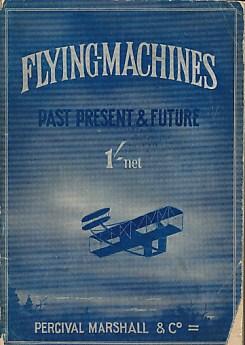
I have just picked up a second-hand copy of a third edition of Percival Marshall’s Flying-Machines – Past, Present & Future, as pictured above. Near as I can tell it was published around 1909-1910 and found it utterly fascinating, since every book is written in the present and tells us quite a bit about the time when it was just a newly published text and hardly anything else. What intrigued me most of all was the emphasis given to conjectures about the future. Here are the last three lines of the book:
The experience of the present development of the art of flying, and opinions expressed by aviators, seem to predict that aerial navigation will be the safest of all forms of mechanical transit. Many flights have been made after sunset, practically in the dark. Mr Cody has flown in moonlight, showing that flying machines can be used at night.
In 1909 even flying at night was only a conjecture, a possibility, an aspiration. The author was confident but could hardly be certain. It seems now, just as it was then, that as we try to look ahead, we cannot actually see very far at all. All one can say with certainty is that the future will be nothing like we can imagine it today.
This is from 2015: Obama Strikes a Deal–With Qassem Suleimani. It’s by Lee Smith from the Hudson Institute.
According to the terms of the Iran deal announced in Vienna on Tuesday, U.N. Security Council sanctions regarding nuclear-related issues will be lifted on a number of entities and individuals—from Iranian banks to Lebanese assassins, like Anis Nacacche. The name that most sticks out is IRGC-Quds Force commander Qassem Suleimani. Administration officials counsel calm, and explain that Suleimani is still on the U.S. terror list and will remain on the terror list. But that’s irrelevant. The reality is that Suleimani is the key to the Joint Comprehensive Plan of Action.
It is all incredible, but this is extraordinary.
Obama likes Suleimani, and admires his work. As the president reportedly told a group of Arab officials in May, the Arabs “need to learn from Iran’s example.”
In fact, they need to take a page out of the playbook of the Qods Force — by which [Obama] meant developing their own local proxies capable of going toe-to-toe with Iran’s agents and defeating them. The president seemed to marvel at the fact that from Hezbollah to the Houthis to the Iraqi militias, Iran has such a deep bench of effective proxies willing to advance its interests. Where, he asked, are their equivalent on the Sunni side? Why, he wanted to know in particular, have the Saudis and their partners not been able to cultivate enough Yemenis to carry the burden of the fight against the Houthis? The Arabs, Obama suggested, badly need to develop a toolbox that goes beyond the brute force of direct intervention. Instead, they need to, be subtler, sneakier, more effective — well, just more like Iran.
Is it stupidity, incompetence or duplicity? Who can tell, but we should be very grateful it is gone for now. With foreign policy such a low-grade issue to at least half the American population, you never know who they will elect for president next. In the meantime, we have to hope they keep the one they now have for the next four years.
But where you will never unravel any of these questions is by reading the daily papers or watching the ABC. This is from the Australian Financial Review today, with this the heading in the paper, but not online: Trump scraps Obama legacy. This is the sub-head in the paper, but again, not the one used online.
“In confronting Iran, the president, driven by a desire to trash his predecessor’s foreign policy record, is determined to prove himself a superior commander-in-chief.”
And in the very middle of the page, the inset quote reads:
“I don’t think it’s too much of a stretch to say the root of much of this is Obama envy.”
It would be nice if these people would stick to foreign policy and lay off the pop-psychology. For what it’s worth, in my view Obama was the worst president in American history, both for domestic and foreign policy. Anyone who cannot at least understand why someone might come to this conclusion should be prevented from commenting on current events.
Here’s the whole thing.
https://twitter.com/AlinejadMasih/status/1150105699097161728
Positively incredible. Only “progressives” could believe in the certainty of progress. And of course, for some what exists in 2020 is an improvement on the past. You never know your own future in how the world is built. There are many worse fates than having Donald Trump as president. Many!
And let me draw your attention to a quite good article in The Oz today: Soleimani: For once the virtuous have not been meek. This is how it ends:
For the long term, the challenge for Western governments is how we defend our foreign and domestic interests from these growing networks of state and non-state terrorists. A silent risk is the growing number of people in the West who admire the likes of Soleimani.
As the British geopolitical theorist Halford Mackinder stated: “Democracy refuses to think strategically unless and until compelled to do so for purposes of defence.”
Today that is too slow. We need to wake up to the game being played against our system.
Not just by Iran but Russia and China.
Not to mention all of the “progressives” in our midst.
I am very grateful for the comments on my previous post, ‘Classical Economic Theory and the Modern Economy’ cover text comments, thoughts and suggestions sought with special thanks to Gerry on how to begin the text, which was also the point raised by Tim Neilson. However this is the length they are looking for. This is now my second draft.
‘Classical Economic Theory and the Modern Economy’
If you are interested in how economic theory became the wasteland it has become, this is the book you must read.
It starts with two premises: First, that economic theory reached its deepest level of understanding in the writings of John Stuart Mill and the classical economists of his time, and then, secondly, the author of this book has understood Mill and has accurately explained what the classical school of the late nineteenth century wrote. From these premises, this then follows.
To have any hope of understanding how an economy works, and how modern economic theory became the dead end it has become, this is where you must begin.
The classical economists, and John Stuart Mill in particular, lived through the Industrial Revolution, saw its astonishing economic transformation before their eyes, and explained, so others could understand for themselves, how their prosperity had been created through the emergence of the market economy.
Classical economics was entirely a supply-side theory.
Mill, the greatest utilitarian philosopher of his age, refused to use utility as anything other than a minor element in his theory of value. Mill explicitly and emphatically denied any role for aggregate demand in the creation of employment. In reaching these conclusions, there was no disagreement among the entire mainstream economics community of his time.
First through the Marginal Revolution of the 1870s, and then through the Keynesian Revolution of the 1930s, the entire edifice of classical theory has been obliterated and made virtually incomprehensible to anyone educated in modern economics. From a classical perspective, modern theory is Mercantilist trash.
This book explains why that is and how to understand the classics as they were meant to be understood.
From the comments, I can see that this business about utility among the classical economists is extraordinarily difficult to accept. Of course no one will produce anything that they do not believe they can sell, and no one will buy things that do not satisfy some need or desire.
Perhaps this will provide a clearer understanding which is taken from the text of the book. The heading in bold is my assertion, the quote that follows is by D.P. O’Brien from his 1975 Classical Economics Revisited which was such a tour de force that a second expanded edition was published thirty years later, in 2005. He says throughout his book many of the things I say myself, with only this difference, if it is a difference, that I believe the classics were right about what they wrote where he is only reporting.
The Classical Theory of Value was Not Based on Utility Although Mill was Himself a Utilitarian
“Mill advances a ‘cost of production’ theory of value…. He was not a subjective value theorist…. He treated utility as merely a condition of value.” (p.96)
Both Marginal Utility and Aggregate Demand are demand-side theories that completely divorce an economist from thinking in relation to supply. There is much more to it, but there are no easy points to score against Mill over his cost of production approach to value. He has 17 elements in his overview of the theory of value with this the second:
II. The temporary or Market Value of a thing, depends on the demand and supply; rising as the demand rises, and falling as the supply rises. The demand, however, varies with the value, being generally greater when the thing is cheap than when it is dear; and the value always adjusts itself in such a manner, that the demand is equal to the supply.
This is pretty well all that is taught about supply and demand today and I doubt most economists know much more than that, although we now have diagrams and pages of terminology to explain it all (e.g. “price elasticity of demand” or the distinction between “demand” and “quantity demanded”).
Mill’s first proposition, by the way, is that value is entirely a relative concept. The classics were not trying to explain just the temporary price of the moment, but how the relative price structure across an economy is determined. That is a much much more difficult question and I doubt most economists today have much of a handle on it assuming it is even brought to their attention. It is also a much more important issue than mere price determination of a single product in isolation from the rest of the economy.
For those interested in a classical approach to economic theory, there is the third edition of my Free Market Economics. I think of it as Mill’s Principles for the twenty-first century. It is, unfortunately, absolutely unique.
As it happens, we went to see the film just last night: ‘Parasite’ Named Best Picture by the National Society of Film Critics. First let me say it was the most watchable film I have seen in a long time. Then let me say it was the most morally incoherent film I have seen in a long time. I will add no spoilers. Will only say it’s worth your time. It was as watchable as the new Starwars is dull beyond imagination. Modern PC has not caught up with Korea while Starwars was so Hollywood that almost from the first second I could tell where the film would end, as it did. You most definitely cannot say that about Parasite. There is even talk that it might win Best Picture at the Academy Awards so others seem to see its moral centre, but that’s Hollywood for you. You’ll have to see the film to know what I mean.
And if you’ve seen Parasite, please include nothing that gives away the story in the comments.
 Law of Markets