The alt-lite v the alt-right explained

The alt-lite v the alt-right explained
I was willing to give Trump the benefit of the doubt over what he was up to in Syria, but if he actually intends to put America on a path to war over the use of chemical weapons in Syria then he had better go to Congress before he takes another step. I thought I would check with The Diplomad to see what he thought and this is what he wrote last Friday in a post titled On Syria: The Morning After.
Now to some basics. I have written before wondering why it is that death by gas strikes us as more horrific than, say, death by napalm or by a .223 round. As I noted in the just linked piece which I wrote almost four years ago,
Despite the temptation, the US did not use gas against well-entrenched Japanese troops in the Pacific, even when gas likely could have saved many American lives. FDR did not want to be known as the President who used gas–he, of course, was developing an atomic bomb . . .
We wouldn’t use gas against Japan but used two atomic bombs to destroy Hiroshima and Nagasaki, not to mention burning nearly all of their other cities to the ground, and flushing their troops out of caves with flame throwers–all justifiable, by the way.
Would we have bombed Assad, if he had merely used conventional explosives delivered by either artillery or aircraft to kill 80 civilians? Are those killed by gas more dead than those killed by explosives? Last July, vacationers in the beautiful French city of Nice were attacked by a jumped up jihadi driving a large truck; he killed over 80 persons. I saw no visible French retaliation against the Muslim world or truck makers.
OK, I don’t want to push this too far, but let me just conclude with a question: Is Assad, despicable as he is, and his alleged use of gas a threat to the United States? We, as noted above, will all have to decide, I guess.
Theresa May has also waded in since she has similar concerns: Split opens between Washington and London over Syria after Theresa May refused to back new strikes on Assad.
Donald Trump’s National Security Adviser HR McMaster and his ambassador to the UN Nikki Haley have both warned the US is “prepared to do more” to enforce an international red line on chemical weapons.
But Downing Street refused to back President Trump’s tough stand when repeatedly pressed today.
The Prime Minister’s official spokesman would only say the question was “hypothetical”, adding: “Our focus is on building international support for a political solution to end the conflict and bring lasting peace and stability to Syria”.
No10 also said Theresa May has no plans to go back to the House of Commons to ask for approval for the UK to stand alongside the US and join future strikes on Assad.
A vote by MPs in December 2015 only authorises the RAF to join attacks on ISIS in Syria.
That is a war aim I understand. What is possibly the most ridiculous part of what is happening is that these actions, which are in themselves senseless and without strategic purpose, are popular in the United States and have Democrat support.
UPDATE: In light of all of this, it is very pleasing to find the American Secretary of State reiterating the same points made by Theresa May, and found in a longer and astonishing discussion of what is going on in an article at The Conservative Treehouse on Recording of Secretary Kerry Admitting President Obama Armed Extremists in Syria – And Now Secretary Tillerson and President Trump are Dealing With Consequences…... This is a direct quote from Tillerson.
So it’s to defeat ISIS; it’s to begin to stabilize areas of Syria, stabilize areas in the south of Syria, stabilize areas around Raqqa through ceasefire agreements between the Syrian regime forces and opposition forces. Stabilize those areas; begin to restore some normalcy to them. Restore them to local governance — and there are local leaders who are ready to return, some who have left as refugees — they’re ready to return to govern these areas.
Use local forces that will be part of the liberation effort to develop the local security forces — law enforcement, police force. And then use other forces to create outer perimeters of security so that areas like Raqqa, areas in the south can begin to provide a secure environment so refugees can begin to go home and begin the rebuilding process.
In the midst of that, through the Geneva Process, we will start a political process to resolve Syria’s future in terms of its governance structure, and that ultimately, in our view, will lead to a resolution of Bashar al-Assad’s departure.
How bad Obama has been for the West and our survival will never be fully known but the bits are coming out and Trump may yet make the needed difference.
An interesting and very timely article on Rules of Warfare in Pre-Modern Societies. In the wake of Trump’s attack on the Syrians over their use of poison gas, with all the risks involved, apparently has ancient roots and is founded on keeping even the mayhem of war within bounds. From the article:
How have rules of war been maintained throughout history without a central enforcing agency? This question is fundamental to the understanding of the nation-state in IR theory, and is also an astonishing example of spontaneous order in an anarchic and chaotic scenario.
The quandary exists because even the laudable negative rights of life, liberty, and property ownership, as Eric Mack discusses in his essay on Just War Theory, require a positive enforcement by others. Similarly, “rules of war” – such as refraining from attacking non-regulars, not attacking neutral parties, abiding by the terms of treaties, treating prisoners of war with respect, etc. – are, theoretically, difficult to establish and dependent on positive enforcement. This is because if Party A respects these rules, they provide a perverse incentive to Party B to take advantage of Party A’s restraint, and if doing so gives Party B the upper hand, they can enjoy the benefits of betraying the rules of war with impunity. This is a classic Prisoner’s Dilemma, and if it generalized across many nations, the theory of rational choice would lead us to expect a coordination problem, in which those using the strategy of Party B would dominate the Party A’s.
Seems, however, not. If these things interest you, and I cannot see why they wouldn’t, you should go to the link.
First the fast
And then the reality
The words in the heading are Ross Cameron’s from yesterday’s Outsiders and let me say the same for myself, I stand with Mark Latham and I want him back. Sky News has to understand that they are responsible for what is wonton destruction of possibly the best political satire and commentary we have seen in years. The management team at Sky are to Outsiders what Yoko Ono was to the Beatles. Ross and Rowan dean were excellent but Mark makes it even better. If you are interested in listening to the audio that trapped Mark Latham, you can find it here at Andrew Bolt.
We were also reminded how the ranks of the non-left are continuously being depleted with the loss of Bill Leak, who was represented by his son; with the absence of Ayaan Hirsi Ali, whose visit to Australia has had to be postponed; and by the disappearance of Mark Latham himself. I am hardly alone in wanting him back.
Let me begin where I last ended:
Just exactly what are America’s war aims in Syria? And how will I be able to tell when those war aims have been achieved? Here the issue is stated in the way I think of it and the kind of questions that need to be answered before sending the military into conflict:
The outstanding politico-military lesson is an old one: that one clarify one’s aim before one embarks upon a military operation; ruthlessly and objectively dissect and analyse where it will lead, what is to be gained from it, and what one will be faced with when it is over.
So the conclusions I have come to reading the comments to the previous post, which I found very helpful, and from others are these.
1) The missiles had virtually nothing to do with the use of poison gas on civilians. Useful as a focus and explanation, but not in any way the actual reason.
2) The actions have almost nothing to do with Syria itself. The Syrian conflict remains as it was. ISIS is getting pounded and will eventually be ground into dust. That’s what the Russians are doing and will continue to do. What happens to Assad is of no real concern to anyone.
3) The actual point was the restoration of American red lines as something others should start paying attention to. There are other issues everywhere, with North Korea, Iran and the South China Sea high on the list. When the United States now says they have a view on something, others are going to start paying attention. Obama has gone and a the defence of Western values is now back on the agenda.
4) Beyond the actual conflict, this is a statement in defence of Western values and our way of life. Trump is not just focusing on military matters and international conflicts but our freedoms and its political system. He is saying don’t mess with us, and dare I say it, because with all our flaws, we have the only way of life that can allow different peoples from different cultures with different backgrounds to live together in peace. But first you have to accept our rules, and if you don’t like them then find somewhere else to live. And that goes for the UN as well, whose hypocrisies are now anathema.
5) Strangely, this might well have been an action that has potentially cemented an American alliance with the Russians. This was never going to lead to World War III. But beyond that we may be heading to an American-Russian foreign policy condominium which would be a very good outcome. Who can tell on that one, but our interests there and elsewhere are often closely aligned. Because of the American left and its media enablers this confrontation in Syria may well have been the sole means to bring such an outcome into reality. Why not be an optimist?
Let me give the last word to Tom Cotton, who is destined to succeed Donald Trump in 2024.
The world now sees that President Trump does not share his predecessor’s reluctance to use force. And that’s why nations across the world have rallied to our side, while Russia and Iran are among the few to have condemned the attack.
The threat of the use of force — and its actual use when necessary — is an essential foundation for effective diplomacy. Mr. Obama’s lack of credibility is one reason the United States watched in isolation as Russia and Iran took the lead at recent Syrian peace conferences. It’s also why Iran got the better of us in the nuclear negotiations and North Korea has defied us for years.
With our credibility restored, the United States can get back on offense around the world. In Syria, Mr. Assad knows that we have many more Tomahawk missiles than he has airfields. So do his supporters in Moscow and Tehran.
You will notice if you read the article, other than a passing reference at the start to poison gas in Syria, the rest is about the re-establishment of American power. And there is nothing sentimental about that.
Where are the positives in bombing Syria?
Sort of diminishes the story that Russia had hacked the election to ensure that Trump would win.
Kind of cuts the feet beneath the Democrats since they are the type of people who actually think a purposeless attack on somebody we don’t like can actually achieve something.
Maybe reduces the use of gas as an offensive weapon in a theatre of war against civilian populations.
Seems to have genuinely upset the Iranians so at least there is something that has been achieved. That there are others that have said good words I discount – such as Britain, Israel and for heaven’s sake, Australia. They are allies and therefore are unlikely to have said a word of criticism in public.
It may have been popular enough to have brought some redemption to Trump and may lead to some improvement in the polls for both him and the Republicans.
It puts everyone on notice that Trump will actually take action rather than let things lie.
Here are the negatives.
It reminds me how lacking in common sense the foreign policy of democratic nations have become. If the same people who support this kind of action are the same as those who put up “Refugees Welcome” signs then the ability to reason about consequences is severely impaired. We are dealing with national interests and protecting our borders and way of life. This is as stupid as “the war on terror” when it is, as Trump used to say, a war on radical Islamic terrorism. Now we are in the midst of a battle to remove chemical weapons from battles. That’s fine as a tenth level issue. There are plenty of ways to kill people, even children. To wallow in how awful it is to see people die this way rather than in some other way is ridiculous. The Allied bombing of Germany killed many many children. It is not a primary war aim, or even secondary, to start worrying about the particular way one side is attacking and killing the other. The aim should be to win or get out. What exactly was Trump trying to do? Completely lost on me.
It utterly clouds the battle lines of the Middle East. Who are we with? Who do we want to see win? They are all repulsive but if the aim is not to see the Islamists seen off as a first priority then I have no idea why we are involved at all. It had occurred to me that there might be some kind of rapprochement between the Russians and US on this particular issue. Russia is no longer an ideological enemy. We have conflicting interests, which mainly focus on European security. But in the Middle East, how are our interests and theirs in fundamental conflict? ISIS first and then we can worry about the rest.
It clouds my initial hope that Trump would become a man who saw the long view and could push back on his enemies. Instead, it makes me think he may be no better than the man (and woman) in the street who bases such momentous decisions on his “feelings”. Really, one can genuinely be sickened at the way the war is being conducted, but national leaders should not be led around by sentiments such as these:
Using a deadly nerve agent, Assad choked out the lives of helpless men, women and children. It was a slow and brutal death for so many. Even beautiful babies were cruelly murdered in this very barbaric attack. No child of God should ever suffer such horror. Tonight I ordered a targeted military strike on the airfield in Syria from where the chemical attack was launched.
If you want to do something about limiting chemical warfare, this is probably not the time and certainly not the place to do it. If this is what Trump is about, he will be not become anywhere near the president I was hoping for. Better than Hillary would ever have been, but not the president I was hoping he would be.
It was thus interesting to read Georgina Downer’s guest post which really is an example of emotionalism without any obvious sense of the broader policy outcome to be achieved. Really, how beyond serious sense is this:
So, struck by the tragic images of dead and dying children in Khan Sheikun in Syria, the next day an emotional Trump announced to the world that, as US President, he had a responsibility to respond to the attack that crossed “many, many lines, beyond a red line”.
The last thing in the world I am looking for is a president driven by sentimental nonsense. Did no one foresee any of this?
Kremlin tells U.S. it’s ‘one step from war’ as Trump warns he will hit Syria AGAIN after his attack on Russia’s ally Assad triggers fears of World War Three
Russian Prime Minister Dmitry Medvedev denounced Donald Trump
Vladimir Putin has now diverted warship the Admiral Grigorovich to protect the Syrian coast
And now what and where does it go from here?
A COUPLE OF FURTHER QUESTIONS: So let me put it like this: just exactly what are America’s war aims in Syria? And how will I be able to tell when those war aims have been achieved? Here the issue is stated in the way I think of it and the kind of questions that need to be answered before sending the military into conflict:
The outstanding politico-military lesson is an old one: that one clarify one’s aim before one embarks upon a military operation; ruthlessly and objectively dissect and analyse where it will lead, what is to be gained from it, and what one will be faced with when it is over.
And what’s he afraid of? This is all the story there is.
An imam forced into hiding after saying Muslim schools should close and for supporting a controversial anti-Islam speaker now is calling for Australia to appoint a female mufti to give women a voice.
Adelaide-based Sheik Mohammad Tawhidi, who is in hiding in a remote location, said he supported the views of former Dutch politician Aayan Hirsi Ali, who on Thursday night told The Bolt Report that Muslim women were too afraid of retribution to speak against sharia law. She also described a group of Muslim women who protested against her visit to Australia, before it was cancelled early this week, of being “fake feminists” carrying the flag for Islamists.
Sheik Tawhidi said there were no women on the National Imams Council and they did not have a voice. “If Australian Muslims want to prove they’re responsive to women, we need to change,” he said. “There’s not one woman on the grand council who’s given a voice. We need a female mufti in Australia.”
He said although other Islamic countries were changing, Australia was not, and the religion needed to reform to respond to the changing roles of women.
“There’s no elevation of women in Islam … of course women are downtrodden, this is something nobody can deny.”
The council did not return calls seeking comment on the issue.
Sheik Tawhidi said he had received hundreds of calls from Muslim women at his Islamic Association of South Australia office, alleging spousal abuse.
“Women are too afraid to speak out. I’ve had over 500 calls to my office since January 2016, saying their husbands beat them,” he said.
“When I speak like this they’ll kill me because I’m saying it from the inside. The cultural dimensions of the Muslim community don’t allow women to stand out.”
Born in Iran, Sheik Tawhidi describes himself as a Shia Muslim “creationist, educator, speaker, preacher, thinker, researcher and author”. He is the imam at the Islamic Association of South Australia, but told The Weekend Australian he did not preach at a mosque and instead operated from venues, university theatres, ministries and offices.
Sheik Tawhidi said he had hired lecture theatres at the University of South Australia and lectured at the University of Tehran, the Simon Fraser University in Canada, and Carleton University in Ottawa, although the international universities could not be confirmed. He says he started his studies in Perth before undertaking studies at the Islamic Seminary in Qum, Iran, before returning to Australia in 2015.
Mike Cernovich talking to Stephan Molyneux about his 60 Minutes interview. Interesting on many levels but possibly the most useful is advice on how to be interviewed by switching the process to interviewing the interviewer.
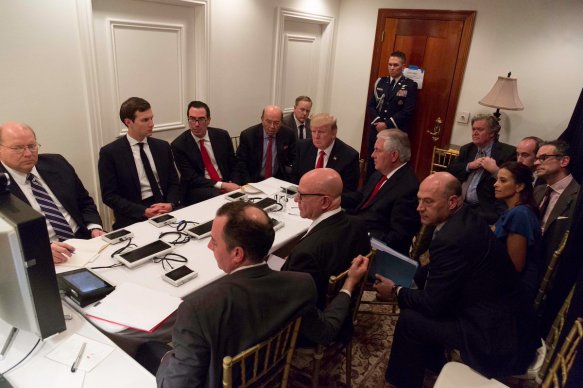
That a million supposed refugees have entered Europe on the back of a photo of a single drowned child is no different from the massive increase in tensions in the Middle East because Assad had used poison gas. The American response to what is going on in Syria should be based on national interests and not some picture that upsets some political leader. Sentimentality in politics is a vice. There will be no escalation into war with Russia and the pseudo-tensions of the moment will wash away but it’s a worry all the same.
Still, this was a decision by the entire administration so one can hope some serious strategic thought has gone into it. That Hillary was also calling for action does not give me any additional comfort. Paul Ryan thought it was a bad idea. But the one certainty is that across the world no one any longer thinks they are dealing with Obama.
 Law of Markets