An international socialist conspiracy

I am in the middle of reading Humboldt’s The Limits of State Action who argued the case that giving things to people was bad for those on the receiving end. Reward without effort is debilitating, he wrote. Here in Oz we have ‘More tax, more equitably’ left-wing intellectuals cry in open letter.

Australia’s left-wing intellectual establishment has heaped pressure on politicians to collect “more tax, more equitably” to fund greater health, education and transport spending without cutting welfare entitlements.

An open letter – co-signed by 50 progressive advocates, union leaders and academics – identifies capital gains and superannuation accounts as ripe targets for revenue-raising, and came as opposition treasury spokesman Chris Bowen explicitly ruled out cutting company tax in the May budget.

Meanwhile, in the United States, Hillary Confirms Trillion Dollar Tax Hike Plan.

Daily News: So if I understand you correctly, if you look at your proposals for college costs and for family leave, for infrastructure investments…

Clinton: Well, that’s a little bit different, because infrastructure investment, I’m still looking at how we fund the National Infrastructure Bank. It may be repatriation. That’s one theory, or something else. It’s about $100 billion a year.

Daily News: A hundred billion a year, so that comes out to about a trillion dollars…

Clinton: Over ten.

Daily News: …over ten years.

That’s not the total, that’s the increase. The land of the free has become the land of the free lunch, of which there is no such thing.

Self interest – nothing quite like it for clearing the mind

From Millennials Like Socialism — Until They Get Jobs.

A Reason-Rupe poll found that while millennials still on their parents’ health-insurance policies supported the idea of paying higher premiums to help cover the uninsured (57 percent), support flipped among millennials paying for their own health insurance with 59 percent opposed to higher premiums.

When tax rates are not explicit, millennials say they’d prefer larger government offering more services (54 percent) to smaller government offering fewer services (43 percent). However when larger government offering more services is described as requiring high taxes, support flips and 57 percent of millennials opt for smaller government with fewer services and low taxes, while 41 percent prefer large government.

Charting our Keynesian disaster

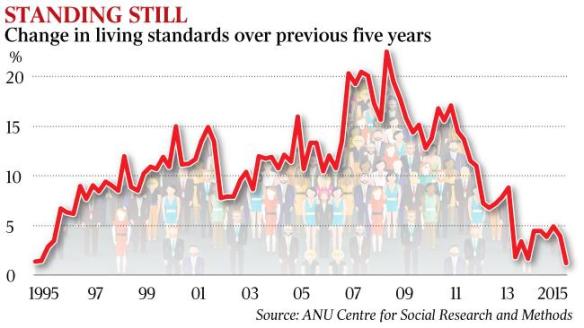
aust living standards fallen

Quite an amazing story, Living standards at a standstill for five years: report. The peak was reached in 2009, at which moment those Keynesian incompetents decided that what was needed was a Keynesian stimulus, and the results are now there for anyone to see. They won’t believe that they caused it, of course. Economists across the world will be united in the belief that things would have been even worse had they not taken the actions they took. Nothing can be proven, but there was, of course, my own forecast from February 2009.

Just as the causes of this downturn cannot be charted through a Keynesian demand-deficiency model, neither can the solution. The world’s economies are not suffering from a lack of demand, and the right policy response is not a demand stimulus. Increased public sector spending will only add to the market confusions that already exist.

What is potentially catastrophic would be to try to spend our way to recovery. The recession that will follow will be deep, prolonged and potentially take years to overcome.

Every classical economist understood this. Now only a handful do. But if you won’t take my word for it, how about listening to Sir Winston Churchill in his budget speech from 1929.

“Churchill pointed to recent government expenditure on public works such as housing, roads, telephones, electricity supply, and agricultural development, and concluded that, although expenditure for these purposes had been justified:

‘For the purposes of curing unemployment the results have certainly been disappointing. They are, in fact, so meagre as to lend considerable colour to the orthodox Treasury doctrine which has been steadfastly held that, whatever might be the political or social advantages, very little additional employment and no permanent additional employment can in fact and as a general rule be created by State borrowing and State expenditure.’”

And I emphasise that this was in 1929 before the Great Depression had even begun. The world is heading towards a disastrous downturn, and in spite of everything, we still only have Keynesian clowns stationed in every major economic post across the globe. Yet I am encouraged by our Treasurer, who gets this exactly right:

Mr Morrison said the key to raising household incomes was to improve productivity and this required business investment.

“You don’t get that from taxing and spending as Labor proposes; you get it from encouraging enterprises to innovate,” he said.

You also don’t get it by building massively loss-making very fast trains, which are really very fast drains on our productive capabilities. It should be no mystery why the Treasurer doesn’t get on with his PM, who still thinks the NBN was a great success.

“Genes are the most important determinant of maths and reading skills among schoolchildren”

Is it really permissible to say this in public? Jennifer Oriel did: Cash can’t beat genetics in class. Here’s the detailed comment:

Speaking on SBS’s Insight program, Brian Byrne of the University of New England revealed findings of soon to be published research with colleagues at the Centre of Excellence for Cognition and its Disorders. It indicates that genes are the most important determinant of maths and reading skills among schoolchildren. Their study of twins’ NAPLAN performance apparently found that maths, reading and spelling skills are up to 75 per cent genetic and writing skills are about 50 per cent genetic. The influence of schools and teachers, the focus of Labor’s policies, accounts for only about 5 per cent of performance.

It wouldn’t worry me one way or the other whether it is genetics or environment, but not since I was very young has it even been possible to side with the genetics without creating a storm of protest. Maybe things are changing, maybe it’s just that this is Australia or maybe I will have to read the papers tomorrow to see the reaction.

You can’t break the law of markets without being punished

Consider this a joint post by myself and Spartacus. He came across the article but for obvious reasons passed it on to me. And the article is Another Volcker Moment? Guessing The Future Without Say’s Law which was posted at Zero Hedge in March. What I find so interesting is not that the phrase “Say’s Law” comes up, which it often has in the past as an anti-Keynesian meme, but this is actually an accurate use of the concept (even though they call it “laws of the markets”). So what did they write?

The explanation for most of the failures behind modern macroeconomic thinking is the substitution of market-based economics by economic planning.

The fact that today’s macroeconomics dismisses the laws of the markets, commonly referred to by economists as Say’s law, explains all. Subsequent errors confirm. The many errors are a vast subject, but they boil down to that one fateful step, and that is denying the universal truth of Say’s law.

Say’s law is about the division of labour. People earn money and make profits from deploying their individual skills in the production of goods and services for the benefit of others. Despite the best attempts of Marxism and Keynesianism along with all the other isms, attempts to override this reality have always failed. The failure is not adequately reflected in government statistics, which have evolved to the point where they actually conceal it. So when an economist talks of economic growth being above or below trend, he is talking about a measure that has no place in sound economic reasoning, and that is gross domestic product.

You would almost think they had been reading my text, since in it you will find not only quite a bit on the vandalism behind low interest rates which is what the article is about, but also quite a bit on the nonsense intrinsic to using the national accounts. More realistically, once people start to wonder what went wrong with the stimulus, they wander back into the economic archives to see if there are any clues to the present that are available from the past – which is why economics remains the only science in which its own history is an important part of the subject itself.

FURTHER NEWS ALONG THE SAME LINES: This, too, has been forwarded to me which fits into the same story. ECB will do ‘whatever is needed’ to raise inflation. These central planners who will make their mates very rich but put the rest of us into serious bother are not about to stop. Really, there is no “theory” for any of this; they just make it up as they go along.

Pushing back against critics who argue he has backed too much stimulus, European Central Bank head Mario Draghi says the top monetary authority for the eurozone will do “whatever is needed” to lift dangerously low inflation.

Draghi’s remark Thursday underlines the bank’s willingness to step up its stimulus efforts — even though they were increased as recently as its last meeting on March 10.

His speech indicated a readiness to rebut criticism from some media and politicians in Germany, the eurozone’s biggest member, who say the ECB’s stimulus is excessive, hurts savers and risks destabilizing the financial system.

Draghi coupled that statement with a call for national governments to take steps to make their economies grow faster, producing more demand for goods and services and raising inflation and employment.

Other than that everything along these lines has already massively failed, what’s the problem?

Possibly the world’s last sane psychiatrist

This is from the incomparable Theodore Dalrymple, the only man on the planet to rival Mark Steyn for saying the most important things in the most readable way. Interestingly, I discovered them both at the same time when they were writing for The Spectator while I was living in England multitudinous years ago, Mark reviewing movies and Dr Dalrymple writing a weekly diary on the travails of life as a prison doctor. Here is a sample of the sort of things Dr Dalrymple (whose real name is Anthony Daniels) writes:

I am no respecter of persons, particularly politicians, but even politicians are human — more or less — and are therefore deserving of some kind of elementary courtesy.

When, shortly after my arrival in Australia to spend April at CIS, I read a Guardian article reporting the Treasurer’s remarks on state taxation, I read with mild dismay, but not surprise, the readers’ on-line responses; for example the following:

… thanks Scott you f***ing two faced jumped up lying mendacious piece of crap. (asterisk insertion mine)

Since the Guardian sometimes excludes contributions as not being in accordance with its ‘community standards,’ one is forced to wonder what those standards actually are. Are contributions excluded for being too polite or too well-reasoned? The community standards do seem to include the use of the language cited above, for the following comment approved of what had been said:

Pretty well spot on with that lot.

It seems, then, that at least a proportion of the population’s minds — not necessarily the least educated proportion of the population, for the Guardian’s readership (I assume) is better educated than average — runs like a sewer, in which insult is not only an argument, but also the only argument. The medium really is the message.

However, for a moment he managed a short burst of lucidity, writing:

… now i know who to blame when i can’t… find a decent public school for the kids…

Certainly, his difficulty is not beyond the bounds of possibility. But if Australia is anything like my native England, the state spends $150,000 per head on a pupil’s education, and still 20 per cent of pupils can’t read properly when they leave school. This is a miracle that makes the parting of the Red Sea seem like an everyday event.

He is in Australia on a speaking tour organised by the CIS and if you can you should go to see him. Here is where you can sign on.

Viva Che, accountant

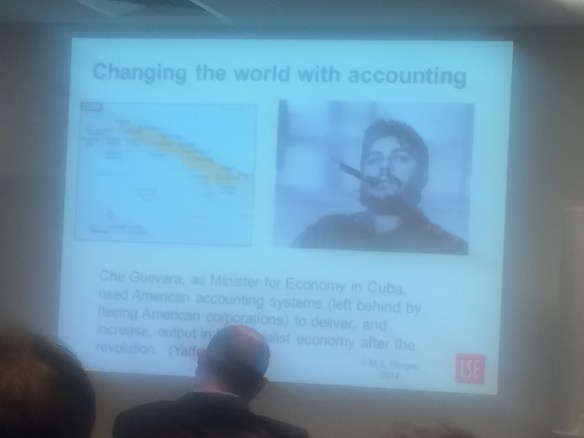
IMG_2049

I went to an Economic Society presentation last night about the role of statistical measurement in creating economic reality given by one of the stellar scholars of our time. That was the first slide of the night. This is the text below the picture:

Che Guevara, as Minister for Economy in Cuba, used American accounting systems (left behind by fleeing American corporations) to deliver, and increase, output in a socialist economy after the revolution.

You would think the presenter would be embarrassed to say any such thing, or if one cared to give the benefit of the doubt, is perhaps oblivious to the offence that might be caused or has no idea how this might be judged given how badly the Cuban economy has been managed. None of it. Understood it all and dared anyone to say a word. No one, of course, did.