
A query on Keynesian economics

I have received a brief email from one of my students:

Dear Dr Kates,

First let me thank you for the emails guiding us through the course.

On a personal note, I am curious as to how and why you believe that we should beware of the Keynesian approach (theories that we all have been taught at some point). Is there a book or some articles I could read to in order to understand why the pre-Keynesian era is more relevant to our current economy?

Thank you.

Kind regards

This I can tell you is not an every-day occurrence in the life of an academic. I have now replied:

You don’t know how much you have gladdened my heart in writing to me with your query. As I try to emphasise, I do not ask anyone in an introductory course to choose which side is right and I teach both. You have no doubt which side I think is valid, but I also teach Keynesian economics as accurately as anyone I know, all the more so since I understand it so well since I have studied it for so long. Nevertheless, you may be in the only classroom in the world that is taught the other side as comprehensively as you will find in this course.

But you ask where you might find some literature on the non-Keynesian classical side. I have, as it happens, just completed an 1800-page, two volume collection of every article critical of Keynesian economics written since the publication of The General Theory in 1936. But if you are looking for what I think of as the best criticism available, the best I can offer are two articles I wrote myself, the first one written at the end of 2008 and published at the beginning of 2009 just as the various stimulus packages were getting under way. The second was a five-year review of the first article written in 2014.

This is what was published in 2009 under the title, “The Dangerous Return to Keynesian Economics”.

This is what was published five years later under the title: “Keynesian Economics’ Dangerous Return – Five Years On”.

Both somewhat long, but both are straight to the point and were written so they could be understood without an economics training. Given how things are going, I am not anticipating much improvement on things when I come to write the ten-year review in 2019.

Again, I thank you for your query and I hope these articles will provide you with the insight into the material you are being taught. And, let me remind you, there is also the course text which covers these same issues in greater theoretical depth.

With kind regards.
A Lynch Mob at Sydney University

What a disturbing story we find at the University of Sydney the other day. I am even more than normally conscious of how disgusting it was, having this afternoon gone along to the Jewish street festival in which a couple of roads were blocked off and where we wandered around in the afternoon sun. But, as always, I was conscious of the Jewish primary school which sits just around the corner from the Holocaust Centre, both of which I pass every day on the way to the station. I had never been in the Holocaust Centre but went in to have a look. Let me just leave it at this. The children in the school are no different in any way from the murdered children whose pictures can be seen on the walls of the Holocaust Centre. We are playing with fire in allowing any of this to continue.

At the centre of the disturbance at the University of Sydney was the presentation by Colonel Richard Kemp, who had been in charge of security operations in Afghanistan and Northern Ireland, who looked down with utter disdain at these pathetic nonentities. As he wrote in his letter to the President of the University of Sydney which was released today, “although the students attempted to intimidate me as well as the audience members, I did not feel personally threatened, as I have faced considerably greater dangers and threats than could possibly be presented or contemplated by such people”. The protestors knew, of course, there was absolutely no danger to themselves in anything they did, total cowards that they are. Here’s what I think of as the central point of the letter written by Colonel Kemp:

Peaceful and reasonable demonstration, such as handing out leaflets, chanting dissenting views or holding placards with messages of opposition to the views of a speaker, is of course acceptable. Indeed, such a peaceful demonstration was under way outside when I entered the room for my lecture. I was offered and accepted a leaflet, which I read and I briefly engaged in discussion with a protester. However the type of racially‐motivated aggression, intimidation and abuse that occurred at this event is wholly unacceptable. Also unacceptable in any respectable university is the curtailment of an invited and approved speaker’s freedom to speak and engage in legitimate academic discourse such as I experienced at your university.

I urge you to investigate this incident and to take action against the students and staff members who were responsible for the behavior that I have described. If you fail to do so then you will be failing to discourage such action in your university in the future. You will thus be failing in your duty to ensure that your students, visitors and guest speakers may take part in debate within the precincts of the University of Sydney without fear or concern for their own safety.

I would add that you have a particular responsibility in respect of the racist, anti‐Semitic nature of this protest. As you know anti‐Semitism is a rising phenomenon in the world. Jews in many places live in increasing fear and concern that they will be singled out and discriminated against. Only by taking firm action against anti‐Semitic abuse and hatred whenever and wherever it occurs can this situation be reversed. Sydney University has the opportunity here to set an example to other academic institutions that lack the moral courage to face up to the modern scourge of anti‐Semitism.

The most beautiful song ever written

It is O mio babbino caro, of course, which comes in the middle of Puccini’s Gianni Schicchi, around the twenty-one minute and thirty-second minute mark in the full production above. You will know the song without any doubt, but if you haven’t seen the opera you have no idea what it’s about. This is, as it happens, also the greatest one-act opera ever written. We saw it last night with another one-act opera, but when paired, it is alway the one to come last. Anything else is guaranteed to seem flat if it comes after. Treat yourself to one of the most exquisite moments anywhere in the arts and watch the whole thing (in Italian but with English subtitles), but if you haven’t the time, just go to minute twenty-one.

But I have to say that while the Glynebourne cast is better, the singing is not as good and the production not as electric. This one from the Paris Opera is also in Italian but comes with French subtitles. The song itself comes at around the twenty-second minute mark.

But for the song on its own, there is nothing quite like the moment when this nine year old wins Holland’s Got Talent in 2013. It was an astonishing moment and went round the world in a day.

The American economy is a mess

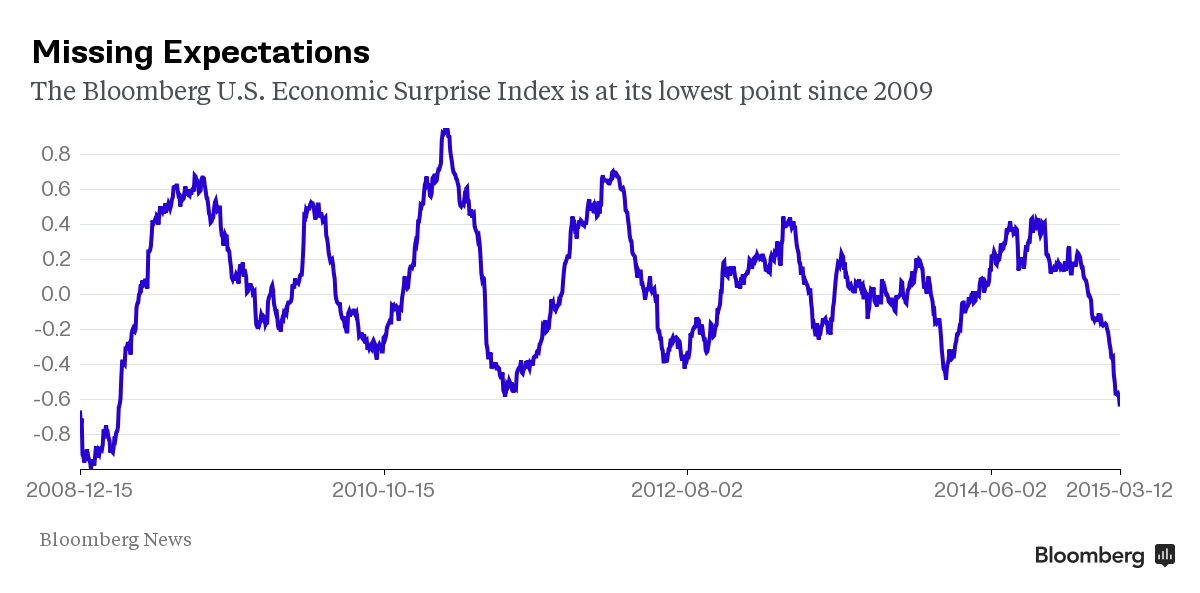
us surprise index march 2015

Don’t ask me what the index actually measures, but it is the worst it’s been since 2009. There is no recovery in the American economy, none at all. It is a complete mess with neither the government, the American economics community nor our existing macroeconomic texts of the slightest use in getting things back on track. This is the first para of the story from which the chart is taken:

It’s not only the just-released University of Michigan consumer confidence report and February retail sales on Thursday that surprised economists and investors with another dose of underwhelming news. Overall, U.S. economic data have been falling short of prognosticators’ expectations by the most in six years.

They however give a pass to economic management because the labour market is doing reasonably well, in their eyes. So it is useful to be reminded of the actual reality once we adjust for falling labour force participation.

us unemployment march 2015 adj for participation rate

The worst part is not the outcome but the lack of insight into what the problem is. Keynesian macro is an economic wrecking ball, but there is not one economist in a hundred who even has an inkling that this is so, never mind why it is so.

Packed full of platitudes

Let me start with Malcolm Turnbull’s speech on the economy the other day and about what a great job he believes he could do to sell the current need to bring fiscal responsibility back into vogue. Maybe so, but the evidence Turnbull can sell anything other than pre-approved Labor polices to Labor voters is still untested. So it is therefore good to have seen another perspective: Hartigan attacks Turnbull on “woeful” record, also a few days back. It begins:

FORMER News Corp boss John Hartigan has launched a blistering attack against Communications Minister Malcolm Turnbull for failing to reform media laws, accusing of him of having a “woeful” track record and ignoring regional communities.

The chairman of regional TV company Prime Media Group was responding to Turnbull’s “tough talking speech about the economy” to the Brisbane Club yesterday, which he said was “packed full of platitudes about embracing the future and the need for reform”.

Hartigan said: “Malcolm Turnbull reckons he can sell tough reform, but his track record in his own portfolio is woeful.”

“The Minister likes to talk the talk when discussing the economy, but when it comes to tackling much needed media reform in his own portfolio, I wonder if he will walk the walk?

For Malcolm to think he has been a political genius in finding a way to bring in Labor’s NBN with a mild reduction in the level of pure waste may seem wonderful to him but not to me. Where was he when the NBN was being debated in the first place? A white elephant that will sink our living standards, an outcome on which I have never heard Turnbull say a word. I wonder if he even knows.

The single worst example of bad teaching I have ever come across

A fascinating post by Scott Johnson at Powerline which he titles, Notes on Middlemarch and in which he discusses what a trial it had been for him to read the book which he has just finished. I therefore wrote him the following:

Dear Scott

I enjoyed your reflections on Middlemarch which is one of my favourite novels of all time, but I think I had a particular reason for the pleasure it gave me, since I identified, sadly, with Dorothea’s first husband, William Casaubon. I think of myself almost perfectly portrayed as that ponderous pedant, writing some weighty but unreadable exegesis into various historical episodes of interest to no one else. I wasn’t actually depressed by his fate, but I did find it instructive. We are what we are, and the book did help me embrace my own nature.

As it happens, I was reading the book at the same time as I was driving our year-seven son to school of a morning, and each day I would tell him where I was up to and what was going on in the plot. You can thus see how like Casaubon I must be, if that is the nature of my conversation with a twelve year old. But the reason I mention it is because he told his English teacher that he had read Middlemarch to which she replied, to this twelve year old, that she could not understand why he had read it, and that she had been forced to read it at university and she had hated it, the most awful book she had ever read. I have always thought of that as the single worst example of bad teaching I have ever come across.

Kind regards

BTW it is ranked as the seventh greatest novel written in English and I completely agree. Unlike Scott, I was just driven along by the plot, but then again, I find John Stuart Mill’s Principles of Political Economy more intrinsically interesting than any economics book I come across today.

The Australian and Mr Abbott

The Australian seems ever so gently to be edging towards an anti-Abbott position which may, or may not, reflect the views of its owner, but which definitely does not reflect the views of at least one of its readers. I almost always start the paper with Cut and Paste which, up until recently, had always been written up in a way that matched my own view of things. But of late, there have been a few that have left me completely perplexed, since to make sense of them as a form of irony, you would have to be pro-Labor. Today Cut and Paste was devoted to Andrew Bolt’s deconstruction of John Lyon’s nonsense story on Abbott’s supposed plan for a unilateral invasion of Iraq. Andrew is back on this theme today, and you will have to pardon his French: This campaign to intimidate me will not work: Lyons’ claim remains bullshit. Why The Australian persists with this story, since it was utterly implausible from the start, I do not know, but it does make me nervous. The editorial, also today, critical of Abbott’s statement about the cost of funding remote aboriginal communities, was more of the same.

And just to push the same message along, there is the feature opinion piece of the day, also a negative take on the cost of servicing remote aboriginal sites, and written by the presenter of Radio National’s Drive Program. Naturally, the need to contain costs is as remote from her consciousness as are these various sites.

And again today, also on the opinion page, there is an article near on incomprehensible to me by Nikki Savva, who I normally ignore, about something Credlin wrote to some Senator and the smouldering resentment it seems to have caused for reasons that remain unclear. Whatever it was, she has seen fit to do a bit of troublemaking, whose long-term good can only be for the Labor Party, but may provide some assistance along the way to Malcolm.

Then yesterday, on the front page but below the fold, there was a small but respectful article about Malcolm Turnbull’s speech on the economy and about what a great job he believes he could do to sell the current need to bring fiscal responsibility back. Maybe so, but the evidence Turnbull can sell anything other than pre-approved Labor polices to Labor voters is still untested. So it is good to see another perspective: Hartigan attacks Turnbull on “woeful” record. It begins:

FORMER News Corp boss John Hartigan has launched a blistering attack against Communications Minister Malcolm Turnbull for failing to reform media laws, accusing of him of having a “woeful” track record and ignoring regional communities.

The chairman of regional TV company Prime Media Group was responding to Turnbull’s “tough talking speech about the economy” to the Brisbane Club yesterday, which he said was “packed full of platitudes about embracing the future and the need for reform”.

Hartigan said: “Malcolm Turnbull reckons he can sell tough reform, but his track record in his own portfolio is woeful.”

“The Minister likes to talk the talk when discussing the economy, but when it comes to tackling much needed media reform in his own portfolio, I wonder if he will walk the walk?

For Malcolm to think he has been a political genius in finding a way to bring in Labor’s NBN with a mild reduction in the level of pure waste may seem wonderful to him but not to me. Where was he when the NBN was being debated in the first place? A white elephant that will sink our living standards, an outcome on which I have never heard Turnbull say a word. I wonder if he even knows.

But the story is also anti-Coalition since it the Government’s media policy, not just Turnbull’s. Not good. Very not good is all I can say.

Yawn: another left-liberal critique of the US government but from an unusual source

Who do you suppose put together this far left liberal critique of the American system of government under the heading, “Fig Leaf: Outrageous Facts About US Congress and Super Pacs”:

This is where the legal absence of institutional checks and balances allows lobby groups, politics and money to come together on a scale that is not imaginable in any other country in the world.

The Senate and Congress are packed with wealthy people that are very rapidly becoming even wealthier. Their collective net worth is now measured in the billions of dollars.

But it is not that easy to get elected to Congress. Candidates have to be heavily connected to lobby groups like Wall Street, National Rifle Association, AIPAC, Military-Industrial Complex and those that are very wealthy. It takes a lot of cash to win campaigns.

The following facts are very difficult to believe but they are actually true. They show that Congress is all about money and lobby politics:

1. The collective net worth of all members is reportedly over 2 billion dollars. But it could be higher, as more than 50 percent are millionaires.

2. This is during a time when the net worth of most American households has declined.

3. The average net worth for a member is $3.8 million and counting.

4. The average cost of winning a seat in Congress is $1.1 million, while in the Senate it is $6.5 million. Spending on political campaigns has gotten way out of control.

5. Insider trading is legal for members, and they refuse to pass a law that would change that.

6. The percentage of millionaires in Congress is 50 times higher than the percentage of millionaires in the country.

There are lots of ways these politicians are raking in the cash. One way is making investments in companies that will go up significantly if legislation that is being considered “goes the right way”. This happens constantly and nobody seems to get into any trouble for it.

For instance, when it comes to the National Rifle Association, climate change deniers, Israel, Big Oil, or Military-Industrial Complex, these “hired guns” waste no time to pass legislation that would support their “friends”. In return, they get all the cash they need for their election campaigns.

This is not new. The emperor is butt naked. Whoever Americans vote for, the money and the lobby groups get in. The law allows unlimited campaign contributions by lobby groups, corporations and unions. The organizations that are taking advantage of this law are known as Super Pacs and they can remain anonymous.

As is, money in American politics is the elephant in the room. In the interim, the White House tenants are asking us to ignore both the sight and the stench. They want us to believe no one is buying the candidates and access to power, and that there is no coordination between the compromised members of Congress and the Super Pac.

In reality, however, this is little more than a fig leaf. Any doubters should go through an unusual open letter from Republican senators, which was made public recently, cautioning Iran against a potential nuclear deal with President Obama. The letter shows us how class interests and the influence of money and lobby groups have visibly corrupted an entire political culture.

In no small part it also explains the depth of cynicism, alienation and mistrust the international community now has for America’s illusion of participatory democracy and sovereign foreign policy.

Why it’s none other than the FNA. And to find out who that is, you need to go here. It’s not just that my enemy’s enemy is my friend. For the left in the US, these are their friends.

[Via John Hinderaker at Powerline]

Who are these people to criticise us?

Stacy McCain brings up something that has also been known to get under my skin. Who are these moral giants who feel free they can criticise the rest of us for our moral failings? I never see anything particularly exceptional about them, but they feel they can set standards for everyone else, based on their own standards of perfection which they never seem to live up to themselves. (See Bill and Hillary for the kind of people who should under no circumstances ever say a word about anything anyone else ever does.) They are more like moral cretins. This is part of how it’s described:

American society, means that we can never have a moment’s peace.

Constantly, we find the Left dividing us, demanding that we choose sides and accusing us of hateful selfishness if we do not join their crusades to destroy American society.

They yell “Civil rights!” And you are a RACIST if you don’t support whatever agenda the Left is pushing. They yell “Economic equality!” And you are a CAPITALIST OPPRESSOR who hates working people if you don’t support the Left’s agenda. “Gay rights!” You’re an ignorant prejudiced HOMOPHOBE. “Women’s rights!” You’re a MISOGYNIST who hates women.

The Left’s agenda is always about accusing us — ordinary Americans just going about our daily lives — of hateful selfishness. Accuse! Accuse! Accuse!

Once you start noticing this pattern, eventually you feel the need to ask these “progressive” activists a simple question: “Who are YOU to accuse ME?”

What gives these people the moral authority to accuse honest law-abiding citizens of “oppressing” others? What acts of unselfish generosity have these “progressives” ever done, that would qualify them as such exemplary characters as to judge us?

Who elected them the Official Arbiters of Social Justice?

Who indeed? They have been calling the moral shots since from around the mid-1960s and while there are some things that have become better, the US is now a lot lot less a good place to live today than it was then. It may be richer, but it is not better.

INTP

Myers-Briggs INTP:

INTPs are quiet, thoughtful, analytical individuals who tend to spend long periods of time on their own, working through problems and forming solutions. They are curious about systems and how things work. Consequently, they are frequently found in careers such as science, philosophy, law, psychology, and architecture. INTPs tend to be less at ease in social situations or in the “caring professions”, although they enjoy the company of those who share their interests. They prize autonomy in themselves and others. They generally balk at attempts by others to convince them to change. They also tend to be impatient with the bureaucracy, rigid hierarchies, and the politics prevalent in many professions. INTPs have little regard for titles and badges, which they often consider to be unnecessary or unjustified. INTPs usually come to distrust authority as hindering the uptake of novel ideas and the search for knowledge. INTPs accept ideas based on merit, rather than tradition or authority. They have little patience for social customs that seem illogical or that obstruct the pursuit of ideas and knowledge. This may place them at odds with people in the SJ (Sensing/Judging) types, since SJs tend to defer to authority, tradition, and what the rest of the group is doing. INTPs prefer to work informally with others as equals.

INTPs organize their understanding of any topic by articulating principles, and they are especially drawn to theoretical constructs. Having articulated these principles for themselves, they can demonstrate remarkable skill in explaining complex ideas to others in very simple terms, especially in writing. On the other hand, their ability to grasp complexity may also lead them to provide overly detailed explanations of simple ideas, and listeners may judge that the INTP makes things more difficult than they need to be. To the INTPs’ mind, they are presenting all the relevant information or trying to crystallize the concept as clearly as possible.

Given their independent nature, INTPs may prefer working alone than leading or following in a group. During interactions with others, if INTPs are focused on gathering information, they may seem oblivious, aloof, or even rebellious—when in fact they are concentrating on listening and understanding. However, INTPs’ intuition often gives them a quick wit, especially with language. They may defuse tension through comical observations and references. They can be charming, even in their quiet reserve, and are sometimes surprised by the high esteem in which their friends and colleagues hold them.

INTPs are driven to understand a discussion from all relevant angles. Their impatience with seemingly indefensible ideas can make them particularly devastating at debate.

INTPs are often haunted by a fear of failure, causing them to rethink solutions many times and second-guess themselves. In their mind, they may have overlooked a bit of crucial data, and there may very well be another equally plausible solution.

It’s just like being a Capricorn, which I am as well.