
If it’s not in itself value adding don’t do it

I share Judy’s exasperation at the push for more infrastructure spending which is a code word for more government waste. If it is government spending, it will never repay its costs. Occasionally a government will grab hold of some natural monopoly – Telecom in the old days – from which even with all of the usual incompetence they were able to take in more money than they paid out. But past those few and far between projects, I cannot think of a single instance where governments take on projects which leave us economically better off. So this from The Australian this morning fills me with tremendous foreboding:

Joe Hockey says state treasurers will find it “very hard to resist” a federal proposal to recycle government-owned assets and boost spending on infrastructure.

State treasurers are in Canberra this morning to discuss spending on infrastructure and the carve-up of the good and services tax.

The federal Treasurer expressed optimism about the discussions ahead of today’s meeting.

The Abbott government is pushing for a deal that will unlock billions of dollars from the privatisation of state government assets to be reinvested in significant new infrastructure projects.

It’s understood proposals put to state treasurers will include new incentive payments from the commonwealth which will be linked to qualification deadlines.

“I have no doubt that the states will find it very hard to resist what the commonwealth is prepared to offer them,” Mr Hockey said.

Mr Hockey said the proposal would be “for the recycling of state government assets and investment in new productive infrastructure that is going to create jobs and improve the capacity of the economy”.

Governments do not create jobs. If you believe that government spending leads to an outcome where there are more jobs in an economy than there would have been had the government not indulged in this kind of spending, or that the economy will end up stronger and more productive, you will never understand a thing about how an economy works. And as an added extra, with increased government spending there will be lower real earnings as well. So let me repeat what Judy said below:

The bigger issue is with all this talk of INFRASTRUCTURE, what we are about to witness is just a monumental waste of taxpayer money on politically popular and excessively expensive projects for which there have been inadequate assessments. Just a continuation of Albo, really, who ramped up infrastructure spending from 1 to 2 per cent of GDP.

The disaster that overcame the Victorian economy in the dismal Cain-Kirner years were built on just those same “hollow logs” they thought they could tap into. If it’s not value adding – that is, if it does not pay for itself after every cost is taken into account – it makes us worse off, not better. Call it charity or welfare or whatever else signifies that it draws down on our productivity if you must do it. But for heaven’s sake, don’t pretend it is a contribution to economic growth.

UPDATE: Here is the Treasurer’s press release, Treasurers agree to boost infrastructure.

The Commonwealth’s incentive will be 15 per cent of the assessed value of the proposed asset being sold for capital recycling. If proceeds are used by the States and Territories for the retirement of debt or other purposes, rather than for agreed, new productive infrastructure, they will not be eligible to receive payments under the initiative.

This is an important initiative to remove debilitating infrastructure bottlenecks, stimulate construction and drive real activity in the economy when it is most needed, as investment in the resources sector declines.

Infrastructure Australia estimates that at least $100 billion in commercial infrastructure assets are currently tied up on government balance sheets and could be sold.

The partnerships could overcome the fiscal constraints Governments face to increase the pipeline of projects and improve Australians’ quality of life, tackle congestion, reduce business costs and help firms better link with their employees and customers.

Those who think this will be of the roads-rail-and-sewers variety of expenditure will just have to wait to see what gets floated instead. At least on the up-side, the States will have to sell up various capital assets to private owners to secure the funds so it’s not all bad.

Someone important you never heard would have turned 100 today

I see from Instapundit that today would have been Norman Borlaug’s 100th birthday. This quote applies to much more than just food, given these same environmentalists aim to cut back on every aspect that makes modern life pleasant:

[Most Western environmentalists] have never experienced the physical sensation of hunger. They do their lobbying from comfortable office suites in Washington or Brussels. If they lived just one month amid the misery of the developing world, as I have for 50 years, they’d be crying out for tractors and fertilizer and irrigation canals and be outraged that fashionable elitists in wealthy nations were trying to deny them these things.

And just who was Norman Borlaug? The article was written in 1997 when he was 82.

He received the Nobel in 1970, primarily for his work in reversing the food shortages that haunted India and Pakistan in the 1960s. Perhaps more than anyone else, Borlaug is responsible for the fact that throughout the postwar era, except in sub-Saharan Africa, global food production has expanded faster than the human population, averting the mass starvations that were widely predicted — for example, in the 1967 best seller Famine — 1975! The form of agriculture that Borlaug preaches may have prevented a billion deaths.

Yet although he has led one of the century’s most accomplished lives, and done so in a meritorious cause, Borlaug has never received much public recognition in the United States, where it is often said that the young lack heroes to look up to. One reason is that Borlaug’s deeds are done in nations remote from the media spotlight: the Western press covers tragedy and strife in poor countries, but has little to say about progress there. Another reason is that Borlaug’s mission — to cause the environment to produce significantly more food—has come to be seen, at least by some securely affluent commentators, as perhaps better left undone. More food sustains human population growth, which they see as antithetical to the natural world.

The Ford and Rockefeller Foundations and the World Bank, once sponsors of his work, have recently given Borlaug the cold shoulder.

We live in such dark times.

Retronaut – another version of now

If you want to see a fascinating site, try this. It is just a collection of historical photos and even paintings that are grouped under a theme but really nothing seems to bind the collection other than being interesting to whomever is doing the collection. This is their own description of themselves:

Retronaut is a photographic time machine.

It is a digital collection of tens of thousands of pictures from across the past, all with one thing in common
– each one has the power to warp your sense of time .

Our team mines archives online and offline, unearthing pictures that seem not to belong to the time when they were created,
that dissolve away the years like tarnish on a ring, that take our collective map of the past and tear tiny holes in it
– holes through which we glimpse the real past lying underneath our map.

These are pictures that show not so much the past as they show “now” – but another version of now.

And just as fascinating is this, imgur.com. This is how I found this site when I was directed to this on rare historical images.

Separating political comment from bigotry

What an excellent government we have. Its ability to see clearly and understand the need to protect free speech and political debate while at the same time protecting individuals from vilification in the public sphere is exceptional. I discussed this in a post on Andrew Bolt and Mark Liebler. This is what I concluded then:

Free speech is about allowing the freedom to say whatever one believes in the midst of political discourse. If an acceptance of racist rants is defended as examples of free speech then the very notion of free speech will be discredited by these very claims in the eyes of anyone who wishes to live in a decent society where individuals are protected from the kinds of racist abuse that has no part to play in a civilised community which seeks to promote peace, order and good will.

And it is exactly this distinction that has been made in the coming legislation.

The Government Party Room this morning approved reforms to the Racial Discrimination Act 1975 (the Act), which will strengthen the Act’s protections against racism, while at the same time removing provisions which unreasonably limit freedom of speech.

The legislation will repeal section 18C of the Act, as well as sections 18B, 18D, and 18E.

A new section will be inserted into the Act which will preserve the existing protection against intimidation and create a new protection from racial vilification. This will be the first time that racial vilification is proscribed in Commonwealth legislation sending a clear message that it is unacceptable in the Australian community.

The coming debates in this country over the course of the next few years will be about political views that mascarade as religious or racial views. We now have legislation that will allow such debates to take place in public without spurious claims of racism being allowed to cloud the discussion. An exceptionally well thought out piece of work.

Educated ignorance

This is about American foreign policy and foreign policy advisors but it is just as true about economics and economists.

Most of these smart young people really don’t know anything. Oh, don’t get me wrong, they had great SATs and went to top schools and have mastered the art of sounding smart, attaining admirable fluency in that unnatural dialect known as Beltway-speak, but as for any deep knowledge about any particular subject relating to how the world really works, that’s about as rare in this crowd as unicorns and Bigfoot. There should be no surprise that Chekists are winning handily these days.

That said, it’s important to note that the ignorance of reality found among our Bright Young Things in DC is hardly their own fault. It can be attributed to their deformed education, especially among those who have studied International Relations, memorizing Game Theory and related unreality when what they needed to be doing was studying languages and history and getting out of the Beltway more.

Experts in game theory, clueless about history and the actual dynamics of the real world. Everything comes back to first principles which are never checked against reality. It is astonishing just how impervious the American foreign policy establishment is to the events of the past few years in the same way that the economic establishment has been impervious to its own disasters of the past few years.

There is then the media who come from the same cohort of over-educated highly intelligent ignoramuses. This is from Rush Limbaugh where I’ve quoted only his first and last lines. You can go to the original to see what comes in between:

I think the mainstream media is pig-ignorant of practically every discipline except party discipline. . . . We talk about low-information voters. We’ve got low-information media, and they are not aware of what they don’t know. They are so arrogant about their all-knowingness that they can’t conceive that they don’t know anything — and, when they encounter it, they’re just flummoxed.

But really, there’s so much going wrong all at once that it’s hard to know either what the problem is or what anyone could do to fix it.

First link via Small Dead Animals

With each day there is less to admire about the US and more to fear

The US is unselfconsciously becoming a corrupt one-party-state autocracy. It has the form and the constitution of a free society but it less and less has the substance. Mark Steyn’s travails within the legal system continue with this latest episode Law is Hell. A more self-conscious society would be embarrassed by what he is revealing but its self-image as the perfect society of freedom and justice has not yet been penetrated by a more accurate understanding of the reality behind the facade. Although quite a bit of his post is about his own efforts in dealing with Michael Mann and the hockey stick, this story he tells about Dinesh D’Souza is incredible:

Take Dinesh D’Souza, one of those “political enemies” who’s managed to attract the attention of the feds. For a campaign finance “violation” of $15,000, he has already been handcuffed and perp-walked, bailed for half-a-million, lost his passport and freedom of movement, and requires permission from a judge even to travel from New York to Boston. This is disgraceful. Yet D’Souza now faces the choice between confessing to something or having his life ruined. This is a disgusting, capricious system of which Americans should be entirely ashamed.

Even if “shame” were the right word for the emotion they should be feeling, they’re not ashamed because it is not how they see it themselves. And “disgraceful” is far too weak to really capture any sense of the oppressive nature of the evolving political structures of the US if the D’Souza prosecution and the IRS are now standard practice. Americans do not see themselves as an unfree people, but it is how more and more of America’s friends are beginning to see where the US has gone and is going. The speed at which things are coming apart is terrifying but there is no denying the direction. With each day there is less to admire about the US and more to fear.

Some call it sleep

Has it really come down to this. From an article titled, Why Europe Sleeps but is actually about how it is now in a coma:

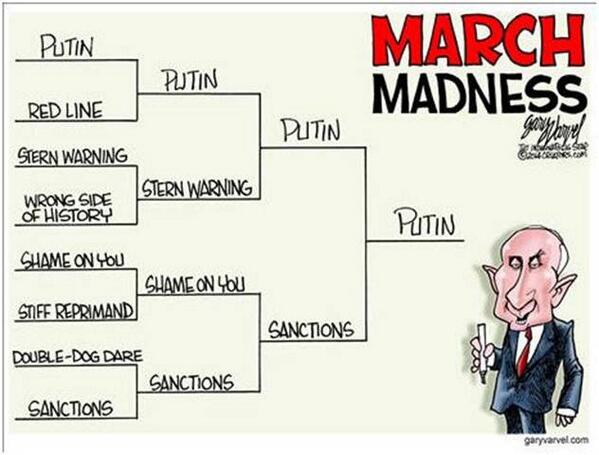
It is not only cleanliness, but concision that is next to godliness. In theory, then, Twitter should promote near-godliness, for it encourages people to express their thoughts in few words. A good example of such admirable concision was the tweet from Laurent Fabius, the French foreign minister, reproduced in the electronic version of Le Monde on March 19, 2014: “On the one hand we cannot imagine delivering arms to Russia, on the other there is the reality of employment” (the French have a $1.7 billion deal to build a miniature aircraft carrier for the Russians). This will hardly have Russian president Vladimir Putin quaking in his shoes; on the contrary, it will set him laughing and reassure him that he can mock Western Europe to his heart’s content.

Putin has four things on his side, at least in the short-term. The first, of course, is military power. The second is his increasing control of the media and over public opinion in Russia. The third is that his policy appeals to nationalist passion which, apart from ethnic hatred, is probably the strongest political passion of all. The fourth is the weakness of his European opponents.