It’s like believing in fairy tales

First there’s this from someone who thinks the planet may be warming and Australia is therefore in need of a massive expenditure program:

Most of the big investment houses are wilfully ignoring the risks that climate change will soon pose to their beneficiaries, and the Abbott government is making the same short-sighted mistake.

And then there’s this, called “Is a Big Chill on the Way?”, in which the number of sun spots in the latest cycle is shown to be falling.

sun activity

Here’s the text to go with the picture:

The monthly International Sunspot Number from the Solar Information Data Center (SIDC) of the Royal Observatory of Belgium was released December 1st. It fell to 77.6 spots/day.

Most newsworthy is that this is still the weakest solar max in over 200 years, well below NASA’s forecast. …

We may be witnessing the sun’s last dying gasps before entering into a long slumber. The impact of that slumber on Earth’s climate remains the subject of growing scientific speculation.

Global warming has never worried me but this does. You cannot take the global warming crowd seriously any more, but they will not go away until they are absolutely convinced that no more money will be placed in their begging bowls ever again.

A study in conservatism

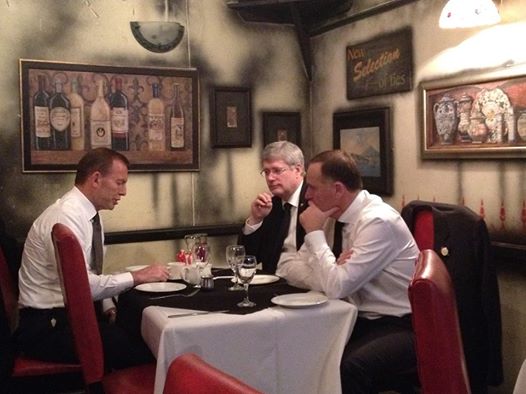
abbott harper key

These are the Prime Ministers of Australia, Canada and New Zealand having a quiet lunch together when they met up at the funeral of Nelson Mandela. I don’t know whether what I like most about it is the quiet reflective down-to-earth mood or that they are three conservative leaders at a time when conservatism is very unfashionable amongst our political elites. I fear that quiet scenes such as this amongst sensible leaders such as these will become more of a rarity. This is from Mark Steyn at National Review. I wonder if this picture has been reproduced anywhere else in Australia.

[Thanks to BW for sending it along.]

Socialist medicine at its finest

This is about the NHS in the UK from the Mail Online:

  • National Health SHAMBLES: Three damning reports describe mothers abandoned during labour, serious hospital blunders every day and how patients have lost faith in their GPs
  • Public confidence in the NHS at record low following run of inquiries
  • A quarter of new mothers say they were abandoned by their midwives
  • Some NHS consulting rooms were found to be infested with maggots
  • Police probe into cover-up claims on cancer treatment waiting times
  • Blunder doctors carried out heart surgery on the wrong patient
  • Another man had laser surgery on his right eye rather than his left

If you live in the UK, plan not to be sick.

Wouldn’t their readers prefer to know what’s really happening?

Do the people who write such stories not know any better or do they have such contempt for their readers that they serve them up what is known to be untrue because it makes them feel better? There is no doubt that the left wants Abbott to fail but still, you have to ground yourself, you would think, in some kind of reality when assessing how things are going. This is from a story in The Sunday Age titled, Stop the boats policy all talk, no action. You can get the gist of where this is going from the opening paras:

The Coalition’s pre-election promise was unequivocal: in the first 100 days of office, it would take ‘immediate action’ to reclaim control of Australia’s borders.

Its Real Solutions policy blueprint vowed: ‘We will immediately give new orders to the Navy to tackle illegal boat arrivals and turn back the boats where safe to do so.’

But in no other policy sphere has the government’s soaring rhetoric crashed more forcefully into reality than in its boats policy – and its damaged relationship with Indonesia has played a key role in the crash.

If anything has been a success, I would have thought, the boats’ policy has been it. Oddly, the bits in bold are not in the online version but only in print. Perhaps the passage has been removed because of this, Yudhoyono wants an even stronger bond, which was picked up at Andrew Bolt.

Talk about a con

American Hustle is a small representation of the extent to which critical standards have fallen. A five star movie, 95% on Rotten Tomatoes, recommended by a number of people and highly rated in the papers was nevertheless an incoherent mash. Lots of events, bit of a character study, but no plausible central thread, no storyline to hold the bits together.

It was kind of a brew of Broadway Danny Rose meets The Sting which really were 70s movies or thereabouts (BDR 1984). But what held them together, specially The Sting, was how cleverly they were plotted. I think the charm for many was that American Hustle brought back the 1970s but only in ways that would resonate with people who weren’t actually there.

Don’t let me put you off since everyone seems to like it except me. But far from being charmed, I was happy to see the film come to an end, which was about half an hour later than it ought to have been.

Nigella Lawson used cocaine says the Toronto Star

Just like Rob Ford. Not to mention that she smoked grass with her kids. The story is from The Toronto Star who will no doubt be making nothing of it.

Did Saatchi have a temper? Had Lawson used cocaine? What about marijuana?

Yes, Lawson said, she had used cocaine a few times in the past — as recently as 2010, when she was enduring ‘intimate terrorism’ by her ex-husband. And yes, she’d smoked cannabis, too, though she’s now given up.

And as for her children and grass, we have this:

Ms Carpenter responded: ‘What on earth do you think you were doing buying cigarettes for underage children?,’ to which Ms Grillo replied: ‘Well, if Nigella Lawson let them smoke weed.’

Well, what if she did? What would The Star make of that?

Heidegger’s Black Notebooks

The Heidegger question doesn’t go away, mostly because he is a man of the left that the left cannot let go of. A National Socialist is a socialist, with all of the right sorts of attitudes and beliefs. But there are now, apparently, the “Black Notebooks” which have been edited and a piece commenting on what they show is found here.

Eric Aeschimann, writing in Le Nouvel Observateur, reports that Heidegger’s Schwarzen Hefte (‘Black Notebooks’) will trouble even the most faithful of his acolytes in France. It appears that the German editor of the notebooks, Peter Trawny, has written an essay entitled ‘Heidegger: “The Black Notebooks” and Historial Antisemitism’ (‘historial’ being one of those neologisms of which Heidegger, and Heideggerians, were and are fond) in which he argues that these manuscripts, written between 1931 and 1946, contain ideas that are ‘clearly antisemitic, even if it is not a question of antisemitism of the kind promoted by Nazi ideology.’ One of Heidegger’s French translators, Hadrien France-Lanord, has read Trawny’s essay and has pronounced himself dismayed by many of the extracts from the notebooks that it contains. We are, Aeschimann writes, on the verge of another ‘Heidegger affair’.

There is also a quite insightful analysis of the kinds of philosophy Heidegger offered up:

Heidegger came to believe that the present is characterised by a forgetfulness of ‘Being’ and that this forgetfulness shows itself in the global domination of modern science and technology. Where, in 1933, Nazism, and the Führer in particular, had promised an ‘awakening’ of the German people and salvation from the ‘nihilism’ of the modern age, now Heidegger regarded it as the latest embodiment of that dispensation. But, as his former student Karl Löwith pointed out in 1946, this did not mean that Heidegger had stopped believing in the necessity of national revolution after 1934—far from it. And Löwith maintained that what a ‘naïve apology’ for Heidegger published the same year in French in Les Temps Modernes really showed was that he was a ‘distinguished representative of the German Revolution’.

To the extent that I make sense of Heidegger, he emphasises that all national groups are different from the cradle on up. One cannot choose one’s destiny; it is not so much in the genes but in the social world in which one is raised. His anti-Semitism is to point out that Jews are not Germans, and he liked what was German and not what was Jewish. So this, about his uptake by Sartre, must have been utterly dismaying for him.

Heidegger denied all connection between his thought and Sartre’s. Sartre takes for granted, he argued, precisely what ought to be questioned, namely: the meaning of ‘the human’. In assuming that man’s essence lies in action or decision, Sartre misses the more fundamental question about the meaning of Being. Sartrean existentialism, it turns out, is but another mode of forgetfulness. The history of the West, for Heidegger, is the history of the growing power of human subjectivity, in which man enjoys technological dominion over nature rather than the more humble role of ‘shepherd of Being’.

So the French Heideggerians believe the opposite of what Heidegger himself believed. Philosophy really is loopy, but the point I think Heidegger is making is right, that your culture will provide barriers against some beliefs and make others virtually mandatory, the absolute reverse of this existential freedom which is a total nonsense. But if Sartre doesn’t understand Heidegger, why should I think I do who has never read more than a hundred pages of his writing, none of which I could really say I understood. But this comes close to what I think he thinks:

Heidegger certainly rejected the biologistic racial theories propounded by Nazi ideologues such as Alfred Bäumler and Ernst Krieck. But this critique is compatible, Faye argues, with Heidegger’s retention of a ‘metaphysical’ conception of race.

The final conclusion of this article I would accept myself, that “the French left should now recognise that there is nothing in Heidegger that has anything whatsoever to do with the ‘promise of freedom and equality’.” There’s a lot in it but the notion of freedom as a universal and an intrinsic aspect of the life of we poor humans, is as nonsensical as any philosophical proposition that has ever been proposed.

Much too implausible

The Rob Ford story has an enchantment about it that is hard to beat. But this, from Eye on a Crazy Planet, add such merriment to the whole enterprise to get rid of an honest politician:

When I used to work in Hollywood for a production company that’s films garnered a slew of major Oscar nominations, one of my jobs as a Creative Executive was to decide whether or not to recommend screenplays for production and to write notes on them.

With the news that The Toronto Star‘s City Hall reporter Daniel Dale is planning, with the enthusiastic support of his employer, to sue Toronto Mayor Rob Ford for libel in a lawsuit of dubious merit, an analogous thought occurred to me, particularly after reading this in The Torontoist:

Dale will continue covering municipal politics, he also explains. ‘With the full support of the Star, I will stay on the City Hall beat while pursuing this action – I can easily imagine the mayor and his brother attempting to turn the tables on the Star and calling for me to take a leave of absence…I will not let this affect my job. I will not be bullied off of my beat.’

I thought of my reaction if I had received a screenplay in which part of the plot involved a City Hall reporter, for a newspaper with the largest circulation in a major city, suing a mayor for libel and continuing to cover the City Hall beat while pursuing the suit.

The ensuing conversation in that imaginary scenario would have gone something like this:

ME: The gags need to be punched up a bit, but on the whole it’s a pretty good premise for a comedy.

WRITER: Comedy? This is a serious political drama.

ME: I love your sense of humor! It’s great, we’ve got the John Goodman-type regular guy slob, and all the stuck-up elitists are out to get him, like King Ralph, but at City Hall. But seriously, we need some more gags with the reporter and the mayor encountering each other. Oh, and that flaky female reporter that made a name for herself by stalking the mayor, I think her motivation should be that she has this sexual fixation on him, like she’s a chubby chaser or something. Here’s a scene you might want to consider: maybe she could corner him in private and flash her beaver and demand she eat her out. She could say something like, “You look like you know how to eat a lot of pussy!” And he’s squirming to get away and says, ‘I’ve got plenty to eat at home!’

WRITER: You don’t understand! I mean it, this is a serious political drama about an oppressed reporter seeking justice from an evil politician!

ME: Seriously???

WRITER: Yes! My sympathies are completely with the newspaper and its reporters.*

ME: Okay. You realize that changes everything. Here’s why that’s not going to work. First off, You’ve got who are the villains and who is the hero mixed up. You have this guy who was elected, and he’s this silly doofus who tells ridiculous lies about his personal life, but when it comes to serving the public, is scrupulously honest. The guy even coaches underprivileged kids and takes them into his own home. And that’s your villain.

On the other side, you have a newspaper run by hypocritical snobs who support a corrupt government that misappropriated billions of dollars in public funds. And they lie about this mayor character, they hate him mainly because he’s not part of their ‘in’ crowd, they obsessively stalk and harass him, and support every undemocratic effort they can think of to get him out of office. And those are supposed to be your heroes??

WRITER: But this terrible mayor has made the city a laughingstock!

ME: That’s pretty harmless, and again, it’s what makes this all more of a comedy.

WRITER: But the real drama comes when this detestable mayor slanders one of the hero reporters by implying he’s a pedophile, potentially destroying his life!!

ME: Yeah. Well, here’s your problem with that. The way you describe it, in the first place, the Mayor never said he was a pedophile, he was talking more about his own state of mind when he heard that some guy was peeping in his back yard. In fact, this mayor character explicitly says he doesn’t know if the reporter was taking pictures of his kids. He was talking about how a father feels when he hears someone might be invading his privacy and taking pictures of his young kids. That doesn’t sound like slander to me and there’s no threat to the reporter’s reputation because quite reasonably, nobody takes seriously the possibility that the reporter could actually be a pedophile.

WRITER: No! Wait, you’re wrong about something! I never had the reporter peeping in the back yard!

ME: Alright, then here’s where you’ve got some more problems with your storyline. After a neighbor calls him, the mayor comes charging out to confront the reporter, who freaks out and runs away.

WRITER: That’s right, the Mayor is a bully!

ME: Okay, so let’s assume your reporter never peeps in the mayor’s back yard. How does the mayor know he’s there? Why would a neighbor call the mayor to tell him someone is walking around on public land? The only way your story makes sense is if, even if he wasn’t taking pictures of it, he was at least peeping in the mayor’s back yard. I still think you should give some thought to the comedy angle. Maybe have the reporter be a bit like Jim Carrey’s character in The Cable Guy…

WRITER: No! It’s not a comedy and no, the reporter was never standing on cinder blocks and peeking in the mayor’s back yard!!

ME: Well, it’s your story.

WRITER: That’s right! I think every decent, social justice-seeking person in the audience is going to identify with the crusading newspaper and its heroic journalists!

ME: Interesting. The way I read it, in your story, the only people you’ve got siding with your newspaper are pompous douchebags and sanctimonious nitwits. But aside from that, we get to the most blatant problem with your story…

WRITER: Which is?

ME: Well, while this reporter is suing the mayor, he still is doing City Hall coverage for the newspaper.

WRITER: Yes, so?

ME: So? So that’s completely implausible. There’s no way a real newspaper could ever allow that to happen. It would undermine any shred of credibility even as biased a newspaper that you’ve written about could even pretend to have. I mean, how could there even be a pretense of objectivity and fair journalism when you allow a guy who is suing the mayor to be writing City Hall coverage!? It’s like committing suppuku as far as all credibility goes. There’s no way an audience would believe that even a third rate rag of a newspaper would do that.

WRITER: That’s the way I’ve written the story and that’s the way I’m keeping it. So when will I hear about whether we go into production?

ME: Don’t call us, we’ll call you.

* Actually, this is the point where I would have thought I was dealing with a lunatic and would have edged the meeting to a quick conclusion.

This was found at the great Canadian website, Five Feet of Fury.

Dealing with trifles

obama and bush umbrellas

A very interesting little photo vignette picked up at Barack and Michelle: The Love Story. George W. holds the umbrella for Laura while Michelle holds her own. Which reminded me of this from Schopenhauer:

A man shows his character in just the way he deals with trifles – for then he is off his guard. This will often afford a good opportunity of observing the boundless egoism of a man’s nature, and his total lack of consideration of others: and if these defects show themselves in small things, or merely in his general demeanour, you will find that they also underlie his actions in matters of importance, although he may disguise the fact. This is the opportunity which should not be missed. If in the little affairs of every day – the trifles of life, those matters to which de minimis non applies – a man is inconsiderate and seeks only what is advantageous or convenient to himself, to the prejudice of other’s rights; if he appropriates to himself that which belongs to all alike, you may be sure there is no justice in his heart, and that he would be a scoundrel on a wholesale scale, only that the law and compulsion bind his hands. Do not trust him beyond the door. He is not afraid to break the laws of his own private circle, will break those of the State when he can do so with impunity.

From Arthur Schopenhauer. “Our Relations to Others.” In The Seven Great Essays of Schopenhauer. London: George Allen and Unwin, 1951, 64-65.