The science of winning elections

On top of all of the other analytics employed by the Democrats there was a new element which included getting people to vote who had never voted before. From the article with the disturbing title, “Liberal Stealth Groups Paved Obama Win”:

More than 4 million people who voted for Barack Obama in 2008 did not vote this year. But by applying new voter science, Obama nudged enough replacements in key states — many who were rare or first-time voters — to give him his margin of victory (leveraged even larger by the Electoral College).

Years of stealthy multimillion-dollar efforts paid off forAmerica’s left in the 2008 and 2012 victories by President Barack Obama. Using new voter science to get rare and first-time voters to go to the polls, the races have changedAmerica’s electorate — those who make the country’s decisions by showing up and voting.

Aided by $5 million minimum from George Soros, plus millions more from others, at least two secretive institutions were created to enable this effort by focused research on behavioral science. Their results are made available only to liberals and their causes.

My Elgar blog post on Free Market Economics

The following first appeared as an Edward Elgar blog post under the title, “Free Markets, Say’s Law and the Failure of Keynesian Economics”.

I wrote my Free Market Economics: an Introduction for the General Reader (Elgar 2011) at the very start of the financial crisis in 2009 – it was written in white heat between February to May as the text for the course I was teaching in Economic Analysis for Business. What drove the book to completion was my dismay at the return of Keynesian economic theory and policy as the guide to recovery. My assumption at the time was that my book would be one of many such texts written in response to the devastation that would inevitably be brought on by the stimulus. What is to me quite astonishing is that this book is the only book of its kind. I fear that after 75 years of Keynes, virtually no one can any longer see what the problem with modern macroeconomic theory is and why a Keynesian demand-side stimulus could not possibly have worked.

What makes this book different is that the macroeconomics is not just pre-Keynesian and not just un-Keynesian but actively anti-Keynesian. The book also explains Keynesian theory, of course, since it is impossible to teach economics without discussing modern macroeconomics as it is currently taught. Nevertheless, anyone interested in understanding the nature of the business cycle, how to return an economy from the midst of recession to rapid rates of growth, or what is needed to achieve low rates of unemployment from a classical perspective – that is, from the perspective of the free market – ought to look at this book. Let me merely note that free market does not mean laissez-faire.

On the macroeconomics side, the core concept is what has come to be known as Say’s Law which no one understands unless they have personally read the narrow and specialist literature on this fundamental concept. The one person, moreover, from whom you cannot find out its meaning is Keynes. Keynes made it his business to demonstrate that Say’s Law is wrong – the original name of Say’s Law, it might be noted, having been the Law of Markets. Keynes went about his work firstly by setting up his straw man version of Say’s Law and then by refuting a proposition no one had ever supported. Indeed, it is utterly fantastic that Keynes was ever able to convince anyone that classical economists had always assumed full employment was assured even when they were discussing recession, but that he did. This has now entered into the mythology of economic theory which is one of the reasons few economists ever look back at the economic theories that preceded the publication of The General Theory. What a mistake that is!

Since the very point of Say’s Law was to deny absolutely that demand deficiency could have been the cause of recessions even while recognising that recessions were frequent and often devastating, it can be seen just how different a non-Keynesian theory of the cycle is from virtually all versions of macroeconomics today. What my Free Market Economics does is provide a guide to the pre-Keynesian theory of the cycle which not only makes clear what causes economic crises but also why using Keynesian policy to attempt to restore growth through increasing aggregate demand is doomed to failure. Since these Keynesian policies have unquestionably failed, asking why that is ought to have become the main order of business across the economics world. It is a question that has, however, virtually never been asked.

But the book does more than recast macroeconomics in its classical form. The microeconomic sections of the book also provide a different perspective on the nature of the market, the role of the entrepreneur and the unparalleled importance of uncertainty whose significance in economic analysis cannot be exaggerated. The text wages a battle against the other major innovation of the 1930s, the diagrams associated with marginal revenue and marginal cost. Anyone who has done economic theory has been dragged through a set of diagrams that show how the price of individual products are determined according to where the additional cost of producing one more unit of output is equal to the additional revenue that would be received by producing that one extra unit of output. Maddeningly complex while simultaneously shallow, it will leave an economist almost completely unequipped to deal with the genuine questions an economy poses to policy.

This analysis has distracted economists from focusing on what is most important about entrepreneurial decision making by making it appear that profit maximisation is about getting MR to equal MC. The reality of business, however, is that the future is an absolute unknown; economic decisions are seldom about single products and never about whether one more unit of anything ought to be produced. Instead, virtually all economic decisions are based on conjectures built on the past and projected ahead into the future about which nothing can ever be known for sure, and the more distantly into the future decision makers project, the less likely they are to get right.

This, then, is how marginal analysis needs to be explained. Decision making occurs as the expected costs associated with some decision (their marginal cost) are weighed against the expected return (their marginal revenue). Such decisions have nothing to do with deciding whether to produce one more unit of output. It is about making decisions that often put millions on the line and involve years of pre-planning. The free market succeeds because there are many different projections being made by people who venture their own money and who therefore have the most intense interest imaginable in getting it right, and then correcting their errors when things go wrong, as they inevitably do. That is what marginal analysis is actually about.

The book is my update for the twentieth century of two of economic theory’s great classics, John Stuart Mill’s Principles of Political Economy published in 1848 and Henry Clay’s Economics: an Introduction for the General Reader published in 1916, and from which I adopted the title. They knew nothing of Keynesian economics other than its being a common, but at the time unnamed, fallacy that economists had to continuously refute. Keynesian economics is now, however, the mainstream. If you would like to understand what is wrong with Keynesian theory and much else, as well as understanding how to view the economy and economic issues, my book is the place to start.

Free Market Economics: an Introduction for the General Reader has recently been given the RMIT University College of Business Best Book Award for 2012.

Slowing economy boosts case for public spending cut

The headline in The Australian this morning.

Slowing economy boosts case for Reserve rate cut

Data released yesterday show the dismal turn in the Australian economy. Things have been in a downwards descent for quite some time as data from business surveys, and especially my ACCI Survey of Investor Confidence, have been showing. You can hide it for a while but with the continuing switch from private to public direction of economic activity, the effect is to lower per capita real incomes. It’s slow and decremental but it catches up with you in the end. And this, goodness knows, is not the end.

Meanwhile the government is on its madcap chase to balance the budget using every approach but the right one. If you balance the budget by killing off private sector growth (monthly corporate tax payments, anyone?) you are missing the point since budget balance and higher public outlays is a pretty sorry outcome.

Rates will probably be cut since everyone now expects it but I suspect Glenn Stevens will be very reluctant to have done it. Lower interest rates are a problem, not part of the cure. Lower public spending, however, that would work but macro being the way it is, how is anyone ever going to find out?

I’ve been up so long it looks like down to me

From a review of The Victims’ Revolution: The Rise of Identity Studies and the Closing of the Liberal Mind by Bruce Bawer:

In what must be reckoned a martyrdom operation, Bawer has spent countless hours not only reading the collective oeuvre of the leading luminaries in Black, Women’s, Gender, Queer, Fat, and Chicano Studies, but also traveling America to attend their conferences. At a gathering of the Cultural Studies Association at the University of California, Berkeley, for instance, Bawer encounters the young Michele, who’s ‘like, a grad student at UC Davis?’ She’s ‘sort of reviving a Gramschian-style Marxism,’ involving the idea that global warming is ‘sort of, like, a crisis, in the human relationship to nature?’ Bawer claims that his heart goes out to her. (His heart is bigger than mine.)

This inability of many young Americans to express a simple or even grammatically coherent thought, in Bawer’s view, owes to a variety of academic fads that in the early 1980s captured the American university. One was postmodernism, of course, which traced its roots to the great anthropologists, but from which, alas, was derived a form of crude cultural relativism that achieved the ignominious trifecta of insipidity, incoherence, and blithe ignorance of a philosophical literature treating the idea of relativism from the Sophists to, at the very least, G. E. Moore. From this followed the conclusion that values, such as individual liberty, were not universal, and as the Canadian poet David Solway put it, that we must perforce believe that ‘[t]here are no barbarians, only different forms of civilized men.’

Then arrived the minor idea of hegemony, conceived by the minor Marxist intellect Antonio Gramsci, who argued that modern liberal democracies are no freer than the most ruthless of totalitarianisms. The oppression was merely unseen. That this idea is absurd—engineers don’t waste energy worrying about plane crashes so subtle that passengers neither notice them nor complain of them—was no obstacle to its advancement. Bawer notes as well the Leninist Paulo Freire, who gave us the common jargon of the contemporary humanities—dialogue, communication, solidarity—and the idea that the point of education is to recognize one’s own oppression so as better to resist it. The Marxist post-colonialist Frantz Fanon completes the intellectual trio.

The chief objective of an education in the humanities today, Bawer argues—with abundant anecdotal evidence to support the claim—is to appreciate that life is all about hegemonic power and to use ‘theory’ to uncover its workings. Depending upon their sex, skin color, or sexual orientation, students are asked to accept as axiomatic that they are either the unconscious instrument of such power or the repository of its collective grievance and victimhood.

Sounds pretty familiar to me. The reviewer, on the other hand, doesn’t actually like the book’s conclusions since it visits much of the problems of our youth culture on the social science and humanities as taught at the institutes of higher learning they attend. Sure there’s lots more to it than that, but that is also a big part of the problem. Will now track down the book and read it for myself.

Married to the state

The American election has put up some interesting demographic effects for the future. Thinking about the American election once again, some depressing thoughts about the gender gap in the US which is emphasised by the marriage gap:

You don’t hear nearly as much about the rise of single voters, despite the fact that they represent a much more significant trend. Only a few analysts, such as Ruy Teixera, James Carville, and Stanley Greenberg, have emphasized how important singletons were to President Obama’s reelection. Properly understood, there is far less of a “gender” gap in American politics than people think. Yes, President Obama won “women” by 11 points (55 percent to 44 percent). But Mitt Romney won married women by the exact same margin. To get a sense of how powerful the marriage effect is, not just for women but for men, too, look at the exit polls by marital status. Among nonmarried voters​—​people who are single and have never married, are living with a partner, or are divorced​—​Obama beat Romney 62-35. Among married voters Romney won the vote handily, 56-42.

Far more significant than the gender gap is the marriage gap. And what was made clear in the 2012 election was that the cohorts of unmarried women and men are now at historic highs​—​and are still increasing. This marriage gap​—​and its implications for our political, economic, and cultural future​—​is only dimly understood.

Why is there a reluctance to marry? According to the article:

How did we get to an America where half of the adult population isn’t married and somewhere between 10 percent and 15 percent of the population don’t get married for the first time until they’re approaching retirement? It’s a complicated story involving, among other factors, the rise of almost-universal higher education, the delay of marriage, urbanization, the invention of no-fault divorce, the legitimization of cohabitation, the increasing cost of raising children, and the creation of a government entitlement system to do for the elderly childless what grown children did for their parents through the millennia.

There are, however, other considerations of first grade importance that have been left out. First is the changed moral climate that surrounds sexual relations. Boys like playing the field and girls find it more difficult to get some chap to commit. Secondly, since no-fault divorce also now includes divide-all-assets-in-half divorce and support-your-children-till-they’re-at-least-18 divorce, the potential costs of a failed marriage are ruinous. And because we live longer while the potential for extra-marital adventures are becoming more readily available, there is less to induce anyone to take the plunge. And since it is becoming easier to have the state pick up the tab on so many of the costs that were once a family burden, the financial advantages of marriage is melting away.

The wisdom of youth

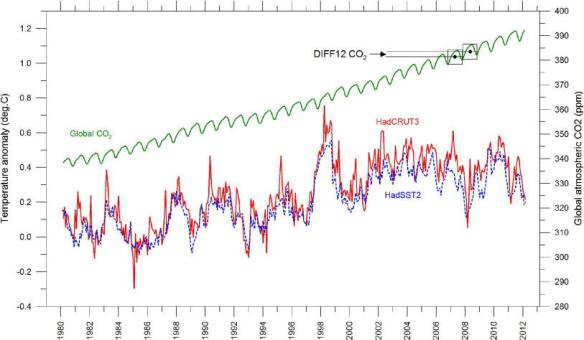
First let me start with this:

global temps - dec 2012

The text below is from a different article with a different chart but the result is just the same:

The apparent ‘decoupling’ of global heat from atmospheric CO2 concentrations — with the clear divergence of observed temperatures from projected temperatures — provides mounting evidence for falsification of IPCC climate models.

The conclusion:

Some observers of climate data are expecting the Earth to pass through at least a 30 year climate cooling period.

But if you are young you are generally less knowledgable. You therefore need something to show your independance even if that something is totally preposterous and impossible to believe if the facts are closely examined, But it is useful as a means to show independance and to differentiate yourself from your elders off you go. But really, why pick something so damaging that continuing along these lines will wreck your own life? The world is not apt to stay as it is, and your futures are not likely to be as rich and rewarding as were the lives of the generation now heading into retirement if by the policies you support you ruin our energy producing industries and raise production costs that send industry offshore. You may think you are being self sacrificing by your willingness to accept lower living standards for a better world with less carbon in the air. I just think you’re fools.

Which brings to mind this letter to the editor at Barron’s following the election. It was published under the heading, “A Warm Thank You” and so it is.

To the Editor:

This 50-something, white, conservative Republican wishes to thank America’s youth for sacrificing their financial futures and standard of living so that boomers, such as my wife and I, can look forward to a long and comfy retirement, which we could easily have afforded on our own. Now we have the youth as our guarantors and providers of a little something extra.

As reported by the national exit poll conducted by Edison Research, Americans aged 18 to 29 voted 60% to 36% for Barack Obama. Prior to Obama’s re-election, I believed that it was morally wrong for my generation to pass a crushing national debt on to the next one.

The debt will top $20 trillion before Obama moves out of the White House, and it will include spiraling retirement-related costs that the administration has shown zero interest in bringing under control, largely driven by baby boomers piling into the Social Security and Medicare systems.

With the president’s electoral crushing of Mitt Romney, my overriding sense of morality and guilt have vanished. Thank you, kids!

Edwin D. Schindler

The sad part for these fools is that they have shown little appreciation for irony. Such a bunch of nitwits, but at least there is that one silver lining that we will not have to live most of our lives led by such dumbells as these.

Computer politics

More on the analytics used by the Democrats during the campaign:

The appeals were the product of rigorous experimentation by a large team of analysts. ‘We did extensive A-B testing not just on the subject lines and the amount of money we would ask people for,’ says Amelia Showalter, director of digital analytics, ‘but on the messages themselves and even the formatting.’ The campaign would test multiple drafts and subject lines—often as many as 18 variations—before picking a winner to blast out to tens of millions of subscribers. ‘When we saw something that really moved the dial, we would adopt it,’ says Toby Fallsgraff, the campaign’s e-mail director, who oversaw a staff of 20 writers.

It quickly became clear that a casual tone was usually most effective. “The subject lines that worked best were things you might see in your in-box from other people,” Fallsgraff says. ‘”Hey” was probably the best one we had over the duration.’ Another blockbuster in June simply read, ‘I will be outspent.’ According to testing data shared with Bloomberg Businessweek, that outperformed 17 other variants and raised more than $2.6 million.

Writers, analysts, and managers routinely bet on which lines would perform best and worst. ‘We were so bad at predicting what would win that it only reinforced the need to constantly keep testing,’ says Showalter. ‘Every time something really ugly won, it would shock me: giant-size fonts for links, plain-text links vs. pretty “Donate” buttons. Eventually we got to thinking, “How could we make things even less attractive?” ‘That’s how we arrived at the ugly yellow highlighting on the sections we wanted to draw people’s eye to.’

Another unexpected hit: profanity. Dropping in mild curse words such as ‘Hell yeah, I like Obamacare’ got big clicks. But these triumphs were fleeting. There was no such thing as the perfect e-mail; every breakthrough had a shelf life. ‘Eventually the novelty wore off, and we had to go back and retest,’ says Showalter.

Fortunately for Obama and all political campaigns that will follow, the tests did yield one major counterintuitive insight: Most people have a nearly limitless capacity for e-mail and won’t unsubscribe no matter how many they’re sent. ‘At the end, we had 18 or 20 writers going at this stuff for as many hours a day as they could stay awake,’ says Fallsgraff. ‘The data didn’t show any negative consequences to sending more.’

The full article quoted from is found here.

Martian men, Venusian women

From the first moment I saw the title, Men are from Mars, Women are from Venus, the very idea of feminism as I understood it died. The only feminism that actually made sense, if you wanted to argue that there ought to be no reason for a woman to be seen as anything other than exactly comparable to a man, is to say that all differences are due to socialisation and none to genetics. But if men are from Mars and women are from Venus, then there are differences in the DNA that might well end up reflected in social outcomes. Quoting stats about different outcomes for men and women would only demonstrate the nature of the world, not some inbred discrimination.

All this by way of a lead in to a fascinating piece of transcript from Rush Limbaugh which he titles, “‘War on Men’ Column Causes Stir, Illustrates the Left-Wing Stuff We Laugh About But Lots of People Believe”. We used to laugh at these leftist idiocies, he points out, but as he looks at the opinions of the young, their views match these very delusions. What has touched off these reflections are Susan Venker’s piece on “The War on Men”. This is Limbaugh talking.

I was of the opinion that no rational majority of people is ever gonna subscribe to this radical feminism. For example, portraying men as natural predators. All sex is rape. Remember Catharine MacKinnon, all sex is rape, even the sex in marriage. And she was a professor of something at the University of Michigan. She was teaching this stuff and I remember do feminazi updates about it, laughing, ‘Okay, there’s always gonna be some small group of unhappy people.’

No, it’s not a small group. It has become reality for a whole lot of women. That and a lot of other things. The man, as a natural predator, had to be shielded, the children had to be protected from him. At the slightest raising of his voice, they called child protective service and said, “Come over to the house.” Maybe take the kids away if the husband was out of whack, and being out of whack didn’t take much other than raising your voice. All these things. I mean, I can’t remember, but some of them were just ridiculous. But they’ve become mainstreamed, and it’s not just with feminism. It’s a lot of other liberalism. The same kind of thing with environmentalism. The whole hoax of global warming.

However it has happened, the world is now filled with such ignorant and arrogant beliefs about just what ain’t so which has affected the politics of the West. Do people like Obama or Gillard believe these things too? It’s all possible, but there are plenty of those in the younger demographics who with certainty do, and many of these have been university educated.

And that’s why you get ads run by Obama on Julia. She’s single her whole life. And it’s why it works. We laughed at the Julia ad. That ad worked. The War on Women, this whole business of giving away contraceptives, we’re laughing at it. It worked. I don’t know on a majority, but it worked. There were actually enough women in this country who were made to believe that Mitt Romney was gonna take their birth control pills away from ’em, not let them have them. And then after they got pregnant he was gonna make them not have an abortion. They believe it. They’ve been told it. They’ve been educated this way.

I often wonder about what it was that I was taught that wasn’t so and has turned out that way. Nothing at all comes to mind. Scientific opinion does shift and new ideas become predominate. And the metaphysical will always be metaphysical. But something as obviously untrue as global warming does not exist in anything I was taught that I can think of. A non-reality-based political culture cannot survive. We are heading for the rocks.

Voting for revenge – Australian style

A very interesting article by Paul Kelly and expanded on by Andrew Bolt. The real Julia is a far left socialist filled with anger at the ways in which she has been treated by who knows who. She has, moreover, discovered there are no votes in good policy aimed at making Australia a better place. She now builds a constituency around a shared sense of resentment supplemented by taxpayer funded handouts of every description. From Bolt:

Abbott is now struggling to respond to Gillard’s screams of ‘sexism’ ‘smear’, ‘slime’ and ‘negative’ – with the disengaged, especially women, drawn in by the yelling and, with no context to guide them, taking Gillard’s description of events at face value. Yes, Abbott must have been attacking her just for being a woman. Yes, he must not have evidence for his ‘smears’. When did we last have Prime Ministers who’d say with such certainty what was not true?

Gillard has also taken the Obama playbook to pitch to identity groups and the great masses of welfarists. The handouts – largely funded by borrowings and taxes now found to raise no revenue – have been extraordinary, from cash splashes to extra payments just for having children at school.

It’s brought her back from the dead. A Prime Minister who does not deserve to win and should be excoriated for her deceits, policy disasters and divisiveness is now back in the contest. [my bolding]

There is plenty of identity politics out there and the national interest be damned. It is the beginning of the end in the new world being created before our eyes, both here and in the US.

What’s so funny?

When good economics and good politics diverge, politics wins.

The Obama administration’s opening bid on Thursday in negotiations to avert a year-end fiscal crunch included a demand for new stimulus spending and authority to unilaterally raise the U.S. borrowing ceiling, a Republican congressional aide said.

The proposal, made by Treasury Secretary Timothy Geithner to congressional Republican leaders on Capitol Hill, was seen as offering little the Republicans could agree to and was greeted with laughter, the aide said.

‘We can’t move any closer to them because they’re not even on our planet,’ the aide said. ‘It was not a serious proposal.’

Macro is still C+I+G and even if it doesn’t work and cannot work as economics, it is the only acceptable political answer. Where is “responsible government” then?