
An email on Say’s Law

On Friday, I received the following email.

Dear Professor Kates,

As perhaps the only lay person in the United States to have read the two books by Sowell and Hutt, as well as Anderson’s book and some of the articles you cited in your book, I consider myself pretty knowledgeable about the logic and rationale behind Law of Markets and I must say, yours is the best I have seen on the subject.

Your classical views pretty much line up with Austrian theory, especially in their criticism of the “lack of aggregate demand” theory accepted today as being the root cause of recessions, although it would not appear that you are totally sold on their link of recessions with “expansion of money supply” and consequential “malinvestment” in production– leading to the proverbial “cluster of errors” referred to by Robbins. You seem to believe that the malinvestment can occur without the expansion of the money supply. Austrians would agree, but they would maintain that malinvestment would not cause anything but micro level adjustments or perhaps a mild slowdown and not an outright macro-recessionary period. Dispute seems to be more about degree and semantics on how to define recessions rather than serious dispute on substance. Clearly, you and Austrians do not buy the general glut argument.

Your book was excellent overview of history of economic thought, at least from early 19th C. onward. It points out how wrong Keynes was on history of economic thought, either by ignorance, or as I believe, by design. He set up a false historical narrative in developing his straw man to make it easier to take down.

Your point that the acceptance of the “lack of aggregate demand” theory by economists since 1936 has set the science of economics on a terrible path cannot be understated. Failure to understand cause will almost always result in bad policy, as can be seen by measures taken in recent years by the “policy makers”. J.B. Say: “Thus, it is the aim of good government to stimulate production, of bad government to encourage consumption”. Contrast that with:

“Simply put, we live in a world in which there is too much supply and too little demand,” star economist Nouriel Roubini of New York University …

Ugh! That is the media’s “star”. How far the profession has fallen. Unfortunately, guys like Roubini, Stiglitz and Krugman now rule the day.

I have been working on a book for several years challenging most all of modern day macroeconomic theory, with one of the first fallacies being the lack of aggregate demand theory. (The deflation bogeyman is another.) I also bought your “Free Market Economics” and just started it last night. It looks like you beat me to the punch. Keep up the good work.

Kind Regards

So today, I wrote back.

Thank you very much for your kind and encouraging letter. We are so obviously on the same wave length that it is uncanny. I had thought that once the failure of the stimulus had become perfectly clear to everyone, there would be a groundswell of some kind to think through what had gone wrong, and that, perhaps, there would be a closer re-examination of the Keynesian macro that has ruined economic theory along with most of our economies. I must therefore confess to no little astonishment to discover that Keynesian economics is even more embedded within economics than ever. I suppose that to confess to such a massive error, as would need to be done if economists rose up and said, “come to think of it, Say’s Law seems to have been right after all and Keynesian economics wrong”, would have been a gigantic step too far. But even if not that, some kind of re-thinking about how an economy works, and whether valueless public spending really can generate growth, might have been in order. Such is not how it’s been. It is therefore not a little frightening that the cures continue to be administered from the demand side.

About the way I look at the cycle, “mal-investment” gives the impression that if entrepreneurs had been more clear-eyed about the future, that the downturn would never have occurred. For me, the recession that I grew up on was the downturn that followed the OPEC oil boycott of the 1970s which was followed by a massive inflationary pulse that led to an international wage explosion. The dislocations that rolled across the world were neither caused by nor could have been cured by monetary policy. Certain categories of investment – such as those that depended on low-cost energy – were left high and dry by these major changes in the economic environment in ways that no one could have foreseen. I also think that it helps me see these things because I live in one of the more remote provinces, where domestic monetary policy will seldom be the cause of a downturn. I therefore see recessions as a consequence of government policy generally and the effects of major international instability. The GFC started in the US, and while I think we in Australia should for the most part have ignored it so far as policy went, there was never any chance we were not going to be affected irrespective of the monetary policies we might have run, either before or after. My main point is that recessions are structural and not caused by too much saving (or supply!). My chapter 14 on the cycle is a summary of the classical view, which I have synthesised from Haberler. Chapter 15 looks at the role of government, which was not a classical perspective but it is mine.

I do hope you write your own book. The one thing I know from having written what I have is that you only truly understand what you think yourself by trying to write it all down. The things that end up on the page often surprise even you. Please let me know how you go. And if I may, I will attach a paper I did on the origins of the Keynesian Revolution. Just to be able to mention Fred Manville Taylor and Harlan McCracken is often a showstopper for someone trying to argue with a Keynesian. Try it out and see how you go.

With kind regards and many thanks again.
Keynes and Keynesian Economics in Light of the Financial Crisis

The economic societies of the United States meet over the first few days of the year, with the meeting this year in Boston. This is the full conference program which is gigantic. My interest is what is being said about the sad state of economic theory and its inability to provide guidance on how to find our way out of the present low state of our economies. This was the part of the conference I was most interested in myself:

Keynes and Keynesian Economics in Light of the Financial Crisis

So in its own way, you might say that these issues were on the agenda. However, not only was this the sole manifestation across the hundreds of papers given during the conference, but this was also not in any way part of the mainstream program, only tucked away as part of the program devoted to the history of economic thought. Clearly, none of this is of any genuine interest to virtually the entire profession. Nevertheless, all credit to Robert Dimand for putting the session together, and for treating this as the serious contemporary issue it is. These were the papers found in this session.

Keynes and Financial Crises
ROBERT DIMAND (Brock University)

The global economic and financial crisis that began in 2007 has renewed interest in Keynes’s analysis of whether the economic system is self-adjusting and of his proposals for ending depression. This analysis is complemented by Keynes’s more specific accounts of financial crisis, notably in his incisive “The Consequences to the Banks of the Collapse in Money Values” (in his Essays in Persuasion, 1931) and his Harris Foundation Lectures, a body of work that is much less well-known.

Keynes, Wages and Employment in Light of the Great Depression
HARALD HAGEMANN (Universität Hohenheim)

The wage-employment relationship is one of the central and most controversial issues in the General Theory. . . . and etc for another 200 or so words.

James Meade and Keynesian Economics
SUE HOWSON (University of Toronto)

James Meade (1907-1995), although Oxford-educated, was one of the very first Keynesians, a member of the Cambridge “circus” which met to analyze and criticize Keynes’s just published Treatise on Money in the early months of 1931. Not only did he use Keynesian ideas in his writings throughout his long career; he was a major player in the implementation of Keynesian policies in Britain during and immediately after World War II. My paper will discuss his encounters with Keynes and his use and development of Keynesian economics in his own academic and policy work.

Not that you should think that Keynesian economics was mentioned nowhere else. It showed up one more time, under “Heterodox Macroeconomics”, a session put on by the Union for Radical Political Economics. But I do love his first line, which is something the rest of the profession would prefer to forget. I’ve put it in bold just because, and left the rest in just to see how tedious this stuff can be.

Keynes is Dead — Long Live Marx
ISMAEL HOSSEIN-ZADEH

Many liberal/progressive economists envisioned a new dawn of Keynesianism in the 2008 financial meltdown. More than five years later, it is clear that the much-hoped-for Keynesian prescriptions are completely ignored. Why? Keynesian economists’ answer: “neoliberal ideology,” which they trace back to President Reagan. Using a Marxian method of inquiry, this study argues, by contrast, that the rise/dominance of neoliberalism has much deeper roots than pure ideology, that the transition from Keynesian to neoliberal economics started long before Reagan was elected President and that the Keynesian reliance on the ability of the government to re-regulate and revive the economy through policies of demand management rests on an optimistic perception that the state can control capitalism. Contrary to such hopeful perceptions, public policies are more than simply administrative or technical matters of choice. More importantly, they are class policies—hence, continuation/escalation of neoliberal policies under the Obama administration, and frustration of Keynesian/liberal economists. The study further argues that the Marxian theory of unemployment, based on his theory of the reserve army of labor, provides a much robust explanation of the protracted high levels of unemployment than the Keynesian view, which attributes the plague of unemployment to the “misguided policies of neoliberalism.” Likewise, the Marxian theory of subsistence or near-poverty wages provides a more cogent account of how or why such poverty levels of wages, as well as a generalized predominance of misery, can go hand-in-hand with high levels of profits and concentrated wealth than the Keynesian perceptions, which view high levels of employment and wages as necessary conditions for an expansionary economic cycle.

The largest single problem with economic theory today is that economists do not even know they have a problem. But the second most important problem is that what ought to have been the most important part of the entire program was relegated to students of the history of economic thought, which is the one area of economic theory economists are trying to rid themselves of. It’s as if these are issues so completely settled that no one any longer has to waste their time thinking about any of it at all.

AND LET ME JUST ADD THIS: From the Wall Street Journal, The Depression That Was Fixed by Doing Nothing. Before Keynes, there was no such thing as a Keynesian stimulus, but recessions got fixed anyway:

Beginning in January 1920, something much worse than a recession blighted the world. The U.S. suffered the steepest plunge in wholesale prices in its history (not even eclipsed by the Great Depression), as well as a 31.6% drop in industrial production and a 46.6% fall in the Dow Jones Industrial Average. Unemployment spiked, and corporate profits plunged.

What to do? “Nothing” was the substantive response of the successive administrations of Woodrow Wilson and Warren G. Harding. Well, not quite nothing. Rather, they did what few 21st-century policy makers would have dared: They balanced the federal budget and—via the still wet-behind-the-ears Federal Reserve—raised interest rates rather than lowering them. Curiously, the depression ran its course. Eighteen months elapsed from business-cycle peak to business-cycle trough—following which the 1920s roared.

That was what they did, but with the low state of economic knowledge today, there is little likelihood anyone will understand why it worked.

McCracken, Malthus and Say’s Law

It was all the way back in October that I received an email from Thomas Colignatus, a blogger in The Netherlands. He had read my article on the origins of the General Theory and had written a post on it titled, Thomas Robert Malthus visiting Maastricht. This is how he begins his post in relation to what I had written:

Malthus set John Maynard Keynes on the path of the theory of effective demand. Keynes in his Essays in Biography:

“If only Malthus, instead of Ricardo, had been the parent stem from which nineteenth-century economics proceeded, what a much wiser and richer place the world would be to-day!” (Keynes 1961 [1933], p. 120)

Relevant is also this archive of the History of Economics Review, and in particular Steven Kates on JMK and TRM and then also on JMK and McCracken, or see the longer discussion by Kates in HER 48, 2008.

“Thus, at the very time that he has commenced writing the book that will become the General Theory, the single most influential book on the business cycle written during the past century, Keynes states in no uncertain terms that the most fruitful approach to dealing with the economic issues raised by the cycle ought to be set within an analytical framework that descends from Malthus.” (Kates HER 48, 2008)

Note that David Ricardo isn’t kicked out of the window. His method of mathematical modeling is retained, of course. His arguments are duly weighted too. The only thing is that Malthus’s argument on the lack of demand finds proper recognition. What was counter-intuitive to Ricardo is rephrased so that it becomes the proper intuition that we enjoy today. Merely putting money in the bank doesn’t help: it are the real investments that determine income.

“The Keynesian Revolution, which swept the economics world in a matter of less than a decade, had its origins in Keynes’s reading of Malthus’s letters to Ricardo in late 1932. It was from these letters that Keynes discovered the issue of demand deficiency. Reading Malthus’s letters in the midst of the Great Depression infused within him the be­lief that demand deficiency was the cause of recession and mass unem­ployment. The essay on Malthus, found in Keynes’s Essays in Biography and published in February 1933, makes plain the extent to which he had absorbed Malthus’s economic views while reading Malthus’s writings. Malthus had been the leading advocate of demand deficiency in the nineteenth century. It was this message that Keynes’s carried into the twentieth.” (Kates 2010, History of Economic Ideas, xviii/2010/3)

I can only say that it has been a long semester, and while I ought to write to people immediately, there was a lot to write about. Even with this reply which I attach below, there is much more I could have written and should have written. But this gets to the issues at hand, or at least some of them.

Dear Thomas

I apologise for this long time in writing. And the delay was not because I was in any way hostile to what you had written. I actually found myself very pleased to see how accurately pretty well all of what you wrote was. If I were to say anything at all about the text, it is that while I do not think of Keynes as a plagiarist in the normal sense, I am certain he knew the sources of what he wrote but preferred to be thought original than have to share the glory with anyone else. There is no doubt in my mind that Keynes found knocking over Say’s Law the perfect vehicle for him to get governments to spend money in the midst of recession. He came upon Malthus in later 1932 because he was updating his Essay on Malthus, he borrowed Malthus’s letters to Ricardo from his closest friend, Piero Sraffa, and discovered the entire literature on demand deficiency. He is then swept along by his discovery and by one of the stranger flukes of history, is sent a copy of McCracken’s book that does two things. It completes every thought he had had about demand deficiency and Say’s Law, even giving him the phrase “supply creates its own demand”. And it disturbs him to find that someone else had seen exactly the same thing, either simultaneously, or more likely, even before he had, given how long it takes to get a book into publication. My memory on this is a bit suss by now, but I somehow recall that this was a book that was sent out to a few people McCracken thought would be interested, which is why Keynes takes the trouble to write to McCracken personally. It doesn’t matter much, but if it is not a personally sent copy, there is no reason for Keynes to have written to McCracken at all.

As for the phrase itself, I am not even sure that Keynes recognised that he had taken it from McCracken. In my view, he would never have used the phrase in the way he did if it had McCracken’s DNA all over it. Either he read it and noted the phrase since it so perfectly fit into the point he was trying to make and then forgot the source, or he merely thought that McCracken had himself taken it from the classical literature. But it is the one absolutely certain dye marker that connects Keynes to McCracken. I had always been convinced that McCracken had been a major influence on Keynes. He appears as an “undocumented” influence, in my Say’s Law and the Keynesian Revolution (Elgar 1998). It was only when Richard Kent picked this up years later – my thesis was written before internet searches were possible – that I was finally able to nail the connection. It is now absolutely undeniable, except that everyone in the Keynes industry continues to deny it.

And I do have to disagree with you where you write that “McCracken’s book did not contain other elements that Keynes was concerned about”. I read every pre-Keynesian book on the cycle as part of the research, which is why I read McCracken. But the moment I picked McCracken up, I knew that I was reading a preliminary version of The General Theory. It is wall-to-wall Keynesian pre-history. And the other interesting part about the General Theory is that all of the parts on Mill and Say’s Law and supply creates its own demand are not found in the three sets of galley proofs. This was inserted at the absolute last moment, either because he didn’t want anyone else to know what he was doing, or he felt he needed to strengthen the attack on established theory, or because it only occurred to him at the last minute. But he must have put this in almost at the very last minute either during Christmas 1935 or just after the New Year in 1936. I don’t think it was a last minute decision, myself, since it is so neatly done. But it was an issue he kept from every single person he had been dealing with, other than Sraffa, who knew exactly what Keynes was up to. And if you cross over to Cambridge, you can see Sraffa’s “Notes on the General Theory” which are sitting in the archive but have never been published. I have tried to publish them myself, but they will never be allowed out, you may be sure of that, or at least not for some time yet.

Anyway, I was very grateful that HEI published my article, so it remains in the literature, studiously ignored by everyone. To me, the combination of Fred Taylor’s general publication of the phrase “Say’s Law” in 1921, and McCracken’s first use of the phrase “supply creates its own demand” in 1933, is a devastating revelation, that if it became the issue it ought to be, would absolutely require a wholesale revision of the mythological version of the trek from the Treatise to the General Theory. I hear these nonsensical stories about the major role of the Cambridge Circus and the rest of it, but it is all horsefeathers to me. But you either have to take the evidence as it is, and recognise that Keynes out and out misled everyone about how he came to write the book, or you have to shrug your shoulders and say that he wrote his book, without telling everyone what he was actually doing at the time.

However, if you actually understand that he was reading McCracken and probably Taylor, there is a very different story to tell about the genealogy, and about the actual effect of the General Theory on the nature of economics, since he was absolutely wrong about the economics of his classical forebears. This is an instance, in my view, where understanding the history makes a very large difference to understanding the present.

UPDATE: Mantaray asks:

“Supply creates its own demand”. OK, so we all know this is a strawman. Is there a correct one-line definition?

I know this is already a long post, but who else is around at the moment, so I have taken this opportunity to slip all this in. Here is the best one-line definition in the whole of the economics literature. It is from a private letter written by David Ricardo to Malthus on 9 October 1820 (source: Ricardo 1951-73: VIII. 277), just after Malthus had touched off the General Glut debate with the publication of his Principles of Political Economy earlier that year.

“Men err in their productions; there is no deficiency of demand”.

There are three parts I like about it, all devastating for Keynesians. First, although Keynes specifically states that Ricardo and those who followed did not recognise the very fact of recessions, it is absolutely clear that Ricardo and Malthus are discussing the nature of economic recession and their cause. Second, Ricardo provides in short form, a summary of the classical theory of recession. The economy becomes misdirected for some reason. Recessions are structural, due to errors on the production side. Third, we have the true meaning of Say’s Law, stated as clearly as one could wish: whatever may be the cause of the downturn, “there is no deficiency of demand”. Every economist from Ricardo’s time till the publication of The General Theory in 1936 believed exactly that. Today, it’s down to me and about a couple of dozen others. Modern macroeconomic theory is a well recognised classical economic fallacy.

Krugman’s Keynesian cluelessness reaches new heights

This is economic cluelessness reaching some kind of peak:

The point is that relatively good private sector performance has been masked by public-sector cutbacks; this is the opposite of what you usually hear, but that’s no surprise.

This is, of course, the point of cutting back on the public sector during bad times, as Obama was forced to do. Krugman is describing the current upturn that has followed the sequester. Making virtue of necessity is the way of the world. But the incapacity of seeing what a dismal detour all of the stimulus spending actually was is the province of Keynesians. Of course, the fall in public sector spending shows up as a fall in GDP. But that’s a fault of the statistic, not of the policy.

Importantly, the reality described is of a rising private sector that is finally being allowed to recover by cutting back on public spending. For a true equation of economic growth, you should try Y=C+I-G, just for a change. It’s still pretty subdued by this is why “austerity” has become the universal policy, irrespective of what our economic textbooks say.

Ha-Joon Chang – please copy

Ha-Joon Chang seems to be the economist of the moment, with yet another book published by Penguin, Economics: The User’s Guide. But what is notable for me is that he has obviously, but only obviously to me, looked either at what I have written about Say’s Law or looked at someone else who has picked up on what I have written on Say’s Law. He does the usual ritual on “supply creates its own demand” but then adds:

“There can be no such thing as a recession due to a shortfall in demand.” [p 116]

You who have heard me harangue on this for many a moon may think nothing of this, but this is precisely the definition I use myself. It is apparently and pleasingly getting out and about. Because once the focus is in the right place and on the right thing, then we can have a genuine debate. Are recessions caused by a shortfall in demand? Because you would have to be demented to believe that the Global Financial Crisis was in any way caused by a fall off in demand. Same for every other recession in history up until now. But if one merely looks at the GFC, a fall in demand because of decisions to save has to be the least plausible of all possible explanations. In fact, Chang, and I think following my lead, goes on to describe the kinds of things that those classical economists used to look at for explanations, which again you would have to be demented not automatically to look at yourself. He writes:

Any recession had to be due to exogenous factors, such as a war or the failure of a major bank.

He thinks bank failures are exogenous [ie external to the operation of the economy, like being hit by a meteorite, say]! A bank failure is precisely what might be thought of as both endogenous and not in any way a Keynesian explanation, which is based around demand failure due to too much saving, not some kind of crisis on the production side. And you would like then to know what caused the bank to fail, and whether the problem was more widespread than a single bank, since during a financial crisis there is never only one bank going to the wall.

But then he goes on to add the usual Keynesian idiocies since economists just do not seem to be able to help themselves:

Since the economy was incapable of naturally generating a recession, any government attempt to counter it, say, through deliberate deficit spending, was condemned as disturbing the natural order. This meant that recessions that could have been cut short or made milder became prolonged in the days of Classical economics.

You really do have to wonder about these blockheads! We are the midst of what may already be the most prolonged of all recessions in history, and it is by no means over yet, and he complains about classical economists’ reluctance of try to fix things by public spending. Let me once more quote from my Quadrant piece from February 2009 which was titled, The Dangerous Return to Keynesian Economics:

Just as the causes of this downturn cannot be charted through a Keynesian demand-deficiency model, neither can the solution. The world’s economies are not suffering from a lack of demand, and the right policy response is not a demand stimulus. Increased public sector spending will only add to the market confusions that already exist.

What is potentially catastrophic would be to try to spend our way to recovery. The recession that will follow will be deep, prolonged and potentially take years to overcome.

That is classical economics forecasting almost six years ago the prolonged recession every economy in the world is in the midst of and cannot shake off. If you would like to understand more fully what classical economists actually believed, you cannot do better than this.

Free Market Economics and Say’s Law

This post is the second of a series I am writing on the second edition of my Free Market Economics that has been published in association with the Institute of Economic Affairs in London. This post focuses on the single most important principle in economics which now goes under the name Say’s Law. But it is a principle that was deliberately eliminated from within mainstream economic theory by Keynes in his General Theory and has disappeared from virtually all economic discourse since that time.

The book was itself written because there is literally no economics text of any kind anywhere that discusses Say’s Law. Yet it was this principle that made it perfectly obvious that the stimulus being applied across the world from the end of 2008 would lead to an economic stagnation that would last years on end. That is why I immediately began to write the book then and there, but it is also why I had published in February 2009, just as the stimulus was getting under way, an article with the title, “The Dangerous Return to Keynesian Economics”. The article specifically discussed the crucial disappearance of Say’s Law and included this forecast:

“Just as the causes of this downturn cannot be charted through a Keynesian demand-deficiency model, neither can the solution. The world’s economies are not suffering from a lack of demand, and the right policy response is not a demand stimulus. Increased public sector spending will only add to the market confusions that already exist.

“What is potentially catastrophic would be to try to spend our way to recovery. The recession that will follow will be deep, prolonged and potentially take years to overcome.”

While virtually the whole of the economics profession remains flummoxed by what has happened since the stimulus, neither my students nor myself have been in any doubt. It has been as obvious as the noonday sun, but invisible to anyone brought up on modern macroeconomics which has embedded the theory of aggregate demand, Keynes’s disastrous contribution to economic theory.

Say’s Law specifically stated that demand deficiency, that is, a deficiency of aggregate demand, could never be the cause of a recession (or in the archaic language of the classics, “there is no such thing as a general glut”). It then specifically told governments that while some additional public expenditure during recessions might do some small good, such a stimulus would never restore an economy to robust health but would, instead, do serious damage, and the larger the stimulus the more damage it would do.

The book explains the nature of Keynesian economics but also explains why a stimulus could not possibly have returned our economies to rapid rates of growth and low unemployment. The experience of the past six years ought to have made all this supremely evident in practice. But without an understanding of Say’s Law, there is not a chance in the world anyone will understand why the stimulus has been the colossal failure it has been.

Although named Say’s Law after the early nineteenth century French economist J.-B. Say, it was a principle that was part of the bedrock foundation of economic theory right up until 1936. But what will never be told to you by any Keynesian economist (in large part because they don’t even know themselves) is that the term Say’s Law was invented in the twentieth century by an American economist who thought it was absolutely essential for clear thinking in economics and brought into active use only in the 1920s.

If for no other reason, I commend my book to you because it is the only place where one can have Say’s Law explained in a way that makes you understand what economic theory has lost. It will also explain why the stimulus did not work and what must be done instead, reasons enough to buy the book I would hope. But there are also others which I will come back to in later posts.

General gluts and laissez-faire

The European Society for the History of Economic Thought has proposed the following as an issue that might be investigated during its next meeting in May:

First, over the issue as to whether a market-based economy tends naturally to use its resources in the best possible way without any State intervention beyond that of providing basic infrastructure and protecting property rights: a matter of concern from the times of the General Glut controversy that saw Malthus opposed to Ricardo down to the debates that have marked the evolution of macroeconomics since the publication of Keynes’ General Theory.

I suppose with the words “from the times of” they are not with absolute certainty suggesting that there is any relationship between the general glut debate and laissez-faire, but let’s face it, they are. And I realise that just because I stated in my Say’s Law and the Keynesian Revolution that “the issue in regard to Say’s Law is not laissez-faire” (p 16) doesn’t mean (1) that anyone interested in this issue read the book or that (2) even if they read it, that they had accepted my argument even if they noticed it.

The conclusion reached at the end of the general glut debate was that demand did not affect the level of economic activity and therefore did not affect the level of unemployment. That may or not be true but was accepted almost without dissent from around 1808 through to 1936, during which time the role of the state became ever more large. In 1935, no one thought of economic policy as laissez-faire but there was even so an almost universal denial of overproduction as a cause of recession and mass unemployment. Indeed, just how far apart the two concepts are may be seen in this comment by John Stuart Mill, the most relentless defender of the impossibility of a general glut amongst classical economists, in his volume, On Socialism. How much farther from the notion of laissez-faire could this be:

The kind of policy described is sometimes possible where, as in the case of railways, the only competition possible is between two or three great companies, the operation being on too vast a scale to be within the reach of individual capitalists, and this is one of the reasons why businesses which require to be carried on by great joint-stock enterprises cannot be trusted to competition, but, when not reserved by the State to itself, ought to be carried on under conditions prescribed, and, from time to time, varied by the State, for the purpose of insuring to the public a cheaper supply of its wants than would be afforded by private interest in the absence of sufficient competition.

Thus roping the two together only demonstrates how little is understood about the nature of the general glut debate – which in our own time being about whether the GFC was due to demand deficiency and a stimulus is the proper response is the central economic question of our time. If I argue that the poor economic conditions of the present are not caused by an absence of demand that makes absolutely no claim about whether there are a chain of government policies and interventions that might help to improve the state of the economy. The possibility of general gluts and laissez-faire are independent concepts.

That governments may base their interventions on the belief that they have to increase aggregate demand is something else. But even if governments finally eventually do reduce their own level of expenditure and did somehow balance their budgets, the notion that we would then be living in a laissez-faire economy would remain unmistakeably wrong. They are not the same issue and should not be confused.

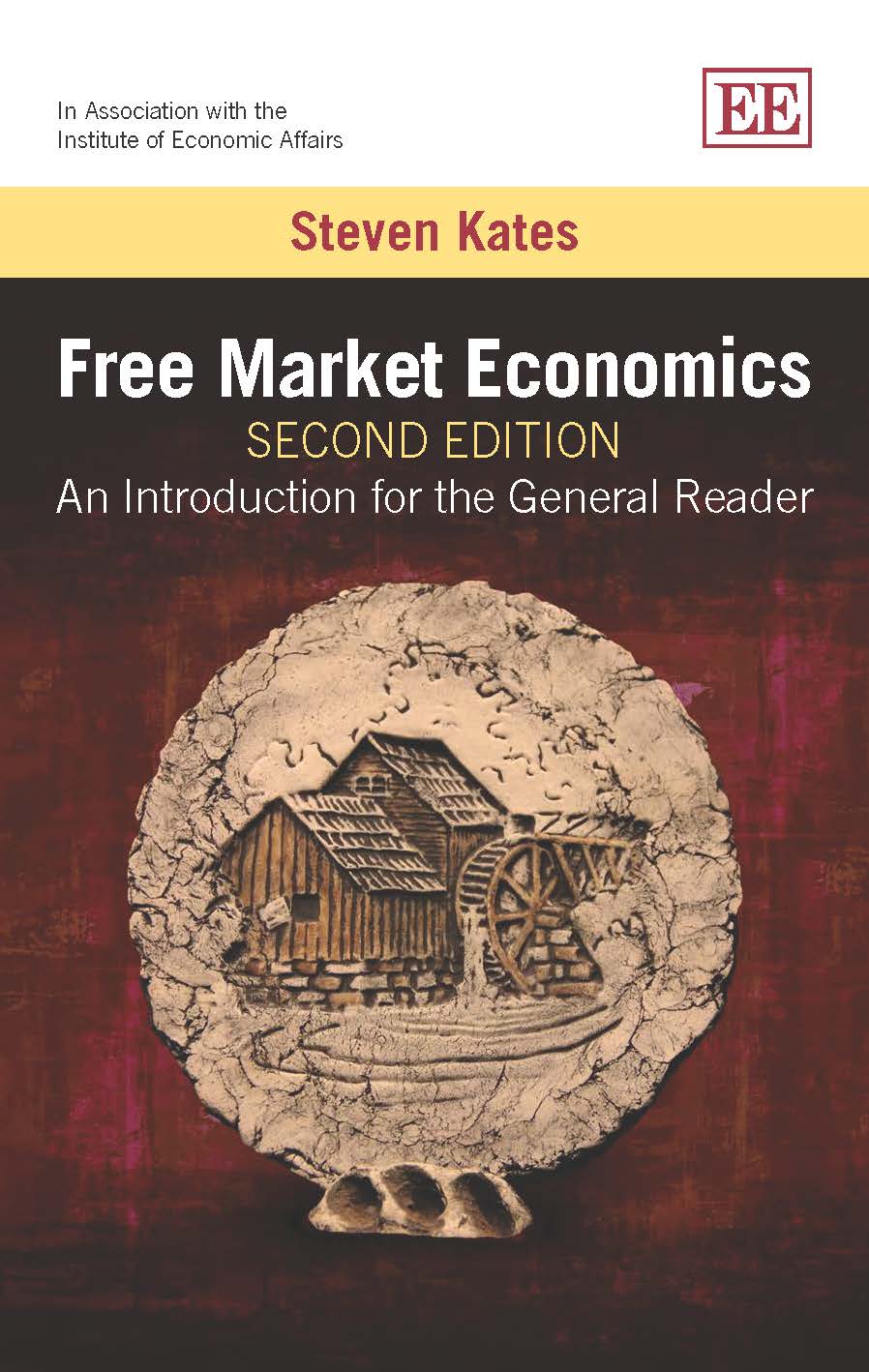
Free Market Economics 2nd ed

fme2 cover_Page_1

When I wrote the first edition of my Free Market Economics in 2009, I thought of it even then as the best introduction to economic theory anywhere. It combined five features that were unique to this book: an uncompromising anti-Keynesian core, a microeconomics that rejected the notion of an equilibrium, a focus on the role of the entrepreneur, a discussion of the classical theory of the cycle and the installation of uncertainty as the crucial element in any serious discussion of how an economy runs.

I also had no idea how much more I wanted to say until I came to write the second edition which to my eyes has transcended the first, having been fashioned out of what I learned by teaching the first edition for five years while watching how economic events unfolded following the stimulus. You may only have the author’s word for it here, but there is no book like it. If you want to understand how an economy works based on the English tradition in economic theorising that goes from Adam Smith to John Stuart Mill, there is literally only a single place you can go. The book reverses two “revolutions” in economics, not just the Keynesian of the 1930s, but the marginalist revolution of the 1870s as well. It is a companion volume to David Simpson’s wonderful The Rediscovery of Classical Economics, also co-published by the IEA. Reading the two will provide you with an understanding of just what is wrong with economic theory today. That traditional policy based on standard economic theory is ruining our economies is beyond any doubt, but the reason why that is so will nevertheless remain incomprehensible to anyone who continues to believe that aggregate demand is a valid concept in trying to make sense of economic events or that equilibrium has much if anything to do with how an economy works.

My Free Market text was written in a kind of white heat over twelve weeks as the text for the course I was giving during the first months of the worldwide introduction of stimulus packages pretty well everywhere. The absolute dead certainty I had was that public sector spending whose only aim was to create jobs would end in disaster, as it most assuredly has. Our economies are sinking under the weight of massive levels of unproductive public spending and debt levels that continuously subvert every attempt to wind them back. Yet you cannot go to any standard economics text even for an inkling of why that is.

To understand any of this you must first understand Say’s Law. Say’s Law was the bedrock principle of economic theory from the earliest years of the nineteenth century until swept away in a fit of distraction by the publication of Keynes’s General Theory in 1936. It is founded on recognising that only value adding production can create economic growth and add to the number of jobs. The most central chapter in the book is the chapter on Value Added, a chapter found in no other text that I know of. Yet without understanding value added, understanding that every form of production not just creates more goods and services but also at the same time uses up existing goods and services during the production process, it is impossible to think about public spending and economic policy correctly. Only if what is produced has greater value than the resources used up can an economy grow. Government spending seldom creates value. The stimulus was therefore doomed to fail as is so much of the policy matrix found today.

The strangest part about the book, however, was for me to discover my own beliefs on the nature of economic theory. There is not a chapter in it that would fit into a standard economics text. All of it takes you back to an earlier time and a different theoretical matrix. Space is too short to tell you much more but let me draw you to the cover which shows a water mill on a plaque made of clay. This is because the two most important influences on my own way of thinking have been two of the greatest economists England has ever produced, John Stuart Mill and Henry Clay.

I can do no more than encourage you to read this book. It is a defence of the market economy published at a time when there may never been a greater need for such a defence.

Paul Krugman has no idea what Say’s Law means

In the same week that the 2nd edition of my Free Market Economics has been published, which I began specifically in response to the stimulus that followed the GFC and the certainty that it would fail because of the principles that underlie Say’s Law, I have received copy of a review of a book titled, Seven Bad Ideas. The book is by Jeff Madrick while the review is by none other than Paul Krugman. And here once again we find Say’s Law, as the second worst idea in economics, just after the number one bad idea, “the invisible hand”. If you think the invisible hand is the worst idea economists have ever come up with, you are near enough not an economist, more a charlatan but then he has the Nobel Prize so who’s to argue. This is what Krugman thinks the invisible hand means amongst economists:

Today the phrase is almost always used to mean the proposition that market economies can be trusted to get everything, or almost everything, right without more than marginal government intervention.

What “everything, or almost everything” might consist of is a quite bizarre notion. The reality is that no one thinks an economy will run without institutional intervention at almost every facet of an economy’s operation. Every economist is perfectly aware of the absolute necessity of an institutional structure, much of it at the hands of government, and much of it based on legislation and regulation. There are debates about the sorts of regulation needed and the kinds of legislative penumbra that has to surround an economy. But the notion an economy requires only “marginal” intervention is nonsensical and straightforwardly untrue.

But so what if there are economists who think this. The absolute reality is that every economy has regulation up to its eyeballs. If some of us think less regulation would be better is hardly evidence that the economy is doing poorly because of its absence. You would have to be utterly out to lunch to think the regulation of any economy in the world could be described as light-handed. There must be quite a few gullible types out there if the kind of statement that Krugman makes can carry any weight at all.

But it is the second supposedly bad idea that is an old story. It is what is known as Say’s Law which in its micro form states that demand is created by value adding supply and in its macro form states that no economy ever goes into recession because of a lack of demand and that an economy in recession cannot be resurrected by a stimulus made up of non-value adding forms of expenditure. The macro version condemns just the kinds of expenditure every single stimulus has consisted of. The issue isn’t crowding out. The issue is that public spending uses up more value than it creates. If you waste your resources, your economy will shrink. That is what has happened universally since the “stimulus” and Krugman has not a clue in the world what has gone wrong. Here is what he wrote:

No. 2 on Madrick’s bad idea list is Say’s Law, which states that savings are automatically invested, so that there cannot be an overall shortfall in demand. A further implication of Say’s Law is that government stimulus can never do any good, because deficit spending by the public sector will always crowd out an equal amount of private spending.

But is this “mainstream economics”? Madrick cites two University of Chicago professors, Casey Mulligan and John Cochrane, who did indeed echo Say’s Law when arguing against the Obama stimulus. But these economists were outliers within the profession. Chicago’s own business school regularly polls a representative sample of influential economists for their views on policy issues; when it asked whether the Obama stimulus had reduced the unemployment rate, 92 percent of the respondents said that it had. Madrick is able to claim that Say’s Law is pervasive in mainstream economics only by lumping it together with a number of other concepts that, correct or not, are actually quite different.

Economists can say all they like that the stimulus lowered the unemployment rate but the fact of the matter is there cannot be any actual evidence one way or the other. That the models used by economists almost universally say that a stimulus will reduce unemployment is of itself the only “proof” that it has. The logic goes:

Major premise: a public sector stimulus will reduce unemployment below the level it would otherwise have reached

Minor premise: most economies introduced a public sector stimulus

Conclusion: the stimulus reduced unemployment below the level if would otherwise have reached.

That is, A causes B. There was A so therefore B. There is no evidence since there are no controlled experiments. All this is by assumption only. Well two can play at that game.

Major premise: a public sector stimulus consisting of non-value adding forms of expenditure will keep unemployment higher than it would otherwise have been

Minor premise: most economies introduced a public sector stimulus consisting of non-value-adding forms of expenditure

Conclusion: the stimulus has kept unemployment higher than it otherwise would have been.

And the fact of the matter is that the American labour market has not returned to the level it was at in 2008. Unemployment is a disaster without the slightest evidence that matters are on the mend.

Paul Krugman has not a clue. He is stuck in that Keynesian bunkum from which no actual evidence from the real world will ever dislodge him. The American economy continues to sink because of the straight out ignorance of basic economics of pretty well the entire economics profession (approximately 92 percent). Nothing can be done about it in the short term, but the smug smarmy superiority in the face of the immense harm that he and his likeminded colleagues have caused makes me very angry indeed.

Krugman is obviously a hopeless case. But I will simply state that economic theory will never provide useful guidance during recessions until Say’s Law is once again seen as the fundamental principle it is. And if you are interested in what it means and why it matters, the 2nd edition of my Free Market Economics is the place to start finding out.

A Say’s Law moment

There are three events coming to a head at the moment that relate to my work on Say’s Law.

There is, firstly, the publication of the 2nd ed. of Free Market Economics which will be co-published by the Institute of Economic Affairs in London. On my involvement with the IEA in the publication of this book, I have written:

Let me also add how delighted I am that this second edition is being published in association with the Institute of Economic Affairs. There has been no organisation more influential on my way of thinking about economic issues than the IEA which almost alone stood up for free markets and free enterprise in those dark days of the 1970s and early 1980s. It was the IEA which brought to wider public attention authors such as Milton Friedman, Friedrich Hayek and James Buchanan. The points they made have to be continually re-iterated as ideas with a less impressive academic provenance, not to mention frequently disastrous economic results, continually take hold in public policy debates

Then, second, if it can be arranged, I will be off to the First Congress on Jean-Baptiste Say and the Entrepreneur in Auchy on the north coast of France. This is the letter of invitation I received last night.

Dear Colleague,

I am honored to invite you to participate in the 1st International Congress Jean-Baptiste Say- RNI Summer School 2014, organized by the Research Network on Innovation and the International Society Jean-Baptiste Say (SAYS) from the 27th to 30th August 2014 at Universite du Littoral Cote d’Opale, Boulogne-sur-Mer and at Auchy-les-Hesdin (Nord-Pas­ de-Calais, France):

The conference is composed of various conferences, workshops and cultural activities (Cf. the program of the conference http://says.univ-littoral.fr/?page id= 102). Your contribution to the academic debates and your participation in different activities during will be highly appreciated.

I am looking forward to meeting you this summer.

I wish I were ten years younger. I didn’t think it would come to this, but travel has a lot of wear and tear. But for this one I am definitely ready to make the effort. Say is returning, and even though they focus on his work on the entrepreneur, they only leave out Say’s Law because it is too contentious.

And last but definitely not least, there is the movie being made that has, at its very centre, a series of principles of economic management based on Say’s Law. If you would like to read the book from which the movie is being made from, it’s called Waffle Street. It is premised on an understanding of Say’s Law so you’d hardly think it’s movie material but the world is stranger than you can sometimes believe. But if you get the book, you will see nine principles at the end, the first one being, “production is the source of all consumption”, that is, demand is constituted by supply. I am told there is a cameo of my Say’s Law and the Keynesian Revolution that has been filmed. But whether or not it makes it past the cutting room floor, this is strangely the first movie ever made based on an economic principle. It also has an incredible story line that has the potential to make it the movie of the year. If you don’t believe me, read the book, and if you do, make sure you get to the list of nine “Articles of Economic Faith” at the end.