If you want to raise the minimum wage you need to raise productivity first

The video comes at an opportune time since this is a large part of where our next election will be fought: Business faces world’s highest minimum wage under Bill Shorten. I will also mention that the Card and Krueger study mentioned in the vid for many years played a large part in our own wage cases where I had to spend an inordinate amount of time demonstrating how inane the notion is that higher minimum wages do not cost jobs. They do. Unless productivity goes up, the only possible outcome of raising minimum wages is a fall in employment. The vid makes the case, while also establishing how out to lunch the economic establishment is in yet one more area. Thinking you can create jobs by raising the minimum wage is as stupid as believing you can increase employment through unproductive public spending. Modern economics has almost entirely lost its way, but if that’s the advice people want, there will be plenty of advisors to provide it.

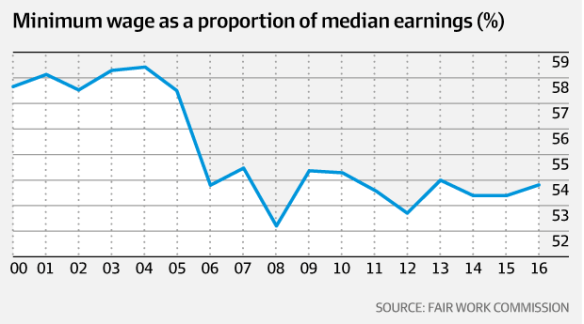
The chart below is from that same article, showing the drop in the minimum wage as a proportion of the median wage which coincided with the GFC and may even have preceded it. A very old sequence, a downturn that decimates industry changes the employment pattern along with the underlying wage structure. Using averages as a measurable reality that can be adjusted by some kind of administrative policy will never ever work. If you want to raise the real wage or the minimum wage you can only do it by raising the level of real value added per employed person. That’s called leaving things to the market, a very old idea that has always worked when it has been applied, but another one of those notions economists in general have long ignored and is now all but forgotten.

Just because it’s the minimum wage doesn’t mean it has only minimal impact

The minimum wage costs a lot of jobs. If people prefer to work than live on welfare, we should not prevent them. These are interesting stories from San Francisco where they just had a radically large increase in the minimum wage across the city. Usually, it is an increase that is a shade higher than the prevailing wage so no one really notices. There are few extra losing their jobs, and those who were already unemployed are just part of the background. It’s a case study, When Minimum-Wage Hikes Hit a San Francisco Comic-Book Store, but for those simpletons who think minimum wage adjustments make little difference, this should be an eye opener.

‘I’m hearing from a lot of customers, ‘I voted for that, and I didn’t realize it would affect you.’

So says Brian Hibbs, owner and operator of Comix Experience, an iconic comic-book and graphic-novel shop on San Francisco’s Divisadero Street, of the city’s new minimum-wage law. San Francisco’s Proposition J, which 77 percent of voters approved in November, will raise the minimum wage in the city to $15 by 2018.

As of today, May 1, Hibbs is required by law to pay his employees at Comix Experience, and its sister store, Comix Experience Outpost on Ocean Avenue, $12.25 per hour. That’s just the first of four incremental raises that threaten to put hundreds of such shops out of business.

Hibbs opened Comix Experience on April Fools’ Day, 1989, when he was just 21 years old. Over two-and-a-half decades, the store has become a must-visit location for premier comic-book artists and graphic novelists, and Hibbs has become a leading figure in the industry, serving as a judge for the prestigious Will Eisner Comic Industry Awards and as a member of the Comic Book Legal Defense Fund’s board of directors. He notes with pride that his store has turned a profit each year — no small task — since its very first year.

But that may not last. Hibbs says that the $15-an-hour minimum wage will require a staggering $80,000 in extra revenue annually.

“I was appalled!” he says. “My jaw dropped. Eighty-thousand a year! I didn’t know that. I thought we were talking a small amount of money, something I could absorb.”

He runs a tight operation already, he says. Comix Experience is open ten hours a day, seven days a week, with usually just one employee at each store at a time. I

t’s not viable to cut hours, he says, because his slowest hours are in the middle of the day. And he can’t raise prices, because comic books and graphic novels have their retail prices printed on the cover.

What is a small-businessman to do?

The small business shuts. The next one doesn’t open, while large business just trims.

Asking people earning $350,000 a year, as we do in Australia, may be the wrong way to determine the minimum wage.

Hey hey FWA – how many jobs did you kill today?

The economic arguments in favour of the minimum wage are for all practical purposes non-existent. But our National Wage Case is an established ritual that will not be disappearing any time soon since it continues as the linchpin in our system of industrial relations. But for the system to work as it needs to, those who make the decisions have to understand in their bones that there are no good economic reasons for raising the minimum wage. It keeps many people unemployed who otherwise would have jobs. If anyone on the Fair Work Commission panel adjudicating this case believes they have a convincing and contrary argument to make, they ought to write it up and send it off to a journal. They would thereafter maintain an enduring fame as the person who showed that a higher cost of labour did not lead to a reduced demand for employees. Many have taken up that challenge, but no one has yet succeeded. It is something like the economics equivalent of squaring the circle.

Given that raising the minimum wage will cost jobs, the absolute necessity for those who make these wage decisions is that they balance the economic harm against whatever industrial relations peace it might bring. You cannot count on unions understanding any of this, but you would hope that the Commission does. With the first round of this year’s submissions having been submitted on Thursday, we will see all of this reach a peak sometime in June when the decision is brought down.

I mention all this for a second reason. I am, with Sinclair, on the editorial board of the Journal of Peace, Prosperity and Freedom whose third ever edition has just come out. As its editor, Sukrit Sabhlok, says, it is edited “by a graduate student (me) without administrative/marketing support”. He therefore adds that “letting your local libraries/databases know about print subscriptions would be appreciated”. He further adds that “the journal is the only Austrian economics, free market economics, libertarian academic journal in Australia.” So if you would like to subscribe, you can subscribe here.

And as one of many reasons to subscribe, let me draw your attention to the latest issue in which there is an article with the title, The Irony of the Minimum Wage Law: Limiting Choices Versus Expanding Choices written by the extraordinarily eminent Walter E. Block (PhD, Columbia University), the Harold Wirth Eminent Scholar and Professor of Economics at Loyola University New Orleans, whose co-authors are Robert Batemarco and Charles Seltzer.

Here is the abstract, whose contents will be of no surprise to anyone who understands economics, or indeed to anyone who possesses an ounce of common sense.

Persistently high unemployment among specific sub-groups, namely teenagers, African-Americans and workers with low skills has been a serious problem in the United States. In this paper, we trace a large portion of that problem to the existence of minimum wage laws that have been in force nation-wide since 1938. These laws remain popular despite their adverse effects because of a lack of economic understanding among the general public. In this paper, we aim to make clear even to those without advanced economic training why the minimum wage law is not a viable solution to the problems of those its proponents purport to help, but rather a cause of worse problems for them. Our method is to use elementary economic logic to show that the minimum wage must harm many of those it is claimed to help by costing them their jobs and to review the data to show that it always has harmed them. Our conclusion is that minimum wages have not achieved their putative goal, but have served the ulterior motives of limiting the competition faced by labor unions. Our recommendation is to repeal minimum wage laws, and failing that, to at least lower their rates, and in their place to help low-skill workers by reducing the barriers to their receiving enough education to raise their marginal revenue product so as to permit them to earn higher wages in a way that does not remove their employment opportunities.

As for the title, I know I am using the Commission’s now discarded name, Fair Work Australia, but then if I used its real name, it wouldn’t rhyme. I, of course, trust that you will know what I mean. But will they?