General gluts and laissez-faire

The European Society for the History of Economic Thought has proposed the following as an issue that might be investigated during its next meeting in May:

First, over the issue as to whether a market-based economy tends naturally to use its resources in the best possible way without any State intervention beyond that of providing basic infrastructure and protecting property rights: a matter of concern from the times of the General Glut controversy that saw Malthus opposed to Ricardo down to the debates that have marked the evolution of macroeconomics since the publication of Keynes’ General Theory.

I suppose with the words “from the times of” they are not with absolute certainty suggesting that there is any relationship between the general glut debate and laissez-faire, but let’s face it, they are. And I realise that just because I stated in my Say’s Law and the Keynesian Revolution that “the issue in regard to Say’s Law is not laissez-faire” (p 16) doesn’t mean (1) that anyone interested in this issue read the book or that (2) even if they read it, that they had accepted my argument even if they noticed it.

The conclusion reached at the end of the general glut debate was that demand did not affect the level of economic activity and therefore did not affect the level of unemployment. That may or not be true but was accepted almost without dissent from around 1808 through to 1936, during which time the role of the state became ever more large. In 1935, no one thought of economic policy as laissez-faire but there was even so an almost universal denial of overproduction as a cause of recession and mass unemployment. Indeed, just how far apart the two concepts are may be seen in this comment by John Stuart Mill, the most relentless defender of the impossibility of a general glut amongst classical economists, in his volume, On Socialism. How much farther from the notion of laissez-faire could this be:

The kind of policy described is sometimes possible where, as in the case of railways, the only competition possible is between two or three great companies, the operation being on too vast a scale to be within the reach of individual capitalists, and this is one of the reasons why businesses which require to be carried on by great joint-stock enterprises cannot be trusted to competition, but, when not reserved by the State to itself, ought to be carried on under conditions prescribed, and, from time to time, varied by the State, for the purpose of insuring to the public a cheaper supply of its wants than would be afforded by private interest in the absence of sufficient competition.

Thus roping the two together only demonstrates how little is understood about the nature of the general glut debate – which in our own time being about whether the GFC was due to demand deficiency and a stimulus is the proper response is the central economic question of our time. If I argue that the poor economic conditions of the present are not caused by an absence of demand that makes absolutely no claim about whether there are a chain of government policies and interventions that might help to improve the state of the economy. The possibility of general gluts and laissez-faire are independent concepts.

That governments may base their interventions on the belief that they have to increase aggregate demand is something else. But even if governments finally eventually do reduce their own level of expenditure and did somehow balance their budgets, the notion that we would then be living in a laissez-faire economy would remain unmistakeably wrong. They are not the same issue and should not be confused.
John Stuart Mill and the logic of economics

I have just been confronted by two articles I have refereed, both on the economics of John Stuart Mill, that I rejected because they have no idea what Mill is trying to explain or the logic of what he is getting at. Both, however, are likely to be published no matter what I might think. Here was Mill, the man with the nineteenth century’s highest IQ, the author of the book on logic that was used for two generations across the English speaking world, a book still eminenty worth reading to this day, yet both of these papers criticise Mill for contradicting himself and faulty logic.

Mill’s Principles of Political Economy is far and away the best book on economic theory ever written. My own book on Free Market Economics (now in its second edition) is Mill brought up to date with a few modern gadgets. Also brought into the text and heavily criticised are the various additions to economic theory that have made economics far worse as a tool of analysis and a basis for policy, most notably MC=MR and Keynes.

All I can say is how exasperating it is to read these critics of Mill who cannot even begin to understand the problems with their interpretations. But what is the peculiar bit is that in being possibly the only economist in the world who thinks of Mill as the best economist who has ever lived, there is not a soul alive who I can turn to for support. I am not the smartest person on the world today, but I do come closer to understanding Mill than anyone else writing on economics. The massacre of our economies by the modern doctors of economic theory is as obvious to me as it is invisible to them. So on it will go but the certainty is that if we keep up in the way we have, we will never ever generate a recovery worth having and living standards will continue to fall.

The great discontinuity in Keynes’s economic thought

This is an extract from a note I have written to an economist in the United States whose work I have only just come upon. I am beginning to become aware of the various attempts by a number of economic schools to abandon modern neo-classical theory which, in my view anyway, mostly means trying to rediscover what the classical economists already knew. Perhaps there is more to it but so far I cannot see what. The interest in this letter, however, is in the nature of the Keynesian Revolution. I have no in-depth knowledge of Keynes’s Treatise on Money although am reasonably familiar with it. But it was published in 1930 while my interest begins in 1932 with Keynes’s discovery of demand deficiency as the explanation of recession and involuntary unemployment.

The paper I am commenting on treats Keynes’s ideas as if there had not been the great disruption at the end of 1932 when Keynes came upon Malthus’s 1820 letters to Ricardo. It was these that instantly converted him into a Keynesian theorist which he had not previously been, even though he had always sought to increase public spending to reduce unemployment during recessions. That virtually all of his contemporaries understood how thin Keynes’s arguments are is now just of historical interest and of interest to hardly anyone at all. Only by going back to those moments of transition, and by understanding what economic theory was like before 1936, is there any hope for again turning economic theory into something useful for analysing economic events. This then is what I wrote:

I would have written back straight away but Tuesdays is my heavy duty teaching day and I also didn’t want to clutter your inbox until I had read your brilliant article on Keynes. You cannot imagine how similarly we see the world and what a treat it is for me to read something like what you wrote. I will, of course, include this paper in my Anti-Keynesian Reader, but I must also beg your indulgence if I explain to you the 1932-1933 shift in Keynes’s thinking which is my speciality. I have also ordered your macroeconomics text which I am looking forward to since it came after your paper and must therefore incorporate the same ideas.

You have also made me even more aware than I was before that I have not been keeping up with the literature as well as I should. I found the scholarship of your article exhilarating and finished it at one go. I just sat down and read it and was only sorry that after thirty pages it turned out to be so short. My own excuse for not being aware of the most recent literature is that I spent the years from 1980-2004 as the Economist for the Australian Chamber of Commerce and Industry. I therefore think that my economic interests were driven by an eclectic interest in arguments that could be used to explain economic issues from the perspective on an entrepreneur. It is why the classical economists so appealed to me since that was their aim. From the marginal revolution on, I find almost nothing of much value in framing issues, specially since post the marginal revolution economics went micro and into equilibrium analysis, both of which are utterly contrary to what I could see right before my eyes being the need to make sense of an economy in which every business decision is fraught with the uncertainty of spending tonnes of money before the outcome of each of those decisions could be known. And while I may have been feeding on the classics, nothing I ever wrote looked archaic to those to whom our submissions went. Classical economics makes perfect sense and is much more logical and insightful than the kinds of economic theory we find today.

But what started me on the trajectory I travelled was a minor issue in the National Wage Case of 1980. I was brought on to write the economic submission to our industrial relations court on behalf of employers. It was explained to me that every argument in a court of law must be controverted so I had to go through the union submission, identify each argument they had made and then explain why it was wrong. Believe me, this was the easiest task I have ever been given, but one of them was easiest of all. This was the argument that wages had to be raised as a means to stimulate demand. So I just pointed out that you could not stimulate an economy by making employers pay an extra $100 a week so that employees could then spend that extra $100 in their shops. And then, in 1982, I was reading John Stuart Mill’s Principles, for no other reason than because I was interested in what he might have to say, and came across his Four Propositions on Capital which literally, on the spot, ended my days as a Keynesian. (And now, 32 years later, I am about to finally have an article published on these four propositions.) From there, I continued reading more of Mill and found a passage in which he pointed out how ridiculous it was that people thought an economy could be driven forward by demand. And the example he gave of how ridiculous this argument is was of someone who might steal from the till of the business they are working in, go out the back door and come back in the front and spend the money, and that the more this was done, the faster the business would grow. This was so exactly my own argument that it completely dumbfounded me. And yet, it was probably not until another couple of years later that I worked out that the notions that Mill was discussing are the actual meaning of “Say’s Law”. It has been coming to terms with Say’s Law and what it meant and all of its implications that has been the pole star for all of my economic writing ever since. And so, my Free Market Economics, which is me trying to do in my own fashion right now what Mill had done in 1848.

I have tried to explain over and again that Say’s Law is the Rosetta Stone for understanding The General Theory, and is also the foundational principle for understanding how an economy works. For the second, you can read my text when it gets to you. But the first is what you have written your article about which has been in so many ways a revelation to me. My speciality is the Keynesian Revolution and know less than perhaps I ought to about The Treatise and Keynes’s original monetary theories. You have perfectly situated Keynes’s arguments for me and his original conception which fits into everything I already know and understand. It is a tour de force, and I have tried to read everything I can on the critics of Keynes. But this is what I can add to what you have written. I have, of course, published things on this but to say that it has been ignored is something of an understatement. It so badly fits the narrative others wish to promote, and truly undermines Keynes as an original thinker and an honest purveyor of ideas, that it just cannot be allowed into the canon. Perhaps, however, you will see my point.

Keynes was doing exactly what you write all the way up to the end of 1932. He was going to write a book about the Monetary Theory of Production, almost certainly along the lines you set out. Unfortunately, it was just then that he came across Malthus’s long-lost letters to Ricardo which had just been discovered by his best friend, Piero Sraffa. In updating his “Essay on Malthus” for inclusion in his Essays in Biography, he read through those letters and discovered demand deficiency, the issue of the general glut debate of the 1820s. He therefore stopped writing about the monetary theory of production and began to write about Say’s Law. And rather than requiring a form of disequilibrium analysis, he is forced by what he wishes to argue, to adopt the most rigid form of equilibrium analysis. This may seem a conundrum to others who work forward from Keynes’s previous writings, but working backwards from The General Theory as I do, it seems perfectly clear to me what he had done.

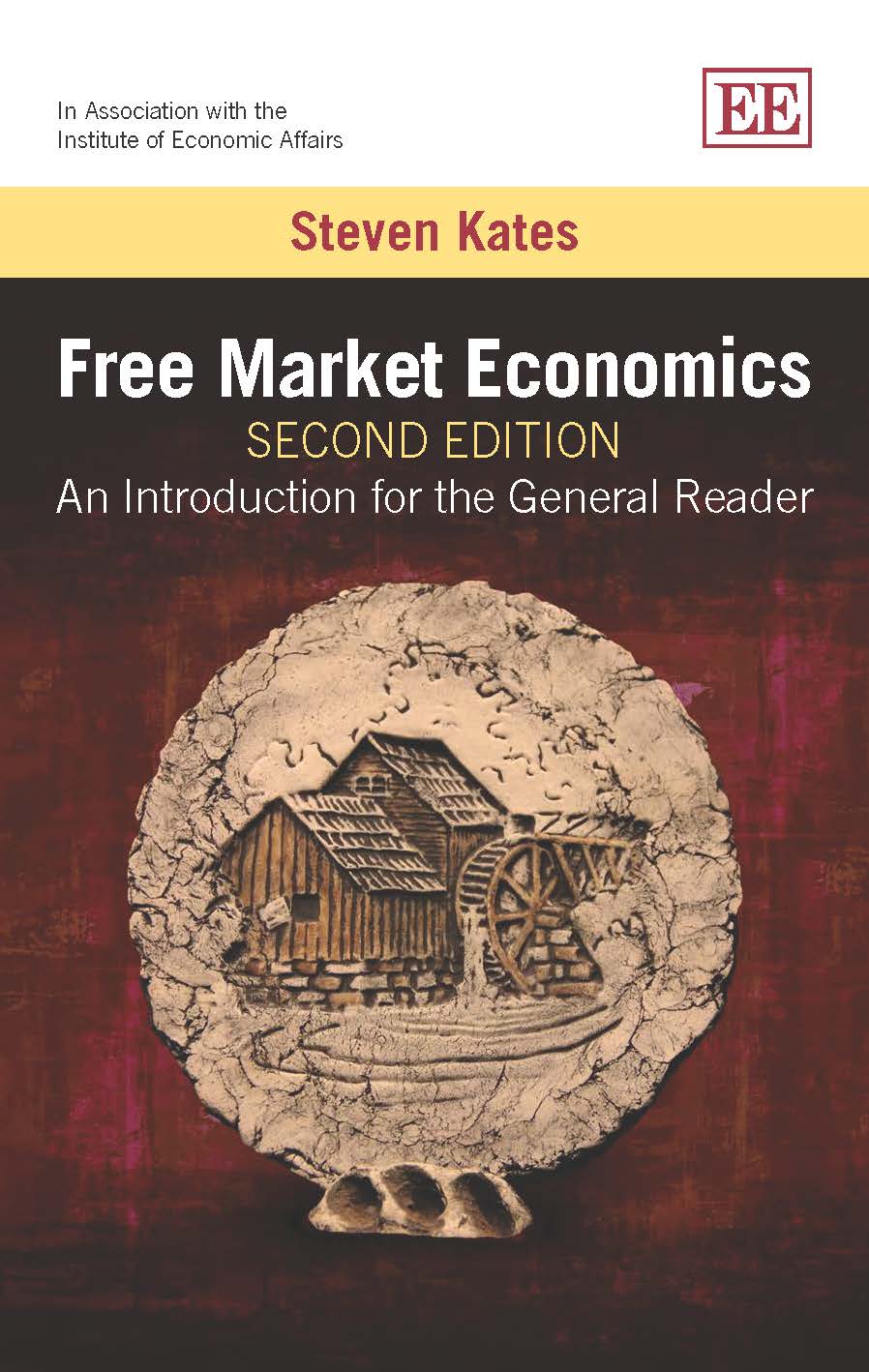
Free Market Economics 2nd ed

fme2 cover_Page_1

When I wrote the first edition of my Free Market Economics in 2009, I thought of it even then as the best introduction to economic theory anywhere. It combined five features that were unique to this book: an uncompromising anti-Keynesian core, a microeconomics that rejected the notion of an equilibrium, a focus on the role of the entrepreneur, a discussion of the classical theory of the cycle and the installation of uncertainty as the crucial element in any serious discussion of how an economy runs.

I also had no idea how much more I wanted to say until I came to write the second edition which to my eyes has transcended the first, having been fashioned out of what I learned by teaching the first edition for five years while watching how economic events unfolded following the stimulus. You may only have the author’s word for it here, but there is no book like it. If you want to understand how an economy works based on the English tradition in economic theorising that goes from Adam Smith to John Stuart Mill, there is literally only a single place you can go. The book reverses two “revolutions” in economics, not just the Keynesian of the 1930s, but the marginalist revolution of the 1870s as well. It is a companion volume to David Simpson’s wonderful The Rediscovery of Classical Economics, also co-published by the IEA. Reading the two will provide you with an understanding of just what is wrong with economic theory today. That traditional policy based on standard economic theory is ruining our economies is beyond any doubt, but the reason why that is so will nevertheless remain incomprehensible to anyone who continues to believe that aggregate demand is a valid concept in trying to make sense of economic events or that equilibrium has much if anything to do with how an economy works.

My Free Market text was written in a kind of white heat over twelve weeks as the text for the course I was giving during the first months of the worldwide introduction of stimulus packages pretty well everywhere. The absolute dead certainty I had was that public sector spending whose only aim was to create jobs would end in disaster, as it most assuredly has. Our economies are sinking under the weight of massive levels of unproductive public spending and debt levels that continuously subvert every attempt to wind them back. Yet you cannot go to any standard economics text even for an inkling of why that is.

To understand any of this you must first understand Say’s Law. Say’s Law was the bedrock principle of economic theory from the earliest years of the nineteenth century until swept away in a fit of distraction by the publication of Keynes’s General Theory in 1936. It is founded on recognising that only value adding production can create economic growth and add to the number of jobs. The most central chapter in the book is the chapter on Value Added, a chapter found in no other text that I know of. Yet without understanding value added, understanding that every form of production not just creates more goods and services but also at the same time uses up existing goods and services during the production process, it is impossible to think about public spending and economic policy correctly. Only if what is produced has greater value than the resources used up can an economy grow. Government spending seldom creates value. The stimulus was therefore doomed to fail as is so much of the policy matrix found today.

The strangest part about the book, however, was for me to discover my own beliefs on the nature of economic theory. There is not a chapter in it that would fit into a standard economics text. All of it takes you back to an earlier time and a different theoretical matrix. Space is too short to tell you much more but let me draw you to the cover which shows a water mill on a plaque made of clay. This is because the two most important influences on my own way of thinking have been two of the greatest economists England has ever produced, John Stuart Mill and Henry Clay.

I can do no more than encourage you to read this book. It is a defence of the market economy published at a time when there may never been a greater need for such a defence.

Endangering the security of the whole society

Those exertions of natural liberty of a few individuals, which might endanger the security of the whole society, are, and ought to be, restrained by the laws of all governments.

Adam Smith (1776)

I think of myself as a free speech absolutist. There is no point of view that is not open for debate and all perspectives are invited to join. Jews are descended from apes and pigs. Well, that’s one way of looking at things. Jews are murderers of Gazan children and use their blood to make matzohs. Speak the truth as you see it. There was no holocaust but if there were one we would do it right this time round. Interesting, please tell me more.

As you may imagine, I am disgusted and outraged by each of these but the principle is more important than the abuse that some make of the principle. Public discourse is very dangerous, but beliefs that cannot be challenged in public debate is where the greatest dangers lie. Bring them out into the light. Go on, discredit yourself, because if there comes a time when saying such things in public does not make you a social leper, then things have already gone too far. Your rabid, racist, repulsive views are genuinely useful information for the rest of us. It requires judgement to know what can and cannot be said in public without consequence, but there should be nothing to stop you from saying what you want.

But racist rants in public amongst strangers, people abused on the streets by others they do not know, are out of bounds in a civilised community. It is just not on, rightly illegal. In the workplace or amongst those known to each other it becomes trickier but I side, with a heavy heart, on the side that this is just one of those things up with which we must put. But I also understand those who take a different view.

Ordinary people are not political philosophers. They are not social theorists who have read, absorbed and contemplated the arguments of John Stuart Mill. They are not people who are immune to abuse for their religion, skin colour, gender or anything else. Most people are prepared to debate all issues but they are not prepared to have to deal with some idiot shouting abuse at them on the street or where they work.

If the government cannot distinguish between free speech in a civilised community and a racist rant individually one-on-one in a public place, then it should not have gotten into this debate in the first place. And had they made this distinction, they could have presented their aim in terms of doing something positive, that being stopping racists rather than protecting the rights of bigots. What a loser argument that was! Why didn’t the government show they were providing something that will aid comity in the community, not taking something useful away. I fear by not thinking this through, they have damaged the cause of free speech in this country.

The evolving nature of the history of economic thought

An email to a colleague in Europe who is going off to the Congress on J.-B. Say and the entrepreneur at the end of August.

I am very pleased to hear from you and to find you are heading off to this Congress. It seems exceptionally interesting and the focus on the entrepreneur has been for too long ignored within economic theory and policy. There was some interest expressed to me about my going there as well but it has unfortunately come to nothing. It would have been a quite long journey and as I also have a conference in Hong Kong just after may have been too much of an excursion. But whatever might have been the original interest in my attendance, nothing has come of it so I am off to Hong Kong which will be a bit easier than the 20,000 mile round trip going to France would have required. Still, I would have liked to have gone but that’s life.

The seriously interesting part for me, but probably of little interest to anyone looking at what Say was writing in 1803, is that I have written what amounts to Say’s Treatise for the 21st century. I will attach a blog post I did on the book, but it is about nothing less than the crucial role of the entrepreneur combined with an understanding of Say’s Law as expressed by Say, Ricardo, James Mill and John Stuart Mill. I am the living embodiment of those values but probably 150 years behind the times, but in my view, also about 15-20 years before my time. The fact of this conference is a sign of the subterranean changes going on. But it is hard for anyone who has grown up on aggregate demand and math ec to understand what’s required if you remove AD from within macro and start treating the future as genuinely uncertain. What happens then is you end up with the classical theory of the cycle which no one any longer understands. You should be able to read the back cover of the text in the blog post attached which explains all this in more detail.

I should also mention one other reason I was pleased to hear from you. Had you not written, I would not have known that my post to the SHOE website had actually been posted since it drew not a single response and google mail doesn’t post returned emails that one has sent out oneself. My campaign to save HET from the historians and philosophers of science seems to fall on deaf ears, but the more I engage in this debate, the most astonished I am at how misconceived their ideas are. Sure certain aspects of HET are HaPoS but that is not anywhere near HET’s core significance. I really do believe that HET has been overrun by philosophers and sociologists who have almost no interest in economic issues other than as a peripheral matter upon which they can contemplate everything else under the sun aside from the way an economy works. I think that because HET in Australia retains its original essence almost entirely, that the shifts that are going on elsewhere were almost invisible to us when they came to try to remove HET from economics which is why we all rose up as one. Now with conferences such as this in Boulogne-sur-Mer, where the central interest is mainly in understanding how economies function but using past economists as a vehicle, there may be a shift back coming into play. My intervention to preserve HET, however much it seems to have been resented by some of our American and European colleagues, was just in time. Had HET gone to HaPoS, it would have died within the decade within departments of economics. It would have become as relevant to economics as the history of physics is to physicists.

Finally, I am going to copy into this email my young colleague from Auchy so he can know what’s going on. I hope you enjoy the conference which I hope will be a great success and please do keep me informed.

Kind regards

Economie du Libre Marché

Astonishing to come across this, my work on Say noted in French in France. To find others who think about Say in the same way as I do, is astonishing. Say along with JS Mill, are odd as it may seem, part of the road that must be travelled to put economic theory onto a solid foundation.

Steven KATES est professeur au Département « Economie, Finance et Marketing » de l’Université RMIT de Melbourne (Australie). Avant d’évoquer deux de ses récents ouvrages, citons quelques extraits de son analyse du livre d’Evert SCHOORL ci-dessus :

« C’est le genre de livre qui devrait faire de l’histoire de la pensée économique une part essentielle de l’éducation de tout économiste…
..le livre… présente donc la vie de l’un des économistes les plus influents qui ait jamais vécu et dont l’oeuvre a encore beaucoup à apporter à la fois aux économistes et aux historiens de la pensée…
… l’épisode de son affrontement à un Napoléon à l’apogée de sa puissance fait de la propre intégrité personnelle de SAY un réel sujet d’étonnement…Cela a quelque chose de surhumain…
…Le personnage mis à l’honneur est la même personne décrite par John Stuart Mill (penseur philosophe britannique de grande influence qui rencontra J-B SAY) :
« un homme réellement honnête, courageux, éclairé »
Le même John Stuart Mill a également écrit de J-B SAY :
« c’est un bel exemple du meilleur type de républicain français »

S. KATES a publié en 1998 (réédition en 2009 ) :
« La Loi de SAY et la Révolution Keynésienne »
[ Dans ce livre fascinant et bien documenté, KATES contredit l’interprétation bien connue de Keynes de la « Loi des Marchés de Say… ».
Ce livre est une critique des positions de Keynes hostiles à la « Loi des Marchés de SAY » ; il oeuvre donc en faveur d’une réhabilitation de cette dernière.]

S. KATES a également publié en 2011 :
« Economie du Libre Marché…. »
« Free Market Economics – An Introduction for the General Reader »
[Une contre-attaque théorique rafraîchissante face à la conception Keynésienne bien établie….
Le Professeur KATES a brillamment remis à l’honneur la Loi des Marchés

Missing the point perhaps

John Cochrane published an article a few weeks back on The Failure of Macroeconomics which you tend not to see much of even though its failures are manifest and undeniable. Here is the first para of his article which refers to the US but the story is hardly better anywhere else:

Output per capita fell almost 10 percentage points below trend in the 2008 recession. It has since grown at less than 1.5%, and lost more ground relative to trend. Cumulative losses are many trillions of dollars, and growing. And the latest GDP report disappoints again, declining in the first quarter.

He is down on Keynes and Keynesian theory but his analogy is sus to me. If I read him right, he is saying that climate science is all right because it is using modern evidence unlike macroeconomics. Anyway, he writes:

The climate policy establishment also wants to spend trillions of dollars, and cites scientific literature, imperfect and contentious as that literature may be. Imagine how much less persuasive they would be if they instead denied published climate science since 1975 and bemoaned climate models’ “haze of equations”; if they told us to go back to the complex writings of a weather guru from the 1930s Dustbowl, as they interpret his writings. That’s the current argument for fiscal stimulus.

I take it that the “guru from the 1930s Dustbowl” is Keynes. I suppose then that Cochrane wouldn’t like to go back to my own set of authorities which are the economists of the mid-nineteenth century, John Stuart Mill in particular. But whether he knows it or not, that is what he’s doing in pushing structural reforms while abandoning attempts to increase aggregate demand:

These views are a lot less sexy than a unicausal “demand,” fixable by simple, magic-bullet policies. They require us to do the hard work of fixing the things we all agree need fixing: our tax code, our cronyist regulatory state, our welter of anticompetitive and anti-innovative protections, education, immigration, social program disincentives, and so on. They require “structural reform,” not “stimulus,” in policy lingo.

Economists once knew this, since that was the core element of what an economist knew that had been passed down through the first century of economic thinking, starting from Adam Smith in 1776. Yet even though Cochrane can see there are problems with a stimulus, I don’t myself think he really gets it himself since it never occurs to him to suggest that cutting the level of public spending might actually do some good.

[My thanks to J.B. for sending this article along.]

A bit of a rant and tirade of my own

From the most recent of Captain Capitalism’s rantings and tirades of a frustrated economist:

As I’ve aged and become more experienced, I start to realize just how much of a fraudulent study economics is. Not because economics isn’t important. Not because there isn’t some serious important issues that economics addresses. It’s not even that the secret to riches for all does lay within economics (it does and it is what ultimately drives my eternal passion for economics). But rather how the field’s self-proclaimed experts have turned it into nothing more than self-serving political bunk. It is no longer simply about the “efficient allocation of resources” or “maximizing the wealth of people” but rather idiotic concepts like the Phillips Curve, running advanced (and ultimately flawed) economic models, fretting about things like the liquidity trap, drawing idiotic foursquare games for “prisoner theory,” and the hundreds of other temporary and fleeting relationships that have been observed in the past 60 years that the economist academians trump out and treat it as if it were a real science when in reality it is a constantly changing art as it is human psychology that underpins it all.

The unfortunate fact is that economics has gone from amongst the social sciences to join the non-science of socialist religious observance. So if I may continue to quote:

If you truly want to understand (or disprove some things about) economics, I argue going backwards. I argue going outside the study. I argue applying some basic, simple logic and factual testing to see if this increasingly complex “field” even makes sense anymore or is merely a circle jerk for wanna-be mathematicians just like religion is for most clergymen.

For example, a simple question I have, is WWII the only data point the Keynesianism can point to in history where it worked? And if so, why the hell did we base the entire western world’s governance and economic policies on something so ill-tested?

Another, precisely whose brilliant idea was it that government should intervene period? Who precisely died and made you economic king giving you authority to “provide incentives” or “boost demand curves?” Since when was it the government’s and politician’s responsibility to MANAGE people? (I’ll tell you who. One sick, power-hungry, totalitarian, that’s who).

And though I am certainly very political, shouldn’t we be concerned when the likes of Krugman call Republicans racist or we start claiming that 100% purely politically moves such as “diversity” have some kind of inherent value? i.e. – why is politics allowed to enter, let alone corrupt economists and their views?

I could go on, but these simple questions are identical to the basic, logical questions we need to ask (but aren’t allowed to) of religion.

Economics once really was useful and enlightening but you’d have to go back to its golden age, from Adam Smith to John Stuart Mill. Since the mathematicians took over sometimes around the 1870s, and economics became social-physics, it has been generally downhill. I read journals now as part of my penance, but it is mostly non-answers to unimportant questions. Meanwhile, not only do politicians invent whatever economic theory they need to suit their wishes, so too do their economic advisors. Economics was once a discipline. You obeyed its rules or your economy would unravel. There is only just that last small bit of Adam Smith-John Stuart Mill left to keep our economies from completely crashing, but even that small bit is eroding fast. Economics has for the most part gone back to being Mercantilist trash.

Say’s Law and the failure of Keynesian economics

I am very happy to say that the best paper I have ever written was just yesterday accepted for publication. It’s on John Stuart Mill’s Fourth Proposition on Capital which he published as part of his Principles of Political Economy in 1848. In his own lifetime it was never challenged. Leslie Stephen (who incidentally was Virginia Wolf’s father) described it in 1876 as “the best test of a sound economist”. And yet by 1890 and ever since, although some of the great minds of economics have had a go at it, no one has been able to make straightforward sense of what Mill had meant. And when I say some of the great minds of economics, I am including Alfred Marshall, Friedrich Hayek and Allyn Young.

I should also add that understanding Mill may be amongst the most important issues of our time. Keynesian economic theory, which argues the exact opposite of what Mill had written, has had a devastating effect on every economy in which a Keynesian policy has been applied. Our economies are sinking under the weight of useless public spending and misdirected expenditures under the delusion that such spending will actually do us some good. Mill and every one of his classical contemporaries perfectly well understood that wasteful non-value-adding spending would not only do no good, it would actually do positive harm.

So what was this Fourth Proposition. It may not look all that formidable but in it there lies a truth that may yet save our economies. What Mill wrote was this: “Demand for commodities is not demand for labour.” Or restated using the jargon of today: an increase in aggregate demand will not lead to an increase in employment. The principle stated here is the classical pre-Keynesian meaning of Say’s Law, which has vanished from amongst economists and been replaced by the Keynesian theory which had been specifically designed to refute Say.

For me, the disastrous outcome of the application of Keynesian policies was a certainty. It was beyond any doubt in my mind that the stimulus would not just fail but bring ruin in its wake. I put my views into print in February 2009 just as the stimulus programs were being put into place and my five-year review was published in March this year. In 2009 it was mostly just theory although there had been plenty of Keynesian failures before that. By 2014, the evidence has become so overwhelming that there should no longer be the slightest doubt that a Keynesian stimulus will sink your economy into a coma and leave it that way for years on end. If you want to know why, you can read Mill, or if you find a thousand pages of mid-nineteenth century prose a bit on the heavy duty side, you can read this instead.