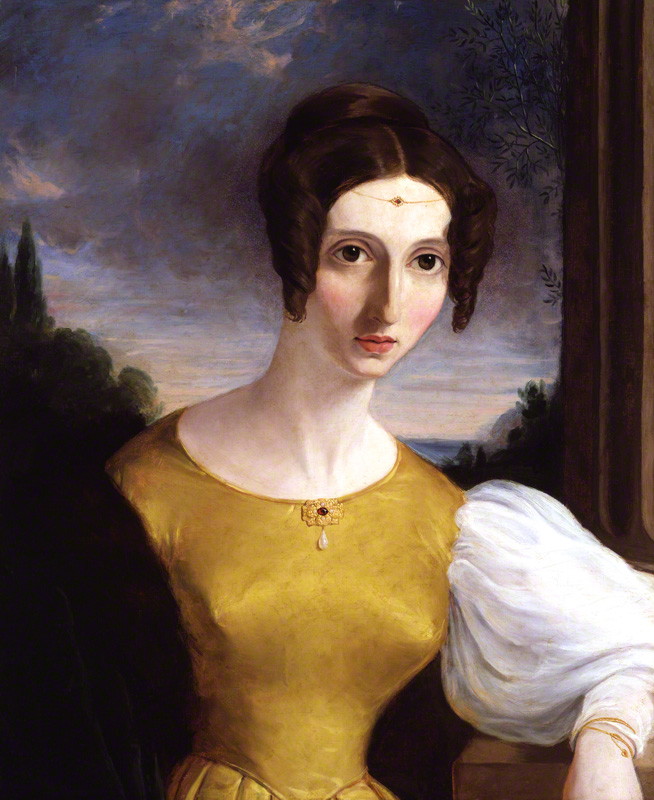
Harriet Taylor as she would be today

harriet taylor up to date

The picture has nothing to do with the story other than it was an ad on the New York Review of Books site where I was reading a review of Hayek on Mill: The Mill-Taylor Friendship and Related Writings (The Collected Works of F. A. Hayek) which has been edited by Sandra Peart and just released. Yet when I looked at the picture, I wasn’t sure that it wasn’t meant to illustrate the story. If Harriet Taylor were alive today, that is what she would be like. Below is what she was really like.

NPG 5489; Harriet Mill by Unknown artist

And while we’re at it:

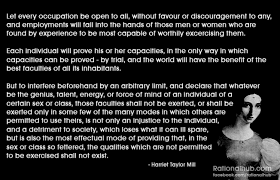
harriet taylor mill on feminism

This is what I think too, and perfectly stated.

Economic theory’s version of Fermat’s Last Theorem now finally explained

I have just had an article published that has taken five years to finally see the light of day. More formally, “Steven Kates (2015). MILL’S FOURTH FUNDAMENTAL PROPOSITION ON CAPITAL: A PARADOX EXPLAINED. Journal of the History of Economic Thought, 37, pp 39-56.” This is the abstract:

John Stuart Mill’s Fourth Fundamental Proposition Respecting Capital, first stated in 1848, had become an enigma well before the nineteenth century had come to an end. Never challenged in Mill’s own lifetime and described in 1876 as “the best test of a sound economist,” it has become a statement that not only fails to find others in agreement, but fails even to find an internally consistent interpretation that would make clear why Mill found it of such fundamental importance. Yet the fourth proposition should be easily understood as a continuation of the general glut debate. Economists led by Malthus had argued that demand deficiency was the cause of recession and a body of unproductive consumers was needed to raise the level of demand if everyone who wished to work was to find employment. Mill’s answer was that to buy goods and services would not increase employment, or, in Mill’s own words, “demand for commodities is not demand for labour.”

That observation by Leslie Stephen in 1876 was literally the last time anyone had ever made such a positive statement about Mill’s Fourth Proposition. After that, it had been worked over by Alfred Marshall, A.C. Pigou, F.W. Taussig, Allyn Young, Friedrich Hayek, J.M. Keynes and Harry Johnson amongst many others, none of whom could make it make sense. I will write it down again, because it is the essence of Say’s Law. Understanding what Mill meant is the only means I can think of to refute Keynesian theory:

Demand for commodities is not demand for labour.

From the moment I read it in Mill, which I was just reading for fun, I was convinced by both the conclusion and the logic that had come before. I had no idea that it would change my life and give a shape to all of my economics thereafter. It simply says that buying of itself never creates economic momentum, but it is the logic of the argument that is required if you are to see the point. Everyone understood both the proposition and the logic for the entire period from the time of Adam Smith right through to the marginal revolution in the 1870s, but from that moment on has made no sense to anyone, other than me. How odd is that!

So now I have the paper in print, but I doubt anyone will get it anyway. You really do have to go back to Mill and the classics to see not just what they meant, but why it’s true. The alternative is to read my Free Market Economics which is classical economics for the twenty-first century. It is also the first book since the 1870s that has actually discussed and defended Mill’s fourth proposition, indeed all four propositions. I say this as honestly and sincerely as I can. You will never understand how an economy works unless you understand what Mill meant. There is no difficulty in seeing the point since I have been teaching it successfully as part of my course since the start of the GFC, but I also recognise how hard the point is to grasp and hold to in the midst of controversy. But if you can do it, it is worth the effort since Mill’s Fourth Proposition truly is the best test of a sound economist.

Not as wild as you might think

Some background on Cheryl Strayed, the woman who wrote the book that has been turned into the film, Wild, starring Reece Witherspoon:

Strayed married Marco Littig on August 20, 1988. They were married for six years. In 1999, Strayed married filmmaker Brian Lindstrom. They have two children and live in Portland, Oregon. Her daughter, Bobbi Strayed Lindstrom, played the younger version of Strayed in the film adaptation of Wild. A long-time feminist activist, Strayed served on the first board of directors for Vida: Women in Literary Arts.

Conventional as her life may seem, I take it then that the film is intended to portray a feminist icon, although I must confess to having been quite shocked by the way the story went. I am a first-stage feminist going back to the 1960s. The moment the word “zipless” appeared, I knew exactly where I was. Indeed, I am a nineteenth century feminist, in that probably the greatest influence on my thinking has come through John Stuart Mill and his The Subjection of Women.

Still, what astonished me about the story was the role that men played in saving her at each of the main turning points in her life, at least as portrayed in the film. I won’t say where, but you can watch for it. The final moments, when a group of chaps tell her the trail name others have given her – something like Queen of the PCT (that is, Queen of the Pacific Crest Trail where she was hiking) – was due to the way everyone had bent over backwards to help her out as if she were royalty, made me think this was supposed to be a parody of the self-contained, independent woman. But it’s not.

One final point. Her mother dies of some unspecified form of cancer, but in the actual account she dies of lung cancer, and had presumably been a smoker. Not mentioned, nor do I recall seeing her mother with a cigarette. In Hollywood, positive characters are not permitted to have negative characteristics.

Clay’s Economics

This was the query at the history of economics website, which I might note, has had quite an interesting response:

I’m working on an analysis of introductory economics textbooks published in the United States between about 1890 and 1950 (the period between Marshall and Samuelson, roughly). I’ve accumulated an ad hoc collection of texts based on the holdings of my library and scattered references in the secondary literature (Elzinga 1992, Walstad et al 1998, and Giraud 2013 in particular), but I was hoping that there might be some more systematic way to generate a universe of texts from which to sample. Does anyone have a recommendation for a good source that discusses principles texts in this period, perhaps with information on relative influence (number of editions, course adoptions, or sales)? Does such a source exist?

This was my own contribution:

In a reply to a recent request for any centenary celebrations coming up in economics in 2016 which was put out by the editors of the History of Economics Review, our HET journal here in Australasia, I wrote:

“2016 is the hundredth anniversary of the publication of what I think of as the best single introductory text on economics published in the twentieth century, Henry Clay’s Economics: an Introduction for the General Reader. I would very happily provide you with a shortish note on this great text – you have to see just its publication history from 1916 to 1942 when the second edition was published to appreciate just how extraordinary it was. Used everywhere, including Oxford and Cambridge, and not just mechanics institutes. Also the best summary of pre-Keynesian theory available, in my view, from any source.”

I realise that the request in this instance is for “introductory economics textbooks published in the United States” and Clay was published by Macmillan in the UK. But looking here at my lovely first edition, the second listing of the publisher’s location reads in a way which does suggest that it would have had a publication history within the US:

“The Macmillan Company
“New York . Boston . Chicago
“Dallas . San Francisco”

And as in indication of its presence in the United States, I also have this: Problems and Exercises to Accompany Clay’s Economics for the General Reader and Ely’s Outlines of Economics, which was published in 1921, whose author was:

“H. Gordon Hayes
“Professor of Economics in Ohio State University”

I might point out that in this set of questions – which you might for fun test your graduate students on for their understanding of economics – it is Clay who is mentioned before Ely.

I will finally mention that in The Great Gatsby, a text as American as it gets, we have this passage in reference to Gatsby himself as he stands waiting in the library for Daisy to arrive:

“[He] looked with vacant eyes through a copy of Clay’s Economics.”

If even Gatsby was reading Clay, who wasn’t?

What I didn’t mention was that I titled my own text to follow Clay’s: Free Market Economics: an Introduction for the General Reader. The number of out and out Keynesian falsehoods that are revealed by going through Clay is astonishing, starting with acceptance of Say’s Law means classical economists always assumed full employment. It’s not a short book, and its lack of diagrams makes it hard for someone of the present generation of economists to bother with, but it very efficiently gets the job done. And naturally, what I like best about it, is that it is the economics of John Stuart Mill, brought up to date for the first half of the twentieth century, just as my own text is Mill for the 21st century. Did I ever mention, by the way, that the cover of my book shows a Mill made of Clay?

John Stuart Mill – Principles of Political Economy

John Stuart Mill’s Principles of Political Economy is the greatest text on economic theory ever written. It was put together over the period from 1845 till 1848 when he had come to the conclusion that it was impossible to write a book on sociology that could address all of the contradictions that exist within human life. There were no principles of human life that could be summarised in the way that could be contained within a single set of covers. He turned therefore to economics instead.

The book is, however, unreadable today, partly because of the density of his writing and partly because of the presuppositions he brings along with him. I am therefore about to write an edited version of Mill’s Principles in which I will keep Mill’s words but edit the text down to its essentials. That is still around 300 words, but even then there will be the need to include introductory passages to underline the points Mill is trying to make. And the main reason I think I can do this is because I share most of Mill’s presuppositions myself, which I had originally learned from reading his Principles at the very moment I had discovered Say’s Law for myself.

Steven Kates’s Free Market Economics 2nd ed

I was particularly pleased by Old woman of the north, blogstrop and danger mouse who saw Mill’s genius in my previous post on Mill’s Principles of Political Economy. I could not agree more with OWOTN where she wrote “What beautiful, clear English! The thought processes flow.” And so they do. And Mr Bear, Ted if I may, I just mention the book because I do think it would be an aid to governments who are sinking our economic ship. I merely translate Mill into language that is easier to read in the twenty-first century. This is my attempt to say what Mill said in that same passage. Nowhere as poetic, nowhere as deep, but hopefully getting to the same point. These are the opening paras of Chapter 3.

Value added

Possibly the most difficult area to understand about economics is one that you would think would be amongst the easiest and most commonly understood. This is the area of value and value added.

If economics were going to provide an understanding of anything, it would have to be, you would think, an understanding of what value is and where it comes from. And while economists do have such theories, they are relatively obscure and are almost never discussed at the introductory level. Value in economics is a very difficult idea.

Yet for all that, it is not possible to have a clear understanding of either economics or economic policy unless one has a reasonably clear idea about what value is and how it is created. And unless one has this reasonably clear idea about the nature of value, it is almost impossible to make judgements about almost anything done in an economy, from its very organization to the finer details of individual decisions.

That the aim of economic activity is to create value is obvious and straightforward, for all the difficulty in knowing just what value actually is. Something has value to the extent that a person is better off with it than without it. In economics we frequently say that a good or service has value if it is able to provide utility. Economic activity is aimed at providing individuals with increased levels of personal utility.

But it is also true that in almost all cases to produce something of value it is first necessary to use up some of our resources that also have value. Nothing comes from nothing. And this is where the notion of value needs to be further refined. A tonne of steel also has value, but not as a final good providing utility. It has value only as a productive input that can be used to produce the goods and services that do provide that utility. The value of such inputs is derived from the value of the final goods and services they can be used to produce. Which brings us to the crucial issue of value added.

To create value in the form of the final goods and services that provide utility is the central purpose of economic activity. In the process of creating such value, some part of the resources that exist must be used up in the process. Value added underscores what is too often forgotten, that to add value one must also at the same time destroy value. The word ‘added’ is there to remind us that we have also had to subtract the resources used up in producing whatever has now been brought into existence. Value added is thus the net result of using up various resources which already have value, to create other products that have even more value.

It is only if the value of the products newly produced is greater than the value of the resources used up that value adding has occurred. Economic growth is the way we normally discuss value adding activities. They are one and the same. The value of output must exceed the value of the inputs used up if economic growth across an economy is to occur.

My advice is to read Mill if you can. But if you would like a modern version, then you will need to read this.

John Stuart Mill’s Principles of Political Economy

I have long had a view that John Stuart Mill’s Principles of Political Economy is the best economics book ever written. But I have now also come to the view that no one is ever going to contradict me because virtually no one can any longer read the book. I have just been back over the book on a project on Mill I am just beginning and turned to Book I Chapter II which is “On Labour”. I say to you in all honesty that it is a fascinating chapter from which there is much to learn, including how little there is that is truly new that is not in Mill. But here is the opening para of the chapter from which the one thing I guarantee you will learn is how hard the book must be to read.

§ 1. The labour which terminates in the production of an article fitted for some human use, is either employed directly about the thing, or in previous operations destined to facilitate, perhaps essential to the possibility of, the subsequent ones. In making bread, for example, the labour employed about the thing itself is that of the baker; but the labour of the miller, though employed directly in the production not of bread but of flour, is equally part of the aggregate sum of labour by which the bread is produced; as is also the labour of the sower and of the reaper. Some may think that all these persons ought to be considered as employing their labour directly about the thing; the corn, the flour, and the bread being one substance in three different states. Without disputing about this question of mere language, there is still the ploughman, who prepared the ground for the seed, and whose labour never came in contact with the substance in any of its states; and the plough-maker, whose share in the result was still more remote. All these persons ultimately derive the remuneration of their labour from the bread, or its price: the plough-maker as much as the rest; for since ploughs are of no use except for tilling the soil, no one would make or use ploughs for any other reason than because the increased returns, thereby obtained from the ground, afforded a source from which an adequate equivalent could be assigned for the labour of the plough-maker. If the produce is to be used or consumed in the form of bread, it is from the bread that this equivalent must come. The bread must suffice to remunerate all these labourers, and several others; such as the carpenters and bricklayers who erected the farm-buildings; the hedgers and ditchers who made the fences necessary for the protection of the crop; the miners and smelters who extracted or prepared the iron of which the plough and other implements [30] were made. These, however, and the plough-maker, do not depend for their remuneration upon the bread made from the produce of a single harvest, but upon that made from the produce of all the harvests which are successively gathered until the plough, or the buildings and fences, are worn out. We must add yet another kind of labour; that of transporting the produce from the place of its production to the place of its destined use: the labour of carrying the corn to market, and from market to the miller’s, the flour from the miller’s to the baker’s, and the bread from the baker’s to the place of its final consumption. This labour is sometimes very considerable: flour is [1848] transported to England from beyond the Atlantic, corn from the heart of Russia; and in addition to the labourers immediately employed, the waggoners and sailors, there are also costly instruments, such as ships, in the construction of which much labour has been expended: that labour, however, not depending for its whole remuneration upon the bread, but for a part only; ships being usually, during the course of their existence, employed in the transport of many different kinds of commodities.

He does wear you out. I have visions of Mill, who wrote this thousand page book in about eighteen months while holding a full-time job in the East India Company, sitting there in his free moments with his pen, ink and paper, scratching out the text as he tried to distill his thoughts into something coherent. The man with the highest IQ in the nineteenth century, his book was the byword for economic theory for the following fifty years and then some. My copy is a discarded text from the 1920s that was still being used at the University of Melbourne. If you would like to see Mill up to date, you can read the 2nd ed of my Free Market Economics and when you see the book (unless you read it electronically) you will understand why the cover shows a water mill as its main motif.

To which from further comments I must add this:

John Stuart Mill,
By a mighty effort of will,
Overcame his natural bonhomie
And wrote “Principles of Political Economy.”

John Stuart Mill on the role of the state in the prevention of harm to others

This is John Stuart Mill on the basic principle of a free society found in his On Liberty:

“The object of this Essay is to assert one very simple principle, as entitled to govern absolutely the dealings of society with the individual in the way of compulsion and control, whether the means used be physical force in the form of legal penalties, or the moral coercion of public opinion. That principle is, that the sole end for which mankind are warranted, individually or collectively, in interfering with the liberty of action of any of their number, is self-protection. That the only purpose for which power can be rightfully exercised over any member of a civilised community, against his will, is to prevent harm to others.” [My bolding]

I have an article at Quadrant Online on The Right and Will to Defend Ourselves. What do I think of the state taking strong measures to protect us from the harm that others wish to do. I am all for it. There is no single simple overriding principle that is the final arbiter in what actions a state may take to protect me from the harm others wish to do. Here is Isaiah Berlin, whom I quote in the article, discussing the same thing:

If these ultimate human values by which we live are to be pursued, then compromises, trade-offs, arrangements have to be made if the worst is not to happen. So much liberty for so much equality, so much individual self-expression for so much security, so much justice for so much compassion.

My point is that some values clash: the ends pursued by human beings are all generated by our common nature, but their pursuit has to be to some degree controlled — liberty and the pursuit of happiness, I repeat, may not be fully compatible with each other, nor are liberty, equality, and fraternity.

Berlin not only understood Mill perfectly well, that would be where he would have found his own principle first stated. Minority opinion is one thing which must be protected to the ends of the earth; the call to murder one’s fellow citizens is quite another thing altogether.

The economics of John Stuart Mill

I have just sent this note off to a publisher about a book I would like to edit. I recently wrote a rejection for an article on John Stuart Mill that was sent back to me three times after which they asked me to write a reply since they were going to publish it anyway. I was coincidentally also refereeing another article at the time for a different journal which has come back for a second time since I think the other referee must have liked it and they will publish notwithstanding anything I might say which is also about Mill. It was then with the two of them together that I finally worked out that no one knows what Mill wrote or what he means. I very strangely fell into Mill’s economics as just part of my reading things that seemed interesting and was immediately captured by his logic and good sense. I didn’t read it the way most academics do, as a kind of deciphering exercise with modern economics as the standard of excellence. I instead read it with an open mind just for interest. My Free Market text is almost literally an amalgam of Mill, Henry Clay and a smattering of more modern gadgetry. So this is the note I wrote:

I copied you in on an earlier email in which I mentioned an idea I had proposed to you quite some time ago. As I noted, John Stuart Mill’s Principles of Political Economy is the least accessible economics text from amongst the whole of the economics literature. It is not just that it is long-winded, but it contains so much that is completely foreign to a modern economist that it is straightforwardly impenetrable. It also delves into vast oceans of explanation that exhaust even the most patient reader. And there are chapters one after another that deal with issues that might have been current in 1848-1871 but which are of no relevance today. My wish is to put together a more compact Mill that is directed at people who would like to understand what Mill was saying that is relevant today but do not have any idea where to start. And to tell the truth, I think there is hardly anyone else alive who could do it. I will attach an article of mine on Mill’s “Fourth Proposition on Capital” which I have described as economic theory’s version of Fermat’s Last Theorem. No one has been able to make sense of it since 1876 although many have tried, including Marshall, Pigou, Taussig, Keynes and Hayek, not to mention modern commentators such as Harry Johnson and Sam Hollander. No one can even make it make sense, whereas I just included it in my Free Market Economics and teach it to my students who find it perfectly straightforward. They wouldn’t even know there’s a controversy or why it’s controversial since really, it makes perfect sense. Therefore in editing Mill, each of the chapters that I would want to include would also require some kind of introduction so that someone could get past the 150-word sentences and see the point. It is, of course, hard for me to judge whether this would be a commercial proposition for you but for me it would represent an important contribution to the economics literature and for that reason may also sell.

What has made this seem more urgent than before was a paper I recently refereed which I rejected three times before being told that based on the other referee they had decided to publish but invited me to write a response which I have now done. You will see the kinds of things in the article that are found in Mill but which are incomprehensible today. Even scholars who write on these issues are unable to comprehend what classical authors believed and why it might be relevant today. But the thing is, Mill is the comprehensive answer to so much of what is wrong with economic theory today. I just find myself surprised to discover that I am one of the few people around who can explain what Mill wrote. I read others who write on Mill and almost no one seems to read Mill directly but only in second-hand form, much the same as with Adam Smith. Anyway, this would interest me to put together and I would like to think of this as my next major project.

What gets me is that if you merely apply Mill to current economic events and policies, the outcomes are perfectly obvious.

Classical economics rediscovered

I have come across a summary of David Simpson’s The Rediscovery of Classical Economics written by David Simpson himself and published by the Royal Economic Society. Before I quote more extensively, I will note where he wrote:

I refer to an intellectual tradition that began with Adam Smith, was continued by Marx, Menger and Marshall, Schumpeter and Hayek and in the present day is represented by theorists of complexity.

It never surprises me to see the name of John Stuart Mill missing from such lists since Mill is the most difficult of all of the classical economists to access for any one schooled in modern theory. Yet it was Mill who set the standard for the second half of the nineteenth century and was explicitly followed by Marshall and even Hayek even as they turned economics into the more familiar form we find today. I might also mention that what makes Marx interesting even now is found in Mill only with much more common sense as well as a far deeper economic understanding. Mill is the high point of classical thought, and in many ways the high point of economic thought. But who amongst any of you would be able to contradict me, you followers of Keynes and marginal analysis, who barely know Mill’s name never mind have any idea of what he wrote? This is Simpson’s description of the economics that has all but disappeared.

The hallmarks of this classical tradition are principally three. The first is the belief that the growth of the economy, rather than relative prices, should be the principal object of analysis. Coupled with that belief is an understanding of the market economy as a collection of processes of continuing change
rather than as a structure, and that the nature of this change is self-organising and evolutionary. Finally there is a conviction that economic activity is rooted in human nature and the interaction of individual human beings.

The differences between classical theory and equilibrium theory can be summarised in the following terms. Classical theory focuses on change and growth within open, dynamic nonlinear systems that are normally far from equilibrium. Equilibrium theory, on the other hand, analyses the theory of value within closed, static linear systems that are always in equilibrium. As to the essential nature of economic activity, classical economics makes no distinction between micro- and macroeconomics. Patterns of activity at the macro level emerge from interactions at the micro level. Evolutionary processes provide the economy with novelty, and are responsible for its growth in complexity. In equilibrium theory micro-and macroeconomics remain separate disciplines, and there is no endogenous mechanism for the creation of novelty or growth.

The behaviour of human beings in classical theory is analysed individually. People typically have incomplete information that is subject to errors and biases, and they use inductive rules of thumb to make decisions and to adapt over time. Their interactions also change over time as they learn from experience. In equilibrium theory, individual behaviour is assumed to be homogeneous and can be modelled collectively. It is assumed that humans are able to make decisions using difficult deductive calculations, that they have complete information about the present and the future, that they make no mistakes and have no biases, and therefore have no need for adaptation or learning.

Simpson finishes by discussing where economics now needs to go under the heading, “The Implications for Economic Theory”. I think this is both very limited in what is sought but also almost impossible to imagine being taken up within the profession. I’m not so sure about the need for non-linear algebra, but at least with this we have the commencement of a program for change:

First of all, courses in economic history and in the history of economic thought should be a required part of the curriculum for every student of economics. The study of economic history, like the study of complex systems, reveals the importance of context in understanding economic behaviour. The study of the development of economic thought helps us to appreciate the weaknesses as well as the strengths of a theory. Macroeconomics should be downgraded, and give way to the study of business cycles.

Secondly, more space should be found for the analysis of dynamic processes at the expense of static theory. The study of the processes of economic growth should be restored to centre stage. This probably means a greater emphasis on nonlinear algebra.

At the same time, the limitations inherent in applying mathematics to economics need to be acknowledged. The importance of the human factor and of human institutions in economic activity means that more attention needs to be given to non-quantitative methods of analysis.

With the scale of disaster that has befallen us since the GFC, there is something radical that needs to be done. And if you are interested in seeing a twenty-first century update on Mill and classical theory, you can always try this.