
If the SHOE fits

There has been a kind of hammer and tongs discussion at the Societies for the History of Economics (SHOE) website that began when I posted that the President of France had stated in support of a more “austerity”-oriented economic policy that, L’offre crée même la demande. Or in English, that supply really does create demand, a principle known in English as Say’s Law. Every economist is taught from the first day of macro that Say’s Law is wrong and that a Keynesian stimulus is the answer to recession. Sounded better five years ago but today, who would suggest more public spending even though our economies remain as dismally placed as they are. But part of what I found so charming is that the suggestion is made that I am near enough the only economist in the world who thinks “the strong version” of Say’s Law is true. How weird is that! But of course, that doesn’t mean that I think that I’m wrong, specially since all the evidence is so one way.

The SHOE website is filled with interesting discussion over a vast range of economic issues. You definitely do not have to be an economist either to join or to listen in on the discussion. You can register here. Meantime, this is my latest post on how I see the role of the history of economic thought.

I am rather charmed by Barkley Rosser’s last post, to wit:

So, my final comment will be directed very directly at Steve Kates and James Ahiakpor. Can you guys not figure out that you have totally and utterly lost this debate? Nobody here agrees with you, nobody. You have lost, period. Sure, you can get the occasional Per Berglund to sort of attempt to help you out by questioning details of the critiques of your arguments, but even those folks in the end do not come down on agreeing with your defense of a strong version of Say’s Law. Deal with it, please. We have all had more than enough.

I am more than aware that so far as numbers go, we are on the wrong side of the ledger. When I began to argue in public against the stimulus back in 2009, there were attempts made by that solid mainstream to have me sacked from my university appointment. There are risks in taking such positions. What protects me now from such attacks is the unbelievably dismal outcomes from the stimulus. You may not understand what I’m saying. But there is no doubt that, so far as the way our economies have performed, I have little reason to think anything other than that Mill was right, that the “strong version of Say’s Law” is valid, and classical economists knew what they were talking about. The modern Keynesian fashion, on the other hand, has little to show for it. Does evidence count for nothing?

But I come onto this thread firstly to thank our moderator for his willingness to let the previous thread on L’offre crée même la demande continue to its end. But there is more to it than that. I wrote my book on Defending the History of Economic Thought, not just to explain why making the effort to understand the economic theory of the past is an extremely good way to deepen an economist’s understanding of economic theory, but also to argue that HET is the place where economic theory goes to regenerate itself. This is the one and only place that economists from every one of the traditions in economic theory come to look in on what is being said by others.

There are mainstream journals, but also Austrian, Neo-Keynesian, Post-Keynesian, Institutionalist, Marxist and others, and if you are not part of whatever tradition that journal represents, it is unbelievably difficult to get published. HET has broken this tradition down, at least to some extent. It may well be that no one can follow what I or James or Per are trying to say, although we can follow each other with near perfect clarity. But where else are you going to even hear it at all?

The History of Economic Thought is by all accounts dying yet it is the most intellectually alive area in the whole of economic theory. It teems with ideas and there are economists from every tradition who are willing to fight it out before an audience of upwards of a thousand of their peers who can follow these discussions as they like. There is seldom a thread I don’t learn from and I typically read them through.

And there is no doubt that HET is under threat of extinction. There are people at the top of our hierarchies, and I am talking about our hierarchies within HET, who would willingly take this study into the History and Philosophy of Science and leave economics behind. There are also mainstream theorists who would be glad to see the end of us and our constant criticisms of established textbook economics.

But there are also people, like myself and others who come to this site, who just find it fascinating to listen in on alternative ways of thinking about economic issues. That is what HET is for. Rather than restrict this area to burrowing into particular issues related to economists who are no longer mentioned in our textbooks, it should also be a place where ancient economists are resurrected and their ideas discussed. And I don’t just mean on this site but across the entire expanse of the history of economic thought.

The journal, History of Economics and Policy, is a paradigm of just what is needed. Perhaps not for all of us, but certainly for some of us. This is not the end of HET but in my view is its salvation. Here is a link to its archive.

It is what every HET journal should become more like. Some traditional material but also some which see the relevance of past theory to our present problems.

And in furtherance of this post, I might just mention this news item, Canada charts comfortable course to 2015 budget surplus. If you are a Keynesian, your reaction would be, how terrible! If, however, you have been following the news for the past five years, you can see what a triumph it is. The strong version of Say’s Law remains an absolute necessity if you are to understand how an economy works and why public spending and deficits are the disasters they have so obviously proven to be.
Economic definitions

I am two days away from finally sending the manuscript of the 2nd edition of my Free Market Economics off to the publisher. What do academics do when they aren’t teaching? This, at least, is what one of them has done. But for interest and comment, I am putting the following up which I have just finished writing not five minutes ago. It will be at the very start of the book, right after the preface which I will get to as soon as I finish this section on the definitions.

And I hope you all have as much fun on this long weekend as I hope to have myself.

Before venturing into the full text before you, it is useful to have a few definitions in your mind. The language of economics is entirely made up of words that have ordinary meanings in everyday life. But these words, when they cross over into economics, suddenly take on very specific meanings that can cause someone to lose the thread during an economic discussion. We therefore provide a series of definitions of the specialised words used in the text. Having at least a preliminary grasp of these words and their more technical meaning will also in itself provide a grounding in the nature of the economic theory you will meet in the rest of the book.

Economics often looks easy because everyone already thinks they understand what’s going on in an economy without even having to study. Not true at all. For an economist it is painful to hear the mistakes that those who have not studied economics to at least a reasonable depth constantly make. But there are also major differences in the conclusions different economists reach and these are often at a very deep level that no lay person could possibly resolve.

This text will teach you everything you will find in studying economics in a normal, usual way. But it also provides a second perspective that has been taken from the economic theories that were dominant during the nineteenth century. But unlike with the natural sciences, economic theory does not progress to higher plains and then remain there. Economic theory is infused with the hopes and wishes of policy makers and of those who study the subject who are predisposed to some particular point of view. People just wish the world was one way when the way things are turn out to be something else again, and their wishes cause them to accept economic theories that are not properly grounded in the way the world actually is.

The definitions found here are already pointing in a particular direction. The very first definition is “entrepreneur”. These are the people who run our businesses and often, if they are successful, become very wealthy as a result. As this book will explain, entrepreneurially-managed firms are the foundation for wealth and prosperity for an entire community but also for personal freedom and independence from government. Economic attitudes are often determined by one’s reactions to entrepreneurs running our firms. Some people don’t agree that we should allow people to run firms any way they like as long as they follow the law. Some people think that governments should run our businesses or at least our major businesses. Or if they don’t run them should have a major say in what they do.

These are, of course, philosophical and political issues that are absolutely part of economics when thought about in the widest sense, but are not part of what gets taught at the introductory level when starting out on economic theory. Yet this is the foundational point. Economics, as we teach it and learn it today, assumes that most of what is produced is produced by businesses independent of governments and are run by entrepreneurs for a profit. These businesses sell goods and services on a market and these goods and services are bought by consumers with money they have for the most part earned by providing either their own labour or some other input into the production of some other good or service. How this process works in detail is what the study of economic theory is about.

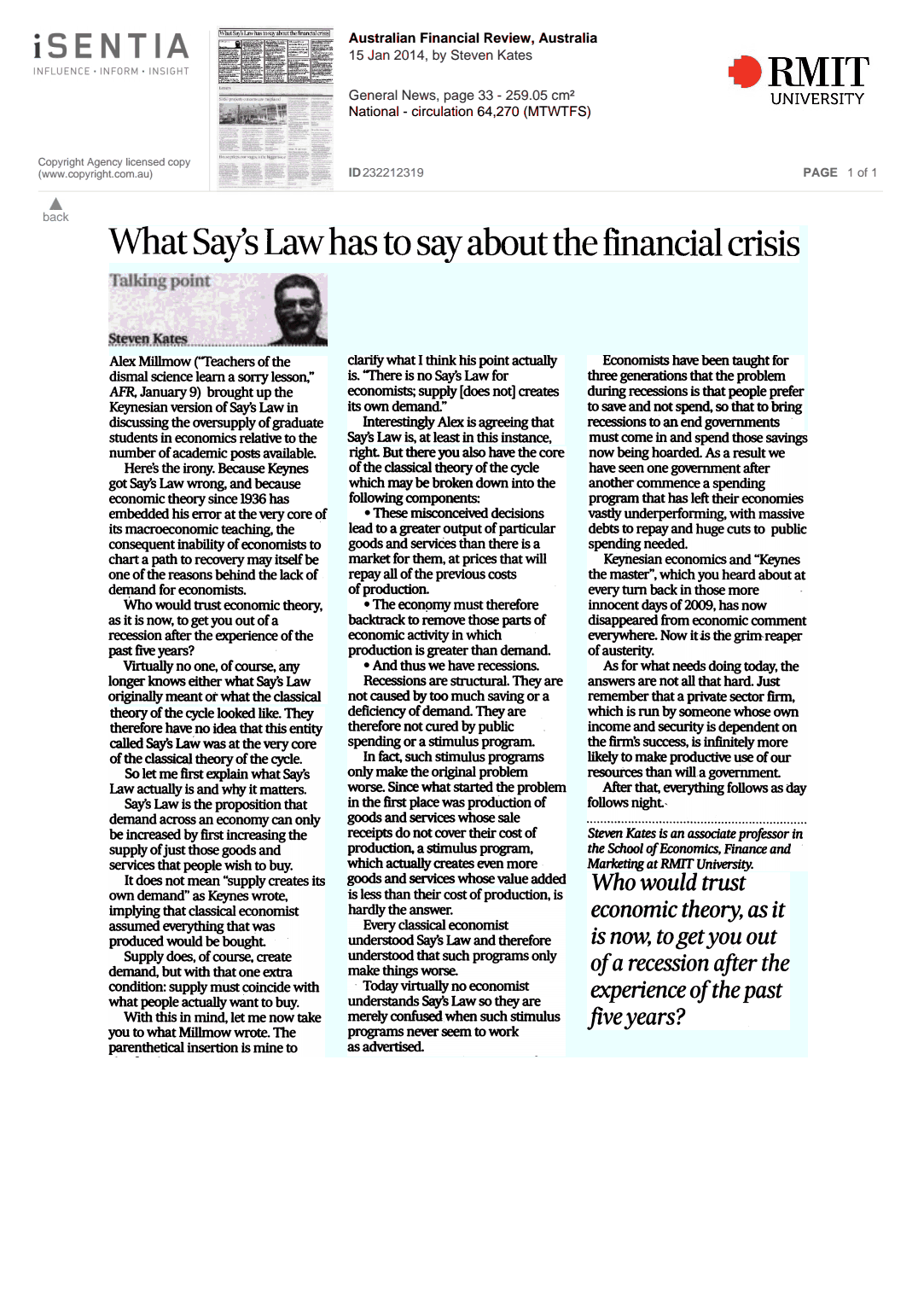
Say’s Law makes it to the AFR

afr - steve kates on says law

says law and the keynesian revolution

Is it possible that economic theory has regressed over the past hundred years. Well if you ask me, it’s a certainty. (For further confirmation, see Alan’s post on Larry Summers below.) An economist in 1914 knew more about how an economy worked than an economist in 2014. Less detail, fewer stats but a greater grasp of how it all fit together. How odd is that!

What’s the difference. Economics is now infused, both in it theory and in its practitioners, with socialists who simply refuse to believe that markets left to themselves will generally speaking produce the optimal economic outcome. The idea is now so outré that economics texts – aside from one or two that I am aware of – are no longer designed to explain how the market works. They instead start from the premise that markets will go wrong and that governments must take action at every turn to set things right.

Anyway, I have an article in the Financial Review today which is titled, “What Say’s Law has to say about the financial crisis” which really is, what pre-Keynesian classical theory has to say about the crisis.

There you have the core of the classical theory of the cycle which may be broken down into the following components.

• Misconceived production decisions are what starts the rot.

• These misconceived decisions lead to a greater output of particular goods and services than there is a market for them at prices that will repay all of the previous costs of production.

• The economy must therefore backtrack to remove those parts of economic activity in which production is greater than demand.

• And thus we have recessions.

Recessions are thus structural. Instead our textbooks teach Y=C+I+G and explain recessions as a result of too much saving and too little demand, the fallacious notions that Say’s Law was specifically designed to expose.

Macroeconomic theory is not just nonsense but dangerous nonsense. Using it to manage an economy will leave wreckage in its wake as it has consistently done everywhere and every time it has been used to solve some economic problem.

Economies are built up by genuinely value adding activities which most government forms of spending most definitely are not. That doesn’t say governments shouldn’t do them. It merely says they should not deceive themselves into believing that public spending is the road to rapid rates of non-inflationary growth. Public spending draws down on our productivity rather than building it up. If the last five years have taught us anything, hopefully at least it has taught us that.

“I’d love to know more about what causes business cycles”

I was sent a copy of an interview with Eugene Fama, the newly minted Nobel Prize winner for economics, in which the covering letter implied that when I read it through I would see what a poor choice he had been. So I read it through and at the end I had an even higher regard for Fama than I had had before. Such is the nature of economics. But there was this one bit that jumped right off the page:

Q: What will be financial crisis’s legacy for the subject of economics? Will there be big changes?

A: I don’t see any. Which way is it going to go? If I could have predicted that, that’s the stuff I would have been working on. I don’t see it. (Laughs) I’d love to know more about what causes business cycles.

Now the depressing thought is that there actually might not be any changes, big or small. Economics is now in the hands of the public service who want nothing more from theory than an excuse for their own existence. An economics that leaves them with little to do does not have much of an appeal to heads of Treasuries and central banks. And since Fama just after he says what I quoted above then said, “I used to do macroeconomics, but I gave (it) up long ago”, makes me think that he’s not been in that part of economic theory for quite a while. And that, of course, is the area that needs to be explored.

The business cycle is where the work needs to be done but if Fama is anything like the 99% who know little of what came before Keynes then he knows too little about how to think about the cycle and its rich and detailed pre-Keynesian literature. Fama understands that you cannot beat the market, not just in terms of knowing more than anyone else, but you cannot beat the market as the way to generate economic growth and prosperity. It is the high table of economic management but we have instead handed over economic management to people whose highest personal achievement was getting high distinctions in game theory and math ec.

It used to be said it’s all in Marshall but no one meant that literally. I still say it’s all in Mill, and while I don’t mean that literally either, there’s more there than in Mankiw. But wherever it can all be found if such a place exists, it is definitely not in a modern text in macro. It’s time we all tried to know more about what causes the business cycle, because that is where the answers, if there are any answers, will be found.