
The latest horror stories on the US economy

From Drudge, just a few side comments on the American economy, not featured but just listed. All so very ho hum because really, who doesn’t know any of this:

Fed Official Warns ‘Disappointing’ Growth Could Foretell Future…

Sluggish jobs market points to structural problems…

Yellen Determined To Avoid ‘Nightmare Scenario’…

Record income gap fuels housing weakness…

Wages Down 23% Since 2008…

Bank Profits Near Record Levels…

Let’s start with the first of these, Fed Official Warns ‘Disappointing’ Growth Could Foretell Future:

The official, Stanley Fischer, who took over as vice chairman of the Fed in June, noted that although the weak recovery might simply be fallout from the financial crisis and the recession, “it is also possible that the underperformance reflects a more structural, longer-term shift in the global economy.”

In a speech delivered on Monday in Stockholm at a conference organized by the Swedish Ministry of Finance, Mr. Fischer also conceded that economists and policy makers had been repeatedly disappointed as the expected level of growth failed to materialize.

“Year after year, we have had to explain from midyear on why the global growth rate has been lower than predicted as little as two quarters back,” he said. “This slowing is broad-based, with performance in emerging Asia, importantly China, stepping down sharply from the postcrisis surge, to rates significantly below the average pace in the decade before the crisis.”

Mr. Fischer said it was difficult to determine how much of the slackness was because of cyclical factors and how much represented a more fundamental, structural change in advanced economies.

In essence, they don’t have a clue what’s going on. Clear as crystal what the problem is if you don’t think along Keynesian lines and do not believe raising aggregate demand is the answer. In fact, all of it makes perfect sense if you go back to the pre-Keynesian (i.e. classical) theory of the cycle. But economists are now three generations into Y=C+I+G that thinking in any other way is a near impossibility.

But this is the one I find the most graphic, US Wages Down 23% since 2008. The American economy is falling into bits and real incomes are falling through the floor:

U.S. jobs pay an average 23% less today than they did before the 2008 recession, according to a new report released on Monday by the United States Conference of Mayors.

In total, the report found $93 billion in lost wages.

Jobs lost during the recession paid an average $61,637. As of 2014, jobs in the same sectors paid an average of $47,171 annually.

“Under a similar analysis conducted by the Conference of Mayors during the 2001-2002 recession, the wage gap was only 12% compared to the current 23%–meaning the wage gap has nearly doubled from one recession to the next,” stated the Conference of Mayors in a statement.

The report also found that 73% of metro area households earn salaries of less than $35,000 a year.

And the only thing they have thought to do to assist business has been to lower interest rates to near zero which, if they understood anything at all, they would understand would only make matters worse.

The slow death of the American economy

ageing us businesses

The descent of the United States is taking so many different forms but economically it is heading down towards the middle of the pack and will fall lower before it even begins to turn around. This story from the Wall Street Journal looks at one aspect of this demise: Why It’s Worrying That U.S. Companies Are Getting Older. The effect of public spending and low rates of interest are not just inflation but also come in the form of a crumbling capital stock. In fact, this decay of capital is more insidious since it is harder to identify but eventually there is no doubting that the process is in place and that it is having a devastating effect.

Meanwhile there is this fully related story although modern economic theory would have trouble seeing how the are connected: $7,060,259,674,497.51–Federal Debt Up $7 Trillion Under Obama. How do you suppose this will eventually work its way out?

As of June, there were 115,097,000 households in the United States, according to the U.S. Census Bureau. The $17,687,136,723,410.59 in debt the federal government had accumulated as of the end of July equaled $153,671.57 per household.

The $7,060,259,674,497.51 in new debt that the federal government has taken on during Obama’s presidency equals $61,341.82 per household.

An absolute shambles and with no one in charge.

The fiscal policy of Warren Harding

Warren Harding succeeded Wilson in 1921 as the American economy fell into a post-World War I inflationary recession. Although almost never mentioned, he turned an incipient Great Depression into the Roaring Twenties. I use this story in class as the last example of a classical economic policy ever put into play. Here is how his approach is described:

Harding’s pledge to restore America to a condition of “normalcy” led to his landslide victory in November 1920. In office, he cut government spending to the bone and reduced federal income tax rates across the board. As he said to Congress, the government acted during the war as if “it counted the Treasury inexhaustible”; if that pattern continued, it would result in “inevitable disaster.” To get government spending under control, Harding established the nation’s first Budget Bureau (the forerunner of today’s Office of Management and Budget) in the Treasury Department. As a result, federal spending dropped from $6.3 billion in 1920 to $5 billion in 1921 and then $3.3 billion in 1922. He supported the Revenue Act of 1921, which eliminated the wartime excess-profits tax, lowered the top marginal income tax rate from 73 to 58 percent, decreased surtaxes on incomes above $5,000, and increased exemptions for families. . . .

Many people, he noted, benefited from the gains made “as a result of the economic measures he implemented.” Unemployment fell from 15.6 percent to 9 percent. The industrial side of the economy revived at a rapid pace. A boom took place in construction, clothing, food, and automobile sectors. From 1921 to 1923, the volume of manufacturing climbed 54 percent.

Cut public spending, cut taxes and balance the budget. A radical idea even then and today beyond the pale.

What does it take to get the point across?

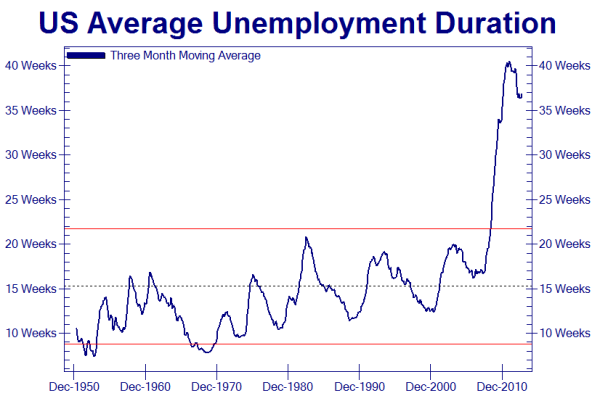
duration of unemployment - us average - 2013

There is something different about the years since 2009, that is, since the year in which the stimulus commenced. The US may never again open for business in the way it once did, and it certainly won’t without some profound change in direction for which there is no evidence of a will on anyone’ part to make that change of direction happen.

Far less than many of us hoped for but far better than what some had sought

So where are we now? The President and his Democrat cohort have been put on notice so that negotiations must now take place. Since default was never an option there was going to be an agreement of sorts to get us into the new year when the process can begin again. The sequester cuts, which really burn the Democrats up, have not been reversed and are not going to be reversed under any circumstances. The air space is now clear so that more attention can be focused on the many other screw ups of the Obama administration, most particularly the Affordable Care Act which will burn its way into community consciousness as it burns its way through the incomes of many an American. How to fix it from here is their problem but there will be a lot more sick Americans unable to find medical care at affordable prices as time goes on. Bulk stupidity but if it can’t be stopped it can’t be stopped.

What seems to have been agreed looks in many ways like the maximal position the Republicans might ever have realistically hoped to achieve given that the presidency and the Senate are in the hands of others and the media are like one great big ABC of leftist bias. Big win to the Democrats. I don’t think so, and certainly not if you are thinking about the long-term future of the American economy.

This is from The New York Times relayed via Drudge who of course describe the ongoing economic mismanagement of the American economy as a great victory for those responsible for these disasters:

Speaker John A. Boehner, the leader of conservative House Republicans whose push to strip money for the health law led to the shuttering of much of the government on Oct. 1, said that the House would not block a bipartisan agreement reached in the Senate that yielded virtually no concessions to the Republicans.

‘We fought the good fight,’ Mr. Boehner said in an interview with the radio station WLW-AM in Cincinnati. ‘We just didn’t win.’

In a statement issued as the Senate and the House prepared to vote on the proposal, Mr. Boehner said: ‘The fight will continue. But blocking the bipartisan agreement reached today by members of the Senate will not be a tactic for us.’

The decision came about 24 hours before the Treasury was due to exhaust its borrowing authority, putting the nation on the brink of a default. Mr. Boehner had earlier told colleagues privately that he would not allow the nation to default.

These are the details as reported:

Under the agreement, the government would be funded through Jan. 15, and the debt ceiling would be raised until Feb. 7. The Senate will take up a separate motion to instruct House and Senate negotiators to reach accord by Dec. 13 on a long-term blueprint for tax and spending policies over the next decade.

Senator Mitch McConnell of Kentucky, the Republican leader, stressed that under the deal, which he negotiated with Senator Harry Reid of Nevada, the majority leader, budget cuts extracted in the 2011 fiscal showdown were not reversed, as some Democrats had wanted, a slim reed that not even he claimed as a significant victory.

The deal, Mr. McConnell said, ‘is far less than many of us hoped for, quite frankly, but far better than what some had sought.’

That the American economy will continue its rapid decline is just one of those things.

UPDATE: An interesting take by Tim Stanley in the UK’s Telegraph. But what is particularly interesting is the comment thread that follows. Here, however, is his core point.

What has Obama really won? He keeps his precious healthcare reform and he gets government open again – but tomorrow morning he’ll still have the same gridlocked political system that he had the night before. The shutdown is a rare example of him winning, but remember that this lame duck president has not only had a very simple (and, frankly, inoffensive) gun control bill killed in the Senate but was so spooked by bad poll numbers that he tried to dump responsibility for military action in Syria onto the Congress – before quietly dropping the idea altogether. Any thought that the shutdown payoff will be that he can sail an immigration reform package comfortably through Congress is pure fantasy. This is a broken presidency living out its last few years either holding off Republican attacks or lazily cruising the country on some pointless, endless, fatuous campaign trail. Obama’s administration is politically bankrupt.