This is ‘Irreversible’

Below the radar isn’t the half of it.

USA INTERNET SURRENDER DAYS AWAY…
Obama’s Reckless Plan Threatens U.S. Oversight of Internet
FCC Commissioner on Internet Oversight Switch: ‘If You Cherish Free Expression,’ ‘You Should Be Worried,’ This Is ‘Irreversible’

The same people who run the UN will now run the single most important communications network in the world.

And it’s not as if the US Senate is not there and available to knock this off. The main story at Drudge at this moment is Congress Votes to Override Obama Veto on 9/11 Victims Bill. The Senate is in session and it could take action.

It’s like the lights in South Australia. There is a belief that things will just go on the way they were, but they never do and in this case they really won’t.

You also have to wonder who is calling the shots here because the lack of action itself speaks volumes.

The drums of war

I can’t hear them, but Victor Davis Hanson can. His title is A Hard Rain Is Going to Fall but his meaning is that we are on the edge of a war we are not preparing for and will be unable to fight.

Russia has been massing troops on its border with Ukraine. Russian President Vladimir Putin apparently believes that Europe is in utter disarray and assumes that President Obama remains most interested in apologizing to foreigners for the past evils of the United States. Putin is wagering that no tired Western power could or would stop his reabsorption of Ukraine — or the Baltic states next. Who in hip Amsterdam cares what happens to faraway Kiev?

Iran swapped American hostages for cash. An Iranian missile narrowly missed a U.S. aircraft carrier not long ago. Iranians hijacked an American boat and buzzed our warships in the Persian Gulf. There are frequent promises from Tehran to destroy either Israel, America or both. So much for the peace dividend of the “Iran deal.”

North Korea is more than just delusional. Recent nuclear tests and missile launches toward Japan suggest that North Korean strongman Kim Jong-un actually believes that he could win a war — and thereby gain even larger concessions from the West and from his Asian neighbors.

Radical Islamists likewise seem emboldened to try more attacks on the premise that Western nations will hardly respond with overwhelming power. The past weekend brought pipe bombings in Manhattan and New Jersey as well as a mass stabbing in a Minnesota mall — and American frustration.

Europe and the United States have been bewildered by huge numbers of largely young male migrants from the war-torn Middle East. Political correctness has paralyzed Western leaders from even articulating the threat, much less replying to it.

Instead, the American government appears more concerned with shutting down the detention center at Guantanamo Bay, ensuring that no administration official utters the words “Islamic terror,” and issuing warnings to Americans not to lash out due to their supposedly innate prejudices.

The last para of the article: “War clouds are gathering. A hard rain is soon going to fall.” If he’s right, we won’t have long to wait to find out.

Man-made disaster

Here is a presentation I will make sure I get to: Masculinism, global warming and ‘man-made’ disasters: Towards a profeminist environmentalist response. Here is the blurb:

In the wake of disasters and other environmental destruction, recent attempts have been made to develop eco-masculinities, many of which simply encourage men to commune with nature, or seek to minimize feminist critiques by finding redeeming features in traditional masculinity. Against this backdrop of debates, this paper explores what profeminist masculinity studies brings to addressing men’s ecologically destructive practices. While the causal relationship of climate change to natural disasters is contested, people’s vulnerability to “natural” disasters clearly relates to economic, cultural and social relations, including those shaped by gender. Further to that, a variety of eco-feminisms are considered which draw connections between patriarchal social structures and ecological destruction. While some eco-feminist literature is criticized as essentialist, contemporary versions of eco-feminism recognize that the greater responsibility of men for environmental catastrophies is due to the social construction of masculinism, intersected by social divisions between men. Masculinism, and the technological rationality that flows from it, has furthermore become a mindset for environmental management, which does not address the causes of environmental crises. Environmental sustainability may even appear to threaten masculinism and hegemonic masculinity, though environment movements are often seen as a supportive context for non-hegemonic masculinities and progressive practices by men. This theoretical discussion reflects on how different forms of profeminist subjectivities lead to resistance to global warming and environmentally destructive policies, and how men can change their subjectivities and practices to construct a more sustainable world.

And this is the bio of the presenter:

Bob Pease is Professor of Social Work at the University of Tasmania, Australia. He has published extensively on masculinity politics and critical social work practice, including four books as single author and twelve books as co-editor. His most recent books include: Undoing Privilege: Unearned Advantage in a Divided World (Zed 2010), Men and Masculinities Around the World: Transforming Men’s Practices (co-editor, Palgrave 2011), Men, Masculinities and Methodologies (co-editor, Palgrave 2013), The Politics of Recognition and Social Justice: Transforming Subjectivities and New Forms of Resistance (co-editor, Routledge 2014), Men, Masculinities and Disaster (co-editor, Routledge 2016) and Doing Critical Social Work Practice (co-editor, Allen and Unwin 2016).

My take on the debate

You can see my own views of the debate at Quadrant Online which in many ways is similar to Trump’s.

Donald Trump said on “Fox & Friends” this morning that last night’s presidential debate went well, despite the fact that he was asked much tougher questions than Hillary Clinton . . . .

Trump pointed out that moderator Lester Holt pressed him on his tax returns, the President Obama birther scandal and his stance on the Iraq War.

He said that Clinton, on the other hand, was not asked about her email scandal, the Clinton Foundation or the Benghazi terror attack.

Trump said that even though it was obvious that Holt leaned “more than a little” to the left, he was satisfied with the message he got out to the American people, particularly his policies on illegal immigration, law and order, and trade.

“Those are basically the three things we’re going to have to get out. And I got them out early and strong,” Trump said. “And a lot of people think the poll numbers are going to go up because of that.”

And his poll numbers are going up with virtually every poll that is run untouched by human hands – that is, every poll not run through the media and their polling organisations – show Trump having won last night. In the end, as I point out at Quadrant, American is not electing a debating team, it is electing the person who must lead them through the next four years which may be among the most perilous in American history. Who knows what is happening, but I will end with this from a comments thread at Lucianne:

There is a truly unscientific poll going on wherever 7-11 is found…they have a sale on hot beverages in their new “thermal” extra large cups with either “Republican”, “Democrat” or a “rant” design. On the east end of Long Island (of all places) there is a shortage of Republican cups and it´s attributable to brisk sales, not someone hiding the pubbie cups. The discount to buy these cups is significant (around 33 cents with tax) but the demonrat cups aren´t selling according to a friend who´s an owner.

Granted it´s unscientific but in the past when they´ve done this you don´t see the pubbie cups selling out.

This election has a feel like the one in ´72 where no one “voted” for Nixon yet he won 49 States over McG.

The media are all-in for Hillary and it is up hill for Trump in every way, but we shall see in November, and before that we will have two more debates.

The first debate

I cannot deny that I was disappointed at the end of the debate. Trump ought to have put her away with so many issues opened up for which there are answers aplenty. He went after her in the first half and drove her to the edge of the field but then let her back.

So let me think about this a bit more. First, the totally one-sided “moderating” really is irritating. The issues that will matter looking forward for the next four years do not include where Obama was really born or what Donald Trump shows on his tax form. These are not policy matters and do not much matter. What counts are the things that were not touched, such as Benghazi, her public email server which has allowed every foreign intelligence agency to read every email she sent, the open border that is not being sealed off and would not be by Clinton, her inveterate lying on everything, large and small. These were not brought into the mix by the moderator.

Second, I think Trump is conscious of the Romney experience. Romney won the first debate and then didn’t win the election. If there is anything that Trump has shown, it is that he gets his timing right. I thought he let her off the hook in a number of places which he ought to have driven a Panzer division through, but didn’t. I don’t know if it was deliberate, but on purpose or not, he will be back for the second and third events. What did Hillary learn from this? Nothing that I think can help her, while Trump learned a lot.

Third, the Trump I saw was not the Trump I believe he can be. The Trump others saw for the first time was, however, someone who does not scare the horses and had as presidential a look about him as one could wish. That Trump has won every one of the online polls asking who won the debate says something about the common expectation which he more than seems to have filled.

Fourth, Hillary’s desire to raise taxes on “the rich” and increase the minimum wage are massive disasters that would ruin the working lives of many, especially those at the bottom. Trump, on the other hand, wants to lower taxes and remove regulations on business. Hillary panders to the ignorant while Trump has a more sophisticated view of how a capitalist system works. It is not a zero-sum game in the way it is discussed by Clinton. Adding to that, his aim to re-negotiate the various trade deals, and have others contribute to the cost of their defence by the United States. These are the kinds of changes that really can make the American economy succeed. Nothing that Hillary says or has ever done, makes you think she has much of an idea how things work, other than via various forms of patronage and corruption.

In all, I wish it had been more of a win for Trump. But on this very day the electoral college for the first time rolled in his favour. He has till the start of November to build on what he has achieved, and there is no reason to think he cannot do what needs to be done. And there is always the possibility that the people who are voting understand that they are not selecting a debating team but who will lead their nation for the next four years during one of the most perilous times in its history.

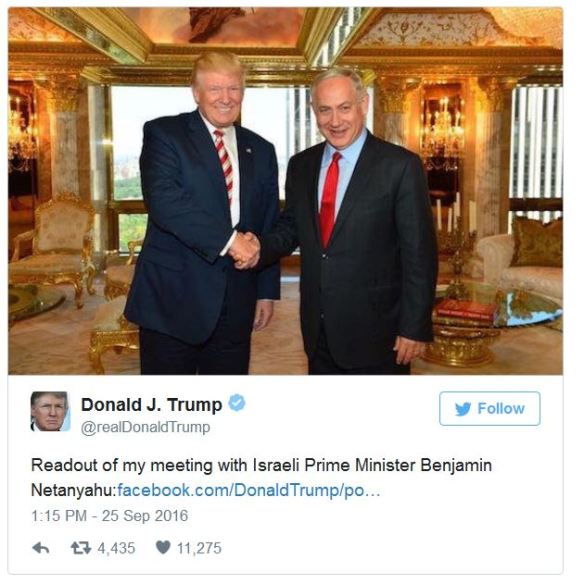
Trump meets with Netanyahu

trump-and-netanyahu

This communique is found at Powerline under the heading, Bibi calls on Trump and Clinton.

Donald J. Trump met privately today with Prime Minister Netanyahu for over an hour at Mr. Trump’s residence in Trump Tower. The two have known each other for many years and had the opportunity to discuss many topics important to both countries.

Mr. Trump and the Prime Minister discussed the special relationship between America and Israel and the unbreakable bond between the two countries. The topics of military assistance, security and regional stability were addressed. Mr. Trump agreed that the military assistance provided to Israel and missile defense cooperation with Israel are an excellent investment for America. Mr. Trump said that under a Trump administration, there will be extraordinary strategic, technological, military and intelligence cooperation between the two countries. Mr. Trump recognized Israel as a vital partner of the United States in the global war against radical Islamic terrorism.

They discussed at length the nuclear deal with Iran, the battle against ISIS and many other regional security concerns.

Mr. Trump and Prime Minister Netanyahu discussed at length Israel’s successful experience with a security fence that helped secure its borders. They discussed Israel’s burgeoning hi-tech and biotech economy and how it has made stunning advances improving and saving lives around the world. In particular, Mr. Trump noted Israel’s emergence as a world leader in cyber defense and security and its cooperation with the United States in this regard.

Mr. Trump recognized that Israel and its citizens have suffered far too long on the front lines of Islamic terrorism. He agreed with Prime Minister Netanyahu that the Israeli people want a just and lasting peace with their neighbors, but that peace will only come when the Palestinians renounce hatred and violence and accept Israel as a Jewish State.

Finally, Mr. Trump acknowledged that Jerusalem has been the eternal capital of the Jewish People for over 3000 years, and that the United States, under a Trump administration, will finally accept the long-standing Congressional mandate to recognize Jerusalem as the undivided capital of the State of Israel.

The meeting concluded with both leaders promising the highest level of mutual support and cooperation should Mr. Trump have the honor and privilege of being elected President of the United States.

For Clinton’s summary of the discussion you can go here.

Tackling climate change and low inflation all at once

The RBA wants to see prices rise in Australia and here is the answer: Climate science support puts pressure on Turnbull.

Malcolm Turnbull faces intensifying public pressure to phase out coal fired power stations and set stronger emissions reduction targets with new polling showing growing support for climate science and greater action to tackle the effects of dangerous climate change.

And so here is the good news: Hazelwood closure could force power prices up.

Estimates of the impact of its closure on retail electricity bills vary from an initial 25 per cent spike reducing to a 9 per cent rise – about the same as the carbon price – to a jump of less than 2 per cent.

If inflation is too low, whatever that means. this is one way to ensure that it gets too high.

Where are the critics of Keynesian economics today?

aust unemployment stats

The thing about these Keynesians is that they have no shame. The nonsense that Australia avoided recession after the GFC is one of those self-serving myths that will not stand an ounce of analysis. The data above (from the IPA) are the latest much-revised version of what happened to the unemployment rate during the GFC. A rise in the unemployment rate by two-plus percentage points over the course of a few months is recession enough for me, whether or not we actually had two consecutive quarters of a falling GDP. Ken Henry was Secretary of the Treasury at the time, and his advice was “go hard, go early”. So Rudd and Co went hard and early, with the results before us for all to see.

So now the self-same Ken Henry is on the front page of The Australian today with some advice on how to fix the problem that hard and early have led to: Fix budget before the crunch hits, urges Ken Henry.

National Australia Bank chairman and former Treasury chief Ken Henry warns that Australia faces an unacceptable risk with its budget deficit and fears the nation will wait for a painful economic crunch before confronting true ­financial repair.

In an exclusive interview, Dr Henry issued his most powerful warning about the failure of politicians and the national parliament, saying responsible fiscal policy had become a “pretence”, the economic reform narrative “no longer exists” and politicians are fixated by “appeals to populism”.

Dr Henry said Australia was now running the risk that its AAA sovereign credit rating might be downgraded, coinciding with another global financial disturbance, and in this situation the consequences for Australia “would be truly catastrophic”.

He said this was a “small risk” in relative terms but “the consequences are so large you cannot take the risk”.

Dr Henry said politicians through domestic economic ­policy failures were now exposing the nation to such risks that the entire reason for the reforms of the 1980s and 90s had been ­forgotten.

Unless the momentum was recovered, Australia would find “we are right back with Paul Keating’s banana republic statement”.

Well Ken, what a disaster we have created for ourselves. You must tell us where we went wrong. The following gets to the heart of the matter, which one would have hoped a Treasury Secretary would already have known. The quote is from Henry Hazlitt’s Economics in One Lesson which was brought to our attention by Tel on a previous post.

When the government comes to repay the debt it has accumulated for public works, it must necessarily tax more heavily than it spends. In this later period, therefore, it must necessarily destroy more jobs than it creates. The extra heavy taxation then required does not merely take away purchasing power; it also lowers or destroys incentives to production, and so reduces the total wealth and income of the country.

The only escape from this conclusion is to assume (as of course the apostles of spending always do) that the politicians in power will spend money only in what would otherwise have been depressed or “deflationary” periods, and will promptly pay the debt off in what would otherwise have been boom or “inflationary” periods. This is a beguiling fiction, but unfortunately the politicians in power have never acted that way. Economic forecasting, moreover, is so precarious, and the political pressures at work are of such a nature, that governments are unlikely ever to act that way. Deficit spending, once embarked upon, creates powerful vested interests which demand its continuance under all conditions.

Hazlitt also published his Critics of Keynesian Economics of which it is said:

Henry Hazlitt confronted the rise of Keynesianism in his day and put together an intellectual arsenal: the most brilliant economists of the time showing what is wrong with the system, in great detail with great rigor. With excerpts from books and articles published between the 30s and 50s, it remains the most powerful anti-Keynesian collection ever assembled.

And here’s the thing. The book was published in 1960 and other than Mark Skousen’s sadly out-of-print Dissent on Keynes (Praeger 1992) there has not been another attempt to do the same until my own modest What’s Wrong with Keynesian Economic Theory? which was only released last month. It is thus almost twenty-five years since anyone has has brought together a series of critics of Keynesian economics and more than fifty years since the only other. And as scarce as they were even then, critics of Keynes were easier to find, let me tell you, in the 1930s, 40s and 50s [and I might mention that Hazlitt included two nineteenth century articles of sublime excellence by J.-B. Say and J.S Mill]. Such economists are almost completely gone today in spite of there being every reason to think they should be found at every turn.

The mysterious and inexplicable survival of Keynesian economics

Now this was very promising: The Reasons Behind the Obama Non-Recovery: It wasn’t the severity of the Great Recession that caused the weak recovery, but government policies, an article by Robert Barro which I was alerted to by a post at Powerline. The Global Financial Crisis was over within six months. The deep and ongoing recession we are in is due to the Keynesian policies that followed.

The essence of a Keynesian policy is to start with Y=C+I+G, assume that the problem is demand deficiency and then try to fix things by raising the level of G. As I have also pointed out in the past, unless government spending is value adding – that is, until whatever is being produced earns revenues greater than their costs – such expenditure is a drain on the economy and will make you worse off, not better. I am near enough the only person I ever come across saying this, so here I lived in hope that perhaps Barro would start to say it. Someone has to say it before we wreck ourselves totally by following one Keynesian idiocy after another.

Here’s the thing. Neither the words “Keynes” nor “Keynesian” show up neither in the original article nor in the comment at Powerline. The vast waste of our resources in one mis-guided stimulus program after another goes unmentioned (although it does show up in a few of the comments). Almost no one even thinks that the problems with policy is the nature of modern economic theory.

The strange thing about my What’s Wrong with Keynesian Economic Theory? is how unique it is. No one seeks to go after the actual problem, which is macroeconomic theory based as it is on deficient aggregate demand. Indeed, no one would even dare to suggest Say’s Law may actually be true, the absolute fundamental guide to managing an economy.

Here it is as it seems to me. I said in 2009 that the stimulus would be a disaster. I wrote my article for Quadrant, The Dangerous Return to Keynesian Economics in which everything that has occurred was mapped out before it began. I started writing my Free Market Economics which is now heading for a third edition. But really, I never thought the reasons for this catastrophic fall in our living standards would remain such a mystery and for so long.