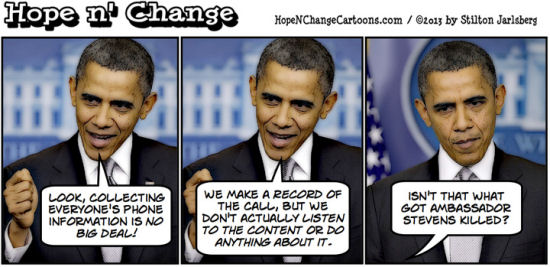
From lucianne.com

From lucianne.com
I’m with Rush Limbaugh on this. Why are people not treating what’s going on in Washington more seriously than they are.
The intelligent people were saying, “Nothing to see here. The reaction is way overblown.” Those of us who think there’s something worrisome here are overreacting and we’re too oriented in politics. And the mature thinkers that weighed in and sound reason and levelheadedness assured us that there was nothing to fear here because this was just metadata, and in fact this is something we should all be thankful that the government is able to do.
I have to tell you when I’m listening to all the smart people tell me this, my mind is about to explode, and I’m saying, “Do these people not realize what we just learned in the last three weeks?” We got the IRS starting in 2010 taking action to suppress the political involvement and ultimately votes of Tea Party people and conservative Republicans. This regime, this government, on the orders of the highest level. In fact, that investigation is ongoing. We have Fast and Furious. We have Obamacare. The evidence of the totalitarian nature or the authoritarian nature of this administration is on display undeniably every day and yet in the midst of this, “Well, don’t go off half cocked on this, Rush. Be very levelheaded. Nothing really to see,” as though there’s no context here.
If they had they would then know that global warming stopped sixteen years ago. And strangely, there are other places they could find this out as well, specially if they really do have an interest in climate change. But like with many other things, they start with what they wish were true and continue from there.
Via Small Dead Animals.
Anything the American Government wants to know about what you have said or written, they apparently know:
Here’s a seemingly comforting statistic: In all of 2012, the Obama administration went to the secretive Foreign Intelligence Surveillance Court only 200 times to ask for Americans’ “business records” under the USA Patriot Act.
Every year, the Justice Department gives Congress a tally of the classified wiretap orders sought and issued in terrorist and spy cases – it was 1,789 last year. At the same time, it reports the number of demands for “business records” in such cases, issued under Section 215 of the USA Patriot Act. And while the number of such orders has generally grown over the years, it has always managed to stay relatively low. In 2011, it was 205. There were 96 orders in 2010, and only 21 in 2009.
Thanks to the Guardian’s scoop, we now know definitively just how misleading these numbers are. You see, while the feds are required to disclose the number of orders they apply for and receive (almost always the same number, by the way), they aren’t required to say how many people are targeted in each order. So a single order issued to Verizon Business Solutions in April covered metadata for every phone call made by every customer. That’s from one order out of what will probably be about 200 reported in next year’s numbers.
The public numbers are the one bit of accountability around the surveillance court, and the Justice Department used them to misdirect the public away from a massive domestic NSA spying operation that, as several Senators approvingly noted today, has been running for seven years.
And this is from The Guardian‘s story itself:
The National Security Agency has obtained direct access to the systems of Google, Facebook, Apple and other US internet giants, according to a top secret document obtained by the Guardian.
The NSA access is part of a previously undisclosed program called PRISM, which allows officials to collect material including search history, the content of emails, file transfers and live chats, the document says.
The Guardian has verified the authenticity of the document, a 41-slide PowerPoint presentation – classified as top secret with no distribution to foreign allies – which was apparently used to train intelligence operatives on the capabilities of the program. The document claims “collection directly from the servers” of major US service providers.
Even The Guardian has more evident concern about government intrusion in the private lives of American citizens than almost every media outlet in the United States. It’s not “it can’t happen here” but rather, “sure it can happen here but who cares since it’s our fellow travelers on the left who are doing it?”
Watching the US from a distance (and I have consciously not described this as a safe distance) you sometimes forget that it is all really happening. The quiet pace at which the left in the US has been snaking its way through every institution of power makes it seem as if it ought to be stoppable but somehow is not. There was therefore what I think of as a very subtle piece of work on what has been taking place that I have discussed in a piece at Quadrant on Line.
The author at the American Thinker, Daren Janescu, describes the experience of living in the United States as like living on the inside of a Kafka novel. But his approach is to begin from the people persecuting five year olds for making guns out of pop tarts and then saying “bang, bang”.
No one ever mistook a half-eaten Pop Tart for a weapon. And that is precisely why you are forbidden from saying ‘bang, bang’ while wielding a half-eaten Pop Tart. If this still makes no sense to you, that is because you are not crazy. But try, for a moment, to put yourself into the twisted psyche of a progressive authoritarian, and ask yourself this question: What is the message being sent through such rules, and the lesson being taught through their enforcement?
Jonescu, of course, notices these people are insane but he also makes the larger point that there is a method in their madness. Their larger if unconscious aim is to make us uncertain of our own instincts, in this way to surround us with rules of what’s impermissible for actions that were once commonplace as a form of social control.
This is quite exceptional. It is from the Ann Althouse blog picked up via Instapundit. I will know that the problem is beginning to recede when you can see this on CBS and NBC. Until then the problem of gigantic government will remain a threat to liberty and our democratic way of life. It is also worth noting the point raised by the first of the commenters:
Gerritson also dropped a bombshell on the committee: Her group received an inquiry letter bearing Lois Lerner’s signature. Lerner has claimed that the IRS abuse of groups like Gerritson’s was the work of a couple of “rogue employees.”
I might note the particular part of the testimony that Ann has herself highlighted:
I am not here as a serf or vassal. I am not begging my lords for mercy.
I’m a born free American woman, wife, mother and citizen. And I’m telling my government that you’ve forgotten your place. It’s not your responsibility to look out for my well-being, and to monitor my speech. It’s not your right to assert an agenda. Your post, the post that you occupy, exists to preserve American liberty. You’ve sworn to perform that duty. And you have faltered.
If the culling stops at the doors of the IRS this will be a job not even one tenth done.
This is almost too disorienting for words. It is the Romney plan on how to move into government once the election was finally won. As far as it is possible to be from the chaos of the second Obama administration, a world utterly different that maps out a future and is filled with an articulate sense of where to go and how to get there. But this is only a loss that will be felt by those who could not imagine voting for Obama. The rest won’t know the difference assuming that if they came across this, would not feel this was a bullet they only just missed.
Among the recommendations for the Romney administration:
Corporate-style training seminars were planned for appointees and nominees before the inauguration to teach management skills.
A plan to restructure White House operations to suit Romney’s corporate management style, with clear deliverables.
Detailed flow charts delineating how information and decisions were disseminated through the administration to achieve “unity.”
Plans to evaluate Cabinet secretaries’s performance by “systematically assessing the efforts of their departments in contributing to [Romney’s] priorities and objectives, perhaps by a newly created ”deputy chief of staff for Cabinet oversight.”
More than 100 detailed one-page project management sheets were in circulation at R2P headquarters by Election Day, charting the organization’s progress and preparing for the run-up to inauguration. Movements for Romney, his wife Ann, and Vice President-elect Paul Ryan were heavily choreographed for the days following the election, and many campaign staffers were told to prepare to assume roles on the transition immediately following a victory. (All were guaranteed a job on either the transition or the inaugural committee.) A painstakingly prepared seating chart and floor plan was developed for Romney, his aides, and transition staff across three floors of the Mary E. Switzer Building in downtown Washington, ready for the rapid post-election expansion.
But go into the document itself to have a look at the incredible amount of detail in preparation for the transition.
The Rogoff/Reinhard v Krugman debate is more left propaganda than an actual genuine debate over economic theory or statistical measurement. There is a fascinating thread on the Econbrowser website which more than anything else demonstrates that so far as economics narrowly considered is concerned, this is not an area in which amateurs have anything to add. But as to the polemics of economic policy debate, it is an attempt, as usual, by the left to shut down and close out any discussion of views that are different from theirs. On the comments thread, I will start with the only comment that discussed the political side of this controversy:
It is rather telling to read the comments attacking Rogoff and Reinhart, and Professor Hamilton for defending them. In the Keynesian view, the notion that government spending cuts can be beneficial is so harmful that it must be fought with all necessary means. Proponents must be shown to be bad actors, hacks, liars.
If small cutbacks are beneficial, larger cuts may be proposed, and the next thing you know, the entire Keynesian edifice may be in danger. If people began to ask whether specific governmental expenditures are worth diverting funds from private use (through borrowing or taxation), then you have a problem. I think this fear is what drives the vehemence of the Keynesian crowd’s attacks on R&R and anyone who would defend them.
Now to the technical part. If R and R are wrong, who will ever know? Here is part of the defence this time from a different commenter who goes by the name Rick Stryker (which might even be his real name):
I understand the problem that many commenters aren’t familiar with technical arguments and so don’t know how to judge. Let me try to explain the weighting issue intuitively.
Let’s forget economics and look at a simple situation. Suppose we have to decide what what the legal drinking limit is going to be, i.e., the blood alcohol level before it’s unsafe to drive. We take 6 men and every day give them enough to drink to raise their blood alcohol level to some point, let’s say it’s 1 on some scale. Each day we measure each man’s reaction time. A reaction time greater than 10 is unsafe to drive. We want to know if a reading of 1 means that you are driving drunk.
We are lucky enough to do the experiment on the first man for 100 days but can only get 10 days of data each for the other 5
Here are the measured 100 reaction times of the 1st man.
8.6 8.2 10.0 7.5 9.8 7.5 10.6 8.2 7.7 8.7
9.2 9.2 8.2 10.1 10.1 7.4 9.0 10.3 8.2 9.6
8.6 9.2 9.1 9.3 9.0 7.0 9.5 9.0 7.9 9.9
9.9 8.4 9.4 9.0 7.5 8.3 9.5 8.3 6.8 10.5
8.2 9.3 7.4 8.6 10.4 9.0 10.4 8.5 10.0 8.6
8.1 8.3 9.9 8.8 9.2 9.2 10.0 8.9 6.5 8.7
8.2 9.3 9.7 6.8 8.6 7.5 8.9 12.1 8.9 9.6
9.0 10.3 10.1 7.4 9.7 7.5 9.2 7.3 8.0 9.1
8.6 8.8 7.7 8.0 8.6 10.2 8.5 9.2 9.9 8.3
9.5 11.8 8.5 9.2 7.8 6.8 8.9 10.1 8.8 9.0You can see on many days he’s too drunk to drive but not on all or even the majority of days.
Here are the reaction times of the other 5 men.
2 3 4 5 6
1 10.4 11.5 10.1 11.3 12.5
2 9.0 11.3 8.3 12.9 13.2
3 11.4 11.6 10.0 13.2 14.0
4 11.2 12.8 9.3 11.5 12.1
5 9.5 11.1 8.7 9.9 12.8
6 11.4 10.5 8.9 13.1 12.5
7 11.4 11.7 11.4 12.6 13.1
8 11.2 12.5 10.9 11.5 13.2
9 10.8 13.2 9.2 11.5 12.5
10 12.2 12.5 10.0 11.4 13.9Now how do we summarize our findings? If we assume that each man’s capacity to hold his liquor is the same as every other and that the only variations are in what they ate that day, etc., you would just take all 150 data points and average them. If you did that, you’d get a reaction time of 9.7. Thus, you’d conclude a blood alcohol level of 1 is OK.
However, what if you looked at the individual averages of reaction times? Here’s what you’d get for each man.
1 2 3 4 5 6
8.9 10.8 11.9 9.7 11.9 13.0Here it becomes obvious from the individual averages that the first guy is different from everyone else–he’s much better at holding his liquor. In fact, everyone is different as we might expect but the majority are drunk on average. So, averaging the first man’s 100 data points in with the 50 of the other 5 men will exaggerate the first guy’s influence and make it look like they can all hold their liquor.
It would be better just to average the averages, in which case you’d get 11 and you’d conclude that a blood alcohol level of 1 is unsafe to drive. That summarizes what’s actually going on better.
HAP [the critics of R&R] did the first estimation and assumed that all the men were the same. R&R did the second method and assumed that the men were in fact different. You can see that the second method is more justifiable if you have any reason to believe that the men are different. Since R&R are talking about growth rates of countries, we certainly have reason to believe they are different.
Moreover, the assumption that the averages are different is the standard starting assumption when analyzing data that is both cross sectional (different men) and time dependent (different days).
Strangely enough, HAP and Krugman accused R&R of doing something non-standard and an “error” by using the second method. I hope it’s clear intuitively how this is wrong from this example. In fact, what HAP and Krugman are proposing is non-standard.
What I asked 2slugbaits [the commenter to whom this comment is addressed] to do would have established that the way we did the average over the 150 data points would have fallen out of the simpler model I gave him if he had done the math. That’s HAP. And the way we did the average of average estimates would have fallen out of the fixed effects model, if he’d done the math. That’s R&R.
Hope this helps.
I don’t know if it helped anyone else, it did help me. It didn’t help 2slugbaits who replied:
Rick Stryker You have completely wasted your time. First, what you described is not what normally passes for a fixed effects panel model. For starters, you either have to establish a separate dummy for each panel (which eats up degrees of freedom) or you have to subtract the global mean from each observation before regressing…which eliminates any time invariant variables and is one of the reasons why random effects models are preferred. You didn’t do either one, so yours is not a fixed effects model. So what you seem to think is a fixed effects model is not. Second, neither HAP nor R&R ran a fixed effects panel model. R&R just lumped things into four buckets, took a simple average of each country’s observations within each bucket, and then took an average of the country averages. That’s it. That’s all they did. HAP skipped the second step and just took an average of all observations within each bucket. That’s why I said that if you wanted to replicate what HAP and R&R and do it in an overly complicated way by treating it as a regression, then you should just regress the observations and against a constant. Which is exactly what you did:
HAP make the assumption that a(i) = a, an unknown constant, and estimate
Y(i,t) = a + e(i,t)
where “a” is a constant. But there is no need for a “t” subscript unless that is supposed to represent one of four buckets…in which case the natural choice would a “b”.
But why would anyone in his right mind do that? Why not just say “take the average”? Third, you have obviously misinterpreted what JDH was talking about when he said that R&R took a panel approach. He clearly did not mean that literally…and if he did then he should have his license revoked. JDH meant that the R&R approach captured the intuition of a fixed effects panel model in that it tried to pick-up each country’s unique features.
And really…we all know how to derive a regression using matrix algebra.
BTW, plenty of new number crunching on the R&R data came out today…and all of it crushed the core of the R&R argument. See especially Miles Kimball’s work. And he originally very sympathetic to R&R’s position but has reluctantly concluded that their work is deeply flawed and worthless.
So Rick Stryker went back again:
I’m certainly wasting my time trying to explain this to you. You are back to your semantics. What we call the models doesn’t matter. I stated precisely what the models were and asserted that estimation of one would lead to R&R and a special case of that same model would lead to HAP. I challenged you to derive the estimators and confirm or deny my claim. I could see that you didn’t seem to understand and wanted you to demonstrate some comprehension of these issues. I was very clear in what I asked you to do. You couldn’t do it. I gave you over 2 days. Now, I’ve shown you exactly how to do it and you still don’t understand. You obviously know nothing about the issues you comment about, not that that stops you or any of Krugman’s other defenders.
The point of all this was for you and others to see that when HAP and Krugman claimed that R&R did something “odd” and an “error” they were just flat out wrong. But you will not to see.
This is why I keep talking about Krugman zombies. The level of illogic and irrationality is breathtaking.
To which the following reply was returned:
This whole sorry saga of R&R is reminiscent of a similar issue with Martin Feldstein back in 1974 in which he claimed to show that Social Security reduced private savings. Like R&R, he used these results politically to push his pet cause, in his case a campaign against Social Security. Once again, years later, two other economists, after a long struggle to get the data, found a coding error in the computer program which when corrected, caused the claimed results to disappear.
Posted by: Joseph at May 30, 2013 08:57 PM
Rick Stryker I stated precisely what the models were and asserted that estimation of one would lead to R&R and a special case of that same model would lead to HAP.
So what’s your point? What I said was that the way you were approaching this is flat out stupid and convoluted. It is certainly possible to take data into something like EViews, run it through a pooled cross-sectional fixed effects model and get an answer that exactly matches the way R&R and HAP did things. But you will get exactly the same answer by taking an average of each cross-sectional unit and then taking an average of all cross-sectional units, which is how R&R actually did their analysis. Now if you want to call the former exercise a fixed effects approach, then be my guest, but it’s a mighty odd one. When people talk about fixed effects models they usually have in mind a model that has slope coefficients as well as just a constant and fixed effects deviations. No one estimates two-dimensional pooled cross-sectional data as a special case of a fixed effects model. JDH was not saying that R&R actually did anything as stupid as run the numbers through a fixed effects model. JDH’s point was that their approach tried to capture some of the intuitions of a fixed effects approach, but they did so in a more straightforward way; i.e., just simple averaging in Excel. Doing things your way makes about as much sense as wanting to go from New York to Chicago by heading east. It’s possible to do that, but not very bright. Same with your crazy example of finding a simple mean by regressing against a constant. Yes, you could also call a simple mean a special case of a linear regression, but no normal person would do that…except I will note that you in fact did just that. Go figure.
With your latest tangent I take it that you have given up trying to defend R&R’s analysis. Both of their key points have been fatally undercut. The 90% “threshold turns out to no threshold at all. And the causality issue has also collapsed. Not only do high debt/GDP ratios fail to predict lower future growth, weak exogeneity tests failed to show a causal relationship.
And as the final posting from Rick Stryker to which nothing more has been added since, we have this:
I know this is a waste of time to continue to discuss this with you, but for the benefit of whoever is not bored silly with this and wants to learn something, I’ll try again.
The question I want to answer is, “Is Krugman right that R&R used an odd estimation technique?”
In order to answer that, we need to understand what the underlying assumptions are in each estimation method. So we need to write down the conceptual models that are equivalent to the estimation techniques. I’m not saying that R&R and HAP literally ran these conceptual models using statistical software, but rather these models are equivalent to what they did. The advantage of writing the models down is that we can see the underlying assumptions clearly.
I asserted that the R&R method is equivalent to estimating the model
Y(i,t) = a(i) + e(i,t) (1)
and averaging the estimated a(i). I also asserted that the HAP method is equivalent to estimating the model
Y(i,t) = a + e(i,t) (2)
If we can agree on that, then we can immediately see that HAP is a special case of R&R in which all means are assumed to be equal. We can also see that if anyone is making an odd assumption in cross sectional data, it’s HAP not R&R. We need to resolve this question because Krugman has asserted yet again in his latest post the unsubstantiated claim that R&R used an odd estimator.
You responded to this argument with a series of points that were irrelevant. For example, the fact that R&R and HAP didn’t literally run these models is irrelevant to the argument.
To keep us on track, I narrowed the point to just the question of whether the models I wrote down are equivalent to the estimators as I asserted. I asked you to derive the estimators. That way, it’s clear whether I’m right or not. If you derive the estimators and show that they aren’t equivalent to R&R and HAP, then my argument fails. But if you derive them and get HAP and R&R, then you will have demonstrated to yourself that a key assertion in my argument is correct.
But despite my request, you did not derive the estimators. Instead, you responded again with the irrelevant point that R&R and HAP didn’t actually run these estimators. At this juncture, I realized that you really don’t understand the point at all and can’t derive these simple estimators. I was frankly annoyed that I was wasting my time with you. I was also quite irritated that you are attempting to defend Krugman when you don’t understand these issues at all.
I gave you a day before I said anything. I thought that you might try look up the solution in an econometrics book. After 2 days, I did the derivation for you.
Amazingly enough, despite the fact that I laid out the derivations for you, you are still fundamentally confused. That’s why you need a conceptual model–to avoid confusion. For example, in your penultimate comment you said
“The R&R approach is also wasteful of information because it effectively throws away the country specific variance. That’s a bad feature of any model. The HAP model at least doesn’t throw away information.”
If you look at the models I wrote down and understand the derivations, then you can see that this statement is wrong. Look at the random effects model I wrote down:
Y(i,t) = a(i) + e(i,t)
where now the a(i) are iid random variables with mean a and variance v. Now, let v, the country specific variance, go to zero, i.e., throw away the country specific variance. What do you get? Not R&R as you claimed, but HAP!!
I think the argument I have laid out is exactly what JDH was saying. It must be frustrating for him too to watch this. He can blame me for not being clear enough in explicating it but his original point on fixed vs. random effects is absolutely right.
Also, I noticed that Krugman has backed away from one of the elements of his and HAP’s smear in his latest post, and is now saying that R&R’s excluded data was not intentional and perhaps unavoidable. But he still is claiming that the R&R estimator was “odd.” I wonder if he will back away from that assertion too? He should back away from both completely but that’s not enough. He should apologize.
Who’s right on the economics and econometrics, who can say? But who won out on the political side of the debate, it is a hands down win for Krugman. But if the American economy does start to tick up, it won’t be because of some stimulus but because of the sequester which is starting to bring down the rate of growth in public spending.
An article on the riots in Sweden and how the Swedes have struck back while being fought off by the authorities and the police who seem content to let the riots continue. I also find the grouping of immigrants and the left as the instigators of the riots a very interesting take. Here’s perhaps the most instructive passage but read the lot:
There were also rumours that armed immigrants wanted to find the vigilantes and kill them, all this while the vigilantes continue their search for rioting immigrants and Marxists. It is also confirmed that left wing extremists have joined cause with the immigrant gangs in their rioting. They see the race riotings, the burning of cars and the throwing rocks at police, ambulances and fire-fighters as a ‘class war’. Even though the cars being set ablaze and the people injured by their violence are ordinary Swedish people and primarily working-class day labourers.
The largest vigilante group had more than 300 people in it. Another group had about 100 people, and there were several smaller groups. About 20 of the vigilantes were been arrested by the police and had to spend six hours behind bars. During which time the rioters could continue with their criminal activities. This should be compared to the 19 arrests of immigrants and rioters made in the preceding 5 days of rioting.
And now this from Andrew Bolt: Quite a story! The bolding is Andrew’s.
Look at Stockholm this past week. Our Government is actively working to increase the number of exactly the kind of communities having most trouble integrating. Expect more of the us-vs-them preaching of the likes of NSW Labor MP Shaoquett Moselmane this week:
On 21 May 2013 the Hon. Amanda Fazio and I had the honour and privilege are formally presenting the Holy Koran to the President, the Hon. Don Harwin, MLC, at an official ceremony in Parliament House attended by more than 100 senior members of the Muslim community, dignitaries and multicultural media.
It should be noted that this was the first time in the history of any Australian Parliament—and possibly any Parliament in a Western non-Muslim nation—that a motion was formally voted on and agreed that a copy of the Holy Koran be presented to the Presiding Officer…
I will always say and do what is right, even in the face of trash that I have read in the Australian Israeli media. One or two reporters writing in the Murdoch press—namely the Australian—have been attacking me and denying the truth of Israel’s occupation of Palestinian land and the killing and dehumanising of the Palestinian people. That is utter garbage. I accept the right of people to express their views, even when they are wrong, naive, ill informed, indoctrinated and blinded by the power of a political lobby group that is cancerous, malicious and seeks to deny, misinform and scaremonger. What I do take exception to is foreigners intervening in the rights of Australian politicians to speak out. Therefore, I say to the Israeli ambassador, Yuval Rotem, ‘Butt out and stay out. Your perceived right to bully as you do in the Middle East does not extend to the Australian political arena.’
In today’s Australian Cassandra Wilkinson, lacking journalistic integrity and informed knowledge of Israeli occupation of Arab land, … conveniently attacks others in the New South Wales Parliament who simply dare to criticise—as any ethical or moral person would do—the State of Israel’s illegal and criminal practices against the Palestinian people. I applaud all Muslim and Arab leaders for speaking out on these and other issues. I call on the Australian Arab Muslim community to unite and for once to speak with one Australian voice. I ask them to protect the right of their community to speak out and deliver a message of peace and citizenship on behalf of their community so that neither they nor their messages are misconstrued or misunderstood.
Their tribe, “our” tribe. The demonisation of Israel supporters as a “political lobby group that is cancerous, malicious and seeks to deny, misinform and scaremonger”.
Remember – this is from a “moderate”, elected to the NSW Parliament with Labor’s help. You should hear the extremists.
Without the media beating the drum, no issue, no matter how crucial, will ever become front and centre in the national conversation. The media is lock, stock and barrel in the hands of the left and they are just running dead on the various scandals that the Obama White House has been involved in. The intensity of the current debate – or lack thereof – will never wake the slumbers of a somnolent population.
This story of the Gibson Guitar Company, which always had the strangest look about it from the start, is now explained. But the explaining is not done with the intense anger it ought to bring forth but really, is nothing more than a venture into, now I can understand what I didn’t understand before. Fancy all that. The para that matters:
On Aug. 24, 2011, federal agents executed four search warrants on Gibson Guitar Corp. facilities in Nashville and Memphis, Tenn., and seized several pallets of wood, electronic files and guitars. One of the top makers of acoustic and electric guitars, including the iconic Les Paul introduced in 1952, Gibson was accused of using wood illegally obtained in violation of the century-old Lacey Act, which outlaws trafficking in flora and fauna the harvesting of which had broken foreign laws.
In one raid, the feds hauled away ebony fingerboards, alleging they violated Madagascar law. Gibson responded by obtaining the sworn word of the African island’s government that no law had been broken.
In another raid, the feds found materials imported from India, claiming they too moved across the globe in violation of Indian law. Gibson’s response was that the feds had simply misinterpreted Indian law.
Interestingly, one of Gibson’s leading competitors is C.F. Martin & Co. According to C.F. Martin’s catalog, several of their guitars contain ‘East Indian Rosewood,’ which is the exact same wood in at least 10 of Gibson’s guitars. So why were they not also raided and their inventory of foreign wood seized?
Grossly underreported at the time was the fact that Gibson’s chief executive, Henry Juszkiewicz, contributed to Republican politicians. Recent donations have included $2,000 to Rep. Marsha Blackburn, R-Tenn., and $1,500 to Sen. Lamar Alexander, R-Tenn.
By contrast, Chris Martin IV, the Martin & Co. CEO, is a long-time Democratic supporter, with $35,400 in contributions to Democratic candidates and the Democratic National Committee over the past couple of election cycles.
And the story’s title, “Now The Gibson Guitar Raids Make Sense“. Good to understand things, I suppose, but where’s the outrage. where’s the anger, where’s the will to do something about it?
 Law of Markets