Mitt Romney – the movie

This is the trailer of a documentary that will be released on January 24. Romney was followed and filmed for six years with these results. I still wait upon the name of that magic Republican who could have won in his place. Instead American can spend the next three years trying to work out how to see a doctor without bankruptcy proceedings while living standards fall back a decade or two. You got Mr Cool as your president instead. Enjoy.

Herbert Hoover on the Great Depression

One of the most extraordinary sentences I ever came across, and I no longer have any idea where, was from something written in around 1939 where whoever it was wrote that the 1930s are going to be completely mis-remebered, and this had entered his head because he’d heard someone the other day refer to “The Hungry Thirties”. He thought such a notion was preposterous and could say so then because everyone would have understood what he meant. Now “The Hungry Thirties” is exactly how the period is remembered and my political education began at the hand of my Father for whom the Great Depression was the most important personal landmark of his life. His socialism had arisen then and it stayed with him till his last days on earth.

The following passage, though, is from Herbert Hoover who was enraged by the way the 1930s have entered into our common consciousness. He, of course, has his own reasons for wishing our historical memory was other than it was, but he couldn’t write what he wrote if it were so off centre that everyone who was there then would see it for themselves. The first para in the quoted passage below is from the editor but the rest is Hoover himself. It is from an excerpt contained in a review of a manuscript that was discovered in 2009 of Hoover’s writings during his post-presidential period. The book is The Crusade Years, 1933–1955 and edited by George H. Nash.

In the presidential contest of 1944, Hoover’s indignation boiled over. Democratic Party leaders and pro–Roosevelt campaigners repeatedly sought to discredit the Republican presidential nominee, Thomas Dewey, by portraying him as an intellectual lightweight who would be a puppet and “mouthpiece” for Hoover and reactionary ‘Hooverism’ if elected. Unwilling to countenance any longer the Democrats’ attacks upon his record, Hoover composed the scathing rejoinder printed here.
_____

The greatest lie told in this whole campaign has been that the Depression of 1930–32 was caused by the Republican Party; that the Republicans did nothing about it; that the people were allowed to starve and were compelled to sell apples; that the country was in ruins; and that Roosevelt rescued it from complete wreck.

This lie has been promulgated in a thousand speeches, in millions of scurrilous pamphlets and circulars. Mr. Roosevelt has himself given currency to it. . . .

The broader facts are and history will record that the depression was world-wide; that its major origins were in Europe; that it swept in on the United States like a hurricane; that it originated from the aftermaths of World War I, including the Treaty of Versailles; that by action of the Republican Administration 18,000,000 people were under organized relief and that any consequential hunger and cold were prevented; that the Republican Administration took drastic measures to protect the peoples’ savings from the storm by creating the R.F.C., the Home Loan Banks and by expanding agricultural credit institutions. There were failures mostly in State Banks not under Federal control.

History will also record that the depression was turned world-wide in June and July of 1932; that we were on our way out with employment increasing but that recovery was halted when business confidence was shaken by the impending election of the New Deal; that with the election the whole country further hesitated awaiting the new policies; that rumors quickly spread that Mr. Roosevelt would devalue the currency; that in consequence, people tried to get their money from the banks and that speculators tried to ship it out of the country; that Mr. Roosevelt upon Mr. Hoover’s request refused to reaffirm the promises he had made the night before election not to tinker with the currency; that Mr. Roosevelt refused to cooperate in other directions with Mr. Hoover to stem the tide of fear—fear of what? It was of the New Deal, not of a retiring administration. It was a panic of bank depositors induced by the New Deal and Mr. Roosevelt. After the banks were reopened it was found that 98% of their deposits were good.

History will also record that the rest of the world, not having a “new deal,” went straight out of the depression and recovered its employment by 1934–35; that unemployment here in the United States continued on a vast scale for six years of the New Deal; and that it took a war to get us out of it.

The whole of the story put over by the New Deal orators is the most gigantic dishonesty ever known in American politics.

Nothing Hoover wrote here is contradicted by anything I know and quite a bit fits into what I have seen for myself. Literally every other market economy emerged from the Great Depression in 1932-33 with the sole exception being the United States. But Hoover himself has a lot to answer for, including the public spending, his wages policy, the higher interest rates and the Smoot-Hawley tariff. But that Roosevelt might have created the very uncertainty he needed to win the election, and then brought along with him the far left ideologues who ran his policies for him, the truth about the New Deal is far different from what you might otherwise have thought from looking at the standard histories.

Herbert Hoover and the New Deal

Herbert Hoover’s memoir written in the 1940’s and 50’s had lain in vault until discovered in 2009. It is now being published under the title, The Crusade Years, 1933–1955. This is from a review of the book:

Now came the final phase of Hoover’s career: his remarkable ex-presidency. For the next thirty-one and one-half years, in fair political weather and foul, the former chief executive became, in his self-image, a crusader—a tireless and very visible castigator of the dominant political trends of his day. He behaved as a committed ideological warrior more persistently and more fervently than any other former president in our history.

Why? Most of all, it was because Hoover perceived in the New Deal of Franklin Roosevelt not a moderate and pragmatic response to economic distress but something more sinister: a revolutionary transformation in America’s political economy and constitutional order. Having espied the unpalatable future, Hoover could not bring himself to acquiesce.

Here is an excerpt from the review. The first paragraph is by the editor, George Nash, the remainder is Hoover himself.

Editor’s note: The paragraphs below are taken from the earliest extant fragment of Hoover’s memoirs relating to his post-presidential years. He probably composed it by hand in September 1944. In this brief essay he identified the poisonous ‘philosophical error’ that had come to dominate American politics during the New Deal years, an error he deemed it his moral duty to combat.
_____

The period from 1933 to 1938 in America was dominated by a clash in philosophical ideas to which I felt it was my duty to apply every bit of strength I possessed. I was convinced that a great error had come into liberal thinking, which threatened to destroy the magnificent civilization which intellectual and spiritual freedom had builded and which was its impulse to progress. . . .

The error in ideas came first in the form of Socialism but had made little progress prior to the first World War. The root of the error was that government operation of economic instrumentalities, or government direction of their operation other than establishment of rules of conduct, could short-cut all human ills and produce immediate Utopia. This gigantic poison of liberty received a great impulse from the government agencies created to mobilize the whole energies of peoples in total war. Here the impulses of patriotism to produce and labor and the fear of the enemy were substituted for free will. After the war the inevitable flood of misery, of impoverishment and frustration furnished the hotbed for the growth of this gigantic error. It developed over Europe in various forms—all from the same root. Communism, Fascism, and the milder forms of Statism, were heralded by well-meaning and generous-minded men as to the new road to life. They were joined by demagogs and seekers-for-power. The ultimate end was slavery, whether in Communistic or Fascist form. This philosophic error had spread mildly in American thinking, but attained no dangerous proportions until the world-wide depression struck us with all its violence, misery and exposure of wrong-doing.

It was certain in my mind that the New Deal was but one form of this same error in ideas and that it was my job to fight it. But fighting a philosophic idea among a people who had never thought in these channels was not only a difficult thing in itself, but one must contend with demagogic promises of Utopia to a suffering people and the obvious needs of reform in the system itself.

The American people at large had scarcely heard the word ideology. They had developed and they had lived and breathed a way of life without defining it as an ‘ideology.’

A study in conservatism

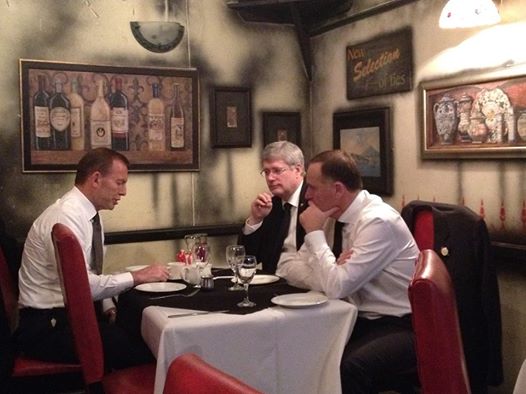
abbott harper key

These are the Prime Ministers of Australia, Canada and New Zealand having a quiet lunch together when they met up at the funeral of Nelson Mandela. I don’t know whether what I like most about it is the quiet reflective down-to-earth mood or that they are three conservative leaders at a time when conservatism is very unfashionable amongst our political elites. I fear that quiet scenes such as this amongst sensible leaders such as these will become more of a rarity. This is from Mark Steyn at National Review. I wonder if this picture has been reproduced anywhere else in Australia.

[Thanks to BW for sending it along.]

Much too implausible

The Rob Ford story has an enchantment about it that is hard to beat. But this, from Eye on a Crazy Planet, add such merriment to the whole enterprise to get rid of an honest politician:

When I used to work in Hollywood for a production company that’s films garnered a slew of major Oscar nominations, one of my jobs as a Creative Executive was to decide whether or not to recommend screenplays for production and to write notes on them.

With the news that The Toronto Star‘s City Hall reporter Daniel Dale is planning, with the enthusiastic support of his employer, to sue Toronto Mayor Rob Ford for libel in a lawsuit of dubious merit, an analogous thought occurred to me, particularly after reading this in The Torontoist:

Dale will continue covering municipal politics, he also explains. ‘With the full support of the Star, I will stay on the City Hall beat while pursuing this action – I can easily imagine the mayor and his brother attempting to turn the tables on the Star and calling for me to take a leave of absence…I will not let this affect my job. I will not be bullied off of my beat.’

I thought of my reaction if I had received a screenplay in which part of the plot involved a City Hall reporter, for a newspaper with the largest circulation in a major city, suing a mayor for libel and continuing to cover the City Hall beat while pursuing the suit.

The ensuing conversation in that imaginary scenario would have gone something like this:

ME: The gags need to be punched up a bit, but on the whole it’s a pretty good premise for a comedy.

WRITER: Comedy? This is a serious political drama.

ME: I love your sense of humor! It’s great, we’ve got the John Goodman-type regular guy slob, and all the stuck-up elitists are out to get him, like King Ralph, but at City Hall. But seriously, we need some more gags with the reporter and the mayor encountering each other. Oh, and that flaky female reporter that made a name for herself by stalking the mayor, I think her motivation should be that she has this sexual fixation on him, like she’s a chubby chaser or something. Here’s a scene you might want to consider: maybe she could corner him in private and flash her beaver and demand she eat her out. She could say something like, “You look like you know how to eat a lot of pussy!” And he’s squirming to get away and says, ‘I’ve got plenty to eat at home!’

WRITER: You don’t understand! I mean it, this is a serious political drama about an oppressed reporter seeking justice from an evil politician!

ME: Seriously???

WRITER: Yes! My sympathies are completely with the newspaper and its reporters.*

ME: Okay. You realize that changes everything. Here’s why that’s not going to work. First off, You’ve got who are the villains and who is the hero mixed up. You have this guy who was elected, and he’s this silly doofus who tells ridiculous lies about his personal life, but when it comes to serving the public, is scrupulously honest. The guy even coaches underprivileged kids and takes them into his own home. And that’s your villain.

On the other side, you have a newspaper run by hypocritical snobs who support a corrupt government that misappropriated billions of dollars in public funds. And they lie about this mayor character, they hate him mainly because he’s not part of their ‘in’ crowd, they obsessively stalk and harass him, and support every undemocratic effort they can think of to get him out of office. And those are supposed to be your heroes??

WRITER: But this terrible mayor has made the city a laughingstock!

ME: That’s pretty harmless, and again, it’s what makes this all more of a comedy.

WRITER: But the real drama comes when this detestable mayor slanders one of the hero reporters by implying he’s a pedophile, potentially destroying his life!!

ME: Yeah. Well, here’s your problem with that. The way you describe it, in the first place, the Mayor never said he was a pedophile, he was talking more about his own state of mind when he heard that some guy was peeping in his back yard. In fact, this mayor character explicitly says he doesn’t know if the reporter was taking pictures of his kids. He was talking about how a father feels when he hears someone might be invading his privacy and taking pictures of his young kids. That doesn’t sound like slander to me and there’s no threat to the reporter’s reputation because quite reasonably, nobody takes seriously the possibility that the reporter could actually be a pedophile.

WRITER: No! Wait, you’re wrong about something! I never had the reporter peeping in the back yard!

ME: Alright, then here’s where you’ve got some more problems with your storyline. After a neighbor calls him, the mayor comes charging out to confront the reporter, who freaks out and runs away.

WRITER: That’s right, the Mayor is a bully!

ME: Okay, so let’s assume your reporter never peeps in the mayor’s back yard. How does the mayor know he’s there? Why would a neighbor call the mayor to tell him someone is walking around on public land? The only way your story makes sense is if, even if he wasn’t taking pictures of it, he was at least peeping in the mayor’s back yard. I still think you should give some thought to the comedy angle. Maybe have the reporter be a bit like Jim Carrey’s character in The Cable Guy…

WRITER: No! It’s not a comedy and no, the reporter was never standing on cinder blocks and peeking in the mayor’s back yard!!

ME: Well, it’s your story.

WRITER: That’s right! I think every decent, social justice-seeking person in the audience is going to identify with the crusading newspaper and its heroic journalists!

ME: Interesting. The way I read it, in your story, the only people you’ve got siding with your newspaper are pompous douchebags and sanctimonious nitwits. But aside from that, we get to the most blatant problem with your story…

WRITER: Which is?

ME: Well, while this reporter is suing the mayor, he still is doing City Hall coverage for the newspaper.

WRITER: Yes, so?

ME: So? So that’s completely implausible. There’s no way a real newspaper could ever allow that to happen. It would undermine any shred of credibility even as biased a newspaper that you’ve written about could even pretend to have. I mean, how could there even be a pretense of objectivity and fair journalism when you allow a guy who is suing the mayor to be writing City Hall coverage!? It’s like committing suppuku as far as all credibility goes. There’s no way an audience would believe that even a third rate rag of a newspaper would do that.

WRITER: That’s the way I’ve written the story and that’s the way I’m keeping it. So when will I hear about whether we go into production?

ME: Don’t call us, we’ll call you.

* Actually, this is the point where I would have thought I was dealing with a lunatic and would have edged the meeting to a quick conclusion.

This was found at the great Canadian website, Five Feet of Fury.

Squandering American prestige and honor

obama castro

Most of the Obama-related commentary on the funeral in South Africa is about his selfie with with David Cameron and the Prime Minister of Denmark, Helle Thorning-Schmidt. But that wasn’t the blockbuster moment. John Hinderaker at Powerline explains the deeper significance.

Otto Reich, former assistant secretary of state for the Western Hemisphere, explains the damaging significance of Obama’s handshake:

The Castro brothers have been vying for the world to see a handshake with a U.S. president for over 50 years. (President Clinton did shake hands with Fidel at a U.N. summit in 2000, but there was no photo.) They knew it would represent a form of recognition, something they forfeited by virtue of presiding over a military dictatorship, and their support for violence and anti-American terrorist movements and governments on three continents.

Until now, every American president had studiously avoided this mistake: At U.N. and other gatherings U.S. Secret Service agents and diplomats were under orders to make sure such a ‘photo op’ so highly desired by the Castros did not happen.

With his greeting, President Obama has squandered U.S. prestige and honor.

All very subtle to you and me but not to those who count.

Hamlet discusses territorial claims in the North Pole

The power vacuum created by the weakness of the American government is allowing tensions to build in places that were once stable and settled. Nothing is forever stable and settled but the instability is happening now – first between China and Japan and now between Russia and Canada – because the Chinese and Russians have estimated that Obama is a paper tiger who will not defend America’s traditional allies in any serious contest of wills. These are just testing, testing, one two three, testing. The real stuff is to come.

So here is where we are now at, Canada plans claim that would include North Pole. Hamlet also once discussed territorial claims involving the Poles:

Enter HAMLET, ROSENCRANTZ, GUILDENSTERN, and others

HAMLET
Good sir, whose powers are these?

CAPTAIN
They are of Norway, sir.

HAMLET
How purposed, sir, I pray you?

CAPTAIN
Against some part of Poland.

HAMLET
Who commands them, sir?

CAPTAIN
The nephews to old Norway, Fortinbras.

HAMLET
Goes it against the main of Poland, sir,
Or for some frontier?

CAPTAIN
Truly to speak, and with no addition,
We go to gain a little patch of ground
That hath in it no profit but the name.
To pay five ducats, five, I would not farm it;
Nor will it yield to Norway or the Pole
A ranker rate, should it be sold in fee.

HAMLET
Why, then the Polack never will defend it.

CAPTAIN
Yes, it is already garrison’d.

HAMLET
Two thousand souls and twenty thousand ducats
Will not debate the question of this straw:
This is the imposthume of much wealth and peace,
That inward breaks, and shows no cause without
Why the man dies. I humbly thank you, sir.

CAPTAIN
God be wi’ you, sir.

And once again worthless rock although it does contain Santa’s workshop.

‘We’re talking about the center of a large, inhospitable ocean that is in total darkness for three months each year, thousands of miles from any port,’ he said. ‘The water in the North Pole is 12,000 feet (3,650 meters) deep and will always be covered by sea ice in the winter. It’s not a place where anyone is going to be drilling for oil and gas.

‘So it’s not about economic stakes, it’s about domestic politics.’

And therefore will be garrisoned to the hilt. The more interesting question is whose side will Obama be on? Given his near hundred percent record of failing to support America’s traditional allies, that it will be the true north strong and free is far from certain.

The difference between propaganda and education

Harold Lasswell explaining the difference between propaganda and education in 1935:

The spread of controversial attitudes is propaganda; the spread of acceptable attitudes is skills education. It is proper to speak of Communism as propaganda in Chicago and as education in Moscow.*

Today, of course, we could define propaganda and education in exactly the same way but the examples would be reversed.

*Harold D. Lasswell. 1935. “The Person, Subject and Object of Propaganda.” Annals of the American Academy of Political Science, vol 179: 189. Quoted in Wolfgang Schivelbusch. 2006. Three New Deals. New York: Picador, 74.