Irony may not be his strongest suit

From The Oz, Subsgate: Malcolm Turnbull fires shot across Tony Abbott’s bow. It begins:

Malcolm Turnbull has fired a warning shot at Tony Abbott over the growing disunity within government ranks, calling in the federal police to investigate a ­security leak as MPs worry about the political damage from the former leader’s actions.

Despite Mr Abbott’s denying he leaked classified documents, his colleagues criticised him for lending weight to a report in The Australian yesterday that highlighted delays in the development of a new submarine fleet.

Liberals warned that the “sniping” from the former leader had turned into a “full-frontal ­attack” that could lead to the ­destruction of the Turnbull government if it continued into an election campaign.

“This is not about a return to power, as with Kevin Rudd, this is a full-frontal attack,” said one MP, who believed Mr Abbott was intent on “blowing the place up” even if that meant the polit­ical death of his colleagues.

The thing is, these are issues people such as myself look on as high priority. And while you cannot entirely trust the author of the leaked story to be telling the truth, maybe he is:

The author of the report, The Australian’s foreign editor Greg Sheridan, told Sky News Mr ­Abbott was not his source.

“I can say this much to you … the source wasn’t Tony Abbott,’’ Sheridan said. “I went to Tony Abbott with my information and interviewed him on the record and, as he says, what he says is on the record.”

It is possible that the community does prefer an extra $10 a week than a stronger national defence, or maybe it doesn’t. But whichever it is, there is no percentage in hiding the debate until the election. What is clear, of course, is that the delay in building our submarine fleet is not universally popular, which is why there are those who would prefer to avoid the entire issue altogether.
Tony’s economic narrative

This is what Tony Abbott thinks: Malcolm Turnbull lost without an economic agenda. This is what John Howard thinks: Tony Abbott would have won coming election. And this is what Tony Abbott now writes: In defence of my economic narrative and tough decisions. He begins:

The first law of governing is that you can’t spend what you can’t raise through taxes and borrowings; and the second law is that today’s borrowings have to be paid for — with interest — by tomorrow’s taxes. Governments, like households and businesses, have to live within their means.

You know, the Micawber Principle of public finance. Which really comes down to this: the reason it is still only just barely worth voting for any of those 54 unworthy bunch of nonentities in the Liberal Party is because Tony and others like him on his side of the speaker remain in the Parliament. The PM is exactly the kind of narcissistic buffoon most of us here took him to be.

Monetary policy and Say’s Law

Here is a bit of transcript from Reserve Bank Governor Glenn Steven’s in response to a question put by Craig Kelly MHR during a Parliamentary committee meeting. You could find neither the question nor the answer anywhere else in the world.

Mr CRAIG KELLY: There was an article published earlier this week in The American Spectator. If I just quote a few passages from it, you might like to comment. It said:

“America is languishing from historically low growth rates for the past ten years … In the fourth quarter of 2015, our growth rate was less than 1% at .70%.”

It goes on to talk about Japan. It says:

“Japan has followed this same pattern of high tax rates, lower interest rates, and endless government spending for the past 25 years. The result is massive federal debt, a slow growth economy, and reduced international competitiveness.”

Then it goes on to Europe:

“Europe has followed the same prescription, with similar results …”

Then it goes on:

“Jean-Baptiste Say theorized that the growth of economies is not demand-driven, but growth is created by new and lower cost products and services.”

Do you think that governments worldwide over the past six, seven or eight years have been too much focused on stimulating from the demand side rather than from the supply side?

RBA GOVERNOR, Mr STEVENS : Say’s law, as it is known, is a long-run proposition that supply creates its own demand. I think my colleagues are more educated in economics than I, but my sense is that mainstream economics would admit that there are occasions when, for one reason or another, aggregate demand in the economy can fall short of its supply capacity, and we lived through one of those. It is actually pretty likely that will happen in a financial crisis, and that is what happened. So it was appropriate for the countries affected—which were many, including us—to adopt more expansionary demand management policies, both monetary and, where space allowed, fiscal.

But then the question is: it is one thing to manage demand around the cycle—most mainstream economics accepts that some of that should be done, especially in deep downturn episodes where it is virtually certain that it is a deficiency of demand that has caused it—but, in the longer run, where does the growth come from? This is a point where I am a broken record, but this is the point we have made many times. It cannot really be the case that we get long-run growth by just using monetary policy which, in the end, borrows from tomorrow’s income to spend today. That cannot be a recipe for sustained, strong long-run growth. The sustained and strong long-run growth in living standards comes from innovation, risk taking, productivity et cetera et cetera. We have talked about all that, as you know, many times before, and I think the committee understands our view.

So I would say that in the past seven or eight years too much has been expected of monetary policy to keep delivering growth. Really—and I am speaking at a global level here—monetary policy globally has been asked to do something it cannot really do. It is not simple to put long-run growth on a better track, but this is why, when we hosted the G20, we talked about the growth plan structural initiatives. None of those initiatives were that the central bank should cut rates further to get the two per cent extra growth the G20 talked about, they were all structural things to help make economies work better—to help productivity, to assist innovation et cetera. That is where prosperity comes from. It does not come from manipulating the price of money. There is a place for doing that in a demand downturn but long-term growth does not come from that. We have been very clear about that.

The question is outstanding and the answer is pretty damn good as well.

“We know what to do but we don’t know how to get re-elected after we do it”

I used to say often during the great Peter Costello years that everyone would see what was happening but never understand why it worked. Public spending would come down – even in the midst of the Asian Financial Crisis – and the economy would simply go from success to success. Falling unemployment and falling taxes just followed year on year. Not just a zero deficit but ZERO public debt. And on we would roll. Why it would work you cannot find in a single modern economics text (well, there is one). What you saw before your eyes was specifically ruled out by the economic theory everyone, including everyone at Treasury, is taught. Peter Costello did what he did in the face of Treasury opposition and set a standard for performance that no one is ever again likely to match.

So we have this from the paper today: on the Government trying to think through what to do on the economy.

As Coalition MPs speak out against a GST increase, Malcolm Turnbull and Scott Morrison are examining other ways to pay for an ambitious agenda centred on tax cuts designed to encourage workers and lift economic growth. . . .

“The only realistic option for very significant income tax cuts is by changing the tax mix, and that is why a number of people have advocated increasing the GST for the purpose,” Mr Turnbull told parliament.

The strategy is to increase the goods and services tax to pay for a fall in personal tax. The Peter Costello option, of cuts to spending, is off the table, not even being considered. How this change in the tax mix would create growth seems incomprehensible to me, since no matter how you slice it, no cuts to public spending are involved so no additional space for the private sector is opened up. But there was also this I found quite interesting.

The Prime Minister insisted yesterday that he had not made up his mind on a GST increase”.

Is this to be a captain’s pick? Is it not a cabinet decision? Are we to understand that an increase in the GST rate is up to Malcolm alone and the rest must merely fall into line?

I was given a great quote yesterday apparently from some European Prime Minister:

“We know what to do but we don’t know how to get re-elected after we do it.”

The problem here is I don’t think these guys even know what they need to do. If they think raising the GST is the answer, they have lost the plot.

Repellent versus Repulsive

Here’s the distinction:

“Repellent” and “Repulsive” both speak to dri­ving oth­ers away, but REPULSIVE is more REPULSIVE than REPELLENT is REPELLENT.

Repellent is more about distaste.

Repulsive is more about disgusting.

Here’s the context:

Malcolm Turnbull risks punishing more than nine million workers with higher taxes on their retirement savings as he prepares a drastic change to superannuation alongside controversial plans to increase the GST.

The super changes would hit every worker earning more than about $18,000 a year if the government proceeds with a tax ­increase on super contributions, highlighting a grave political danger at a time when Coalition MPs are nervous about a GST hike.

Modelling obtained by The Australian shows the government would have to scale back the super reform — and sacrifice $6 billion in extra revenue — in order to limit the damage to millions of workers on average incomes.

The modelling also highlights the challenge the government will face to ensure 200,000 Australians earning more than $300,000 are not left untouched or even better off under the key super ­reform plans being considered.

Angry MPs are pushing back at the Prime Minister’s reform ambitions amid fears of a voter backlash against a GST increase, but the increase in the consumption tax and the separate overhaul of super tax breaks remain the leading ways to pay for generous cuts to income taxes.

I get it, they are going to raise taxes so that they can cut taxes. Makes as much sense as the rest of it. Cuts to spending are for a parallel universe. Taxing superannuation so that they can blow more of our money on projects of their own choosing is not only a loser so far as the economy is concerned, it is a vote loser as well.

The fact that Labor is worse only works for someone like me since there are lots of other issues that matter. But this business how Julie prefers Rudd to Helen Clarke as Secretary General of the UN only makes her marginally preferable to Tanya, and that is only because of the party she represents and whose standards she must more closely conform to. What she personally believes about anything at all I have almost no idea. How Tony must have suffered having to deal with such people over the years.

When you finally get down to it, this is the Turnbull strategy for the likes of us. To be less repulsive, if even only by the slimmest of margins, than Labor. But you try for a 50% increase in the GST and then raise taxes on super, even if you did get my vote you will lose millions more along the way at the same time. Malcolm has the worst political instincts of anyone I have ever seen in politics, with the possible exception of John Hewson, whose own fate he may soon himself mirror.

The parties of the left no longer stand for a single thing

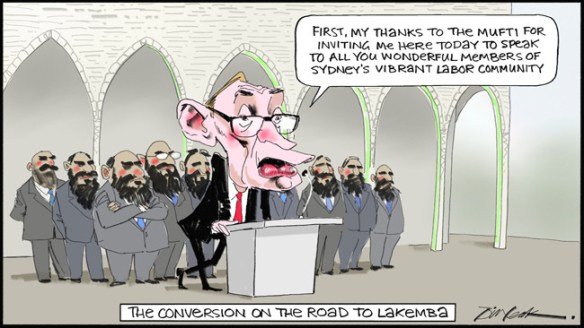
labor and islam

They really are vile and disgusting. The parties of the left are unhinged in so many ways that it is hard to keep up. They now only seem to be for sale to the highest bidder. This is from Andrew Bolt the other day, Labor stirring up Jew-hatred.

The modern Left seems to have a Jew problem. The obsession with Jews even within Labor is extraordinary – and ominous.

Sharri Markson:

Former Labor national president Warren Mundine has launched a blistering attack on the party, saying its move to ban sponsored trips to Israel is “verging on anti-Semitic’’ and is “sickening to watch”….

The NSW ALP international relations policy committee chairman Michael Forshaw told The Australian yesterday that 39 resolutions had been received concerning Israel and Palestine, compared with 17 resolutions dealing with other international issues, such as the Syrian war, the Myanmar junta, Paris terror bombings, China free trade and foreign aid.

There were none on Saudi Arabia or Iran.

There are moves to recognise Palestinian statehood and to boycott products from Israel that originate in settlement areas, and many concerning banning trips to Israel while Benjamin Netan­yahu is Prime Minister. The move by Labor is partly driven by political motivations to secure the vote from Muslim communities in marginal southwest Sydney seats..

Mr Mundine said Labor MPs should remember that Israel was the only democracy in the region with a parliament of Jewish, Arab, Christian and Muslim politicians sitting within a vast region of problematic countries…

Members of the pro-Palestinian group include federal MPs Jason Clare, Sam Dastyari and Tony Burke, with former NSW premier Bob Carr a high-profile advocate.

One on five of Burke’s electorate are Muslim. The surrender of principle for votes seems only too clear. And that careful cultivation of religious bigotry and ethnic resentments leads to the return of sentiments too similar to the kind I once thought the Left had disowned:

Jewish advocacy groups are “cancerous” and “malicious” and try to “deny, misinform and scaremonger”.

A NSW Labor politician voiced these incendiary words — the first NSW Muslim MP, in fact, Shaoquett Moselmane. He didn’t utter them in the privacy of his own home. He felt comfortable enough broadcasting this anti-semitic sentiment within the walls of the NSW Parliament. This is terrifying in itself.

The MP, who ironically decried racism in his first speech to parliament, made the remarks just two years ago, in May 2013. He was not shouted-out of the high office he holds for racist commentary. On the contrary, Labor continues to support him and Moselmane is now a vocal advocate behind a push to ban Labor MPs from visiting Israel on trips funded by Jewish organisations…

The father of the anti-Israel movement is Bob Carr, whose speeches have on at least one occasion, in July last year, elicited anti-semitic commentary from the audience, with a remark made about “the Jews” and their “3000-year fundamentalist influence.”

And I remain deeply concerned by comments by Burke which I reported two years ago – comments by a Labor frontbencher which seemed to legitimise Islamist terrorism against Israel:

Tony Burke, gave a frightening speech last month to the Australia Palestine Advocacy Network in which he savaged Israel as a child-killing, water-polluting, land-stealing aggressor.

He also gave what would have struck some there as praise for extremists fighting Israel: “For those who are political advocates within Palestine itself, I will never know the bravery that comes with putting your life on the line and at risk, in engaging in politics in different ways.”

Burke’s Sydney seat has a Muslim vote of more than 20 per cent, but this is playing with fire.

What is it with the Left and Jews? What is it with the Left and pandering to Islamists?

There must be more to it than few measly votes but I cannot for the life of me see what it is. Malcolm Turnbull or not, nothing will make me vote in any way that might allow the ALP to win at the next election.

We conservatives are not going away any time soon

The fact remains that we conservatives have yet to be impressed with Malcolm as PM who is still to achieve anything of any use other than to end the political instability at the top of the party which he himself was the sole cause of. So far he has held on because he has not done a thing to reverse any of the policies put in place by Abbott. For example, I noted in a post of my own yesterday that:

If conservative means to preserve what is good while allowing positive change to occur, the Donald may well be the most conservative candidate in this election. It is also what I liked about Tony Abbott even though no two people may be farther apart personally than he and Donald Trump.

And then John Comnenus, in a guest post that followed mine, made the following suggestion to Barnaby Joyce to ensure that Malcolm listens to the conservatives among his Parliamentary party:

Upon becoming the Nationals leader you should immediately go to Bill Shorten and ask him what the ALP is happy to offer the Nationals if it were a junior Coalition parter. Think about the potential power of such a move.

And then there is Merv Bendle, in an article at Quadrant Online, The Coming Conservative Revolt, in which he wrote:

Ultimately, history will reveal that it is not conservatism but progressivism that is in crisis. What this nation needs are politicians able to comprehend the ominous trajectory of global events and articulate a conservative response for the Australian people.

We like the Australia we have and don’t want to lose it. That is what is meant by the verb “to conserve” and that is what we are looking for the leader of a party on the right to do. Which brings me to the post by Andrew Bolt this morning who says the same again and then some. This is from a post on The hounding out of Abbott. Why does the Liberal Left fear him?

But bottom line: it says something very sad about the Liberals under Turnbull and Bishop that conservatives like Abbott are so unwelcome. The party is being hijacked and the public increasingly denied a genuine argument or choice on some big issues. Just see how both sides now don’t think slashing spending is good, despite the warnings of the Treasury Secretary that it’s dangerously high. See how both agree global warming is a potential disaster. How both Labor and Liberal leaders agree on a republic, same-sex marriage, Aboriginal recognition in the Constitution and a bloated ABC.

Andrew finishes with this astonishing story which is behind the paywall at the Daily Telegraph:

TONY Abbott has met US President Barack Obama privately in Washington in a move that is bound to further frustrate Prime Minister Malcolm Turnbull.

The former PM also held secret talks with Mr Obama’s spy boss and was urged by the Americans to maintain a role as a global voice on critical issues such as terrorism….

He also met the elder statesman of US foreign affairs, former secretary of state Henry Kissinger, as well as the president of the Council on Foreign Relations Richard Haass and former US Republican presidential candidate John McCain…

Mr Abbott also accepted lunch invitations from the former president of the World Bank James Wolfensohn and the head of investment firm Morgan Stanley James Gorman.

The world is not the kind of world those at the top of the Liberal Party think it is. Abbott represents the proper response to our times and Malcolm, unless he gets with the program, will increasingly find that he and his motley crew do not.

So what was it related to?

Picked up on Instapundit where the story read:

PRECAUTIONARY MEASURE “NOT RELATED TO TERRORISM” IN SIDNEY, AUSTRALIA: Sydney Opera House evacuated and Manly ferry cancelled during police operation.

So they can’t spell Sydney in America. This, however, is what they were referring to:

The Sydney Opera House precinct reopened to the public Thursday afternoon after a police operation caused staff and tourists to be evacuated from the landmark.

Police simultaneously conducted an operation across the harbour in Manly as a “precautionary measure” following information on social media.

“Following information on social media, police conducted an operation in the vicinity of the Opera House and Manly as a precautionary measure,” police said.

It is understood the operation, which began just after lunchtime and was over by mid-afternoon, was not related to terrorism.

Well, that’s a relief. One suggestion of what it was all about is found at the comments thread at Instapundit: “It was probably militant feminists driven berserk by the name ‘Manly’ Ferry.” You never know, these days, you never know.

Turnbull, Bishop have seen the error of their ways

The actual headline to the story is Jamie Briggs, Peter Dutton see error of their ways: Julie Bishop but that is not the real point. It is the PM and his Deputy who have seen the error of their own ways. The opening para:

Deputy Liberal leader Julie Bishop says fallen junior minister Jamie Briggs and Immigration Minister Peter Dutton have “recognised the error of their ways” over a late-night bar incident and accidental text, insisting it’s time to “move on”.

After creating quite an unnecessary tempest over an “incident” that has still not been detailed, they have decided to “move on”. Good, and I hope they have learned some useful political lessons in the process about how to manage a party supposedly on the right side of the divide. Hopefully, they will also now move on to doing something useful, like getting public spending under control or trade union reform, the kinds of things that may not run so well on the ABC.

A seat with a 12.5% margin at the last election is now at risk

It is hard to believe that Malcolm is the leader of any political party of significance. The latest instalment of the Jamie Briggs saga in The Oz defies belief. This is from the latest episode.

As the fallout from Mr Briggs’s resignation continues to rattle the Coalition, The Australian can also reveal that Right-aligned MPs in South Australia will today discuss potential replacement candidates for the blue-ribbon seat of Mayo held by Mr Briggs on a 12.5 per cent margin. The move comes amid heightened speculation that Mr Briggs, 38, may not want to recontest the next election and as Liberal strategists fear losing the seat, which is threatened by Nick Xenophon’s decision to run lower house candidates in South Australia.

Supporters of Mr Briggs say he is considering his future in par­liament and “waiting for the dust to settle”, but feels aggrieved by the process put in place by Mr Turnbull.

The Australian understands that on December 10, after the formal complaint had been lodged by the consular staffer about Mr Briggs’s “inappropriate” behaviour at the Stormies Bar on Nov­ember 27, Mr Turnbull phoned the then cities minister to discuss the complaint against him and his decision to launch an independent investigation.

In the phone conversation, it is understood Mr Turnbull suggested to Mr Briggs that while the investigation would run its course, it was likely that he would need to consider resigning his frontbench role. . . .

While some MPs say this is evidence that the investigation was a “stitch up”, others suggest Mr Turnbull made the assessment that there was little room for leniency because Mr Briggs had failed to apologise to the consular staffer before she complained formally. . . .

There was also an assessment that it would have been more damaging for the government if Mr Turnbull had not acted decisively against Mr Briggs for the breach of ministerial standards, which may have later come to light. . . .

Another senior federal Liberal MP said the Right faction needed to prepare a contingency plan. “One of the things that genuinely has to be discussed is the likelihood of the state executive reopening preselections in Mayo, because I don’t think Briggs will hold the seat.”

How could the fallout have been any worse than it now is? A seat with a 12.5% margin is now at risk. For me, whatever the PM may say, this is political stupidity of the highest order which has destabilised his own side.