The value of free speech demonstrated once again

That letting everyone have their say on any matter of public importance is so evident as the best way to manage differences within a community was never better seen than in the last few days. There are some who, for example, think Australia’s Mufti ought to be sacked or censured for this:

mufti statement on paris

If you can read what he says, you can see which side he is on. Why shouldn’t he be on his own side. He mourns the loss of innocent lives rather than condemning the attacks. Such is as it is. What is important is for us to understand what he believes. His plain speaking has set everything straight. Whether the knowledge we have has any practical value is something else again, but at least we know.

Or take Waleed Aly and his own reaction. All you need is love, apparently:

“If you are a member of Parliament or a has-been member of Parliament [who do you suppose he means by this?] preaching hate [and who’s doing that?] at a time when what we actually need is more love — you are helping ISIL. They have told us that. [Who is “they” and when did they say it?] If you are a Muslim leader telling your community they have no place here [and who has said that?] or basically them saying the same thing — you are helping ISIL.

It’s our fault and not theirs. They may have been savages but they were provoked, and if we condemn their actions, we are playing into their hands. But the value in hearing it is that you start to understand who and what we are up against. They do not condemn these attacks in anything more than a perfunctory way, since they see themselves as more sinned against than sinning. You may not think so, and I may not think so, but they think so, and that’s what letting them say their piece allows us to understand.

The war aims of the Islamic State

The choice between Tony Abbott and Malcolm Turnbull is a choice between someone who gets the major issue of our time v someone who does not. I watched Tony’s interview with Bolt on Sunday and he must have used the word “evil” three or four times in discussing what we are up against. Malcolm is so out of the picture that it is offensive to have to listen to him. His party is worth electing only because of the people he chooses not to promote. Only a shallow fool would fail to appoint Peter Dutton to the National Security Committee.

I have an article at Quadrant Online that deals with the nature of the enemy we face. It was provoked by an editorial in The Herald-Sun which expressed bewilderment about the events in Paris, how could these people do such things, literally asking what would their mothers think. This is the kind of sentiment for which there is all too much of it at the moment, which as best I can tell, is a sentiment shared by the PM. My article is titled, The War That Shall Not Be Mentioned and attempts to clarify what is going on. This is the central point:

The Islamic State is at war with us because they wish to convert us to Islam. You may think that the way the war is being waged is cruel and monstrous, but it is no more cruel and monstrous than many a war in the past. What makes this war so bizarre is that the kinds of people who write such editorials do not even know we are in the midst of a war. It is a war for control of territory, in just the same way every other war in history has been fought. They are attacking us and our civilisation relentlessly. They are attempting to achieve the same result that Nazis and Soviet communists attempted. They are trying to change our way of life into their way of life through force of arms. They are trying to take our territory from us and replace our way of doing things with theirs.

You may imagine in your slumbers that they could not possibly succeed. So let me bring to your attention Niall Ferguson’s article in The Oz yesterday on The Fall of Rome. Here are the passages that count:

In five decades the population of Rome itself fell by three-quarters. Archaeological evidence from the late 5th century — inferior housing, more primitive pottery, fewer coins, smaller cattle — shows the benign influence of Rome dimin­ished rapidly in the rest of western Europe.

“The end of civilisation”, in Ward-Perkins’s phrase, came within a single ­generation.

This is the view of another historian, Peter Heather:

The Visigoths who settled in Aquitaine and the Vandals who conquered Carthage were attracted to the Roman ­Empire by its wealth, but were ­enabled to seize that wealth by the arms acquired and skills learnt from the Romans ­themselves.

“For the adventurous,” writes Heather, “the Roman Empire, while being a threat to their existence, also presented an unprecedented opportunity to prosper … Once the Huns had pushed large numbers of (alien groups) across the frontier, the Roman state became its own worst enemy. Its military power and financial sophistication both hastened the process whereby streams of incomers became coherent forces capable of carving out kingdoms from its own body politic.”

We are starting to wake to the danger, and you will know that we are finally starting to get it when even Malcolm Turnbull starts sounding the alarm. As for Barack Obama, that is something he will never do.

And where will we be a generation from now?

Niall Ferguson has an article on the fall of Rome which he discusses as a warning. It’s not a warning but a prognostication. It won’t be exactly the same, but the circulation of elites is an old story. Even if every political leader in Europe understood everything he said, and wished to reverse the tide of history, I cannot imagine what could be done. Let me quote:

A new generation of historians has raised the possibility the process of Roman decline was in fact sudden — and bloody — rather than smooth.

For Bryan Ward-Perkins, what happened was “violent seizure … by barbarian invaders”. The end of the Roman west, he writes in The Fall of Rome (2005), “witnessed horrors and dislocation of a kind I sincerely hope never to have to live through; and it destroyed a complex civilisation, throwing the ­inhabitants of the West back to a standard of living typical of prehistoric times”.

In five decades the population of Rome itself fell by three-quarters. Archaeological evidence from the late 5th century — inferior housing, more primitive pottery, fewer coins, smaller cattle — shows the benign influence of Rome dimin­ished rapidly in the rest of western Europe.

“The end of civilisation”, in Ward-Perkins’s phrase, came within a single ­generation.

This is the view of another historian, Peter Heather:

The Visigoths who settled in Aquitaine and the Vandals who conquered Carthage were attracted to the Roman ­Empire by its wealth, but were ­enabled to seize that wealth by the arms acquired and skills learnt from the Romans ­themselves.

“For the adventurous,” writes Heather, “the Roman Empire, while being a threat to their existence, also presented an unprecedented opportunity to prosper … Once the Huns had pushed large numbers of (alien groups) across the frontier, the Roman state became its own worst enemy. Its military power and financial sophistication both hastened the process whereby streams of incomers became coherent forces capable of carving out kingdoms from its own body politic.”

I don’t mean to be so down about the future, but it is hard to see how things could change.

Paris and the left’s support for Palestinian terror

A large part of the problem for the West in dealing with Islamic terrorism is the deep anti-Israeli animosity on the left. The left has built its attitudes to Islamic terrorism by defending Hamas and the Palestinian Authority in their attacks on Israel.

To admit that there is an incompatibility between the values of the West, however defined, and the values of radical Islam, is to admit that the Israelis have a valid point. The insanity of the left is that they would rather see the suicide of their own culture, see it submerged beneath the flood of Islamic radicals into our Western nations, than admit that the fight against sharia is legitimate, and that Israel, in standing up for our Judeo-Christian values, has been largely in the right.

Conscious capitalism and central banks

I made it into the media twice during the weekend. Here I am in Alan Kohler’s column from the Business Section of The Oz: Central banks risk becoming economic wreckers. You can find my quote if you’d like to look, but Alan’s point is the one that matters:

After Thursday’s stunning employment figures for October, the chances of another rate cut in December have disappeared. Or at least they should have.

That there remains the chance of a further rate cut in Australia, despite clear evidence that the economy doesn’t need it, is a reflection of the modern paradox and problem of central banking: low and falling inflation.

Central banks everywhere have switched from fighting inflation to ardently desiring it. In the process, they are in danger of becoming economic wreckers.

Central bankers are no better than the theory they apply, and at heart they are all Keynesians. I met Janet Yellen years ago at some OECD meeting I was attending on behalf of Australian employers, and it was an experience I have not forgotten, even though she was years from becoming the Chairperson of the Fed. Her rabid Keynesian views astonished me since by then it was clear enough that no approach to economics was less enlightening than starting from the premises found in just about every introductory text. That Keynesian thought has poured into central banking practice was inevitable. She didn’t cause it, but is a symptom of it. Our own central bank is the most resistant to it, but no bank can withstand the ignorant pressures to lower rates to stimulate growth. That such reductions in rates have never worked ever is just so much data as far as economic practice is concerned.

I also showed up on the ABC’s Sunday Extra where I was in a debate with Denis Kilroy over an intellectual entity described as “conscious capitalism”. It would not be easy for me to say in respect of our economic system that we are on the same side of the fence. Nevertheless, he is in favour of a modified capitalist system, one in which business decisions are guided at every turn by our conscious wish to serve the whole of humanity. From their website:

Conscious Capitalism differs from Corporate Social Responsibility (CSR) by virtue of its origins from within the company as an expression of an overall perspective on how to conceive and build a business, rather than as a response to external notions of what counts as “socially responsible” or external pressure. Conscious Capitalists are unapologetic advocates for free markets, entrepreneurship, competition, freedom to trade, property rights, and the rule of law. They recognise that these are essential elements of a healthy, functioning economy, as are trust, compassion, collaboration, and value-creation. Conscious Capitalism is the system-level effect of a substantial number of companies practicing the four tenets of a Conscious Business as defined below.

So far so good. I am with them on all that. And, in fact, I would say that for the most part, capitalist enterprises are ethical organisations. Aside from personal values, a market system automatically punishes dishonest behaviours, although there is no doubt there is plenty of dishonesty about. But can any economic system embrace all of this:

1. HIGHER PURPOSE

Conscious Businesses adopt a higher purpose that transcends profit maximisation. A compelling sense of purpose can create an extraordinary degree of engagement for stakeholders and catalyse tremendous organisational energy.

2. STAKEHOLDER ORIENTATION

Conscious businesses are managed for the simultaneous benefit of all of their interdependent stakeholders, including customers, employees, investors, suppliers, the environment and the larger community in which the business participates. By creating value for each stakeholder in various and often differing ways the whole system advances.

3. CONSCIOUS LEADERSHIP

Conscious Leaders adopt a holistic worldview that moves beyond the limitations of traditional machine metaphors for business. Conscious Leaders see that profit is one of the important outcomes of the business, but not the sole purpose. Most importantly, they reject a zero-sum, trade-off oriented view of business and look for creative synergistic win-win approaches that offer multiple kinds of value simultaneously to all stakeholders.

4. CONSCIOUS CULTURE

The culture is a conscious business is captured in the acronym TACTILE: Trust, Authenticity, Caring, Transparency, Integrity, Learning and Empowerment. The culture of a conscious business can be felt immediately upon walking in its doors.

I met John Mackie, who started this movement in the US, at Freedomfest so he and his movement are definitely considered within the tent. I won’t even say I am cynical and that it is hopelessly naive. What I do think is that it is unnecessary since the owners of our businesses need a sympathetic understanding from within the community of both their role and the pressures entrepreneurs are under. What they do not need in my view is this kind of approach which seems to side with those who are anti-capitalist and who incessantly rattle on about the immorality of business. If there is immorality about, it is embedded within the anti-capitalist mentality that is the home territory of the left.

Understanding the war we are in

The Herald-Sun editorial on Sunday represents the naivety of far too many. It is titled, “We will never understand such hatred” as if the massacres in Paris were a form of irrational madness driven by some unknown motivation. Here is the central point of that editorial:

“Whatever name the terrorists may use to describe themselves, we already know exactly who they are: monstrous, bigoted and cruel Islamic murderers who have betrayed the very mothers that gave birth to them in their deliberate relinquishment of all that humanity holds dear.

“We will never understand what motivates such hatred. To do so would require a guided tour of the most blackened and fouled souls.”

So let me explain. The Islamic State is at war with us because they wish to convert us to Islam. You may think that the way the war is being waged is cruel and monstrous, but it is no more cruel and monstrous than many a war in the past.

What makes this war so bizarre is that the kinds of people who write such editorials do not even know we are in the midst of a war. It is a war for control of territory, in just the same way every other war in history has been fought.

They are attacking us and our civilisation relentlessly. They are attempting to do the same as the Nazis or the Soviet communists attempted to do. They are trying to change our way of life into their way of life through force of arms. They are trying to take our territory from us and replace our way of doing things with theirs.

This is a war that has been on-going for the past 1500 years, with Islamic expansion the aim since the seventh century. What makes this war novel is that until now, each invasion has come in the form of an actual army, and the battles have been in the form of an armed conflict. There are many such battles where Islam has won, such as across the whole of North Africa in the seven century and Constantinople in 1453. And there are others that it has lost, such as Lepanto, the Battle of Tours or on two occasions at the Gates of Vienna. But the war has never stopped, although our modern ignorance of history has made all of this invisible to the vast majority of the population of the formerly-Christian West.

They have a value system and we have a value system. The reality is that in any territory only one of these systems can prevail at any one time. The Western view, our view, is that we can all get along together, with religion a private matter between each of us as individuals and our own conscience. That is not the view of those who are waging war on behalf of the Islamic State. For them, there is only one true belief, and if in some territory it’s not their beliefs that prevail, then, according to them, they have the right to kill us, enslave our women and force us to convert to Islam at the point of a sword. You can see all of this unfolding at the moment across the Middle East.

That is the war we are in. Because we are not fighting this in the same kind of desperate way we fought the Nazis and the Soviets we are losing. They are playing on our ignorance, which has allowed a million invaders to enter Europe, the ultimate aim of their leaders to convert each and every one of us to Islam.

You may deny that is the intent, but it is. You may think they could not possibly do it, but they can. And if we do not resist this invasion, they will succeed. It may already be too late, so that by 2084 – a century after 1984 – most of what had once been the West will be under Sharia law. History is like that. Nothing is pre-ordained.

You will never understand what motivates those on the other side of this conflict if you do not make at least make the effort to see what their war aims are. And so long as our political leaders fail to recognise, or refuse to recognise, what they are trying to achieve, we will continue to lose ground until it is too late, which it almost certainly now is in Europe.

When the going gets tough, the not-so-tough turn to climate change

There is a quite insightful article on Instapundit by Ed Driscoll on Freudian displacement. He began with this:

Tough language is borrowed from the war on terror and applied to the war on weather. “I really consider this a national security issue,” says celebrity activist and “An Inconvenient Truth” producer Laurie David. “Truth” star Al Gore calls global warming a “planetary emergency.” Bill Clinton’s first worry is climate change: “It’s the only thing that I believe has the power to fundamentally end the march of civilization as we know it.”

Freud called it displacement. People fixate on the environment when they can’t deal with real threats. Combating the climate gives nonhawks a chance to look tough. They can flex their muscle for Mother Nature, take a preemptive strike at an SUV. Forget the Patriot Act, it’s Kyoto that’ll save you.

But then a quarter of an hour later, having thought about his original post, Driscoll went on with a much fuller discussion on how fighting climate change gives some people the pretence of being tough. Link to it all since it is short but subtle, and explains quite a lot. A sample:

While the hawks among us worry about preventing the Armageddon that’s coming, our modern-day hippies just want to make sure the planet is pristine when it does. In fact, the more menacing terrorism becomes, the more some people seem to worry about the weather. Scared and unsure how to fight terrorists, they confront “climate change,” which only requires spending trillions of other people’s dollars on something that may not need fixing or may not be fixable. No wonder some of these people chain themselves to trees – they think money grows on them.

It’s funny when you put it that way, but it’s actually not funny at all. That the US could twice elect Obama at such a moment is the surest sign that we would happily sign the surrender documents if only it wasn’t all too obvious to the other side that this is what we have in effect already done.

The crisis of capitalism is caused by ignorance of history

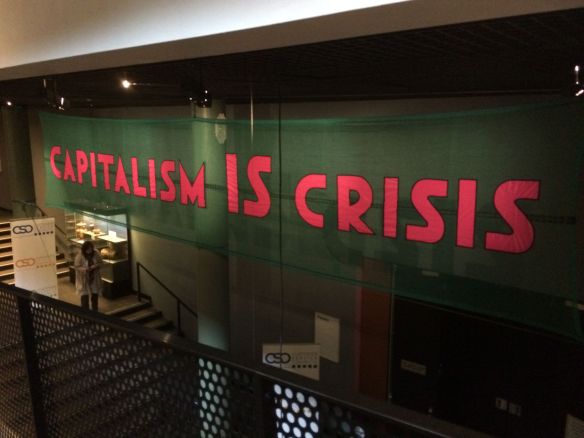
capitalism is

The photo is from The Powerhouse Museum which I took this afternoon where they are having an exhibition on protest. And it was in the museum cafe that I read Maurice Newman’s article on Malcolm Turnbull’s agile nation must avoid politics of envy. The article is about the kinds of thing that people in the second half of their lives are prone to understand, which are why the kinds of things they may have believed in the first half are so stupidly wrong. As he writes:

Why then, in this postmodern world, when we know that free enterprise has so spectacularly raised living standards and prolonged life for all, do we demonise it as uncaring, unfair and outdated?

Free market capitalism, like nature, may favour the resilient, the ambitious and the fleet of foot, but rather than celebrate self-interest and see wealth creation as a positive contribution to all society, we are conditioned by the Left, from school days on, to believe that social goals and the collectivist vision are more important than private choices; that without government intervention, most will be left behind.

This is our world. A top-down social-democratic state where elites are patronised, competition is controlled, where private initiative is stifled, free speech is abridged and where the electorate is increasingly state dependent. Here, big government colludes with big labour and big business to socialise losses at taxpayer expense.

Precious productive capital is wasted on school halls, pink batts, the National Broadband Network, futile subsidies and ordinary political aggrandisement. Loose fiscal and monetary policies give the rich relatively risk-free profits from speculative assets, while winner-take-all returns see a new breed of innovators and disrupters building tax- sheltered fortunes.

The media are filled with people who are the least likely to understand any of it but are most likely in a position to influence the rest of the community about the supposed evils of the market system. For those with few skills of an entrepreneurial nature, making their fortune as critics of the only society that has ever created wealth and freedom may give them a great sense of self-fulfilment and se;f-importance, but there are many societies that have been laid very low when people just like these have taken power. See Venezuela for a recent example.

The end is Nye

Things like the fact that the planetary temperatures have not risen in almost two decades are virtually unknown among those who think of global warming as a catastrophic problem. It is seldom stated, and nowhere someone of a warmest nature might casually go to read about the issues. How debate can ever be engaged remains a mystery since the exposure to facts such as these, required to temper the debate, never happens.

Which brings me to this today linked at Drudge: Bill Nye demolishes climate deniers: “The single most important thing we can do now is talk about climate change”. I was interested in the article from the headline since if he is to demolish those of a more sceptical nature, he has to actually address the kinds of things they say. Well, once again the article is filled with rhetorical flourish but no facts.

Not knowing who Bill Nye was I assumed that he was some deep intellectual, steeped in climate science. Turns out he is the American version of Tim Flannery.

William Sanford “Bill” Nye (born November 27, 1955), popularly known as Bill Nye the Science Guy, is an American science educator, comedian, television presenter, actor, writer, scientist, and former mechanical engineer, best known as the host of the Disney/PBS children’s science show Bill Nye the Science Guy (1993–1998) and for his many subsequent appearances in popular media as a science educator.

This is how he writes and this is about as informative as the article gets.

On Nov. 10, Bill Nye will release a new book titled “Unstoppable.” As only Bill Nye can, he uses the book to explain the science behind climate change, debunks popular myths, and asks readers to take action in their own lives to create a sustainable future. The book is shot through with optimism, but Nye has no illusions about what lies ahead. The message is simple: Climate change is real; humans are causing it; and we have no choice but to build a better and cleaner world.

With his expertise in mechanical engineering and talking to children, sounds like the ideal person from whom to get the facts.

Male and female action figures

From an article titled, Feminization of America Is Bad for the World:

“Mattel’s research showed some differences in what girls and boys wanted in their action figures, Ms. Missad said. ‘For boys it’s very much about telling a story of the good guy killing the villain. . . .’ [Girls] would tell us: ‘Why does the good girl have to kill the villain? Can’t they be friends in the end?’”

And in related real life news:

Why are women so poorly represented on the front lines? Because most women can’t do the job, don’t want to do the job, and in cases where they can do it, can’t do it as well as men… A recent study has demonstrated a big disparity in women’s and men’s battlefield ability. The US Marine Corps examined over a year the impact of female integration on combat readiness and found conclusively that women cannot match male performance. Male units were faster, more effective and able to evacuate casualties in less time. Overall, the study concluded, all-male squads performed better than mixed groups in 69% of the tasks evaluated. Women performed notably less well in their use of every individual weapons system, and in addition women had higher injury rates than men. So in terms of women’s own well-being as well as the overall effectiveness of the fighting force, its ability to kill enemies and save wounded comrades, the study showed that the presence of women in combat units has a negative impact.