This is from Google images based on this request: images of what people in 1900 thought the year 2000 would be like. Here’s one:
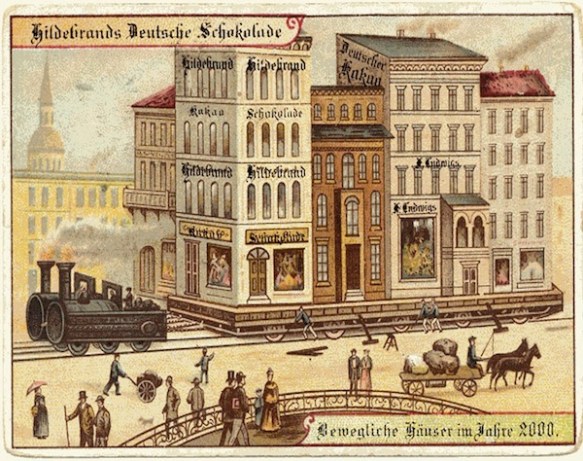
Lots more at the link.

This is from Google images based on this request: images of what people in 1900 thought the year 2000 would be like. Here’s one:
Lots more at the link.
This man is amazing.
Quite an amazing rant! How does he keep his job at a university? His greatest ability beyond clarity of thought is patience. I don’t know how he does it. Just watch.
Then there is this rant on the oppression olympics: “of course you’re a victim” – “things are complicated”. Here his advice: “Be a better person”. “We’re so ungrateful!”
And just one more on: advice to students, beginning with: “Read Great Books!”
And then finally, the Top Ten Rules for getting on.
Very sound! Anyway, one more and this one on intelligence.
IQ as a predictor of perfomance with conscientiousness as the other possible predictor which, unfortunately, no one knows how to measure. Practical intelligence – street smarts – has shown no relationship to outcomes. Anyway, all common sense, as with everything else he says. And a continuation below since the first one ends so quickly.
Massive contributor to life-time success. And, my goodness, one more on not being a patsy.
Necessary, as Jung said, to integrate your shadow.
And one more, and the last which might have gone first.
Who is he?
Jordan Bernt Peterson is a Canadian clinical psychologist, cultural critic, and professor of psychology at the University of Toronto. His main areas of study are the psychology of religious and ideological belief, and the assessment and improvement of personality and performance.
He earned a degree in political science in 1982 and a degree in psychology in 1984, both from the University of Alberta, and his Ph.D. in clinical psychology from McGill University in 1991. He remained at McGill as a post-doctoral fellow for two years before moving to Massachusetts, where he worked as an assistant and an associate professor in the psychology department at Harvard University. In 1997, he moved to the University of Toronto as a full professor.
Dr. Jordan B Peterson has been a dishwasher, gas jockey, bartender, short-order cook, beekeeper, oil derrick bit re-tipper, plywood mill labourer and railway line worker. He’s taught mythology to lawyers, doctors and businessmen, consulted for the UN Secretary General’s High Level Panel on Sustainable Development, helped his clinical clients manage depression, obsessive-compulsive disorder, anxiety, and schizophrenia, served as an advisor to senior partners of major Canadian law firms, identified thousands of promising entrepreneurs on six different continents, and lectured extensively in North America and Europe.
He has flown a hammer-head roll in a carbon-fiber stunt plane, piloted a mahogany racing sailboat around Alcatraz Island, explored an Arizona meteorite crater with a group of astronauts, built a Native American Long-House on the upper floor of his Toronto home, and been inducted into the coastal Pacific Kwakwaka’wakw tribe.
With his students and colleagues, Dr. Peterson has published more than a hundred scientific papers, transforming the modern understanding of personality, and revolutionized the psychology of religion with his now-classic book, Maps of Meaning: The Architecture of Belief. As a Harvard professor, he was nominated for the prestigious Levinson Teaching Prize, and is regarded by his current University of Toronto students as one of three truly life-changing teachers.
Given some of the comments on a previous post let me give you a Bowdlerised version. Says the same thing as before but perhaps not quite as pointed. For myself, reading some of the reactions to what I wrote I can see there are quite a few, even amongst those who come here, who have no idea what the problem we are dealing with is nor what needs to be done. Anyway, see what you make of this.
The one blessing about being brought up in a communist household is that you understand the left a good deal better than most. It also brings an added measure of concern when I see how easily a public unused to lying as a tactic is influenced by these manoeuvres which are standard practice on the left. My Dad was an expert in agit prop and I grew up understanding the role of the agent provocateur only too well. These are not well-meaning individuals who wish to investigate the truth. They are individuals whose only interest is to disrupt the communications among those on the other side through whatever lies they might find convenient and they hope persuasive.
The example I am going to use is my post Remember Michelle Fields? It is simply undeniable that Fields told a story that was intended to harm Donald Trump’s run for president but was thoroughly discredited by the videos that showed everything she said, and the Washington Post initially said, were lies. The point of the post was to remind us that the media will lie without any hesitation if they can see some political advantage for the left’s political agenda. That is also the message of this post, and it is one that can never be repeated often enough. You will be lied to by the left to the furthest extent they believe they can get away with. That there is not an instantaneous scepticism amongst us on this side of politics from any unverified political story carried by a mainstream media organisation fills me with dread since most of us are so middle class that we find it hard to believe others will lie, distort, or withhold relevant information without the slightest hesitation if it serves their ends. The attitude you need to take when reading anything from an MSM report is the same attitude you might take when buying a used car. Do not trust a thing you are told and make sure you verify everything you can from a separate source.
Dishonesty is the trade mark of the left, not that they have a monopoly, but it is a specific tactic aimed at the fair minded who are seldom as aware as they need to be of the practice, and seldom think of the need to guard against the premeditated lies they tell. You would have to be pretty thick not to know that Michelle Fields was a liar and that her aim was deliberate and strictly political. The interesting part is that for the left to succeed, they can only achieve their ends by lying. For the right, what you hear people say is almost invariably what they believe. The left often mimics the same concerns but it is tactical and never substantive unless for a change good policy overlaps what they see as tactical advantage.
The one valuable part of being on this side of the fence is that with so many out there on the left who will swarm around any genuine falsehood stated by someone on the right, the standard of probity is higher. This is part of the reason why sex scandals, to just name the issue in relation to Roy Moore, are not as common on the right as on the left. Except that when they are caught out – such as with Bill Clinton – it is no longer a scandal and is put to bed as soon as it is practical to do so. They never mean it. It is not hypocrisy, it is a policy of deceit. They are perfectly aware they are lying and just take the rest of us for fools.
Oh by the way, have you caught up with the CNN story about Trump feeding the fish in Japan.
You cannot believe a word they say. Why is this even controversial?

Picked up on a Canadian website with the heading: I, Napoleon. I assume this is Victoria, Australia and not Victoria, British Columbia, which is only a city, but wherever it is, it is seriously disturbing. The most telling comments on the thread:
“mature minor” – Words right out of Newspeak.
Just pass a law that no one can perform “gender transition” without prescribing aspirin for the patient. Since a minor cannot be prescribed aspirin without informing the parents, the proposed “gender transition” will be leaked to them as well. What a totally screwed up department of education, and screwed up liberal idea of health care in general. You cannot give an aspirin or apply band-aid to a kid without parental consent, but you can perform abortion or “gender transition.”
This is how Alfred Marshall, in the last editions of his Principles of Economics published in 1920 (in para 4), described “the fundamental characteristics of modern industrial life”.
There is no one term that will express these characteristics adequately. They are, as we shall presently see, a certain independence and habit of choosing one’s own course for oneself, a self-reliance; a deliberation and yet a promptness of choice and judgment, and a habit of forecasting the future and of shaping one’s course with reference to distant aims.
This is what freedom means, and it is a burden. Not everyone can bear the weight. It is the struggle between those who value freedom and independence against those who wish to be told what to do and given their daily bread like a household pet that has been at the centre of the great political divisions for the past five hundred years.
Here’s the link.
MANSON AND THE TOTALITARIAN TEMPTATION: “The potential for entire social movements to end up sympathizing with visibly pathological murderers with swastikas carved in their foreheads is a persistent potential. All you have to do is let down, for a brief moment, your simplest sense of right and wrong, perhaps because you pride yourself on being upset about some social issue….”
Read the whole thing.
15Posted at 1:44 pm by Ed Driscoll
.
And as always some interesting commentary.
Two articles on the very same subject although superficially about entirely different things. There is first this: The Charles Manson Fallacy. The second is: 100 Years. 100 Million Lives. Think Twice.
Here is how the first article ends:
The potential for entire social movements to end up sympathizing with visibly pathological murderers with swastikas carved in their foreheads is a persistent potential. All you have to do is let down, for a brief moment, your simplest sense of right and wrong, perhaps because you pride yourself on being upset about some social issue….
Here is how the second one ends:
The stories of survivors paint a more vivid picture of communism than the textbooks my classmates have read. While we may never fully understand all of the atrocities that occurred under communist regimes, we can desperately try to ensure the world never repeats their mistakes. To that end, we must tell the accounts of survivors and fight the trivialization of communism’s bloody past.
My father left behind his parents, friends, and neighbors in the hope of finding freedom. I know his story because it is my heritage; you now know his story because I have a voice. One hundred million other people were silenced.
One hundred years later, let us not forget the history of the victims who do not have a voice because they did not survive the writing of their tales. Most importantly, let us not be tempted to repeat it.
Read them both, which I took down from Powerline Picks where they appeared separately but at the same time.
TO WHICH WE MAY NOW ADD THIS: Charles Manson’s Radical Chic which comes with this very telling subhead:
Some on the left adored him, before and after the murders.
And this is how the article begins:
The history of the postwar period is the history of the struggle against Communism. What’s sometimes forgotten — conveniently forgotten — is that our victory in that struggle was far from assured, and that a substantial swath of the Western intelligentsia and much of its celebrity culture was on the other side. It wasn’t just Jane Fonda and Noam Chomsky, Walter Duranty and Lincoln Steffens. (“I have been to the future,” Steffens wrote after a visit to the Soviet Union, “and it works.”) Eventually, 100 million people would die under Communism as part of the longest and widest campaign of mass murder in recorded human history. As a phenomenon of specifically nuclear terror, the Cold War lasted from 1949, when the Soviet Union tested its first atomic bomb thanks to the help of the American leftists Julius and Ethel Rosenberg, until 1989, when the Berlin Wall came down.
Precisely in the middle of that period came the strange career of Charles Milles Manson, who has just died in a California hospital at the age of 83. Manson’s death, like his life, was wrapped up in the radical politics of the 1960s.
He died of natural causes, his execution having been set aside as part of the temporarily successful progressive campaign against the death penalty in the 1970s. Just as it is easy to forget how pro-Soviet the American Left was at times, it is easy to forget how pro-Manson American radicals were. “First they killed those pigs, then they ate dinner in the same room with them, then they even shoved a fork into a victim’s stomach. Wild!” That was the assessment of Bernardine Dohrn, the champagne radical who, with her husband, Bill Ayers, participated in a campaign of domestic terrorism, including bombings, and later became cozy with Barack Obama, hosting events for the aspiring politician in her home.
An old question of mine: what do you think of the 1960s – all good? all bad? or a bit of both. I know my answer but I’ll leave that for another time.
Trump on Hannity in 2016. His talk on his evolution into conservatism starts at around 4:40 but really you should start from the beginning.
I’m not sure I know the question to which Cosmopolitanism Is the Answer, but whatever the question, it is the wrong answer for me. As it happens, these are things I have lately been thinking about myself having come across another article looking at these same issues but from a very different perspective. And while it is difficult to sort through the various labels one can put on one’s personal ideology, the closest I have been able to come up with for myself is “Gladstonian liberal” which is quite different from “classical liberal”. So let me take you to an article about the naming of things where “classical liberal” is the equivalent of insane while “conservative” represents prudential common sense.
The differences between the classical-liberal and conservative traditions have immense consequences for policy. Establishing democracy in Egypt or Iraq looks doable to classical liberals because they assume that human reason is everywhere the same, and that a commitment to individual liberties and free markets will arise rapidly once the benefits have been demonstrated and the impediments removed. Conservatives, on the other hand, see foreign civilizations as powerfully motivated—for bad reasons as well as good ones—to fight the dissolution of their way of life and the imposition of American values.
Integrating millions of immigrants from the Middle East also looks easy to classical liberals, because they believe virtually everyone will quickly see the advantages of American (or European) ways and accept them upon arrival. Conservatives recognize that large-scale assimilation can happen only when both sides are highly motivated to see it through. When that motivation is weak or absent, conservatives see an unassimilated migration, resulting in chronic mutual hatred and violence, as a perfectly plausible outcome.
Since classical liberals assume reason is everywhere the same, they see no great danger in “depreciating” national independence and outsourcing power to foreign bodies. American and British conservatives see such schemes as destroying the unique political foundation upon which their traditional freedoms are built.
Here is the definition of “Gladstonian liberal” from Wikipedia which seems accurate enough for me and is utterly distinct from the “classical” variety as defined above.
Gladstonian liberalism is a political doctrine named after the British Victorian Prime Minister and leader of the Liberal Party, William Ewart Gladstone. Gladstonian liberalism consisted of limited government expenditure and low taxation whilst making sure government had balanced budgets and the classical liberal [that phrase again] stress on self-help and freedom of choice. Gladstonian liberalism also emphasised free trade, little government intervention in the economy and equality of opportunity through institutional reform. It is referred to as laissez-faire or classical liberalism in the UK and is often compared to Thatcherism.
It is also the essence of the economics and political philosophy of John Stuart Mill. See his Principles of Political Economy and On Liberty where these things are spelled out.
Personal freedom and personal responsibility within a society of limited government, tolerance and open enquiry guided by an all pervading Judeo-Christian ethic are the core values of Gladstonian liberalism. And to go back to Wikipedia, here is the approach to foreign policy.
In foreign policy, Gladstone was in general against foreign entanglements, but he did not resist the realities of imperialism. For example, he approved of the occupation of Egypt by British forces in 1882. His goal was to create a European order based on co-operation rather than conflict and on mutual trust instead of rivalry and suspicion; the rule of law was to supplant the reign of force and self-interest. This Gladstonian concept of a harmonious Concert of Europe was opposed to and ultimately defeated by a Bismarckian system of manipulated alliances and antagonisms.
Let me therefore go to the last para of the first article discussed for an interesting and enlightening comparison.
Brexit and Mr. Trump’s rise are the direct result of a quarter-century of classical-liberal hegemony over the parties of the right. Neither Mr. Trump nor the Brexiteers were necessarily seeking a conservative revival. But in placing a renewed nationalism at the center of their politics, they shattered classical liberalism’s grip, paving the way for a return to empiricist conservatism. Once you start trying to understand politics by learning from experience rather than by deducing your views from 17th-century rationalist dogma, you never know what you may end up discovering.
Labels do often get in the way but the core principles should be clear. In the modern world a “Gladstonian liberal” is best described as a conservative. But whatever you want to call the ideology, it is all that at present stands between us and the annihilation of Western civilisation and our way of life.
If I am going to get into personal labels, I am a Gladstonian liberal. So here we are with the naming of things where “liberal” is the equivalent of insane while “conservative” is prudential common sense:
The differences between the classical-liberal and conservative traditions have immense consequences for policy. Establishing democracy in Egypt or Iraq looks doable to classical liberals because they assume that human reason is everywhere the same, and that a commitment to individual liberties and free markets will arise rapidly once the benefits have been demonstrated and the impediments removed. Conservatives, on the other hand, see foreign civilizations as powerfully motivated—for bad reasons as well as good ones—to fight the dissolution of their way of life and the imposition of American values.
Integrating millions of immigrants from the Middle East also looks easy to classical liberals, because they believe virtually everyone will quickly see the advantages of American (or European) ways and accept them upon arrival. Conservatives recognize that large-scale assimilation can happen only when both sides are highly motivated to see it through. When that motivation is weak or absent, conservatives see an unassimilated migration, resulting in chronic mutual hatred and violence, as a perfectly plausible outcome.
Since classical liberals assume reason is everywhere the same, they see no great danger in “depreciating” national independence and outsourcing power to foreign bodies. American and British conservatives see such schemes as destroying the unique political foundation upon which their traditional freedoms are built.
Here is the definition of Gladstonian liberal from Wikipedia which seems accurate enough for me and is utterly and in every way distinct from the “classical” variety as defined above.
Gladstonian liberalism is a political doctrine named after the British Victorian Prime Minister and leader of the Liberal Party, William Ewart Gladstone. Gladstonian liberalism consisted of limited government expenditure and low taxation whilst making sure government had balanced budgets and the classical liberal stress on self-help and freedom of choice. Gladstonian liberalism also emphasised free trade, little government intervention in the economy and equality of opportunity through institutional reform. It is referred to as laissez-faire or classical liberalism in the UK and is often compared to Thatcherism.
It is also the essence of the economics and political philosophy of John Stuart Mill. See his Principles of Political Economy and On Liberty to see these things spelled out. (A modern version of the economics of Mill can be found in my Free Market Economics.)
Personal freedom and personal responsibility within a society of limited government, tolerance and open enquiry guided by an all pervading Judeo-Christian ethic. And to go back to Wikipedia, this is the foreign policy approach for a Gladstonian liberal.
In foreign policy, Gladstone was in general against foreign entanglements, but he did not resist the realities of imperialism. For example, he approved of the occupation of Egypt by British forces in 1882. His goal was to create a European order based on co-operation rather than conflict and on mutual trust instead of rivalry and suspicion; the rule of law was to supplant the reign of force and self-interest. This Gladstonian concept of a harmonious Concert of Europe was opposed to and ultimately defeated by a Bismarckian system of manipulated alliances and antagonisms.
Let me therefore go to the last para of the first article discussed for an interesting and enlightening comparison.
Brexit and Mr. Trump’s rise are the direct result of a quarter-century of classical-liberal hegemony over the parties of the right. Neither Mr. Trump nor the Brexiteers were necessarily seeking a conservative revival. But in placing a renewed nationalism at the center of their politics, they shattered classical liberalism’s grip, paving the way for a return to empiricist conservatism. Once you start trying to understand politics by learning from experience rather than by deducing your views from 17th-century rationalist dogma, you never know what you may end up discovering.
Labels will get in the way but I think the core principles are clear. And it need hardly be pointed out that the worst imaginable rationalist dogma is found under the heading of “socialism”, the absolute antithesis of Gladstonian liberalism which is socialism’s most intractable enemy.

 Law of Markets