
Someone’s reading my emails

I am doing a presentation on Tuesday next week and wrote the following note to the coordinator of the seminar:

This is the paper I will speak to which is an update on my previously published paper. I cannot believe how much things have evolved from then. I will also do a set of overheads which will help me keep track of where I am and might even be of use to those who come to listen.

Attached to it was my paper named nowhere other than in the paper itself:

The Use of Multiple Choice Questions with Explanations for Economic Assessment

This was the same title for a paper I had written in 2008 and put up on an academic website along with an abstract. But for the past five years the paper had simply been a paper that could be accessed but no one had. And then, a few hours after sending my note off to the coordinator of the seminar I received the following email:

Hi Professor Kates,

Hope you are doing well.

I would like to introduce myself as [redacted], one of the fastest growing research acceleration firm. We have been working with academicians from 35 of the top 100 universities across the globe including researchers from Harvard, Wharton, Stanford, MIT, NUS, and INSEAD.

We help researchers with Data Harvesting, Analytics, Visualization and Technology Implementation. As an organization, our primary focus is to increase research productivity, reduce research costs, and enable researchers focus on the most important facets of their research. You can read more about us here .

As we read through the abstract of research paper on The Use of Multiple Choice Questions with Explanations for Economic Assessment, we thought it would be a good idea to set up some time for a short call and explore how we can help you accelerate your research. Let me know a good time and we can schedule a call accordingly. I look foward to hearing from you.

Regards

I do not believe in coincidences, specially not one in a million shots like this would have been. This was, moreover, not just someone who had read my email but had been able to open my attachment, read its title and presumably anything else they chose to read, and then send me a follow up email, all on the same day.

It’s not just the NSA and it’s not just our foreign enemies. My google account information is not just being shared but my attachments can be opened by total strangers. And the more I think about it, the more it burns me up.

UPDATE: I have just noticed that there was the following next to the email address of the sender which suggests some suspicion by gmail about the way this note was generated:

via m3kw2wvrgufz5godrsrytgd7.apphosting.bounces.google.com

Clicking on “via” led to this:

Why am I seeing extra information next to the sender’s name?

Gmail believes that by adding more information about the origin of a message, you can be better informed about who sent the message and can avoid confusion. For example, if someone fakes a message from a sender that you trust, like your bank, you can use this information to see that the message is not really from your trusted sender. The information that we use to display this information is included in the message headers but these headers can be hard to understand. Gmail analyzes this information and displays it in a simple to read format.

Why am I seeing an email address next to the sender’s name?

If the sender’s full email address is displayed, then Gmail thinks that you have not communicated with this sender in the past. If the email address is quite long, we’ll show you a shortened version.

Once Gmail concludes that you communicate with this sender (for example, if you reply to emails from this sender, or if you add this sender to your address book) we’ll stop displaying their address next to their name.

Why am I seeing “via” followed by a domain name next to the sender’s name?

Gmail detected that the email was sent via another mail service. This means that the sender may be using a third-party email service to generate this message. For example, the message may have been sent through a social networking site which offers an email service or sent through a mailing list that you’re subscribed to.

Gmail displays this information because many of the services that send emails on behalf of others don’t verify that the name that the sender gives matches that email address. We want to protect you against misleading messages from people pretending to be someone you know.

How can I remove the extra information next to the sender’s name?

Once Gmail concludes that you communicate with this sender (for example, if you replied to emails from this sender, or if you add this sender to your address book) we’ll stop displaying the full email address.

However, if the sender sends the email through a third-party service or a mailing list we may continue to show ‘via’ followed by the service that sent the message.

I’m a sender and I don’t want my recipients to see the “via” link. What can I do?

Gmail checks whether emails are correctly authenticated. If your messages are sent by a bulk mailing vendor or by third-party affiliates, please publish an SPF record that includes the IPs of the vendor or affiliates which send your messages and sign your messages with a DKIM signature that is associated with your domain.
Ignorance rules

Government-run anything is a disaster waiting to happen, especially government-run governments. It is just that everyone seems to have to learn it for themselves. Our generation learned from watching the Soviet Union (what’s that? say all the under-40s). Now they have to learn it from their own soviet-type leaders, as with the Affordable Care Act in the US. This is taken directly off the Instapundit page as printed. Hilarious for the rest of the world; insanity for the US.

OCTOBER 21, 2013
BYRON YORK: President leads a surreal pep rally for ailing Obamacare.

There was a lot of speculation about what President Obama would say when he made his first extended remarks about problems with the Affordable Care Act. Would he apologize? Would he crack the whip on his own administration, pledging that no more mistakes would be tolerated? Would he attempt to deflect blame to the Republicans who have long opposed Obamacare?

What few observers expected, given the ongoing failure of the Obamacare exchanges, was that Obama would hold a pep rally for the troubled system. And yet that is what he did. . . .

The president made a few more brief mentions of Obamacare’s technical deficiencies during his 28-minute speech, but in the end his Rose Garden appearance bore a great resemblance to the campaign-style speeches he made selling the health plan when Congress was considering it back in 2009 and 2010. (Minus, of course, the now-discredited promise that anyone who has coverage and likes it can keep it under the new system.)

Nothing about the event seemed to go smoothly. For example, Obama said anyone having trouble with the Obamacare website could call an 800 number to apply for coverage. “You can get your questions answered by real people, 24 hours a day, in 150 different languages,” Obama said. But a short time later, the Washington Examiner’s Philip Klein tried the system and tweeted what he learned: “Can’t make this up. Got through to 800 number, followed prompts, and got referred to Healthcare.gov.”

Then there were the people Obama used as backdrops for his speech, people he said have “benefited from the Affordable Care Act already.” It turns out that was a stretch. One was a man who works in a Philadelphia restaurant, does not have health care through his employer, but has, according to a White House press handout, “recently used Healthcare.gov to process his application and is waiting for the options for potential plans.”

Another was a man just out of graduate school who has no health coverage but “is planning to enroll after he explores his coverage options on the D.C. exchange.” Yet another was a Tennessee small business owner who “was able to register through Healthcare.gov and now plans to comparison shop for the best plan that meets her budget and needs.”

As success stories go, they didn’t represent much success.

A short time after the president’s event, White House spokesman Jay Carney was either unable or unwilling to offer background on the website’s problems, on the testing that took place before the rollout, on the contractor involved, or on whether the administration will penalize Americans for not buying insurance when the website on which insurance is sold doesn’t work.

Talk about a bad day at the White House.

Even the traditional media are noticing.

And then immediately after – which means in time sequence, immediately before – we find this about the Canadian health care system.

OCTOBER 21, 2013
GOVERNMENT RUN HEALTH CARE: Surgery Caps In Canada:

“There’s even more demand and they’re cutting back,” he said, adding he doesn’t blame the hospital or the surgeon, opthalmologist Dr. Barry Emara. But he believes people who’ve paid taxes to the Ontario government all their lives should get prompt access to health care now they need it. “It’s like a car insurance company saying ‘We’ve had two many accidents this year, we’re cutting everyone off.’”

The problem, according to hospital CEO David Musyj, is that the number of procedures – when it comes to cataracts, hips replacements and knee replacements – is capped by the Health Ministry. And hospital officials (up until October, cataracts were done by Hotel-Dieu Grace Hospital, which has since transferred cataracts to Windsor Regional) were scheduling surgeries based on the previous year’s cap of 5, 022. Then in September, they learned the cap for the fiscal year that started April 1 would be 4,849. In 2010, there were 5,412 procedures, he said. In a guest column published in today’s Windsor Star, Musyj said the cuts are due to the continuing rise in health care costs and governments looking for ways to cope with them.

When the government runs health care, it gets worse, but more expensive. Kind of like health care websites. A move in the free-market direction would accomplish the opposite, but presents fewer opportunities for graft.

It’s bizarre how things can be ruined so quickly. No one any longer even knows how things work, specially the President of the United States and his Democrat allies. They have no idea like their Leninist friends and mentors.The damage they cause will be incredible.

I’m not a Niallist

I read Niall Ferguson’s three posts on Paul Krugman which are generally summarised in this critique of Krugman and titled, “Much Bigger Than The Shutdown: Niall Ferguson’s Public Flogging Of Paul Krugman“. And you may be sure that nothing would be of greater interest to me than a proper take down of Krugman and the Keynesian theory that lies behind it. But while this critique may work in the world of non-economists it doesn’t work for me. There is nothing in it I feel I can refer to as an actual dissection of Krugman’s views. It certainly won’t affect any of Krugman’s own beliefs nor that of any modern economist.

Krugman’s position might really be brought down to three propositions:

1) To get out of our current recession it was, and is, necessary to have a full blown Keynesian stimulus.

2) Obama’s actual stimulus was too small. It was large enough to appear large enough but it was too small to actually achieve its ends and so will only discredit Keynesian theory and policy rather than demonstrate its effectiveness.

3) And for Austrian critics, where’s the inflation that is supposed to follow this wasteful expenditure since prices have been dead flat if not tending towards deflation? You may have pointed out that inflation that followed the spending of the 1970s but now there’s none so an Austrian analysis is completely wrong.

Ferguson made no headway on any of this. Instead, he stepped back and wrote:

I am not an economist. I am an economic historian. The economist seeks to simplify the world into mathematical models – in Krugman’s case models erected upon the intellectual foundations laid by John Maynard Keynes. But to the historian, who is trained to study the world ‘as it actually is’, the economist’s model, with its smooth curves on two axes, looks like an oversimplification. The historian’s world is a complex system, full of non-linear relationships, feedback loops and tipping points. There is more chaos than simple causation. There is more uncertainty than calculable risk.

Well great. This is not just Keynesian economics it is all economics that Ferguson takes aim at. By its nature, economics is about simplification, sometimes using smooth curves on two axes (e.g. supply and demand). And while I am a critic of economic theory along many dimensions, including the way in which the uncertain future is almost invariably swept away by many forms of modern analysis, this is so superficial and wrong headed that it leaves me absolutely cold. Krugman can ignore it because it in no way touches anything that matters in his economics and analysis. This is no answer at all.

But then to go on about how beastly Krugman is in how he attacks his opponents, and to praise Keynes as the contrast, is to show a fantastic ignorance of Keynes and the polemical nature of The General Theory. This is Ferguson attacking Krugman:

Finally – and most important – even if Krugman had been ‘right about everything,’ there would still be no justification for the numerous crude and often personal attacks he has made on those who disagree with him. Words like ‘cockroach,’ ‘delusional,’ ‘derp,’ ‘dope,’ ‘fool,’ ‘knave,’ ‘mendacious idiot,’ and ‘zombie’ have no place in civilized debate. I consider myself lucky that he has called me only a ‘poseur,’ a ‘whiner,’ ‘inane’ – and, last week, a ‘troll.’

Here Krugman is doing no less than Keynes did himself. Keynes famously initiated a slash and burn on the economics of his predecessors and attacked them not just intellectually but personally, most notably his own mentor at Cambridge, A.C. Pigou. Keynes said it was to ensure that attention was paid to his book since the issues were so important, but Pigou was clearly aggrieved and said so in the opening words of his review of the The General Theory:

WHEN, in 1919, he wrote The Economic Consequences of the Peace, Mr. Keynes did a good day’s work for the world, in helping it back towards sanity. But he did a bad day’s work for himself as an economist. For he discovered then, and his sub-conscious mind has not been able to forget since, that the best way to win attention for one’s own ideas is to present them in a matrix of sarcastic comment upon other people. This method has long been a routine one among political pamphleteers. It is less appropriate, and fortunately less common, in scientific discussion. Einstein actually did for Physics what Mr. Keynes believes himself to have done for Economics. He developed a far-reaching generalisation, under which Newton’s results can be subsumed as a special case. But he did not, in announcing
his discovery, insinuate, through carefully barbed sentences, that Newton and those who had hitherto followed his lead were a gang of incompetent bunglers. The example is illustrious: but Mr. Keynes has not followed it. The general tone de haut en bas and the patronage extended to his old master Marshall are particularly to be regretted. It is not by this manner of writing that his desire to convince his fellow economists (p. vi) is best promoted.

Alas, it did turn out that this was indeed the best way to influence his fellow economists and it is a template that Keynesians have followed ever since. Krugman’s style and form of attack – stupid, ignorant, incompetent bungler that he is (two can play at this game, I suppose) – is patterned after Keynes who was as arrogant as anyone who has ever written on economic matters as well as being amongst the most incompetent. An actual economic ignoramus who did his undergraduate degree in philosophy and notoriously, on Joan Robinson’s say so, never understood basic micro – “Maynard never spent the half hour necessary to learn price theory” – which is a pretty large gap in any economist’s knowledge base. That in trying to refute Say’s Law he fell right into the oldest fallacy in economics but then took the entire profession along with him is just one of those very unfortunate events that history is filled with. Every economist of his generation with no exception thought The General Theory was end-to-end nonsense. But the economics they knew has now disappeared as have those economists and is now replaced with the poisonous nonsense peddled by Krugman.

This is what Niall Ferguson does not discuss because he doesn’t understand it himself. But you would need a combination of an actual historical understanding of the development of economic theory up to the publication of The General Theory along with a reasonably sound understanding of why it was superior to what we find today. Alas, it is a relatively rare combination but some at least do have it. But if you try to say this to Keynesians in public, they will shout you down and threaten to remove your license to practise economics. Yet it is the Keynesians of the modern text – the people who think Y=C+I+G actually makes economic sense – who are the barbarians ruining our economies right before our eyes.

The rulers we elect are losing patience with us

This is from an article by Ken Minogue published in the New Criterion in 2010. Its title is Morals & the Servile Mind.

My concern with democracy is highly specific. It begins in observing the remarkable fact that, while democracy means a government accountable to the electorate, our rulers now make us accountable to them. Most Western governments hate me smoking, or eating the wrong kind of food, or hunting foxes, or drinking too much, and these are merely the surface disapprovals, the ones that provoke legislation or public campaigns. We also borrow too much money for our personal pleasures, and many of us are very bad parents. Ministers of state have been known to instruct us in elementary matters, such as the importance of reading stories to our children. Again, many of us have unsound views about people of other races, cultures, or religions, and the distribution of our friends does not always correspond, as governments think that it ought, to the cultural diversity of our society. We must face up to the grim fact that the rulers we elect are losing patience with us.

It’s, of course, our fellow citizens who are losing patience. The ones we elect really couldn’t care less as long as we keep putting them back into power.

Quadrant and the never ending threats to our freedoms

There’s a new web page at Quadrant Online to celebrate the 500th issue of the magazine. What an extraordinary achievement. Congratulations to Quadrant and Keith Windschuttle, the latest in a long line of great editors, who have help keep our liberties alive. And congratulations to Roger Franklin, the online editor, who has made the site a daily requirement. The dangers never cease and Quadrant remains one of the most important of our own institutions in trying to hold back the many threats to our freedoms. If you come here you should also go there.

And as it happens, I have an article on the Quadrant website today dealing with these very threats to our freedoms which is basically an alert to an article by David Horowitz. This is the quote from David which I have cited but there is much more:

Today the Obama juggernaut is systematically bankrupting our country, and undoing our constitutional arrangements. Its contempt for consultative and representative government is relentlessly on display. This week Senate Majority leader Harry Reid defended his refusal to negotiate with Republicans over Obamacare and the debt in these words: ‘We are here to support the federal government. That’s our job.’ End quote. Forget about representing the people whom our Founders made sovereign. Forget what America is about.

The fact that I had a radical past allowed me to see much of this coming. But even I never thought we would be looking so soon at the prospect of a one-party state. Those words may sound hyperbolic, but take a moment to think about it. If you have transformed the taxing agency of the state into a political weapon – and Obama has; if you are setting up a massive government program to gather the financial and health information of every citizen, and control their access to care; and if you have a spy agency that can read the mail and listen to the communications of every individual in the country, you don’t really need a secret police to destroy your political opponents. Once you have silenced them, you can proceed with your plans to remake the world in your image.

I cannot tell whether the complacency comes from a deeper understanding that it can’t happen here or just from a belief that it can’t happen here even though it can. The article has been much linked to on websites such as this in the US but the likelihood that it will become discussed by the public in general is of course nigh on zero, mostly because the public in general has zero chance of even knowing such discussion is even taking place.

Cash registers and the modern economy

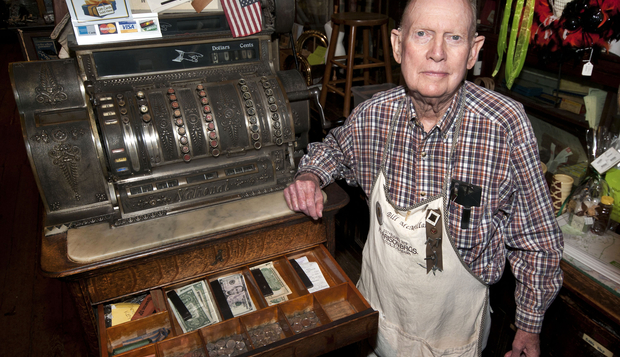
Many years ago, around 1978, I did an article that I titled, “The Cash Register Revolution” about the soon-to-disappear mechanical cash registers which were to be replaced by the now ubiquitous electronic “point of sale” devices. The invention of the cash register, as I discovered, was an essential on the way to allowing modern business to exist. The inventor, a chap named Ritty (?), was being robbed blind by his employees in a one-for-you-and-one-for-me approach to putting money received into the till. So he invented his little apparatus which caught on, was bought up by the National Cash Register Company and there is now not a cash business possibly anywhere in the world that does not have its cash register into which all moneys taken in are to be placed.

cash register

Why mention it? Because I just came across an article, “Why Do Stores Give Receipts?” which comes with a nice photo of the receipt-giving machine. She (Megan McArdle) writes as I once did myself although that’s not how I remember the story exactly but you get the drift:

The history of the cash register is, by and large, the history of theft prevention. Oh, they were originally created as tallying machines for very high-volume businesses. But it was hard to convince businesses that they needed to spend $150 or $200 on a machine to hold cash, at a time when a good workman might earn a dollar or two a day.

And why do they give you are receipt?

They give you a receipt every time, annoying as it is, because they know you’ll glance at the total and notice if it’s very different from what you just paid. And maybe ask the clerk why, in the hearing of their manager.

Without the register and the receipts it issues, commerce and retail to the scale we now have would be impossible.

The prospect of a one-party state in the US

I am like David Horowitz in having had communist parents and having grown up in a household in which plotting against the state with other subversives was second nature. In many ways it provides for us who have turned against the left a form of understanding that gives clarity for what to others are arguable perspectives. In this article Horowitz is trying to say something that should frighten you about the totalitarian world that is forming right before our eyes at a speed that is totally beyond any expectation.

His article is titled “The Threat We Face” and this is the central point about the direction in which the US is right now, right this minute, heading and taking us with it.

Today the Obama juggernaut is systematically bankrupting our country, and undoing our constitutional arrangements. Its contempt for consultative and representative government is relentlessly on display. This week Senate Majority leader Harry Reid defended his refusal to negotiate with Republicans over Obamacare and the debt in these words: ‘We are here to support the federal government. That’s our job.’ End quote. Forget about representing the people whom our Founders made sovereign. Forget what America is about.

The fact that I had a radical past allowed me to see much of this coming. But even I never thought we would be looking so soon at the prospect of a one-party state. Those words may sound hyperbolic, but take a moment to think about it. If you have transformed the taxing agency of the state into a political weapon – and Obama has; if you are setting up a massive government program to gather the financial and health information of every citizen, and control their access to care; and if you have a spy agency that can read the mail and listen to the communications of every individual in the country, you don’t really need a secret police to destroy your political opponents. Once you have silenced them, you can proceed with your plans to remake the world in your image.

I have written much the same recently myself over here. This was my final para in that post:

The full resources of the American government are being used in a punitive way against individuals and groups, against American citizens who disagree with the President. In reading not just the American media but even the right side blogs, the most astonishing part is the absence of expressions of genuine outrage. Maybe with the American media as latently totalitarian as it is there is nothing that can be done, and maybe no one writing a blog wants to be done over by the tax office, but if it doesn’t make you seriously angry, and not just a little frightened, I don’t know what would.

What can be done about anything I cannot at this stage imagine. The media in the United States are corrupted by their own grossly superficial and far left-oriented understanding of every issue of importance, from foreign policy through economics and down to the Constitutional protections of individual rights. That the use of the IRS to persecute individuals is not seen as an absolute abuse of power intolerable in anyone’s hands and is not portrayed loudly and regularly in this way by the media is the final proof that the notion of the fourth estate as a guarantor and protector of our freedoms is hollow. They are a major part of the problem for which solutions evade me.

Recognition of Obama for who he is and what he wants is the first place to start but how will the alarm be sent? How will anyone beyond a handful find out? Who will actually be the Paul Revere who will bring the message that the red press is perverting your freedoms? Where are the constituencies that can turn that concern into a policy of action? It’s not even all that obvious to most on this side of politics. To the other side, they are more than content because they are winning on the politics because they have virtually every means of communication in their hands. The national socialists are in charge in the US and if you don’t like it and try to say or do anything about it, they will soon see how much you like being done over by the IRS and that’s just for a start.

We’re dumb and we vote

This is a story from the Associated Press picked up at Drudge and this is their title, not mine: “US adults are dumber than the average human“. And the point is made in the second para:

In math, reading and problem-solving using technology – all skills considered critical for global competitiveness and economic strength – American adults scored below the international average on a global test, according to results released Tuesday.

The test included questions like how many states are there in the US and what language do they speak in Austria, that kind of thing. You can see an outline of the test here which is not all that easy.

The story is also told in USA Today with the article titled, “U.S. adults lag behind counterparts overseas in skill“.

AP thinks the problem is average intelligence while USA Today sees the problem in the education system. Since we know as an established fact that all human groups are identical in their potential, there is no other reason for this result other than the underfunded and poorly resourced education system in the US.