The PBS News Hour debate on Say’s Law

In reply to John Papola’s article on Say’s Law on the PBS News Hour website, there is an article also on PBS by an historian, John Livingston. I will leave John Papola to fight his own battles, but here would be my own response to Professor Livingston, I presume:

I often wonder when the actual events of the world will begin to make some impression on Keynesian thinking but the evidence from what John Livingston had to write makes it seem that such a time is a very long way away. Should we argue theory? Should we argue the empirics? What will make an impression is almost impossible to know since nothing so far has made any dent in present thinking at all.

We are in the midst of the worst recovery since the Great Depression. Employment levels and employment growth are abysmal. The economy is going nowhere, even having contracted in December some four years after the fiscal stimulus was supposed to have done its work. That is all obvious beyond argument and unless Livingston grabs for the it-would-have-been-worse-without-the-stimulus excuse there is really nothing for him to argue so far as the empirics actually go. There has been a stimulus and the economy not only remains extraordinarily subdued but there is a mountain of debt that now needs to be repaid.

But to enter into the realm of Say’s Law is to enter into the world of theory. Say’s Law is an abstract statement about the nature of the world. It says that at the aggregate level, demand is constituted by supply. A community can only buy what it has produced. It is production which simultaneously creates the incomes that are used to buy the output. If you pay people to dig holes and refill them they may have money in their hands but the economy has not produced anything that this money can be used to buy.

Meanwhile those on the Keynesian side argue that the subdued level of economic activity is because people choose to save rather than spend. It’s the saving that’s the problem. If only we had more consumption and government spending to soak up those savings all would be well.

But of course it was not an increase in saving that caused the recession. Whatever else one might say about the Global Financial Crisis and the recession that followed immediately thereafter, it would be implausible in the extreme to argue that the problem was caused by a sudden desire to save. Right up until the financial crisis began economies were in some kind of boom, racing ahead in every direction. There was no lack of demand, consumer or otherwise, when almost overnight the bottom fell out of the boom and a recessionary period began. I just say to Professor Livingston that if he wants to argue that the recession began because of a fall in demand as everyone suddenly decided to start saving instead of spending, he is welcome to try to defend that ground. Nonsensical though the notion may be, he is welcome to try to prove what is obviously untrue.

What did happen was that a boom that had run on speculative investment in housing financed by an excessive creation of credit ran headlong into reality. Lenders found that an increasing number of borrowers could no longer repay their debts and the homes they had bought were falling in value. The housing bubble burst, the industry and all of the feeder industries into the housing market collapsed and the financial system of the world teetered on a knife edge for six months before some kind of stability returned.

The problems were thus in no way due to a fall off in demand but to a problem with the structure of the economy. Vast areas of the American economy suddenly found that the products they were producing could no longer be sold at cost covering prices. If you asked these producers what the problem was, they would no doubt have told you that there had been a fall in demand. But while that would have been how they experienced the problem, that is not that the actual problem was. The problem was that they had been misled into producing a specific form of output – that is, they had been misled into producing housing – that could no longer be sold at prices that covered their production costs. This, of course, also affected the demand for the inputs into the industry, including the demand for labour.

Meanwhile the financial system, whose assets were bound up in an immense volume of mortgage backed securities – covered as hey were by a housing stock that no longer delivered the revenue stream expected and where the underlying assets could no longer be sold at the prices they were originally borrowed against – found their balance sheets quite unbalanced. They could not call in their loans and could not meet their own debt obligations. The world’s entire system of finance then unraveled as loans were withdrawn and finance fell away. We thus experienced a financial panic as described time and again throughout the classical business cycle literature that existed before Keynes wrote his General Theory, a literature which is unfortunately no longer consulted by anyone in trying to think through our present problems. To pretend that the GFC was caused by a fall in demand rather than a structural disaster in both the real and financial sides of the economy is to be utterly blind to reality.

So to come back to Say’s Law. Its most basic statement is that demand is constituted by supply. You must be able to produce, sell and earn money to spend before you can buy. Looked at from an economy wide perspective, there must be an increase in real value adding production before the real level of demand can increase. But as the level of value adding production contracted during the GFC, the real level of demand also contracted. To describe this as decisions to save would be ridiculous.

A Keynesian would, nevertheless, insist that the problem was too little demand and would therefore argue that the answer to a problem that had been caused by a fall off in value adding production would be even more non-value adding production. A classical economist on the other hand would argue that since the problem was the fall in value adding production, the only solution was to increase the level of value adding output through a shift in the structure of production away from activities that were no longer profitable towards others which were. Not an instantaneous process by any means, but a year or so would have seen recovery well in place had policies been adopted to encourage the private sector to look for and expand value adding forms of production.

But instead we had the stimulus which consisted of nearly a trillion dollars worth of unproductive expenditure that could only make things worse and of course did. There were also efforts made to hamstring the financial sector in its efforts to redirect savings into productive enterprises. And there were – and still are – efforts being made to raise taxation on just those businesses you need to encourage growth. Every one of these policy decisions is guaranteed to slow recovery, and so far as the economic direction of the United States is concerned there has not been a single major policy put in place that will hasten recovery.

Even low interest rates, which are supposed to encourage investment – another demand side solution – merely misdirects those savings that are generated while at the same time keeping the level of saving lower than it would otherwise have been. The one certainty with interest rates near zero is that there will be less saving than there would have been had rates been higher. Less saving inevitably means a lower standard of living.

So to consumer demand and recovery. Livingston’s argument puts the consumption cart before the production horse. To doubt that people would spend more if they could afford more is ridiculous. The cause of low consumer demand is low real incomes. The cause of low real incomes is the absence of growth in value adding areas of production in which people can be hired and earn an income.

That we are in the hands of someone with only a limited understanding of how an economy works when dealing with Livingston is shown by his use of the phrase “surplus capital”. You almost have to cringe at reading such words. The notion that there is capital that their owners would not happily see put to use if the risks were commensurate with the expected returns is quite astounding. To think in such terms is almost to have a death wish for the future of the American economy. There is never enough capital. Surplus capital is never a realistic problem – if only it were. There are always more things you can produce that others would gladly buy if they could afford them when they reached the market. To believe instead, as he seems to do, that there is a mass of capital being left to lie fallow that could not find a productive purpose if economic momentum were again restored is bizarre given just how desperate the unemployment situation is.

Livingston’s plain ignorance of Say’s Law as it was stated by the classical economists is painful to read. To act as if they had argued people were living in a barter economy without money is such a colossal evidence of a failure to have read anything at all about classical views is par for the course in modern economic discourse but is still a disgrace. If you want to discuss Say’s Law it helps to at least understand something about what classical economists actually said and not parrot the inanities spread by Keynes. Let me therefore take you to Say’s first statement of Say’s Law published in 1803 and we’ll see whether he was discussing a barter economy:

“It is not the abundance of money but the abundance of other products in general that facilitates sales. . . . Money performs no more than a conduit in this double exchange. When the exchange has been completed, it will be found that one has paid for products with products.” (Say 1803, quoted in Kates 1998: 23)

Products buy products through the intermediation of money. Demand is constituted by supply. One’s own products or one’s labour time are exchanged for sums of money and then the money received is exchanged for other products. Livingston’s conclusion, that “consumer spending rather than investment seems to be the key to growth,” is no more sound or coherent than his view that Say’s Law ignored money.

Classical economists understood something that modern economics does not. They understood that you cannot drive an economy from the demand side, only from the supply side. Consumption is the payoff from value adding production. If you want growth and employment, then you need to increase the level of value adding production first. To believe anything else, and to try to make an economy succeed in any other way, is the very fallacy that is creating the enormous economic problems that now exist, problems that will never be fixed unless unproductive public spending is reduced and value adding private sector production returns in its place. That is the conclusion that Say’s Law tries to explain. It is the great tragedy of modern economics that Say’s Law has disappeared as a guide to policy because without it we will surely continue to drive our economies into the ground in the belief that we are doing ourselves some economic good. That we are not doing so should have become very evident by now to all by those who are willfully blind to the dismal economic reality that is now found everywhere you turn.
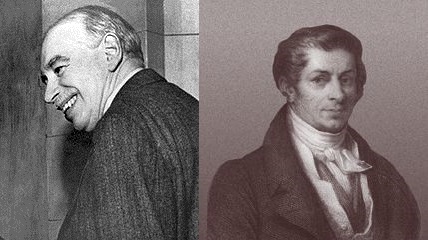
Keynesian follies make the news

An article by John Papola – you know, the chap who did the Macro Follies video and the Keynes-Hayek Rap – on the impossibility of consuming one’s way to prosperity. He has taken Say’s Law to places it has never been before, in this case into the PBS News Hour in the US. Many great observations but I will restrict myself to this:

As John Stuart Mill put it two centuries ago, ‘the demand for commodities is not the demand for labor.’ Consumer demand does not necessarily translate into increased employment. That’s because ‘consumers’ don’t employ people. Businesses do.

Since new hires are a risky and costly investment with unknown future returns, employers must rely on their expectations about the future and weigh those decisions very carefully. Economic historian Robert Higgs’ pioneering work on the Great Depression suggests that increased uncertainty can depress job growth even in the face of booming consumption. Consumer demand that appears to be driven by temporary or unsustainable policies is unlikely to induce businesses to hire.

Increased investment drives economic growth, while retrenched investment leads to recession and reduced employment — and it always has. John Maynard Keynes, like most business cycle theorists before him and since, paid particular attention to this boom and bust in investment, blaming volatility on the ‘animal spirits’ of businessmen. This observation about the importance of ‘confidence’ is surely true, if somewhat obvious.

Unfortunately, Keynes and his successors focus on aggregate levels of spending and often explicitly disregard the details of how money is spent and resources are employed. This led him and the profession down a dark road to the defunct underconsumptionist ideas of the early 1800s which haunt us to this day. Keynes repeatedly asserts throughout his famous tome, The General Theory, that even wasteful expenditures could increase the wealth of society.

Is it any wonder that so many of our policies are focused on consuming and sometimes even destroying wealth rather than creating it?

Do you ever wonder whether the mainstream economic establishment will ever begin to wonder whether this theory they have been peddling for three quarters of a century may be wrong.

Warring on aggregate demand

say and keynes

I have an article at Mises Daily today with the title, “The Errors of Keynes’s Critics”. I wrote it in reply to an article published a few weeks ago with the title, The Errors of Keynes. Goodness knows there are enough of such errors and it is a blessing to find someone else taking the Keynesian apparatus on. But if it is to be done, it needs to be done with care, and if you are going to invoke Say’s Law as this article did, it is essential in my view to get the central point right. The problem with this critque of Keynesian economics, which was a review of a book written in Spanish by Juan Ramón Rallo which had made the same points, was that it used Keynesian arguments as a means to refute Keynes. What I wrote was this:

Rallo thus attempts to controvert Keynes by confirming everything he wrote. People really do hoard, Rallo argues, and store money rather than spend. There really is a deficiency of demand in the short-to-medium term that may finally work itself out in the long run, in three-to-five years perhaps. Overproduction is impossible, but only ‘ultimately,’ and in the meantime it can occur. Involuntary unemployment does apparently occur because of some problem on the demand side of the economy due to hoarding. However, rather than this deficiency of demand being a bad thing, it’s a good thing, since the hoarding allows business to think about what to do next.

All very well, but as I pointed out, if you are Keynesian such as Krugman, once you agree that demand deficiency is a problem and people actually do hoard then it also licenses the government to come to the rescue with a stimulus package that will short-circuit the time period between income earned and income spent. Here is not the place to explain what’s wrong with the argument, but that there is something wrong with the theor is a conclusion that ought to have become more evident with each passing day as we bear witness to the immense damage the stimulus has caused. My conclusion:

If you want to get to the essence of Say’s Law you must never think in terms of aggregate demand and aggregate supply. Just drop it from all conceptual discussions of the economy and I think, although I can’t be sure, you will find yourself necessarily thinking about issues in the same way as the Classical economists. As I have argued in my Say’s Law and the Keynesian Revolution (Elgar 1998), if you want to defeat Keynesian economics, you need to wage war on the very notion of aggregate demand. Nothing else will do.

Really, nothing else will do. There are austerity packages in place but they are half-hearted and uncertain. There is little serious understanding of the economics that lies beneath the need to eliminate unproductive public spending if recovery is going to take hold. Maybe there is some other way to think it through and reach not just the right conclusions but also allow policy makers to explain with confidence why what they are doing needs to be done. Maybe. But to me unless you war on the very idea that demand for anything at all can help move an economy out of recession, I do not see how this Keynesian blight can ever be removed.

And let me finally express my gratitude to the editors at Mises Daily. Not everyone is as open to such discussions as they have very clearly shown themselves to be.

“Men err in their productions, there is no deficiency of demand”

There’s not a lot I agree with Paul Krugman about but his definition of Say’s Law is most certainly one of them. This is from a blog post he wrote on February 10:

When John Maynard Keynes wrote The General Theory, three generations ago, he structured his argument as a refutation of what he called ‘classical economics’, and in particular of Say’s Law the proposition that income must be spent and hence that there can never be an overall deficiency of demand.

He’s wrong about the reason, that it is because income must be spent, but he is right about the conclusion. Whatever may be the state of play in an economy, rapid growth or deep depression, the one point classical economists would agree on was that the level of demand in aggregate had nothing to do with what was going on.

I am sometimes asked why I persist with bringing Say’s Law into the conversation. There are a number of reasons, of which these are the most important.

First, Keynes himself made this his point. He was going to refute Say’s Law. It still seems to me the most direct means to demonstrate that Keynes was wrong if it can be shown and understood that Say’s Law is valid after all. This is a point perfectly well understood by Krugman. This is the Maginot Line of Keynesian economics. If it is ever breached in a serious way the whole of the Keynesian position will be overrun and sent into retreat and disarray.

Second, by bringing the great economists of the classical period into the argument, I am siding with some of the smartest people who have ever lived. Just to have John Stuart Mill, the man with the nineteenth century’s highest IQ on one’s side, adds quite considerable weight to one’s own arguments. If you believe Mill got it wrong you had better have a pretty strong reason for thinking you can see into these things more clearly than he could.

Third, there is a genealogy for these arguments that one can look up. I have become all too aware that virtually no one even amongst historians of economic thought actually knows very much about classical business cycle theory. Expertise in this area is vanishingly small. Yet it is there for anyone to access if they would bother to try. I might mention that an obstacle to even looking is that Keynes explicitly stated that classical theory had no explanation for involuntary unemployment, a statement so ridiculously untrue that it is shameful that saying just this didn’t discredit him on the spot. But the upshot is that no one who wishes to stay onside with the mainstream of the profession ever wishes to make anything of this.

Four, it is important to get people to understand that the crucial issue is aggregate demand. This is Keynes’ innovation. I say this to you, that if you use aggregate demand to explain anything at all in economic theory, you cannot and will not understand anything at all about what you are trying to explain.

If every time you used the phrase aggregate demand you substituted “value adding production” then you would start to see things a bit more clearly. As in, “if employment is to rise we need an increase in aggregate demand” now becomes, “if employment is to rise we need an increase in value adding production”. You employ people to produce, not to buy. Alas, between the writers and publishers of economic texts there is enough heft to stop any such adjustment being made in how we teach and explain economics, but you can do it for yourself. And if you do it, you will then see that nothing that transpired as part of the world’s various stimulus packages could ever have led to recovery since none of it led to an increase in value adding production.

Anyway, there is more along the same lines as this in an article that you can find at Quadrant Online.

And let me just mention the reason for the title. The statement is from David Ricardo and was part of a letter to Thomas Malthus written in 1820. Malthus was arguing that the recession that was then current was due to a deficiency of demand. People preferred to save and not to spend. I will only say that if you think that the depressed level of our economies at the present time is due to too little demand, then so far as the operation of our economies goes, like Malthus in 1820 you do not have a clue.

Aggregate demand has NO effect on employment and economic growth

My economics, so far as macro goes, is pure classical and I do personally believe that economics reached a high point with John Stuart Mill before the coming of the marginal revolution which made some sense is many ways but lost quite a bit as well. This is a continuation of the post on The errors of Keynes’ critics on hoarding and demand deficiency.

What is the question we wish to answer? We would like to know (1) what will cause more people to be employed and (2) what will cause the economy to increase its level of production?

So the answer on both counts is that employment and growth will increase if production increases, if there is more capital in existence that can be used to produce with and if the productiveness of capital can be improved. These are all 100% entrepreneurial decisions. At the back of every entrepreneur’s mind there is, of course, the question whether what they produce will find a buyer so there is always some degree of uncertainty and doubt associated with every entrepreneurial decision. And it goes without saying that no one will produce unless they believe that there will be enough demand for the product or service. But demand here is purely notional and exists entirely in the mind of the entrepreneur as he tries to work out what others will do if the product is supplied to the market.

The second part is that there is no level of output that will not find a market. An economy cannot produce so much that it will exhaust the willingness of a population to buy the lot. Demand deficiency will never be the nature of the problem when an economy goes into recession.

But trying to work out what people will buy in the future is fantastically difficult. Some part of that is determined by the level of demand in the past but all production decisions are forward looking so past and present demand is merely one piece of information to go along with the rest.

So there are two possibilities for demand deficiency as it is thought of by Keynes and the Keynesian model. Firstly, for a variety of reasons, the population in aggregate will not wish to buy everything that the economy at full employment could produce. They have the income but are just not willing to spend, or businesses have the lines of credit but there are not enough ventures for them to pursue for the moment so that the level of investment sags and savings run to waste.

Well, the fact of the matter is that no such economy has ever existed anywhere nor is likely to. Pick any recession you like and you will never find even a glimmer of an explanation in some kind of fall off in demand just as things were going so well. The recession in 2009 was not caused by decisions to save or businesses not wanting to invest. Identify your own explanation as you will, no one has argued that recession began because of demand deficiency, not even Krugman.

So the second part is to ask whether once recession begins there is then some kind of independent fall in demand that makes things worse. The downturn would have only gone one notch but because of this uncertainty it has gone down three notches. But again that’s not right. As the economy goes over the cliff, everyone is working as furiously as they can to keep their own boat upright. They are doing everything they can humanly hope to do to maintain their own businesses or if they are employees, to keep the businesses which employ them from sinking.

But recessions are due because a portion of the economy was non value adding. This is the meaning of a misdirected structure of production. Some of the economy could not maintain profitability and down they go and they pull suppliers down with them and there is a large increase in unemployment that coexists with the fall off in the level of activity.

And every such downturn in the real economy has an inevitable effect on the financial system. Loans are not being repaid and money becomes really tight. This is the situation described by Mill wherein everyone is trying to get their hands on cash. This is not hoarding. This is a financial crisis. To think of this as hoarding cash, as if everyone just went out and decided one day that they wanted to hold more money. This is what you saw in 2008-09. There was a drive to cash up in an economy where the financial system was in the process of losing immense amounts of money through the unravelling of the leveraging that had been rampant. It was musical chairs with money. Eight people but only seven chairs and so some ended up without the finance to keep their businesses going.

And that’s where we were in 2009. The economy was in recession and finance was tight. No one was hoarding cash. There was no demand deficiency. There was a breakdown in the structure of production which lasted for about half a year.

So the question then was what to do. The Keynesian interpreted these events as a fall in demand when the reality was that there was a rotting in one part of the structure of production. The Keynesians therefore said we had to boost demand but they really meant we must boost supply by employing people to create goods and services that would not repay their production costs. So we had the stimulus and the result has been deficits and debt as far as the eye can see without even a hint of recovery.

I, being completely classical, said that the problem was not a deficiency of demand but structural imbalance. There are things to do, such as bringing the level of business taxes down or lowering interest rates (which happens anyway so doesn’t have to be done). Governments can also do some small additional expenditure on various value adding forms of activity but it is a palliative so little can be depended on it.

Recovery will take about a year, as businesses climb out of their shell holes and suss out where profitable areas of activity might now be. It takes a while but is hardly an unconscionable length of time, especially when we have so many forms of income protection around (which stimulate no demand and are purely a form of welfare but so what). And then, if my approach had been adopted, by around 2010 we would have been well into recovery and unemployment would have been falling and the economy’s momentum gathering steam.

But at no moment during the recession would it ever have been sensible to say that the problem was too little demand, too much saving or that hoarding was postponing recovery. That is pure Keynesian junk and has rotted plenty of minds already and it isn’t finished yet, as that review I read this morning clearly showed.

At the aggregate level an economy has no demand side, only supply. Demand is constituted by the supply of goods being placed on the market. If the notion of demand even darkens your thoughts for a moment, just try to see what the supply issue is that is the real issue of any moment. Not being immediately able to guess after a recessionary explosion has gone off where to increase production is not to be classified as a failure of demand.

The errors of Keynes’s critics

I was pointed in the direction of this article at Mises.org on “The Errors of Keynes” by Philipp Bagus. It is a review of a book written in Spanish by Juan Ramón Rallo and titled, Los Errores de la Vieja Economía part of which deals with Say’s Law.

The really interesting part is that it is becoming better understood that the road to unwind Keynesian economics travels through Say’s Law. Keynes himself could not have been clearer on this, that he was reversing the conclusion of those who believed Say’s Law to be true. Thus, there are two things that need to be done. First you have to know what Say’s Law is. Then you then have to show it is valid.

But the problem, and it is such a massive obstacle that it gets in the way of many such attempts, is that all economists are brought up on Keynesian demand side theory and it infuses every aspect of their thought. Even while recognising that it is the structure of demand that is the key they still hang onto the level of demand as an integral part of how they approach economic problems.

Let me therefore put it this way. If one is to understand the classical theory of the cycle, this is what one must know in one’s very bones. Hoarding NEVER causes a recession. Too much saving is NEVER the problem. An economy NEVER suffers from demand deficiency. If you want to say that after a recession begins people become tentative because of a lack of confidence, this you can find absolutely everywhere on the classical side of the Keynes-classics divide. .

Here is the reviewer’s discussion of Say’s Law.

Let’s have a look of some of Rallo’s arguments, beginning with Keynes’s famous critique of Say’s Law. Keynes’s distorted version of Say’s Law in TGT states that supply creates its own demand. Rallo vindicates Say’s Law in its original version: In the long run, the supply of a good adjusts to its demand. Ultimately, goods are offered to buy other goods (money included). One produces in order to demand, which implies that a general overproduction is impossible [in the long run].

Say’s Laws leads us straight forward to the most innovative argument in Rallo’s book that addresses the old argument against hoarding. Even harsh critics of Keynes, for example from the monetarist or neoclassical camp, admit that Keynes was at least right in that hoarding is a destabilizing and dangerous activity.

Rallo, however, proves and emphasizes the social function of hoarding. To demand money is not to demand nothing from the market. Hoarding is the natural response of savers and consumers to a structure of production that does not adjust to their needs. It is a signal of protest to entrepreneurs: ‘Please offer different consumer and capital goods! Change the structure of production, since the composition of offered goods is not appropriate.’ (My bolding and my additional text in square brackets)

This is how he controverts Keynes by confirming everything he wrote. People really do hoard, Rallo argues, store money rather than spend. There really is a deficiency of demand in the short to medium term which may finally work itself out in the long run, eventually, in five to ten years perhaps. Overproduction is impossible but only ultimately. Involuntary unemployment does apparently occur because of some problem on the demand side of the economy due to hoarding cash. However, rather than this deficiency of demand being a bad thing, it’s a good thing since the hoarding allows business to think about what to do next. But if you are Krugman, it also allows the government to come to the rescue with a stimulus package that will short circuit this delay. Here is the example Rallo uses of how hoarding can work:

In a situation of great uncertainty, it is even prudent to hoard and not immobilize funds for the long run. Rallo provides us a visual example. Let’s assume that uncertainty increases because people expect an earthquake. They start to hoard, i.e., they increase their cash balance, which gives them more flexibility. This is completely rational and beneficial from the point of view of market participants. The alternative is to immobilize funds through government spending. The public production of skyscrapers is not only against the will of the more prudent people; it will also prove disastrous if the earthquake is realized.

A government should not build skyscrapers when everyone expects an earthquake! But if the economy has gone quiet and there are useful things a government can do – perhaps reinforcing existing buildings – why wouldn’t that make sense? I’m afraid it’s a metaphor that doesn’t necessarily make sense and certainly won’t explain why Keynes is wrong and would never convince a Keynesian.

So let me get to the problem as expressed in this para in the review:

As Rallo points out in contrast to TGT, it is not aggregate supply or aggregate demand that is important, but their composition. If, in a depression with a distorted structure of production, in a liquidity trap situation, aggregate demand is boosted by government spending, the existing structure cannot produce the goods that consumers want most urgently. The solution is not more spending and more debts, but debt reduction and the liquidation of malinvestments to make new and sustainable investments feasible. (My bolding)

I can certainly agree with that the solution is to leave recovery to the private sector as they find their way towards profitable outcomes. But to use “aggregate demand” in the same sentence as “structure of production” must leave the argument confused. Even more certainly, to include mention of “a liquidity trap” will bar entry to the classical world. Demand is constituted by supply: supply is demand. Aggregate demand and aggregate supply are not two separate entities. There is no such thing as an independent force that can be described as aggregate demand.

If you want to get to the essence of Say’s Law you must NEVER think in terms of aggregate demand. Just drop it from all conceptual discussions of the economy and I think, although I can’t be sure, you will find yourself necessarily thinking about issues in the same way as the classics. If you want to defeat Keynesian economics, you need to wage war on the idea of aggregate demand. Nothing else will do.

A dialogue with John Papola

John Papola is most famous for his Keynes-Hayek Rap but has now added to his Econstories series with the Deck the Halls with Macro Follies video dealing with Say’s Law which came out just before Christmas.

Yesterday I posted an excerpt from an article by John under the heading “Say’s Law going mainstream”. Pedro, in the comments, made an observation to which there was a reply from John himself. Both the comment and John’s response are found below. First the comment:

From the article:

As economic historian Robert Higgs’ pioneering work on the Great Depression suggests, increased uncertainty can depress job growth even in the face of booming consumption. As recent years have demonstrated, consumer demand that appears to be driven by temporary or unsustainable policies is unlikely to induce businesses to hire.

I’m not arguing against the importance of the supply side for recovery, but I think that the system is more interdependent than the article conveys. Uncertainty (and other factors) can lead to demand shocks as well as supply shocks and both will have implications for production and growth. A supply shock is also, of course, a demand shock and the classic keynsian demand shock is liquidity preference. I don’t think anyone would want to say there is no such thing as liquidity preference and that it has no macro effects.

The second part of the para I’ve quoted is a business version of the permanent income hypothesis and I think it is true. Pump priming is therefore very unlikely to start or sustain a recovery. However, when there is a big demand shock I think some spending can act as a parachute.

And here is John’s response which is deeply interesting, very subtle and to the point.

A ‘demand shock’ is, in my view, solely defined as an unmet/excess demand for money. This is not solved by inducing people to consume real output. It is solved by increasing the supply of what is demanded: money. John Stuart Mill understood this, and so do I. Even in monetary disequilibrium, consumption is still not a means to grow the real economy. Demand shocks are not the cause of recession, either. I have yet to find a single economist who could point me to a demand shock which came out of nowhere. Every one is the response to real problems of structural failure. This past one was a response to the house bust. Trillions wasted in non-value-adding production of houses. The bust began in 2006. The money demand shock didn’t happen until AFTER that, in response to the events that followed as a result of that bust in the financial system. Our Fed made matters worse by failing to meet money demand, resulting in a collapse of nominal spending. David Hume, John Stuart Mill and Friedrich Hayek would all say this made a bad situation worse. I agree.

So this article is both compatible with a monetarist and monetary equilibrium approach AND independent of those concerns. Consumption without production leaves society with less. ‘Derived demand’ is a fallacy. And I hope that my notes about the business cycle data make this clear. In the USA, comparing the levels of real growth, employment, private investment and private consumption make clear that record-high consumption can occur along side stagnant or falling employment and growth. Heck, 2012Q4 is a perfect example.

Production is funded by savings, not sales. I know this from experience making payroll for my company. The revenue not distributed to pay for past production is saved for future production to the extent that it is not distributed to the owners. That’s the point of my narrative.

I hope this helps clarify the position and point.

Understanding Say’s Law of Markets

I have been in quite some correspondence since the Macro Follies video arrived and from these conversations I can see that there are four bits I may be leaving out in my explanations, the first being the necessity of seeing these issues in aggregate terms, the second the role of consumption, the third that the delay between receiving one’s income and spending does not provide a theory of recession and the fourth the effect of living in a money economy. Nothing I say in adding these in is in any way contrary to the classical understanding of the law of markets or different from anything I have tried to explain before.

Aggregate Concept

Say’s Law is about the economic aggregates of an economy. There may not have been a set of national accounting figures published during the nineteenth century but they still had a grasp of the economy as a whole. Say’s Law never applies to any individual. No individual’s demand is necessarily comprised of that individual’s supply. We borrow each other’s savings, we pay taxes to the government, we give money gifts for others to spend. Say’s Law is a concept that applies to the economy at the aggregate level only. The total demand found in an economy in real terms consists of the total output of the economy in real terms.

Consumption

Say’s Law does, of course, presuppose that as much output as can be produced will be bought but this will only happen if what is produced coincides with what buyers want to buy.

Production is valueless without consumption. If no one wished to buy then no one would produce. But since desires are insatiable there is no reason to worry that if producers can work out what buyers want to buy that that buyers will stop short of purchasing everything produced. Keynes however argued that people in aggregate would earn incomes for producing 100,000 units of output and then only decide to buy 90,000 units of what they had produced. This is the underlying dynamic in an economy that is experiencing a recession due to deficient demand.

And so far as policy is concerned, he seems to have then assumed that businesses would increase employment and production if what they had already produced could find a market. The reality is that businesses will only employ and produce if they believe they will earn a profit from what they produce next. Past sales have only a minor effect on employment going forward. Current sales are only one indicator amongst many in the production matrix of a typical firm. It is why Keynesians were so astonished by the Great Inflation of the 1970s since the combination of high unemployment and rapidly rising prices should have been theoretically impossible.

When looked at from above, if the amount being spent in aggregate is greater than the amount that was earned from producing output – let us suppose the government is running a deficit – then somewhere within the economy there are income earners being short changed since they do not receive in value the amount of value they produced. The spending may have taken place in Washington or Pennsylvania, the shortfalls may show up in Montana or Tennessee. But as invisible as the process is, the effect is quite clear. Some businesses will not earn the returns they expected. They will therefore scale down their level of production or even close down entirely. Ultimately the level of employment will be lower than it otherwise would have been as will the level of national output. A Keynesian will attribute this to too much saving and not enough demand.

The Time Gap between Receiving an Income and Spending

The existence of money adds some complication to the Say’s Law story but not much. There is always the intrinsic time delay between (A) outlaying money in some productive venture; (B) selling products one has produced or earning wages as someone’s employee; (C) receiving the money for what one has produced or earned as an employee which may be delayed through sales on credit or by being paid wages in arrears; and (D) spending the money one has received.

An increased time delay between C and D is not a theory of recession and unemployment.

This is what Mill in his essay “Of the Influence of Consumption on Production” is trying to get across. He was desperate to try to explain to the boneheads of his own time what the conclusions from the Law of Markets are. And it is extraordinary the number of people I have come across who read this essay and then argue that Mill is contradicting himself because he denies demand deficiency at the start of the essay and then talks about people hanging onto their money and delaying expenditure at the end. This is John Stuart Mill we are talking about, the man with the nineteenth century’s highest IQ and whose previous book was his Logic (1843) which was used throughout the nineteenth century and well into the twentieth. He is not likely to have contradicted himself in a way that any bumbling idiot could pick it up. Perhaps they should try to work out more closely what he meant.

And what Mill is trying to get people to understand is that a prior theory of recession is needed to explain why the delay between C and D has occurred. That is the explanation for recession not some blue sky decision not to spend. The increased delay has been caused by something. What is it? That is what needs to be known. And whatever it is has caused the rate of increase in A to diminish as well. But if you believe that the cause has been too much saving, then says Mill, you will never understand the first thing about how an economy works.

The Role of Money

To understand the money side of these things, it helps to go to Wicksell who followed Mill by about half a century (see Chapters 16 and 17 of the second edition of my Free Market Economics). What Wicksell discusses firstly is the natural rate of interest which is the supply and demand for productive resources (machines, bricks, tools, labour hours, everything that can be used in production). Of these, there is only a finite amount (it is a stock) and the potential rate of increase is very slow. Then there is the nominal rate of interest which regulates money and credit, the number of units of purchasing power in an economy. These can be increased at quite a rapid rate, much more rapidly than can the quantum of real resources.

Start with 100,000 units of productive resources and money and credit equal to 100,000 units of currency. Each unit of production thus costs one unit of currency. If the amount of money and credit goes up to 200,000 units of currency, eventually the price of productive resources will rise to two units of currency. But that is eventually. In the meantime, the people who first get their hands on the extra units of currency can buy more since the price level has not as yet risen to the full extent that it will.

But the producers of those 100,000 units of real output will eventually find that they have not been able to exchange what they produced for enough money to allow them to buy products equal in value to the value of the products they sold. If they are running a business, they find they are unable to replace their stock with the revenues they have earned. They have been cheated blind and yet the one place they don’t look for that theft is in the increased demand created by the government since that is what they have been taught to believe is what has been done to save them from the problem that very solution has caused.

And if you have made it this far and would like to see a further continuation of this discussion, see Misunderstanding Say’s Law of Markets which provides a different perspective but on the same issues.

Misunderstanding Say’s Law of Markets

If you would like to see what passes for a discussion of Say’s Law in the modern world, see below. My comments are in bold and found in square brackets. An utterly and thoroughly Keynesian description of the Law of Markets with almost no understanding of the classical theory that sits beneath it. And I even think this is supposed to be a defence. Why is it impossible for someone writing on Say’s Law to read my book. He even sources Horwitz in the book I edited but hasn’t even bothered to read my intro. Useless junk! No wonder no one understands Say’s Law. The question I always ask anyone who tries to defend Say’s Law is why classical economists thought it was so important. What major principle was involved? What instructions did it give to makers of policy or what did it tell them not to do? From what you see below, the writer could not possibly give a coherent answer to any of these questions. But at least he did give it the perfect title.

Misunderstanding Say’s Law of Markets

– By Garrett Watson, St. Lawrence University

Few ideas in the history of economic thought have achieved a level of perplexity and criticism than Say’s Law. Perhaps one of the most misunderstood and elusive concepts of the Classical economics, Say’s Law of Markets, first postulated by John Baptiste Say in 1803 [They only think this because it was given the name Say’s Law in the 1920s], underwent considerable support and eventual decline after its assault by John Maynard Keynes in The General Theory. Many of the fundamental disagreements we observe in historical debates surrounding macroeconomics can be traced to different conceptions of how Say’s Law operates in the market economy and the scope used in the analysis. By grasping a thicker idea of Say’s Law, one is able to pinpoint where disagreements in both macroeconomic theory lie and judge whether they necessarily must be dichotomized.

Say’s Law is best known in the form Keynes postulated it in The General Theory: “supply creates its own demand” (Horwitz 83) [He needs to footnote Horwitz! Why hasn’t he read The General Theory if he’s going to talk about Say’s Law?]. Despite the apparent eloquence and simplicity [!] contained in this definition, it obscures the genuine meaning of the concept. For example, one may interpret this maxim as meaning that whenever one supplies a good or service, it must be demanded – this is clearly untrue (83). Instead, Say’s Law can be interpreted as saying that the ability to produce generates their ability to purchase other products (84). One can only fully grasp Say’s Law when analyzing the nature of the division of labor in a market economy. Individuals specialize in producing a limited range of goods or services, and in return receive income that they use to buy goods and services from others. The income one receives from production is their source of demand. In other words, “all purchasers must first be producers, as only production can generate the power to purchase” (84) [Not right. The notion is being reduced to individual buyers when it is an aggregate concept where demand in aggregate is constituted by supply in aggregate. Purchasers are often borrowers who have produced nothing but intend to buy more than their incomes will allow. Lots of other possibilities right down to giving my children their allowance.]. This idea is intimately linked to the Smithian idea that the division of labor is limited by the extent of the market (89).

The result of this fascinating principle in the market economy is that (aggregate) supply will equal (aggregate) demand ex ante as demand is equally sourced by previous production (Sowell 40) [And having repeated exactly and with no modification the very conclusion reached by Keynes, we can dispense with any thought that our author has any idea whatsoever about the meaning of Say’s Law in pre-Keynesian times. ]. Another important point made by Say’s Law is that there exists a trade-off between investment and consumption (40). In contrast to the later Keynesian idea of falling investment leading to a fall in consumption and therefore aggregate demand, an increase in investment means falling consumption, and vice versa. This idea can be analogized to Robinson Crusoe [RC is a terrible example since in a discussion of Say’s Law we are of necessity talking about an exchange economy. This is a discussion explaining that saving is the feedstock for investment.] abstaining from consumption to build a fishing net, increasing his investment and his long-term consumption of fish (42). Therefore, a higher savings rate pushes up investment and capital accumulation, increasing growth and output (as Smith eloquently argues) (40). In another stark contrast to Keynesian analysis, there is only a transactions demand for money, not a speculative nor a precautionary demand (40). The implications of this are that money cannot affect real variables; it is a veil that facilitates transactions only – money is neutral (Blaug 148).[This is just Keynes repeated. Does he really think classical economists believed that no one ever held money as an asset and that the amount of money held was a constant. Thinking in terms of the quantity theory of money – MV=PQ – meant that V would fall during recession.] Finally, Say’s Law also shows that there cannot exist a “general glut”; an economy cannot generally overproduce [Why? Needs explanation. I don’t think he understands the reasoning so can’t provide one.](Sowell 41). While relative over and under-production can occur, there is no limit to economic growth [He seems to think Say’s Law is an argument against secular stagnation!](41).

While it was uncontroversial among the Classical economists that there wasn’t a limit on economic growth [Say’s Law is not a theorem about secular stagnation.], several economists took issue with the fundamental insights of Say’s Law (44). One of the most well-known criticisms was that of Thomas Malthus. Malthus was an early proponent of the “Paradox of Thrift” [What an anachronism!] – an excessive amount of savings could generate an economy with less than full employment (43). One could describe the view of Malthus as fundamentally “under-consumptionist” (Anderson 7). Unlike his contemporaries [Wrong, wrong, wrong!!!!! This is drenched in Keynesian idiocies.], Malthus did not view money as inherently neutral (Sowell 41). Other classical economists, such as Smith, argue that money “will not be allowed to lie idle”, effectively dismissing a precautionary motive for holding money and therefore monetary disturbances [He should at least read Becker and Baumol to cure him of at least some of his ignorance.] (38). This is where we see the inherent difference in perspective in the analyses of Smith and Malthus. Smith is focused on long-run conditions of money (its neutrality and importance of real fundamentals) versus the short-run disturbances money can generate in output (39).

Money is half of every exchange; a change in money can therefore spill over into the other half of every exchange, real goods and services [This is not a defence of Say’s Law, it is a criticism from someone who has no idea what the proposition means.] (Horwitz 92). In effect, “The Say’s Law transformation of production into demand is mediated by money” (92). This means that Say’s Law may not hold in conditions in which monetary disturbances occur.[Then Keynes is right!] John Stuart Mill recognized this possibility and affirmed Walras’ Law: an excess of money demand translates to an excess supply of goods [How wrong can you get.] (Sowell 49). An excess money demand manifests itself by individuals attempting to increase their money balances by abstaining from consumption. This therefore generates an excess supply of goods, which some would argue can be self-correcting, given downward adjustment of prices [More Keynes.] (Blaug 149). Malthus (and later on, Keynes [He is explicitly siding with Malthus and Keynes!!!!!!!!!!!]) argues that downward price and wage rigidities (which can be the result of game theoretic problems in firm competition, efficiency-wages, or fixed wage contracts [This is Malthus? Would have been news to him.]) can short circuit this process, yielding a systematic disequilibrium below full employment (Sowell 65). In terms of the equation of exchange, instead of a fall in V (and therefore a rise in money demand) being matched by a fall in P, the fall in V generates a fall in Y. This point was taken into further consideration by later monetary equilibrium theorists, including Friedman, Yeager, and Hutt. The same analysis can be used to understand the effects of drastic changes in the money supply on short term output, as Milton Friedman and Anna Schwartz would demonstrate in the contraction of the money supply during the formative years of the Great Depression [As if classical economists would be unaware that a fall in money supply would constrict economic growth. What does he think the quantity equation shows?].

When analyzing the large disagreements over Say’s Law, it becomes clear that they stem from a difference in scope: supporters of Say’s Law analyzed the macro economy in terms of long-run stability, while Malthus and others after him focused on short-run disequilibrium generated by monetary disturbances (Sowell 72)[Neither he nor Sowell understand Say’s Law. I never liked Sowell’s explanations as can be seen from my book.]. Smith and other classical economists, pushing back against mercantilist thought, emphasized that money was merely a ‘veil’ that does not affect economic fundamentals, and that quantities of money ultimately didn’t matter [Every sentence gives me pain.](72). The Malthusian grain of truth regarding disequilibrium caused by monetary disturbances in the short-run does not refute Say’s Law; it reveals the necessity of getting monetary fundamentals correct in order for Say’s Law to cohesively operate. [This is an Austrian version that is deeply mixed with Keynes. If you accept this, arguments against the stimulus are much weakened since there really is a shortfall of demand.] It becomes increasingly clear that once we look at the disagreements through the lens of scope, the two conceptions of the role of money in a market economy need not necessarily be incompatible.

And now that you’ve read this, you should read Understanding Say’s Law of Markets.

References

Anderson, William. “Say’s Law: Were (Are) the Critics Right?” Mises Institute1 (2001): 1-27. Mises Institute. Web. 19 Oct. 2012.

Blaug, Mark. “Say’s Law and Classical Monetary Theory.” Economic Theory in Retrospect. 4th ed. Cambridge: Cambridge University Press, 1985. 143-160. Print.

Horwitz, Steven. “Say’s Law of Markets: An Austrian Appreciation,” In Two Hundred Years of Say’s Law: Essays on Economic Theory’s Most Controversial Principle, Steven Kates, ed. Northampton, MA: Edward Elgar, 2003. 82-98. Print.

Sowell, Thomas. On Classical Economics. New Haven [Conn.]: Yale University Press, 2006. Print.

“Pure fallacy from beginning to end”

Here is Milton Friedman stating Say’s Law. He is asked this question (35 seconds in):

Isn’t there some benefit to having the government steal our money . . . . They take this money and they give it mostly to government employees. Well the government employees spend it . . . . And so the people who were robbed have to do something creative to get the money back? And isn’t this creative activity the real wealth?

In his answer, Friedman first makes the obvious point that is, unfortunately, almost impenetrable to the modern economic mind. He says that the premise behind the question is:

Pure fallacy from beginning to end.

Friedman explains why but this is his summary in his own words:

Spending isn’t good; what’s good is producing.

Play the tape for yourself and listen to the full answer. And it is interesting that Friedman states this so clearly since what he is stating is the obvious logic of a market economy, a logic now all but lost.

I wrote to Friedman in 1994 at the latter stages in the writing of my thesis to ask him if he had ever discussed Say’s Law. The problem, unfortunately, is that he intuitively understood Say’s Law as a practical explanation of how economies worked, as the above quotation unmistakeably shows, but did not know that this is Say’s Law. So in his reply – excerpted from a letter more than a page in length and personally typed – he wrote this:

I do not recall ever having written anything specifically about Say’s Law. The closest I have come would be in the various discussions of Keynes’s theory, such as my article on the quantity theory of money in the New Palgrave. The issue of whether there can be a long-run underemployment equilibrium is essentially the Say’s Law issue and my discussion of that indirectly is a discussion of Say’s Law, though not directly.

He unfortunately understood “Say’s Law” in the way it has been bequeathed to the modern world by Keynes and recognised that his explanation is indirect rather than specific. But as far as understanding how an economy worked, he most definitely understood Say’s Law in exactly the way it needs to be understood. You cannot drive an economy from the demand side.

[My thanks to JP for sending the video of MF.]