Economic definitions

I am two days away from finally sending the manuscript of the 2nd edition of my Free Market Economics off to the publisher. What do academics do when they aren’t teaching? This, at least, is what one of them has done. But for interest and comment, I am putting the following up which I have just finished writing not five minutes ago. It will be at the very start of the book, right after the preface which I will get to as soon as I finish this section on the definitions.

And I hope you all have as much fun on this long weekend as I hope to have myself.

Before venturing into the full text before you, it is useful to have a few definitions in your mind. The language of economics is entirely made up of words that have ordinary meanings in everyday life. But these words, when they cross over into economics, suddenly take on very specific meanings that can cause someone to lose the thread during an economic discussion. We therefore provide a series of definitions of the specialised words used in the text. Having at least a preliminary grasp of these words and their more technical meaning will also in itself provide a grounding in the nature of the economic theory you will meet in the rest of the book.

Economics often looks easy because everyone already thinks they understand what’s going on in an economy without even having to study. Not true at all. For an economist it is painful to hear the mistakes that those who have not studied economics to at least a reasonable depth constantly make. But there are also major differences in the conclusions different economists reach and these are often at a very deep level that no lay person could possibly resolve.

This text will teach you everything you will find in studying economics in a normal, usual way. But it also provides a second perspective that has been taken from the economic theories that were dominant during the nineteenth century. But unlike with the natural sciences, economic theory does not progress to higher plains and then remain there. Economic theory is infused with the hopes and wishes of policy makers and of those who study the subject who are predisposed to some particular point of view. People just wish the world was one way when the way things are turn out to be something else again, and their wishes cause them to accept economic theories that are not properly grounded in the way the world actually is.

The definitions found here are already pointing in a particular direction. The very first definition is “entrepreneur”. These are the people who run our businesses and often, if they are successful, become very wealthy as a result. As this book will explain, entrepreneurially-managed firms are the foundation for wealth and prosperity for an entire community but also for personal freedom and independence from government. Economic attitudes are often determined by one’s reactions to entrepreneurs running our firms. Some people don’t agree that we should allow people to run firms any way they like as long as they follow the law. Some people think that governments should run our businesses or at least our major businesses. Or if they don’t run them should have a major say in what they do.

These are, of course, philosophical and political issues that are absolutely part of economics when thought about in the widest sense, but are not part of what gets taught at the introductory level when starting out on economic theory. Yet this is the foundational point. Economics, as we teach it and learn it today, assumes that most of what is produced is produced by businesses independent of governments and are run by entrepreneurs for a profit. These businesses sell goods and services on a market and these goods and services are bought by consumers with money they have for the most part earned by providing either their own labour or some other input into the production of some other good or service. How this process works in detail is what the study of economic theory is about.
The Australian way – cut taxes, raise productivity and reduce regulation

The front page story in this morning’s Australian is one more piece of evidence on the death of Keynes and the return to economic management of a kind not seen for almost a century. Its enemies have called it “austerity”, but what you are looking at is a return to a market-based approach to getting economies to work. As the headline says, Tony Abbott tells Davos: let business lead way. And this is what the Prime Minister means:

In meetings in Zurich with Switzerland’s top investors in Australia and an address to the Australian business delegation to the forum, Mr Abbott has launched a pitch for the “absolute centrality” of private business to sustainable economic growth.

Declaring that Australia will take its own actions to cut taxes, raise productivity and reduce regulation, the Prime Minister will call on other nations to make way for business and free trade. . . .

Addressing Australian business leaders, Mr Abbott said it was easy for commentators and governments to forget “the absolute centrality of successful private business to prosperity”.

“You cannot have a society, you cannot have a community and you can’t have an economy without successful private business,” Mr Abbott said.

It sounds so obvious you have to wonder why it isn’t said more often. And this is the new world we are in and I hardly think what the PM will say will fall on deaf ears. If the socialist President of France is quoting Say’s Law, you may be sure that there is a light dawning that will move us towards a kind of prosperity that has been suppressed for seventy years.

And as for the economic textbook writers of the world, if we suddenly find that the road to prosperity is made up of Y=C+I-G, there may have to be a global book burning as macroeconomic theory finds the need to start again.

Say’s Law and François Hollande

Following the discussion on L’offre crée même la demande, which are the words the French President used last week to indicate that economic policy will now follow more classical directions, and in particular adopt Say’s Law as the guide to policy, I have pulled this posting out of storage which was put up in December 2012. Having just watched the video again, I am even more astonished than I was then how accurate this is as a representation of the underlying ideas. But central to understanding Say’s Law is to understand that it is a macro concept related to how an economy works, rather than being a micro concept about individuals. In spite of everything you might have learned in a conventional economics course, Say’s Law was the foundation for understanding the classical theory of the cycle. If you want to know what causes recessions and then how to deal with them, you must understand Say’s Law.

My book, Say’s Law and the Keynesian Revolution, has been turned into a movie! John Papola, the genius behind the Keynes-Hayek Rap, has now done a movie on Say’s Law, the fundamental principle of the pre-Keynesian theory of the business cycle. Before Keynes, they knew you could have recessions but they also knew that the one thing that could never be the cause of recessions was a deficiency of demand. Too little demand relative to potential supply was a symptom, not a cause. Today all macroeconomics proclaims demand deficiency as the problem itself that must be cured. Therefore we have had one stimulus after another followed by one economic catastrophe after another. In Australia there’s the mining industry and nothing else to drive the economy forward.

To help you understand the video, here are a few bits of background to catch the full flavour of just how beautifully done this is.

John Maynard Keynes introduced the notion of aggregate demand into economic theory. Before he published his General Theory of Employment, Interest and Money in 1936, demand deficiency as a cause of recession was literally and with no exaggeration seen as a fallacy. Today, of course, his macroeconomics is the mainstream and when recessions occur the first thought in everyone’s mind is to restore demand.

Keynes took the idea of demand deficiency from Thomas Robert Malthus, a nineteenth economist who published his Principles of Political Economy in 1821. Keynes was reading Malthus’s letters to Ricardo in October 1932 which was the specific reason that he would eventually write a book on demand deficiency as the cause of recession. The entire economics fraternity refuses to accept this obvious bit of inspiration since it would make Keynes’s claims to originality not quite as honest as the great man would have liked us all to believe. But since there is general consensus that Keynes formed the idea of demand deficiency in late 1932 and there is no question whatsoever that Keynes was reading Malthus in late 1932, there is equally no doubt that the standard story as peddled by Keynes is utterly untrue.

Say’s Law, which does not get mentioned by name in the video, was called the Law of Markets during classical times. The principle was given the name Say’s Law in the 1920s but it was Jean-Baptiste Say in France and James Mill in England who together are responsible for the initial crafting of this bedrock proposition. But as a very good first approximation to its meaning, there is only a rolling momentary credit to the best short statement which was given by David Ricardo in a letter to Malthus in 1821. There he wrote:

Men err in their productions, there is no deficiency of demand.

Ricardo was trying to explain to Malthus that the recessions that followed the ending of the Napoleonic Wars in 1815 were not due to there being too much saving and therefore too little spending. It was not even spending that mattered. What had gone wrong, the same thing that is the cause of all recessions, is that the goods and services produced did not match the specific demands that people with incomes had. There were therefore unsold goods and services, but not because there was too little spending and too much saving, but because businesses had produced one set of goods (housing in the US to take the most recent example of recession) that could not be sold at prices which covered their costs. The structure of production was wrong which would inevitably, as it always does, affect credit markets as defaults became legion.

The notion that recessions were caused by not enough spending, either in 1821 or in 2012, is ridiculous. There is never a deficiency of demand, only a deficiency of purchasing power. And this is the last element you need to understand the plot of the video. What gives someone purchasing power – what makes individuals within an economy able to buy more – is more production. Producing saleable products – rising productivity – is the only means by which economies can grow and therefore, beneath it all, as Friedrich Hayek explains, there must be more investment in capital (actual productive assets not money) and more innovation which improves the technology embodied in the capital. An economy is driven by supply, never demand.

That is the message of the video. It is a piece of genius that so much can be so cleverly condensed into just over four minutes. But if you wish to understand the point, these are the things you need to know. And if you wish to know even more, there is my book as well.

This has now been posted at Quadrant Online.

My letter to the Financial Times on Say’s Law

I have just sent this letter to the Financial Times following their publication of a column on Say’s Law. This is what I wrote:

To the editor

The Australian Financial Review here in Australia published an article of mine last week, “What Say’s Law has to say about the financial crisis” which may be why they chose to publish Wolfgang Munchau’s “The Real Scandal is France’s Stagnant Thinking” from your pages. The meaning and significance of Say’s Law within economies that are trying to shed their Keynesian past and work their way through recession to recovery is simply an unknown as Munchau’s article demonstrates. I have written at enormous length on Say’s Law, even spoke at a symposium in Istanbul on the work of Alberto Alesina where at the end of my presentation, Alesina said to the entire room, “I agree with everything you say”. I will attach a copy of this article which was published in 2012.

I cannot emphasise this enough. The General Theory was written to show that Say’s Law was wrong. Economic theory has therefore, since 1936, rejected Say’s Law and continues to accept that economies are driven forward by demand. But because of my understanding of Say’s Law, it was obvious to me from the start that the stimulus packages introduced in 2009 would lead to disaster and things have unfolded almost exactly as I wrote they would at the time. I have published a book on Say’s Law itself, Say’s Law and the Keynesian Revolution (Elgar 1998); edited a collection of articles on Say’s Law, each article having been written for this collection, Two Hundred Years of Say’s Law (Elgar 2003); and I have edited a five volume set of readings on Say’s Law, Critical Assessments of Jean-Baptiste Say (Routledge 2000). I also gave the Ludwig von Mises Lecture to the Mises Institute in 2010 and a video of the presentation is attached.

My frustrations with the poverty of Keynesian theory, which has led our economies into one catastrophe after another, is enormous. Say’s Law seems so archaic because it seems to go back to 1803, but the term only emerged in 1921 only a few years before Keynes wrote The General Theory. It is not some musty old long-ago and rightly-forgotten piece of theory like the labour theory of value. It is, instead, the very core concept needed if one is to understand how an economy works and why it goes into recession from time to time.

I am writing to ask for space on your pages, in the same way that they were offered to me in the pages of the Financial Review, to try to explain the actual meaning of Say’s Law, why reducing public spending is so absolutely necessary today and why a Keynesian stimulus can never possibly work. It can be any length you like and I can have it to you within 24 hours.

With kind regards

L’offre crée même la demande

In the AFR today there is an article reprinted from The Financial Times dated 19 January and written by one of the FT‘s columnists, Wolfgang Münchau. And here is the relevant para:

Last week, we heard another Frenchman, President François Hollande, proclaiming: “L’offre crée même la demande”, which translates as ‘supply actually creates its own demand’. If you want to look for the real political scandal in France today, it is not the sight of the president in a motorcycle helmet about to sneak into a Parisian apartment building. It is that official economic thinking in Paris has not progressed in 211 years.

If you want to understand the financial crisis and the subsequent recession, Say’s Law is of no help whatsoever.

What does this guy know? The Socialist President of France, who more than anything else would have liked to spend the French economy into recovery, having personally experienced the consequences of trying to use Keynesian economic policies, has concluded that economies are not driven by demand. That the writer of this article knows no better is just par for the course. All he knows is Keynes, and wrong or right, one stimulus-generated economic catastrophe after another, on he goes. But at least Hollande has finally understood what needs to be known and has embraced Say’s Law as best he understands it.

You may be sure Hollande did not do this lightly. This awareness has come as the result of the bitter fruits of experience. The stimulus packages of 2009 are today’s debt and dying economies. There will be no recovery until demand is again constituted by actual value adding supply. The article tries to explain the significance of the shift towards thinking in terms of Say’s Law, tries to explain what’s wrong with Say’s Law but discusses nothing with anything resembling economic content, and ends with this:

The third significance lies in the fact that the new consensus spans the entire mainstream political spectrum. If you live on the European continent and if you have a problem with Say’s Law, the only political parties that cater to you are the extreme left or the extreme right.

The problem remains that while they are all trying to walk away from Keynes there are no longer any guideposts on what to do since no economics text, with only a single exception that I know of, will explain the actual meaning of Say’s Law, the classical theory of the cycle and what needs to be done to generate a recovery when the economy is in recession.

Reply to a Question Asked: Stateless, free and happy asked this:

Steve, I have a simple question: Why is there only one textbook on the subject (your book)?.
The market place for ideas works rather well. So, a good idea will gain currency and there should be more than one textbook.
Can we infer that the market for ideas assigns little value in this idea and hence you are left in the wilderness?

Dear Stateless, F&H

This is a question I have also asked myself. And while the simple answer is that it goes against the overwhelming judgment of all mainstream opinion today, that only puts the same question but in a different way. And the problem I have encountered time and again is that to understand the very essence of Say’s Law all you have to do is understand that there is no such force in an economy as aggregate demand, and therefore demand cannot exist without supply, is such a difficult concept that hardly anyone can grasp it. I learned Say’s Law from John Stuart Mill and he complained that in his own time it was difficult to keep this idea straight, and at the time classical theory was the mainstream, I can only wonder that hardly anyone gets it today. But it’s worse. Keynes made acceptance of Say’s Law the equivalent of the flat earth society so that to this day no respectable economist would be caught dead saying that Say’s Law was valid. It is professional death for an economist. But because no one can lay a glove on the arguments I use, and since they are in 100% accord with the views of John Stuart Mill, I have been left this tiny patch of economic theory to keep for myself. But since no one aside from myself will ever admit they agree with Mill’s Fourth Proposition on Capital – “demand for commodities is not demand for labour” – and that is Say’s Law in seven words. If you understand what those words are trying to explain, and therefore understand that the stimulus could not possibly have led to higher growth and more jobs, then you too can be shunned by economists and your papers ignored. But Mill was right and I have done no more than repeat what he tried to explain. Where the odd part is is that I am the first person to do this since 1876.

Say’s Law makes it to the AFR

afr - steve kates on says law

says law and the keynesian revolution

Is it possible that economic theory has regressed over the past hundred years. Well if you ask me, it’s a certainty. (For further confirmation, see Alan’s post on Larry Summers below.) An economist in 1914 knew more about how an economy worked than an economist in 2014. Less detail, fewer stats but a greater grasp of how it all fit together. How odd is that!

What’s the difference. Economics is now infused, both in it theory and in its practitioners, with socialists who simply refuse to believe that markets left to themselves will generally speaking produce the optimal economic outcome. The idea is now so outré that economics texts – aside from one or two that I am aware of – are no longer designed to explain how the market works. They instead start from the premise that markets will go wrong and that governments must take action at every turn to set things right.

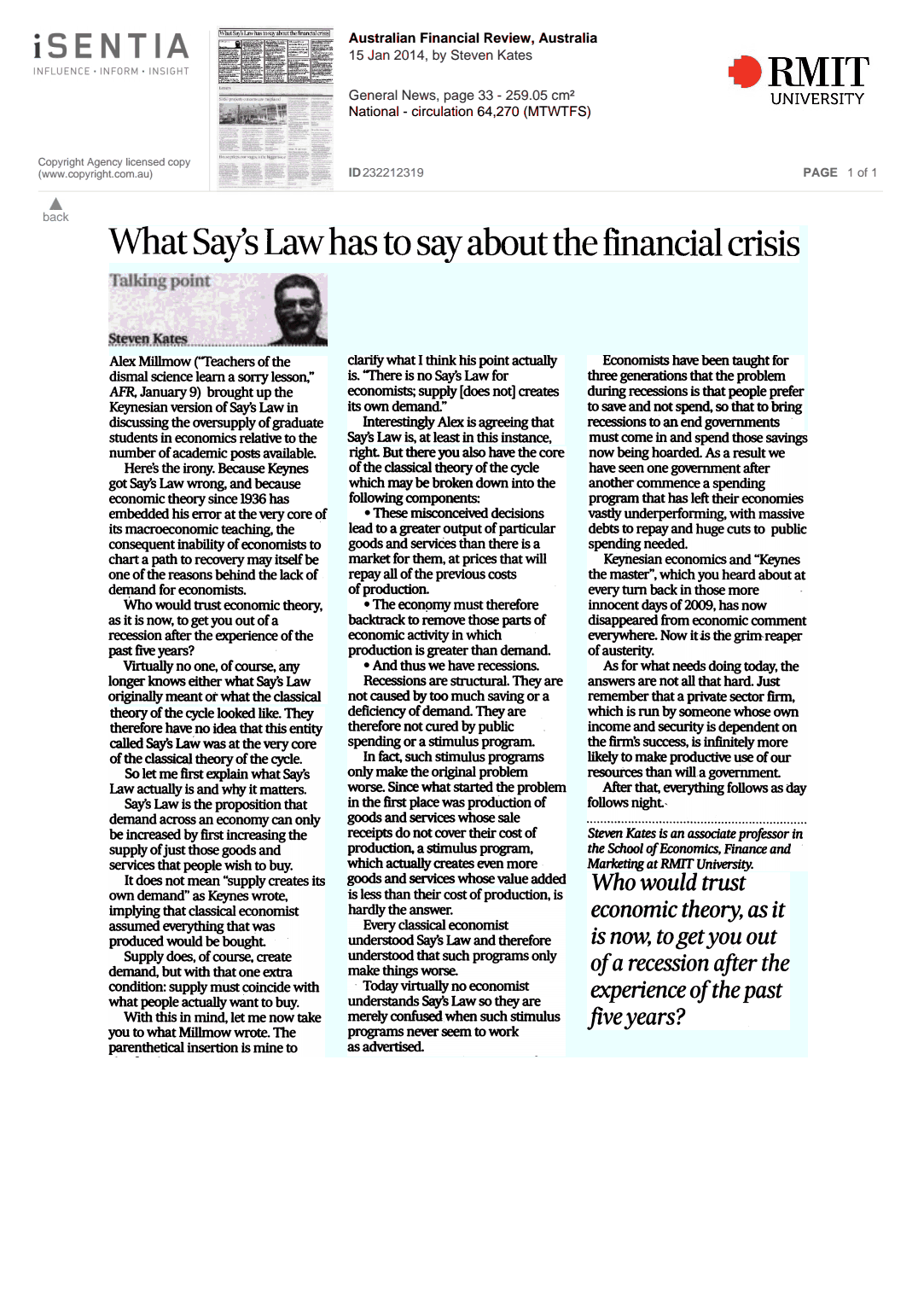
Anyway, I have an article in the Financial Review today which is titled, “What Say’s Law has to say about the financial crisis” which really is, what pre-Keynesian classical theory has to say about the crisis.

There you have the core of the classical theory of the cycle which may be broken down into the following components.

• Misconceived production decisions are what starts the rot.

• These misconceived decisions lead to a greater output of particular goods and services than there is a market for them at prices that will repay all of the previous costs of production.

• The economy must therefore backtrack to remove those parts of economic activity in which production is greater than demand.

• And thus we have recessions.

Recessions are thus structural. Instead our textbooks teach Y=C+I+G and explain recessions as a result of too much saving and too little demand, the fallacious notions that Say’s Law was specifically designed to expose.

Macroeconomic theory is not just nonsense but dangerous nonsense. Using it to manage an economy will leave wreckage in its wake as it has consistently done everywhere and every time it has been used to solve some economic problem.

Economies are built up by genuinely value adding activities which most government forms of spending most definitely are not. That doesn’t say governments shouldn’t do them. It merely says they should not deceive themselves into believing that public spending is the road to rapid rates of non-inflationary growth. Public spending draws down on our productivity rather than building it up. If the last five years have taught us anything, hopefully at least it has taught us that.

The enduring legacy of Keynes

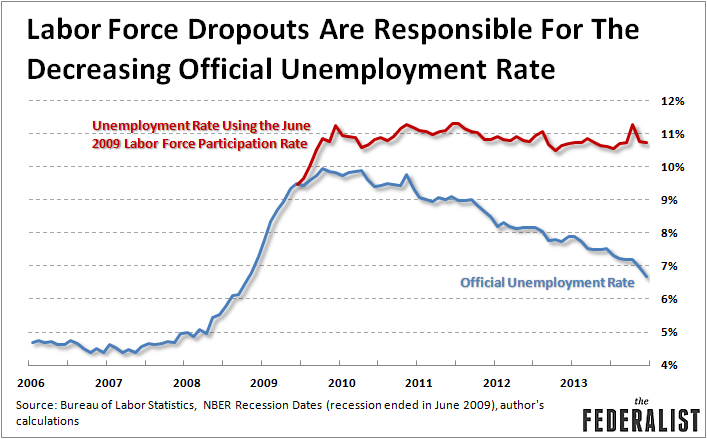
us unemployment jan 2014

After a while the dismal state of the world’s economies becomes merely background. We forget the better times and accustom ourselves to how things now are.

I am, however, in the process of putting together the second edition of my Free Market Economics and have just been through the Keynes versus the classics section. And let me tell you, there has been a lot to add based on our experiences over the past five years but there is nothing that needs to be revised. And the most interesting part that needs no revision is the way that macro continues to be taught which is Keynesian from end to end. How anyone can still think that a public stimulus has anything to offer in bringing recessions to an end after what we have gone through is beyond me. But they do, and Y=C+I+G remains in every text and is taught as the best explanation economists have for how economies work and what needs to be done when an economy is in recession.

Anyway, the data are from the US which is the epicentre of economic policy death. From an article on the last six years of the American Labour Market and picked up at Powerline. It’s a measure I often used to do myself since the labour market data only include as unemployment people who are actively looking for work. After a while you just give up so the unemployment rate falls even while the labour market remains stagnant. That’s what the picture all too clearly shows about the US.

There is more to it than just the deadly effects of the stimulus but most of it starts from there. It’s almost as if the US had never heard about free enterprise and the private sector the way they are going about things.

Meanwhile, at Drudge the main headline highlights a new record of sorts:

92 MILLION AMERICANS NOT IN LABOR FORCE

And those subheadings beneath add to the picture:

Record Number of Women Not In Labor Force…

Growth slumps…

Slowest in three years…

1,500 people camp out for chance to apply for job…

‘For Every One Job Added, Nearly 5 People Left the Workforce’

MSNBC: ‘Awful,’ ‘Very bad,’ ‘Ugly’…

If you are interested in finding out about Say’s Law and the classical theory of the cycle, or what a classical economist would do when an economy is in recession, so far as I know there’s only one place where you could find any of that out. I may, of course, be wrong but what I write is in accord with the way economists looked at things from 1776-1936 and that includes a very large number of very cluey people. If there really is such a thing as evidence-based policy as opposed to ideologically-based policy, you could do worse than to see what the book has to say.

Me at Powerline

For me it was a moment to treasure to find myself quoted by Scott Johnson at Powerline. I, of course, told everyone I know and only later realised that no one else but me amongst the people I know have even heard of Powerline never mind read it (this is Australia, after all). But for me, the four contributors are the four bloggers closest to my own way of thinking about things (although to them you’d have to add Mark Steyn, Glenn Reynolds (the Instapundit) and although she’s not a blogger, Ann Coulter). So a special moment for me was one that could not really be shared. Such is life. But a special moment it most certainly was.

The title was, “HITLER GETS TRAPPED IN SEA ICE”. This was the introductory text:

At Catallaxy Files Professor Steven Kates et al. have been following the Ship of Climate Fools with a gimlet eye as a local (Australian) story — in “The rest of Chris Turney’s life mapped out,” for example. Most recently, in “The spirit of Turney,” Professor Kates draws attention to Andrew Bolt’s Herald Sun Post “Something’s cracking, and it’s not the ice around the warmists’ ship” and to the video below

And this was the text of the story:

At Catallaxy Files Professor Steven Kates et al. have been following the Ship of Climate Fools with a gimlet eye as a local (Australian) story — in “The rest of Chris Turney’s life mapped out,” for example. Most recently, in “The spirit of Turney,” Professor Kates draws attention to Andrew Bolt’s Herald Sun Post “Something’s cracking, and it’s not the ice around the warmists’ ship” and to the video below contributing to the Hitler Discovers genre (rated R for language).

And then there was the video, the best version of these satires I have seen. I have watched a lot of these over the years but this was the best ever. Not only did it get the politics right but the words are perfectly coordinated to the visuals. No other has made me laugh out loud and this one continually does. I only wish I knew who did do it since it is attributed to Tony Ice. My suspicion is that whoever did it is an Australian since he gets the nuances right, although I must say he spells not just “hocky” wrong but also “Abbot” which may mean he’s not an Australian. But citizenship he should be immediately granted if not here already. So once more into the breach dear friends:

Hayek on Keynes’s ignorance of economics

I’d never seen this before and was apparently first published on 29 September 2012. The notes on the Youtube clip read:

Friedrich Hayek explains to Leo Rosten that while brilliant Keynes had a parochial understanding of economics.

“Parochial” is quite a word when the clip actually speaks of Keynes’s ignorance. It is well known that Keynes had a third rate understanding of economics but was a genius at polemical writing. After Marx, Keynes is the most destructive economist who has ever lived.

It is also interesting that Hayek sees understanding the history of economics as an important part in the education of an economist. Keynes’s ignorance of the economics of the past was seen as a great failing, a failing which now besets the whole of the profession. I wonder how much any modern economist would know about the monetary economists Hayek lists assuming they even know their names.

[My thanks to Harry for sending this on.]