Spadina Avenue

You can always tell if someone is really from Toronto by asking them to pronounce “Spadina”. I won’t give away the secret but you will only know how if you actually know how. I have had these pictures sent from another friend from those long lost days, David Klug, who I have known almost as long as David Kwinter who sent me the photos of Toronto in the 1910s. But these photos of Spadina Avenue take me right back to the very neighbourhood I grew up in.

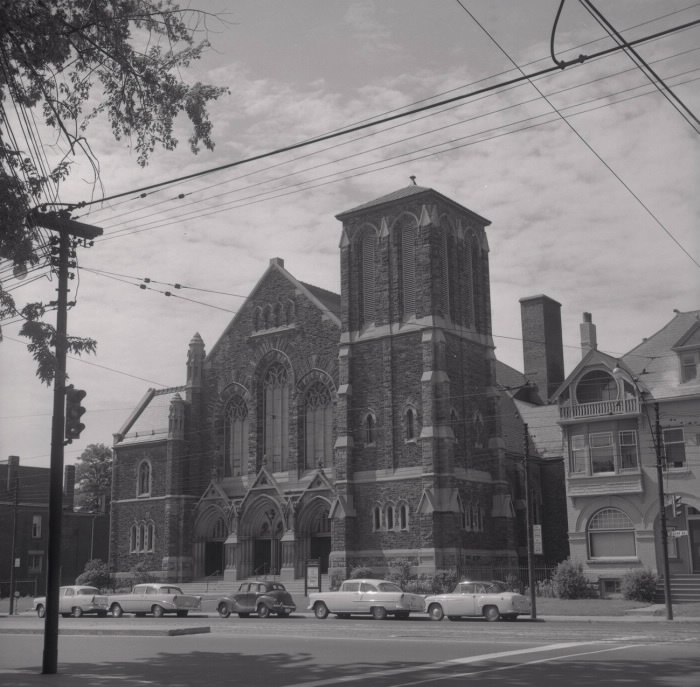
The first of these is of Knox Church, where I was sent to nursery school ages 4-5. I genuinely do attribute my Presbyterian take on life to those days. I am a firm believer in give me the child for the first seven years of his life and I will give you the man. They only had me for two of those seven, but they did make a difference. The picture is from 1956 when I might have been right there when the picture was taken.

knox church

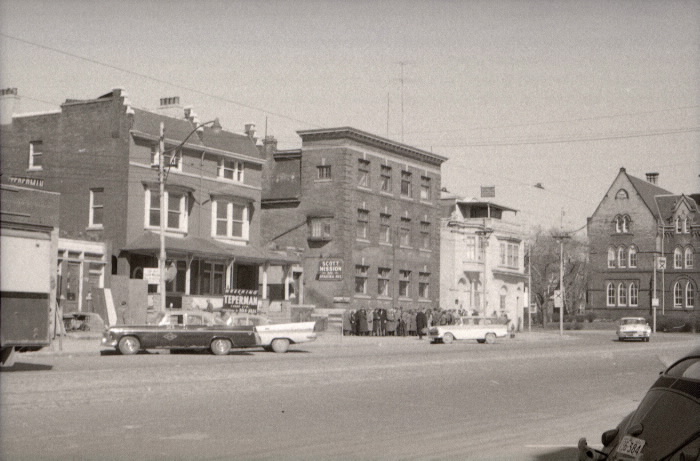
There is then the Scott Mission around 1960. If you continue left around the corner you will come to my first grade school, Landsdown Public (which was also my parents’ school), so I knew this place very well. And if you look really really close, you will see the queue of people who used to line up outside the building each day, since it was a charity whose mission was to feed the hungry. Always and only men, but always a line that stretched more than the length of the building. A very working class area, but not something I have ever really thought about since it was also home. It’s a shame they don’t have pictures of the old Borden’s Dairy building which was also on Spadina, and just across the back fence from the house I lived in. Today where I lived would be seen as undesirable – a manufacturing plant just outside your back door – but I thought of it as wonderful, a real adventure playground.

toronto scott mission

The last picture is College and Spadina in 1870. I guess there had to be a time when there was nothing there, but it is astonishing to realise how relatively recent that time was. My grandfather used to tell me how he had run into the Two Boys from College Street (“the tzvei boy-es fin College Street” – accent supplied upon request) and what they had been up to. Really, only now as I write, do I appreciate how inventive he must have been since undoubtedly every one of those stories was a story he made up himself to tell me.

toronto college and spadina

Life is short. These pictures are an entire lifetime away from me now, but I remember them like yesterday, better than yesterday.

Ephry Merkur

ephry merker

This has no significance for anyone, but Ephry Merker was the councillor in the only year I ever went to camp that I really enjoyed. The story is from Macleans and deals with a major discovery of Group of Seven works of art that had been away from the public eye for more than half a century and in the home of his parents. The caption on the picture reads:

Ephry Merkur, the son of major Group of Seven collectors Max and Reta Mekur, in his house in Toronto.

It is only the shock of seeing his name after more than half a century that leads me to write this post. I am very happy to see that he is doing so well.

FURTHER DEVELOPMENTS: The ways of the net being as they are, I have received a note from Ephry Merker himself. I therefore wrote back:

Dear Ephry

The name I have never forgotten, and the reason I remember you I have also never forgotten. It was the only year I really enjoyed as a camper, although the other councillor I also recall with a great deal of affection was Mike Saxe. If his name comes up some day, I will not be as sure that it would be the same Mike Saxe, but there must be only one person in Toronto, in Canada, with yours.

I won’t go into too much detail, partly because there isn’t a lot of detail left. But for what it’s worth, and when I think back on it now, it comes to mind that what I truly recall is that you were the only person I ever dealt with, in all the years of camping, that brought a philosophical dimension to it. I wasn’t much of a swimmer, hiker, sailer, canoer (OK canoeist) or the rest, but I did like thinking about things. I know why I associate this with you, but even that I won’t get into. But had they sent me to Camp Plato instead of Playtime [the actual name of the camp I went to] I think it might have suited me a lot better. So you were, in a sense, the Maimonides of my camping experience. In fact, the book you had with you at the time, and which I then came back home and made my parents buy for me in spite of its ridiculous price, I have with me still. It remains one of the most important books of my life, which I was telling my children about not all that long ago. And if you are wondering about any of this, I can only tell you that I will say not another thing about any of it. These are my memories, and I do not intend to have them disturbed by someone else’s version of events.

In keeping with all of the above, I am now a university professor in Australia, and have been here for forty years. I won’t blame you for leading me in this direction, but you were one of the first to help me see the elements of my own nature and character. So there is a lot of gratitude in my writing to you, and unlike most of my camping experience, all of my memories of you are warm. And they are genuine memories, as long ago as this seems to have been.

It was very exciting to see these Group of Seven paintings found like this. Your parents must have had such a good eye for these things to have known then what the rest of us knew only later. I also loved the picture of your home which looks fantastic. You must have been as good a lawyer as you were a councillor.

Thank you for putting your reply up on my blog. If you are ever in Melbourne, you are more than welcome. I can only hope that my name doesn’t ring a bell, and if it does, please don’t mention a thing.

With kindest best wishes.

In thinking this over, “Mike Saxe” was no doubt Mike Sachs who I also remember with great fondness. He was the only councillor who was truly different. What I remember about him best was leading us – Cabin 4 – while we were camping on the shores of Lake Watchimicallit, on an Indian raiding party on Cabin 3, who were camping at a different site about a mile up the lake. This was at night and we had to travel more than a mile through the woods. The moment we arrived at the edge of their campsite must have reprised a primordial moment in the history of the human race. They were going about doing what they did around their camp fire, with not a care in the world, while we surrounded them in the dark of the forest. For us, it was just fun – and they would later attack us in a similar way to even things up – also through motives I expect are primordial in origin – but fun though it was, its darker side has never left me.

Greece opts for spending 120% of domestic output

One more experiment in Keynesian economics. The politics of living within your means are what they are. The Greeks have reason to believe that they can blackmail the rest of the EU into funding their debts. But literally in this case, where will the money come from?

Syriza’s demands for a debt restructuring have raised the prospect of a stand-off between Athens and other European leaders that might lead to “Grexit” although financial markets were treating that as a marginal risk on Monday.

The potentially disastrous consequences of such a move for Greece and Europe were likely to force policymakers to find an agreement, analysts said.

So they’re beggars? So what do they care? You want to save your precious Euro, this is what you got to do? However as Daniel Hannan notes:

It would, indeed, be very difficult to make an economic case for euro membership.

The past six years have seen a greater depression in Greece than that of 1929 to 1935. Output is down by an almost unbelievable 25 per cent. A quarter of all Greeks – half of all youngsters – are unemployed, and tens of thousands more have emigrated in search of jobs.

Their currency is overvalued and market disciplines are almost invisible. If they leave the Euro, there are actually things they might be able to do.

Anyone who invokes aggregate demand as part of an economic argument is wrong

A market economy in recession, left more or less to itself to adjust to circumstances, will find its way back to growth and full employment within a year, a year and a half at the outside. That same economy, under the administration of managers unsympathetic to the market, may travel in the desert for a very long time before coming good, assuming it comes good. I would like to come back to a post put up yesterday, The Next Phase of Economic Stagnation, which contains the transcript of a debate between a defender of Quantitative Easing in Europe and someone who thinks it is a very bad idea. But what I particularly wanted to comment on was this, stated in defence of QE:

If you’re in a situation where aggregate demand is very weak and that’s a position I think the eurozone is in and you are in danger of slipping into the sort of deflation which I at least and some other judges think is pretty damaging, then this is a mechanism for fending that danger off. And I have to say, I don’t think that there will be much impact from quantitative easing within the Eurozone, apart from through the exchange rate. In driving the exchange rate lower that’s going to help to boost eurozone net exports. It will boost aggregate demand. It will tend to keep up the price level. On balance I think those are pretty good things to be aiming at.

Anyone who invokes aggregate demand as part of an economic argument is wrong. Once universally understood, now universally disregarded, there is no independent force in an economy called aggregate demand. You can shift who gets to do the spending – and in every case where aggregate demand is invoked it is the government that gets to do the extra spending – but you cannot increase the rate of growth or employment. In fact, over time, it weakens an economy’s structure so profoundly that you are frequently worse off than when you began.

Recessions are inevitable, and there are actions a government can take, but increased public spending and higher levels of public debt are not amongst them. The sad part is that economists have so comprehensively invested in this nonsense theory, governments find it perfectly in tune with their basest political desires, and the public cannot understand why it shouldn’t work and like to see more spent on them by government. So here we are, a perfectly constructed downwards spiral based on the latest most up-to-date theories, in which no one can ever quite see the way out again.

The next phase of economic stagnation

The disastrous consequences of Keynesian thinking never seems to subside, the next catastrophe being the introduction of Quantitative Easing by the ECB. The following is an exchange of views under the heading, Eurozone prepares for QE. Bootle is your Keynesian, and when it comes down to it, can only think in terms of aggregate demand. The Europeans, like the Americans and the Japanese, and I guess pretty well everyone else, generally cannot think outside of macro aggregates. They seem to have no understanding of how a market economy slowly, but ever-so surely, knits itself back together, if the government would only stop messing with the parameters under which businesses must operate. The following is a bit long-winded, but since we are heading into the next phase of economic stagnation, it is worth understanding the kind of macro thinking behind it.

The ECB is preparing to announce a huge stimulus programme. We hear diverging views from the chief economist at one of Germany’s largest banks Commerzbank Joerg Kraemer and leading British economist Roger Bootle.

KRAEMER: I think that deflation is one of the most abused terms in economic policy discussions. Because there is no real threat from deflation. The Bank for International Settlement made it clear over a study of 150 years that a mild decline in prices is no problem for real GDP growth, and especially in the eurozone. The only reason why we have a negative inflation rate is the decline in oil price, but the decline in oil price is good for the economy. And if you strip out oil and look at the underlying core inflation at 0.8% is also low, but this is primarily caused by the fact that in some peripheral countries such as Spain, Portugal and Ireland, firms have cut their unit labour costs, they regained their price competitiveness and now they pass on a part of the cost reduction onto their customers in the form of slightly falling consumer prices, but again this is GOOD deflation because it goes hand-in-hand with an increase in profit margins and this is nothing to worry about, but nevertheless the negative inflation rate is used by the doves on the ECB council as an argument to go for QE which – in the end – will not change the picture of low inflation and low growth, but will primarily help the finance ministers of the highly indebted countries and their banks, which had bought a lot of government bonds, for example Spanish banks have bought roughly one-third of the outstanding volumes of Spanish government bonds.

BOOTLE: I think this is a dramatic misjudgment and it’s one that people coming from Germany are rather inclined to make with German history behind them because of course, the great fear in Germany – understandably – is inflation. Other countries have suffered significantly from deflation. As to the idea that the BIS concluded that over the last 150 years, deflation has been a good thing, well I wonder where they’ve been all that time. I mean, it all depends quite frankly on what the circumstances are.

Now, when you’ve got an economy that isn’t that heavily indebted, that isn’t super-sensitive to every little jot and tittle of the latest CPI figures, that isn’t very financially sophisticated, then yes, probably falling prices no one notices frankly and even know what’s going on. But when you move to the sort of economy we’ve got in today, where you have very heavy levels of debt, both government and private sector, we’ve got the markets all agog to see what’s happening to the CPI, I think is potentially quite dangerous to have a situation where prices are falling and are likely to fall year after year. Now we are not quite there yet really because at the moment all I think that’s happened in Europe is really the effect of a one-off drop in oil prices, which isn’t really if you like genuine deflation. But the danger is we might move to that.

KRAEMER: The Bank for International Settlements also showed that the slight decline in the Japanese consumer price index over the past 14 years did not change the picture that per capita GDP in Japan has grown roughly by the same amount than per capita GDP in the U.S. As long as consumer prices decline only mildly, this is not a big problem. We had this, for example, in the second half of the 19th century, during the gold standard, we had several periods of mild deflation, which had no negative impact on real GDP. I think the point is when you try to fight, when you try to avoid the inevitable, low inflation, low growth environment, after the burst of a debt bubble, then you only fuel asset price inflation.

BOOTLE: Let me be clear. I am not the greatest fan of quantitative easing in the sense that I don’t think it’s going to cure the European malaise, much of which has real rather than monetary foundations. It’s not the answer to a maiden’s prayers. It’s not a magic wand and moreover, the evidence of its effectiveness in other countries is not settled. In Japan it didn’t do very much good for a long time. In the United States and the UK it appears to have done some good quite how much we don’t know. The point is there is not much else in the locker. There is not much else you can do. If you’re in a situation where aggregate demand is very weak and that’s a position I think the eurozone is in and you are in danger of slipping into the sort of deflation which I at least and some other judges think is pretty damaging, then this is a mechanism for fending that danger off. And I have to say, I don’t think that there will be much impact from quantitative easing within the Eurozone, apart from through the exchange rate. In driving the exchange rate lower that’s going to help to boost eurozone net exports. It will boost aggregate demand. It will tend to keep up the price level. On balance I think those are pretty good things to be aiming at.

No one ever mentions markets, profits or entrepreneurs in any discussion of the economy. Economic theory has become junk science.

If you don’t understand the problem you cannot find the cure

Every so often, you run across someone who puts a new perspective on how badly the American economy is travelling. The caps to spending that came with the sequester have slowed the rot, but the anvil that has fallen on productive activity has not been lifted. The title here is Don’t Believe the Hype—We’re Not Even Close to Full Employment. Where he uses the word “hype”, I might have chosen “lies”, but at least he can explain plainly how far below potential the US economy is performing.

Before the recession, the Congressional Budget Office (CBO) projected we would have 5 million more jobs at the end of 2014 than we actually do. It also projected that the GDP would be more than 11 percent higher in 2014 than it is now. This translates into a difference in annual output of roughly $2 trillion or more than $6,000 per person. They predicted that wage and salary income would be roughly 20 percent higher than it is today. Many economists had similar projections.

Measured against where these people expected the economy to be at this point seven years ago, the economy is indeed awful. Millions of people who should have jobs don’t, and those who do have jobs are working for much lower wages than would be the case in a healthy economy.

Alas, having noted that the economy is barely alive, and that the fact of growth is hardly remarkable in a market economy, he lays the problem on the absence of anything on the demand side to drive the economy upwards. You do have to despair at someone who sees how bleak things are but attributes it to a lack of demand. Demand is subdued because value-adding supply is subdued. Value-adding supply is subdued because there is no direction in which the American economy might move that is not blocked by government regulation and waste. It is a mess all round, but as long as even those who are even willing to notice are unable to see what must be done, how does it end? As bleak as the economy is, reading this kind of thing makes me think there is a lot worse to come.

1500

It’s actually 1515 but who’s counting? This began mostly just for me to say things away from anyone else so that I at least would have a record. And as a way to discuss things with my son (Hi, Joshi). It’s now a bit beyond that, and there are others who I am pleased to see wander by. But every so often, I am linked to by someone at the heavy-duty end of right-side blogging and the number of hits explodes. It is astonishing on those days, but even then I am reminded of two things. How little influence most of us have, but more importantly, how little influence any of us have. We are, almost entirely, just talking amongst ourselves. But that is why each of us do it. We are so clearly right about most of the issues that matter, that you need the company of others like ourselves just to keep from going mad.

But the other side of this blog no longer being just between myself and a few friends is that there are some things I regrettably just can no longer say. The debate over free speech misses the most important issue, which is such a devastating problem that it cannot even be stated. One day I might write about it. I will now only note that there are more ways than putting someone in a gulag to discipline what others write and say. And I don’t mean threatening to chop their heads off, which is hardly a threat to any of us. You really have to be Charlie Hebdo to get into that league. But there are other things for which the costs are so massive relative to any possible good one might do, that it just isn’t done.

There is an interesting argument that I think belongs to Leo Strauss, in which he says many of the great philosophers cannot be read straight, but must be seen to have written in a kind of secret messaging code, because to say exactly what they meant would have landed them in serious trouble. I am not amongst the great philosophers, but I know just the feeling. There are some things I don’t say, and others that are said in a way that is intended to diminish the dangers such thoughts must cause. No one is infinitely brave. We all wish to see another day. But we know the kind of world we are in and hope to shape things for the better. And so we write, but on some things are not entirely straightforward. But this much I can say. Everything I have written represents what I personally believe.

And with that, I will leave off.

Maybe this austerity stuff works after all

There is only so long you can avoid reality, although Keynesians can go on for a very very long time. This is about the latest observations on the UK economy by Christine Lagarde, the head of the IMF.

The head of the world’s economic watchdog delivered a stunning endorsement of the coalition’s record last night – saying Britain was setting an example to the rest of the world.

Christine Lagarde, director of the International Monetary Fund, said in much of the world growth was ‘too low, too fragile’.

But completing an extraordinary volte face on the Government’s austerity measures – which as recently as 2013 were being attacked by the IMP as ‘playing with fire’ – she called on other countries to look to the UK’s example.

Look all you like, but how would you explain it? Of course, with the modern textbook version of economic theory, this is all in the realm of impossible, just as they forecast in 2013. The story continues:

‘Certainly from a global perspective this is exactly the sort of result that we would like to see: more growth, less unemployment, a growth that is more inclusive, that is better shared, and a growth that is also sustainable and more balanced.’

Miss Lagarde’s endorsement will be greeted with delight by senior Conservatives and Liberal Democrats, who were angered by previous IMF criticism of their policies.

In 2013, the organisation warned that persevering with strict austerity policies risked denting Britain’s economic prospects.

Olivier Blanchard, chief economist at the IMF, said George Osborne was ‘playing with fire’ by pressing ahead with austerity, insisting: ‘In the face of weak demand it is really time to reconsider an adjustment to the fiscal consolidation plans.’

What would Blanchard know, anyway? Meanwhile, for the rest of the world’s economies, here is Ms Lagarde once again:

Strong headwinds from weak investment, substantial debt burdens and high unemployment are preventing a pickup in global economic growth despite a strengthening U.S. recovery and tumbling oil prices, International Monetary Fund Managing Director Christine Lagarde said.

A healthier U.S. and cheaper energy “won’t suffice to actually accelerate the growth or the potential for growth in the rest of the world,” the head of the emergency lender to nations said in a speech Thursday at the Council on Foreign Relations in Washington.

“If the global economy is weak, on its knees, it’s not going to help,” said Ms. Lagarde in remarks previewing the IMF’s latest forecasts for the global economy due out on Monday.

The eurozone, at risk of a third recession in six years, continues to struggle with the fallout from the 2008 financial crisis. Japan is also mired in low inflation, high debt and anemic growth. And output in many major emerging markets—economies that have provided most of the gas for global growth over the last decade—is slowing faster than expected.

However, there is the US, which has been suffering under sequestration and restrained public spending since 2013:

Nonetheless, the IMF is upgrading its forecast for economic output in the U.S., one of the few advanced economies bucking the weak global-growth trend. But the world’s biggest economy and a shot in the arm from cheaper gasoline aren’t cures for deep-seated weakness elsewhere, Ms. Lagarde said.

If you think in terms of aggregate demand, my only message to you is that you will never understand how an economy works. You certainly could not explain the relative success of the UK and US.

Keynes and Keynesian Economics in Light of the Financial Crisis

The economic societies of the United States meet over the first few days of the year, with the meeting this year in Boston. This is the full conference program which is gigantic. My interest is what is being said about the sad state of economic theory and its inability to provide guidance on how to find our way out of the present low state of our economies. This was the part of the conference I was most interested in myself:

Keynes and Keynesian Economics in Light of the Financial Crisis

So in its own way, you might say that these issues were on the agenda. However, not only was this the sole manifestation across the hundreds of papers given during the conference, but this was also not in any way part of the mainstream program, only tucked away as part of the program devoted to the history of economic thought. Clearly, none of this is of any genuine interest to virtually the entire profession. Nevertheless, all credit to Robert Dimand for putting the session together, and for treating this as the serious contemporary issue it is. These were the papers found in this session.

Keynes and Financial Crises
ROBERT DIMAND (Brock University)

The global economic and financial crisis that began in 2007 has renewed interest in Keynes’s analysis of whether the economic system is self-adjusting and of his proposals for ending depression. This analysis is complemented by Keynes’s more specific accounts of financial crisis, notably in his incisive “The Consequences to the Banks of the Collapse in Money Values” (in his Essays in Persuasion, 1931) and his Harris Foundation Lectures, a body of work that is much less well-known.

Keynes, Wages and Employment in Light of the Great Depression
HARALD HAGEMANN (Universität Hohenheim)

The wage-employment relationship is one of the central and most controversial issues in the General Theory. . . . and etc for another 200 or so words.

James Meade and Keynesian Economics
SUE HOWSON (University of Toronto)

James Meade (1907-1995), although Oxford-educated, was one of the very first Keynesians, a member of the Cambridge “circus” which met to analyze and criticize Keynes’s just published Treatise on Money in the early months of 1931. Not only did he use Keynesian ideas in his writings throughout his long career; he was a major player in the implementation of Keynesian policies in Britain during and immediately after World War II. My paper will discuss his encounters with Keynes and his use and development of Keynesian economics in his own academic and policy work.

Not that you should think that Keynesian economics was mentioned nowhere else. It showed up one more time, under “Heterodox Macroeconomics”, a session put on by the Union for Radical Political Economics. But I do love his first line, which is something the rest of the profession would prefer to forget. I’ve put it in bold just because, and left the rest in just to see how tedious this stuff can be.

Keynes is Dead — Long Live Marx
ISMAEL HOSSEIN-ZADEH

Many liberal/progressive economists envisioned a new dawn of Keynesianism in the 2008 financial meltdown. More than five years later, it is clear that the much-hoped-for Keynesian prescriptions are completely ignored. Why? Keynesian economists’ answer: “neoliberal ideology,” which they trace back to President Reagan. Using a Marxian method of inquiry, this study argues, by contrast, that the rise/dominance of neoliberalism has much deeper roots than pure ideology, that the transition from Keynesian to neoliberal economics started long before Reagan was elected President and that the Keynesian reliance on the ability of the government to re-regulate and revive the economy through policies of demand management rests on an optimistic perception that the state can control capitalism. Contrary to such hopeful perceptions, public policies are more than simply administrative or technical matters of choice. More importantly, they are class policies—hence, continuation/escalation of neoliberal policies under the Obama administration, and frustration of Keynesian/liberal economists. The study further argues that the Marxian theory of unemployment, based on his theory of the reserve army of labor, provides a much robust explanation of the protracted high levels of unemployment than the Keynesian view, which attributes the plague of unemployment to the “misguided policies of neoliberalism.” Likewise, the Marxian theory of subsistence or near-poverty wages provides a more cogent account of how or why such poverty levels of wages, as well as a generalized predominance of misery, can go hand-in-hand with high levels of profits and concentrated wealth than the Keynesian perceptions, which view high levels of employment and wages as necessary conditions for an expansionary economic cycle.

The largest single problem with economic theory today is that economists do not even know they have a problem. But the second most important problem is that what ought to have been the most important part of the entire program was relegated to students of the history of economic thought, which is the one area of economic theory economists are trying to rid themselves of. It’s as if these are issues so completely settled that no one any longer has to waste their time thinking about any of it at all.

AND LET ME JUST ADD THIS: From the Wall Street Journal, The Depression That Was Fixed by Doing Nothing. Before Keynes, there was no such thing as a Keynesian stimulus, but recessions got fixed anyway:

Beginning in January 1920, something much worse than a recession blighted the world. The U.S. suffered the steepest plunge in wholesale prices in its history (not even eclipsed by the Great Depression), as well as a 31.6% drop in industrial production and a 46.6% fall in the Dow Jones Industrial Average. Unemployment spiked, and corporate profits plunged.

What to do? “Nothing” was the substantive response of the successive administrations of Woodrow Wilson and Warren G. Harding. Well, not quite nothing. Rather, they did what few 21st-century policy makers would have dared: They balanced the federal budget and—via the still wet-behind-the-ears Federal Reserve—raised interest rates rather than lowering them. Curiously, the depression ran its course. Eighteen months elapsed from business-cycle peak to business-cycle trough—following which the 1920s roared.

That was what they did, but with the low state of economic knowledge today, there is little likelihood anyone will understand why it worked.

McCracken, Malthus and Say’s Law

It was all the way back in October that I received an email from Thomas Colignatus, a blogger in The Netherlands. He had read my article on the origins of the General Theory and had written a post on it titled, Thomas Robert Malthus visiting Maastricht. This is how he begins his post in relation to what I had written:

Malthus set John Maynard Keynes on the path of the theory of effective demand. Keynes in his Essays in Biography:

“If only Malthus, instead of Ricardo, had been the parent stem from which nineteenth-century economics proceeded, what a much wiser and richer place the world would be to-day!” (Keynes 1961 [1933], p. 120)

Relevant is also this archive of the History of Economics Review, and in particular Steven Kates on JMK and TRM and then also on JMK and McCracken, or see the longer discussion by Kates in HER 48, 2008.

“Thus, at the very time that he has commenced writing the book that will become the General Theory, the single most influential book on the business cycle written during the past century, Keynes states in no uncertain terms that the most fruitful approach to dealing with the economic issues raised by the cycle ought to be set within an analytical framework that descends from Malthus.” (Kates HER 48, 2008)

Note that David Ricardo isn’t kicked out of the window. His method of mathematical modeling is retained, of course. His arguments are duly weighted too. The only thing is that Malthus’s argument on the lack of demand finds proper recognition. What was counter-intuitive to Ricardo is rephrased so that it becomes the proper intuition that we enjoy today. Merely putting money in the bank doesn’t help: it are the real investments that determine income.

“The Keynesian Revolution, which swept the economics world in a matter of less than a decade, had its origins in Keynes’s reading of Malthus’s letters to Ricardo in late 1932. It was from these letters that Keynes discovered the issue of demand deficiency. Reading Malthus’s letters in the midst of the Great Depression infused within him the be­lief that demand deficiency was the cause of recession and mass unem­ployment. The essay on Malthus, found in Keynes’s Essays in Biography and published in February 1933, makes plain the extent to which he had absorbed Malthus’s economic views while reading Malthus’s writings. Malthus had been the leading advocate of demand deficiency in the nineteenth century. It was this message that Keynes’s carried into the twentieth.” (Kates 2010, History of Economic Ideas, xviii/2010/3)

I can only say that it has been a long semester, and while I ought to write to people immediately, there was a lot to write about. Even with this reply which I attach below, there is much more I could have written and should have written. But this gets to the issues at hand, or at least some of them.

Dear Thomas

I apologise for this long time in writing. And the delay was not because I was in any way hostile to what you had written. I actually found myself very pleased to see how accurately pretty well all of what you wrote was. If I were to say anything at all about the text, it is that while I do not think of Keynes as a plagiarist in the normal sense, I am certain he knew the sources of what he wrote but preferred to be thought original than have to share the glory with anyone else. There is no doubt in my mind that Keynes found knocking over Say’s Law the perfect vehicle for him to get governments to spend money in the midst of recession. He came upon Malthus in later 1932 because he was updating his Essay on Malthus, he borrowed Malthus’s letters to Ricardo from his closest friend, Piero Sraffa, and discovered the entire literature on demand deficiency. He is then swept along by his discovery and by one of the stranger flukes of history, is sent a copy of McCracken’s book that does two things. It completes every thought he had had about demand deficiency and Say’s Law, even giving him the phrase “supply creates its own demand”. And it disturbs him to find that someone else had seen exactly the same thing, either simultaneously, or more likely, even before he had, given how long it takes to get a book into publication. My memory on this is a bit suss by now, but I somehow recall that this was a book that was sent out to a few people McCracken thought would be interested, which is why Keynes takes the trouble to write to McCracken personally. It doesn’t matter much, but if it is not a personally sent copy, there is no reason for Keynes to have written to McCracken at all.

As for the phrase itself, I am not even sure that Keynes recognised that he had taken it from McCracken. In my view, he would never have used the phrase in the way he did if it had McCracken’s DNA all over it. Either he read it and noted the phrase since it so perfectly fit into the point he was trying to make and then forgot the source, or he merely thought that McCracken had himself taken it from the classical literature. But it is the one absolutely certain dye marker that connects Keynes to McCracken. I had always been convinced that McCracken had been a major influence on Keynes. He appears as an “undocumented” influence, in my Say’s Law and the Keynesian Revolution (Elgar 1998). It was only when Richard Kent picked this up years later – my thesis was written before internet searches were possible – that I was finally able to nail the connection. It is now absolutely undeniable, except that everyone in the Keynes industry continues to deny it.

And I do have to disagree with you where you write that “McCracken’s book did not contain other elements that Keynes was concerned about”. I read every pre-Keynesian book on the cycle as part of the research, which is why I read McCracken. But the moment I picked McCracken up, I knew that I was reading a preliminary version of The General Theory. It is wall-to-wall Keynesian pre-history. And the other interesting part about the General Theory is that all of the parts on Mill and Say’s Law and supply creates its own demand are not found in the three sets of galley proofs. This was inserted at the absolute last moment, either because he didn’t want anyone else to know what he was doing, or he felt he needed to strengthen the attack on established theory, or because it only occurred to him at the last minute. But he must have put this in almost at the very last minute either during Christmas 1935 or just after the New Year in 1936. I don’t think it was a last minute decision, myself, since it is so neatly done. But it was an issue he kept from every single person he had been dealing with, other than Sraffa, who knew exactly what Keynes was up to. And if you cross over to Cambridge, you can see Sraffa’s “Notes on the General Theory” which are sitting in the archive but have never been published. I have tried to publish them myself, but they will never be allowed out, you may be sure of that, or at least not for some time yet.

Anyway, I was very grateful that HEI published my article, so it remains in the literature, studiously ignored by everyone. To me, the combination of Fred Taylor’s general publication of the phrase “Say’s Law” in 1921, and McCracken’s first use of the phrase “supply creates its own demand” in 1933, is a devastating revelation, that if it became the issue it ought to be, would absolutely require a wholesale revision of the mythological version of the trek from the Treatise to the General Theory. I hear these nonsensical stories about the major role of the Cambridge Circus and the rest of it, but it is all horsefeathers to me. But you either have to take the evidence as it is, and recognise that Keynes out and out misled everyone about how he came to write the book, or you have to shrug your shoulders and say that he wrote his book, without telling everyone what he was actually doing at the time.

However, if you actually understand that he was reading McCracken and probably Taylor, there is a very different story to tell about the genealogy, and about the actual effect of the General Theory on the nature of economics, since he was absolutely wrong about the economics of his classical forebears. This is an instance, in my view, where understanding the history makes a very large difference to understanding the present.

UPDATE: Mantaray asks:

“Supply creates its own demand”. OK, so we all know this is a strawman. Is there a correct one-line definition?

I know this is already a long post, but who else is around at the moment, so I have taken this opportunity to slip all this in. Here is the best one-line definition in the whole of the economics literature. It is from a private letter written by David Ricardo to Malthus on 9 October 1820 (source: Ricardo 1951-73: VIII. 277), just after Malthus had touched off the General Glut debate with the publication of his Principles of Political Economy earlier that year.

“Men err in their productions; there is no deficiency of demand”.

There are three parts I like about it, all devastating for Keynesians. First, although Keynes specifically states that Ricardo and those who followed did not recognise the very fact of recessions, it is absolutely clear that Ricardo and Malthus are discussing the nature of economic recession and their cause. Second, Ricardo provides in short form, a summary of the classical theory of recession. The economy becomes misdirected for some reason. Recessions are structural, due to errors on the production side. Third, we have the true meaning of Say’s Law, stated as clearly as one could wish: whatever may be the cause of the downturn, “there is no deficiency of demand”. Every economist from Ricardo’s time till the publication of The General Theory in 1936 believed exactly that. Today, it’s down to me and about a couple of dozen others. Modern macroeconomic theory is a well recognised classical economic fallacy.