It was the stimulus that did us in not the GFC

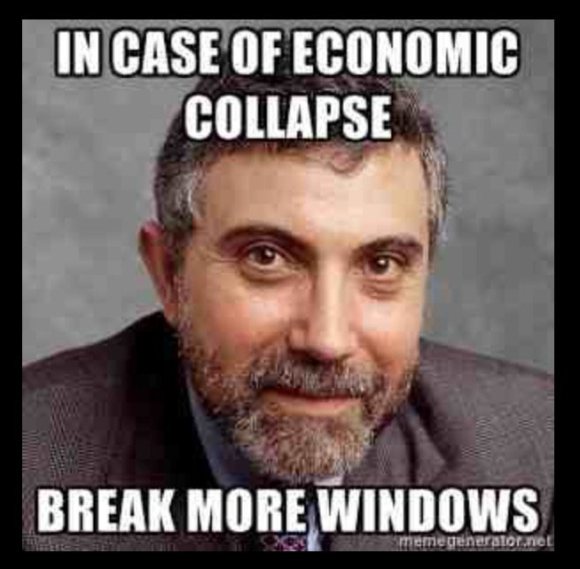
krugman Break-More-Windoes-copy

It’s only the headline writer, but it is the most common of all economic illiteracies. From The Australian: Growth rates slashed as GFC fallout lasts decade.

Normal economic growth rates won’t resume until at least 2017, the Reserve Bank declared yesterday as it slashed its growth forecast for next year, leaving Australia with weak growth for almos­t the entire decade since the global financial crisis began.

The Reserve Bank’s vision, outlined in its quarterly review of the economy released yesterday, now stretches for another 18 months, with a 0.5 percentage point downgrade in growth estim­ates for next year, to 2.5 per cent, casting a shadow over budget forecasts.

Let me couple this from Drudge today:

Record 93,770,000 Americans Not in Labor Force…
Participation Rate 38-Year Low…
Record 56,209,000 Women Not Working…

The only relationship between the GFC and the dismal economic outcomes today is that the GFC led one government after another to put in place a Keynesian stimulus. As I said at the time, we will be lucky to get out of the problems created within a decade. If you would like more of the same, Policy in the Pub on Wednesday the 19th.

Productive and unproductive labour

This is an online conversation I had with the editor at the Liberty Fund that helped me clarify even in my own mind some of the concepts that had remained free floating and had not been nailed down.

Q: Steve, let me ask you something. I’ve never been clear on the classical distinction between productive and unproductive labor. If a menial servant (in a free market) doesn’t add value to something, why is he paid? Did Menger, Bohm-Bawerk, or Mises reject the Smithian distinction? Maybe this would be good to address in a comment. . . . Why doesn’t the menial servant add value?

A: What do you think of this which is the point I think Smith and Mill were trying to make?

“It might be argued that economists are productive. But the reality is that if we heard that entrepreneurially-driven construction activity with no government subsidy was to double over the next ten years we would all agree that the economy would be bigger and stronger at the end of that time, more jobs would be created and real incomes would rise.

“But suppose, instead, we heard that over the next ten years there would be twice as many meetings of the Economic Society and that the number of journal articles would double. What then would be the effect on output and employment, do you think?”

I do think I contribute in a longish-term sort of way to productivity by building the human capital in my students. But it is not what makes the economy stronger, but in fact, the incomes of menials and others draws down on the productivity of the existing capital structure. If that doesn’t work for you, I will think about it some more. But the stimulus drew down without building back up which is why things are falling apart in so many ways.

Q:It still seems that everyone earning an income must therefore be productive.

A: Many earning an income are subsidised by the state, which the stimulus entirely consisted of just about everywhere. But even going past that, every private sector job will hold its place in that its production costs are met in full, but only some forms of economic activity allow real incomes to expand over time. Someone who carries someone else’s bag adds value and can be paid out of existing productivity which is the income of the owner of the bag being carried. But the economy does not become larger as a result. Only activities that add to a nation’s capital, including human capital, can do that. That is the distinction that they were trying to make. They would never have thought that the effects of C, I and G had identical effects on an economy which is what we now do.

Q: Does someone making consumer goods “allow real incomes to expand over time”?

A: I don’t see how incomes can expand unless there is some kind of capital expansion under way somewhere.

Q: In other words, isn’t someone who makes a car more like a valet than like someone who makes capital goods?

A: Mill’s not trying to be judgemental. He is only pointing out that some of the productive effort going on adds nothing to future growth while some does. And he is pointing out that all activity, both productive and unproductive, drains productivity which must be replaced. A machine breaks and so maintenance must take place just to stay where you were. Without some part of the economic structure first maintaining and then adding to the economy’s capacity to produce, the economy goes backwards. Those parts of the economy that are working to increase future productivity he describes as productive employment. I think the inferred insult is what must have annoyed so many. A Supreme Court judge might not like to think of himself as unproductive labour, but in Mill’s sense, unless his work makes the economy more capable of producing goods and services in the future, that is what he is. I have tried to replace the concept with the term value added, but I am beginning to think that I have overloaded this one poor word with two aspects of the issue under discussion.

I can also see that I didn’t explain completely why I had chosen the bag carrier as an example. I chose it because there is no capital required for someone to lift a bag and carry it somewhere else. But that is beside the point anyway. I can see that an enterprise earning profits above the level required to maintain the business’s capital structure also contributes to the flow of saving in a very minor way, if the owner reinvests those profits into productive forms of output. Nevertheless, most of the saving that matters is in the form of the accumulated capital that has been built up through economic activity over the past. It is not the flow of newly-produced capital that constitutes saving but the stock of assets that have been built up over the past.

John Stuart Mill and the market economy

I have posted my own final note on the Liberty Fund website where I have had the great honour of writing the lead article and in which I have been joined by three great scholars: Richard Ebeling, Nicholas Capaldi and Sandra Peart. The entire discussion may be found here. One seldom has the opportunity of having one’s own work put before such an informed group and I cannot tell you how privileged I feel in having had such an intense discussion about issues that for the most part hardly anyone has any genuine understanding of. It has also given me an opportunity to focus wider attention on Mill, who is still to my mind the greatest economist who has ever lived.

And what may be the most astonishing thing I may have learned during this last month is that one of the greatest Mill scholars is now president of the Mont Pelerin Society. I read Pedro Schwartz’s New Economics of John Stuart Mill (1973) quite a while back and then Nicholas Capaldi’s intellectual biography of Mill (2005) when it came out. I felt I was dealing with kindred spirits with each yet never thought there was much else to it other than a similar regard. A a result of this symposium I appreciate that Nicholas and I have a similar understanding of the economics of Mill in much the same way for many of the same reasons. But I have also just found out, only yesterday in fact, that Pedro Schwartz is the recently elected President of the Mont Pelerin Society. I cannot tell you how astonished I am.

My assumption had always been that those with free market beliefs would shun Mill because of his promotion of economic experiment and his willingness to see “socialism” of some kind or other in a positive light. I would say to others that Mill has provided the best defence of the free market and the deepest understanding amongst anyone I have ever read. No one is exactly right about everything, or even if they were, since no two people see everything the same way, there will be differences that must come up. I only now feel an ability to insist even more than before, because of the example they have set, that if you would like to understand the nature of the market system, it is to John Stuart Mill you must go. Go through the posts on the Liberty Fund first to get you familiar with what you will find. But it is with Mill that you will find the best appreciation of the way an economy works and how it can be made to grow, than from any other of the great economists of the past. And for my own pale understanding of what he wrote, the second edition of my Free Market Economics is the closest attempt there is to bring the economics of Mill into the twenty-first century.

John Stuart Mill explaining what is wrong with Keynesian theory

I have just posted an article on “Mill’s Defence of Say’s Law and Refutation of Keynes” as part of the Liberty Fund discussion on “Reassessing the Political Economy of John Stuart Mill”. If you are interested in knowing how far economic theory has gone wrong since the Keynesian Revolution, you ought to have a look at this thread which includes not just me, but also Richard Ebeling, Nicholas Capaldi and Sandra Peart. However, my latest post is due to the editor at the Liberty Fund picking up an offhand comment of mine and asking me to expand. Why this did not occur to me on my own, I cannot say, but this is the first time in which I have written a condensed version of what is wrong with Keynesian macro using Mill’s Principles as the basis for understanding pre-Keynesian theory. This is the final para but I do encourage you to read it all.

Reading the three sections of the Principles together we find Mill arguing:

  • recessions do occur and when they do the effect on the labor market is prolonged and devastating;
  • recessions are not caused by oversaving and demand deficiency;
  • recessions cannot be brought to an end by trying to increase aggregate demand.

That is as complete a rejection of Keynesian economics as one is likely to find, and it was stated in 1848. These propositions and their supporting arguments were with near unanimity accepted by the entire mainstream of the economics profession through until the publication of The General Theory in 1936. Since then they have almost entirely disappeared resulting in a loss in our ability to understand the nature of recessions or what needs to be done to bring recessions to a timely end.

Mill is not hard to understand unless you have learned Keynesian macro first. And then it is very difficult indeed. But if your interest is in understanding things such as why the stimulus was such a catastrophe, I cannot think where better to go to find out than from Mill. And if you are interested in Mill, then you should read this Liberty Fund discussion first.

Still more on Say’s Law and Austrian economics

The debate on the Coordination Problem website continues but see here, here and here for the prior discussion. Personally, but what do I know, those on the attack have ground to a halt, with these the latest posts:

Oh, my. Where to begin?

Kates says that Say’s Law emerged out of the general glut debate. A debate requires two sides. So there were economists who advocated “Keynesian-type solutions.” Sismondi, to name just one.

Kates fails to distinguish between long-run (equilibrium) and short-run (dynamic) propositions in classical political economy. JS Mill and many other classicals had a dynamic theory of economic crises. Barkley’s characterization is on the mark.

Then there is the problem of fifty years of missing economic history. Economists on the eve of the Keynesian Revolution were not classical economists, but neoclassicals. They were Austrians, Walrasians, Marsahllians, etc. so, Haberler was an Austrian, not a classical economist.

By the time of the GT, Keynes had an embarrassingly large number of precursors for Stimulative fiscal policy. Indeed, Keynes was a latecomer. The Chicago School was a hotbed of such policies. Friedman explains that Chicago was inoculated to Keynesian economics because of that.

In The New Economics and the Old Economists, J. Ronnie Davis details the pre-Keynesian origins of what we call Keynesian policy. Rothbard details how many economists supported pump-priming under Hoover and later under FDR. All before the General Theory. Ditto Steve Horwitz’s work on Hoover.

Fisher represented another strand of thought. His debt deflation theory of the cycle is one in which a fall in nominal values has real effects. The obvious solution is reflation. The issue is not whether Fisher was correct, but that there were many, many demand-driven policies to cure recessions before Keynes.

Kates seems to just leave out any ideas that do not fit his thesis. Other ideas are simply fitted onto his Procustean bed.

Posted by: Jerry O’Driscoll | July 19, 2015 at 09:51 PM

First let me thank Jerry O’Driscoll for dealing with some matters I would have otherwise. I agree in full with his remarks.

On Steve’s post before that, two things. One is that he is like Keynes in way overstating the importance of Say’s Law. It was never the “foundation of economic theory,” although maybe J.S. Mill thought it was.

The second is that Steve embarrassingly botches his discussion of Smith’s view. I think one can indeed find a variation of Say’s Law in WoN, but this is a joke. Productive versus unproductive labor has nothing to do with the idea of value added, beyong the trivial point that if something does not add value it does not add value, duh. In fact, Smith’s focus on material production was later carried over by Marx, and one could find this distinction between productive and unproductive labor in Soviet income and product accounts, although it might be useful in regard to rent seeking. As it is, one can easily imagine a “menial servant” providing valuable input even into a material production process. This whole thing is silly and has Kates making Smith look silly. Yikes!

On the later post, sorry, Steve, you do not remember your history. We debated this matter on the internet before your first book was out, and I told you then about Say’s views. But, this is just trivial and boring.

You continue to avoid the main arguments by both Mill and Keynes about the sources of macro fluctuations, which focused on financial crises and collapses of capital investment, not shortfalls of consumption. While Keynes ridiculed what he called Say’s Law and defended the possibility of general gluts, that was not really the focus of his theory, which had more to do with the collapse of animal spirits of business people.

Your efforts to dismiss Say simply look ridiculous. In fact, his examples against the law were already in his first edition. You have trouble reading, don’t you, for such a great scholar of Say. But we already know how worthless Say was and can ignore him, especially given that he actually supported government spending on public works projects during the downturn after the end of the Napoleonic wars.

Again, I am not going to bother arguing with you about the many cases where most economists would say that there was an increase in aggregate demand that pulled the economy out of a slump as we have already seen what you will say, which is simply to declare everything that happened that had any effect to be supply side.

I am glad, I guess, to see that you thought maybe something might be done by government to help get out of the Great Recession, although it would appear that you wish to get all worked up again about public spending that involves “value added” versus that which is not. Yeah, sure, pretty much everybody would prefer to see productive public spending on useful infrastructure or whatever rather than the old joke Keynes digging holes in the ground and filling them up again, although I suspect you have either forgotten or did not know what that famously repeated-out-of-context quote was really about.

And as for your big final question, why should anybody care and of what importance is it? Sorry, none, although I am not going to argue with your claim that it was Fred Taylor who first coined it, woo woo woo.

Posted by: Barkley Rosser | July 20, 2015 at 02:14 AM

BTW, I shall agree with Steve Kates that Ricardo’s discussion in the general glut debate does look somewhat Austrian in his emphasis on misdirected production that needs to be reallocated, and I have said that in a forthcoming paper on “History of Economic Dyhamics” to appear in the Handbook of the History of Economic Analysis and currently available on my website.

I should also say that while Jerry identifies Haberler as an Austrian, he is sort of as Schumpeter was. His great book is very eclectic and even handed in its accounting of many views, many of which have been forgotten even though quite interesting and worthy of reconsideration.
Posted by: Barkley Rosser | July 20, 2015 at 02:20 AM

It is hard to gauge where I stand since no neutral has bought in to indicate what they think themselves. Anyway, here is my reply to Barkely. I will reply to Jerry after.

Essentially, Barkley, what you have done is call the classical theory of the cycle “Keynesian” and declared victory. If I really do have to demonstrate that Keynes was trying to show that demand deficiency was the cause of recession, we are at such a primitive level of debate that it is almost impossible for me to work out where we can find some kind of solid ground on which we can agree so that we can work out between us where our differences lie.

This making it up as you go along version of Keynes is quite astonishing. Do you really believe that “while Keynes ridiculed what he called Say’s Law and defended the possibility of general gluts, that was not really the focus of his theory, which had more to do with the collapse of animal spirits of business people”? Here is what Keynes actually argued and right at the start of the book as he is trying to give an overview of what is to come:

“The idea that we can safely neglect the aggregate demand function is fundamental to the Ricardian economics, which underlie what we have been taught for more than a century. Malthus, indeed, had vehemently opposed Ricardo’s doctrine that it was impossible for effective demand to be deficient; but vainly. For, since Malthus was unable to explain clearly (apart from an appeal to the facts of common observation) how and why effective demand could be deficient or excessive, he failed to furnish an alternative construction; and Ricardo conquered England as completely as the Holy Inquisition conquered Spain. Not only was his theory accepted by the city, by statesmen and by the academic world. But controversy ceased; the other point of view completely disappeared; it ceased to be discussed. The great puzzle of Effective Demand with which Malthus had wrestled vanished from economic literature. You will not find it mentioned even once in the whole works of Marshall, Edgeworth and Professor Pigou, from whose hands the classical theory has received its most mature embodiment. It could only live on furtively, below the surface, in the underworlds of Karl Marx, Silvio Gesell or Major Douglas.” (GT: 32)

I think Keynes in this instance is absolutely right about the nature of economic theory right up to his own time. The General Theory is about deficient aggregate demand and designed to refute Say’s Law. For you not to know this you must somehow have avoided the Keynesian-cross diagram, leakages and injections, IS-LM, AS-AD along with Y=C+I+G, versions of which may be found in every single Samuelson clone and which are still taught to just about everyone. If what you call “Keynesian” is some package of inferences from the later chapters of The General Theory that ignore what you can find at the front, well feel free to go on with your private understanding of what Keynes really meant, but it is not the Keynesian theory that now disfigures virtually every first-year macro text in the world, nor the one that informs policy.

And as for ignoring what Keynes thought was the cause of the recession of his own time, he is perfectly clear about it in the GT:

“The post-war experiences of Great Britain and the United States are, indeed, actual examples of how an accumulation of wealth, so large that its marginal efficiency has fallen more rapidly than the rate of interest can fall in the face of the prevailing institutional and psychological factors, can interfere, in conditions mainly of laissez-faire, with a reasonable level of employment and with the standard of life which the technical conditions of production are capable of furnishing.

“It follows that of two equal communities, having the same technique but different stocks of capital, the community with the smaller stock of capital may be able for the time being to enjoy a higher standard of life than the community with the larger stock; though when the poorer community has caught up the rich — as, presumably, it eventually will — then both alike will suffer the fate of Midas.” (GT: 219)

I know this is dead set stupid, and not at all like the sophisticated arguments of Mill, but if you are going to defend Keynes, this is what you must defend. “The fate of Midas” is, of course, a situation where everyone is so wealthy that they stop buying and save instead. This is why Keynes thought the world had gone into depression, because he sure wasn’t discussing the 1920s, or at least not the “roaring ‘20s” of the United States.

That you disdain the need for spending to be value adding is quite clarifying so far as this exchange of views is concerned. You do represent a modern view of what Keynesian policy makers believe. You do not think that such expenditure has to be value adding to lead to faster growth and employment. Economists have, indeed, been taught that spending on anything at all will add to growth and employment. And you say this even with the labour market in the US as moribund as it is, where the only reason for the fall in the unemployment rate is the even faster fall in the participation rate.

The economics of John Stuart Mill is so superior to this unbelievable nonsense that you make every effort you can to associate your views with Mill’s while disassociating yourself from what Keynes really wrote. And it is no wonder why, because what Keynes wrote is such nonsense. But it is this Keynesian theory that has informed the Keynesian policies that were tried 2009-2011, which are now being abandoned. There is a need for policy guidance that will explain to policy makers what needs to be done, since they certainly cannot find any such thing in our modern Keynesian-saturated texts. But they could find it in Mill, if they only knew enough to look.

At this stage, all I can hope is that some of those who pay attention can see the point, or at least that there is a point. It is beyond me how anyone can continue to defend modern textbook theory when it never delivers what it promises. But in this instance, the notion that Keynes was really arguing some dynamic theory of adjustment, that is, arguing what Mill had been arguing, and not trying to overturn Say’s Law is just ludicrous. But since no one knows any history any more, what someone might end up believing is anyone’s guess.

Even more on Say’s Law and Austrian economics

The debate on the Coordination Problem website continues but see here and here for the prior discussion. The following three posts have just been put up.

Hayek detailed the influence of classical political economists on his theory of the business cycle. See the 1st chapter of Prices and Production. Many predecessors are mentioned, just not Say.

In Economics as a Coordination Problem, I suggest that Say is relevant. But it is Say’s theory of the entrepreneur that is relevant.
Posted by: Jerry O’Driscoll | July 18, 2015 at 08:35 PM

James Mill did not use the term “Say’s Law,” preferring the “Law of Markets,” but he and Say corresponded and they each cited the other in their works.
Posted by: Barkley Rosser | July 18, 2015 at 11:17 PM

In the WN, Adam Smith argued that “parsimony” was the immediate cause of “the increase of capital.” That is an ex ante version of what came to be known as Say’s Law.
“What is annually saved is as regularly consumed as what is annually spent, and nearly in the same time too.” In other words, the supply of savings constitutes the demand for investment.
Even earlier, there are statements by the Physiocrat, Mercier de la Rivière, that anticipate Say’s Law. And so on.
Posted by: Jerry O’Driscoll | July 18, 2015 at 11:55 PM

Again it is Barkley Rosser who sticks to the issues to whom I focus my reply.

It is not a little odd to be instructed by Barkley Rosser that James Mill and J.B. Say corresponded and cited each other’s works. I have written one book, many articles, and brought together two collections of writings on Say’s Law, including a five volume set on everything written on Say’s Law through until the year 2000. Of course James Mill didn’t use the term “Say’s Law”. The phrase wasn’t even invented until the twentieth century. That he discussed “le loi des débouchés” (the law of markets) is different since that is the name he applied himself. That still doesn’t answer where Keynes came up with the term Say’s Law since that is from F.M.Taylor (1921). Those who think they know the story of how Keynes went from the Treatise (1930) to The General Theory (1936) typically ignore this very inconvenient fact.

Say’s Law does not mean “goods buy goods”. What Say’s Law means is that demand deficiency (overproduction) does not cause recessions and therefore a demand stimulus is never the remedy. Everyone once knew that goods bought goods – see the second paragraph of the introduction to Book II of The Wealth of Nations where it is spelt out with perfect clarity.

For an indubitably Austrian perspective on Say’s Law, let me then direct you to Murray Rothbard in an article specifically titled “Say’s Law of Markets”. It is mostly right but Rothbard is unfortunately caught up in the trap of thinking that Say’s Law was originated by Say, or worse, that Say explains it properly. But here he is absolutely on the money as he is on most of the rest in his article:

“Essentially Say’s law is a stern and proper response to the various economic ignoramuses as well as self-seekers who, in every economic recession or crisis, begin to complain loudly about the terrible problem of general ‘overproduction’ or, in the common language of Say’s day, a ‘general glut’ of goods on the market.”

And please take note of the technical term he uses, “economic ignoramuses”. I understand the exasperation, especially in the face of yet another massive failure of policy in the various Keynesian stimulus packages that followed the GFC.

That no one gets it is as normal, but perhaps, by pulling Murray Rothbard into the mix, there might be some recognition that Say’s Law has a legitimate Austrian pedigree.

More on Say’s Law and Austrian economics

The conversation on Say’s Law continues at The Coordination Problem website. These were posted following my own post yesterday. Neither of the posts are anything other than assertions with no actual text references, but they do raise issues that are raised all the time. But the second, from Barkley Rosser, gets into the issues that truly matter.

Actually, Hayek viewed Say’s Law as an equilibrium concept. He argued it did not hold in a monetary economy because money allows there to be demand without supply. One could say the denial of Say’s Law in a monetary economy undergirds Hayek’s monetary theory of economic fluctuations.

It is not clear that the Law originated with Say. It already appears in the Wealth of Nations.

Then there is the question of whether Say changed his mind. In the fifth edition of the Treatise, never translated, Thomas Sowell argues that Say changed his mind about the Law.

Finally, Mill’s Fourth Fundamental Proposition Respecting Capital is at the heart of Hayek’s cycle theory. Hayek clarifies that in an Appendix to The Pure Theory of Capital. And I analyzed its relevance in Economics as a Coordination Problem. It is not a forgotten concept.

Posted by: Jerry O’Driscoll | July 18, 2015 at 02:43 PM

The quote that Kates provides from Mises is peculiar. It is clearly a criticism of Keynes, but aside from declaring that Keynes failed to disprove Say’s Law, he really provides no defense of it or how it fits into Austrian economics.

I am interested to see that Steve Horwitz basically that the main Austrians said very little about it, and one has to go such figures as Hutt to find much, with followups by Steve himself and some others.

I think Jerry is right that Hayek probably did not accept it in a monetary economy.

Mill took it very seriously and spent much time talking about it and relying on it in his arguments.

Regarding Say himself, he may have changed his mind on it, but from the very beginning he always recognized that it did not universally hold and gave various examples of how and when it might not hold, most of these involving people hoarding money for some reason or other, such as in the Ottoman Empire not to have to spend more on taxes if one engaged in conspicuous consumption, although one can find numerous quotes from him in various places where he certainly states some version of it. As it is, I think it was James Mill who coined the term and promoted it in the English literature, thus making it not too surprising that his son would also be an advocate of it, although I may be mistaken on this last point (and I accept that versions of it may well have been around earlier).

Posted by: Barkley Rosser | July 18, 2015 at 05:31 PM

Understanding Say’s Law may be as difficult an issue as it is possible to find in a world where every economist is taught Keynesian aggregate demand as their first approach to thinking about the nature of recession. Say’s Law is the essence of supply side economics. At the aggregate level, demand has absolutely no role to play. What demand there is originates with supply and can come from no other source. Public spending unbacked by real production is no more a stimulus than the printing of counterfeit money. I have therefore put up the following post:

The fact that this fundamental principle of pre-Keynesian economic theory is named “Say’s” Law has been one of the more damaging aspects of both the history of economics and of economic theory itself. Here is something to contemplate about the true origins of the Keynesian Revolution. The term “Say’s Law” was invented by Fred Manville Taylor and entered into common usage on the American side of the Atlantic in the 1920’s with the publication of Taylor’s Principles of Economics. How, it may be asked, did the term get into The General Theory? Say himself never understood Say’s Law properly. If you do want to understand it properly you need to go to John Stuart Mill and those among the classical school who followed after. J.E. Cairnes is the most accessible source.

Say’s Law states that you can never make an economy grow from the demand side. Mill’s version is a direct refutation of Keynesian economics: “demand for commodities is not demand for labour”. Mill and the classics said you could not make an economy grow by increased expenditure; Keynes said you could. All modern macro continues to argue that it can be done and is to that extent entirely Keynesian. That there is no real world evidence that increases in aggregate demand lead to increases in output and employment confirms in every instance a stimulus has been applied that Say’s Law is valid. If you would like to see my explanation in short form, you have my articles at the Liberty Fund to go to. If you would like to see the longer and more extended version, you could try the second edition of my Free Market Economics. I will just leave you with Ricardo’s reply to Malthus in the midst of the general glut debate (the first attempt to introduce “Keynesian” economics during the 1820s): “men err in their productions, there is no deficiency of demand”. This is the classical and Austrian theory of recession. There has been a disorganisation of markets that has led to recession and unemployment (that is, men have erred in their productions). The problem is not over-saving and a lack of aggregate demand.

Will anyone get it? It is such a frustration.

Say’s Law and Austrian economics

Peter Boettke at Coordination Problem links to the Liberty Fund discussion on the economics of John Stuart Mill under the heading, Mill > Keynes, so says Steven Kates. Very pleasing, but more pleasing are the two comments, very critical of what I wrote, that have been sent in by Barkley Rosser.

Kates is obsessed with Say’s Law, how it is true basically by definition. Mill’s view of macroeconomics is very sophisticated indeed, and Keynes notoriously undervalued the knowledge of his predecessors. But one very big difference is indeed over Say’s Law, which Mill accepted and Keynes did not. Given Kates’s strong views on this, of course he says Mill > Keynes, but, in fact, Say’s Law is not true in general, and Say himself knew it, as Kates has had pointed out to him on numerous occasions, but…
Posted by: Barkley Rosser | July 16, 2015 at 04:45 PM

BTW, now that it seems I can post here again after a long period of not being able to, let me add that I do not see anything particularly Austrian about Say’s Law. I just scanned a few books by Hayek and von Mises I have here in my office, and there was not a single mention of Say’s Law in any of them. I did find a mention of Say in Mises’s Socialism, but about whether or not Ricardo was right about gross versus net product. No Say’s Law.

I would suggest you all should not get yourselves too worked up about hanging your hats on Kates’s obsession, which he shares with the even more fanatical James Ahiakpor, whom those who follow HET know of. What is in it for you guys other than another way to bash Keynes?
Posted by: Barkley Rosser | July 16, 2015 at 04:53 PM

It’s as if criticising Keynes is some kind of thing in itself, and not one of the paramount economic issues of our time. Or that Say’s Law is not absolutely embedded in Austrian theory even if seldom mentioned. This is what I have replied:

It pleases me to see that Barkley Rosser has opened a second front on the issue of Say’s Law. And let me begin by noting where we agree, which is the absence of much discussion on Say’s Law among Austrian economists. But while there is not a lot, there is some, the most important one unfortunately going all the way back to 1950, in an article by Ludwig von Mises in The Freeman, “Lord Keynes and Say’s Law”. You can read the whole lot at this link but I will quote you the most relevant passage:

“The exuberant epithets which these admirers have bestowed upon his work cannot obscure the fact that Keynes did not refute Say’s Law. He rejected it emotionally, but he did not advance a single tenable argument to invalidate its rationale.

“Neither did Keynes try to refute by discursive reasoning the teachings of modern economics. He chose to ignore them, that was all. He never found any word of serious criticism against the theorem that increasing the quantity of money cannot effect anything else than, on the one hand, to favor some groups at the expense of other groups, and, on the other hand, to foster capital malinvestment and capital decumulation. He was at a complete loss when it came to advancing any sound argument to demolish the monetary theory of the trade cycle. All he did was to revive the self-contradictory dogmas of the various sects of inflationism. He did not add anything to the empty presumptions of his predecessors, from the old Birmingham School of Little Shilling Men down to Silvio Gesell. He merely translated their sophisms—a hundred times refuted—into the questionable language of mathematical economics. He passed over in silence all the objections which such men as Jevons, Walras and Wicksell—to name only a few—opposed to the effusions of the inflationists. . . .

“In fact, inflationism is the oldest of all fallacies. It was very popular long before the days of Smith, Say and Ricardo, against whose teachings the Keynesians cannot advance any other objection than that they are old.”

Say’s Law is at the heart of Austrian theory without most Austrians being fully aware of it. I have spent a good deal of effort trying to get Austrians more interested in Say’s Law as a means to explain the fallacies of Keynesian economics. I will merely here provide a link to my “Ludwig von Mises Lecture” of 2010, where I tried to show just how important Say’s Law is if classical economic theory – of which Austrian economics is the only modern manifestation – is ever again to become central to our understanding of the way in which an economy works. Just let me apologise in advance for the way in which I pronounce Mises’s name; at the time I had read much of what Mises had written, but by the nature of things, had never actually heard his name said by anyone else. It’s one of the problems being a lonely scholar way off on the other side of the globe. But as you will see, there is no denying my extremely high regard for both Mises and Hayek which I discuss early on.

Krugman v Moore discussed by Moore

I did a live blog of the debate between Paul Krugman and Steve Moore at Freedomfest on July 10, and now there is a first person account from Steve Moore himself. Here are the bits on Keynes and the stimulus:

Last week I debated New York Times columnist and Nobel-prize-winning economist Paul Krugman in front of 2,000 people at FreedomFest in Las Vegas. It was billed as the economic showdown of the year, and the major theme was socialism vs. capitalism.

Given the financial turmoil in Greece, Puerto Rico, Argentina and most of the eurozone, it would be hard to think of a worse time for Krugman to be defending big government. . . .

The first issue we squared off on was “stimulus.” My point was that Obamanomics gave America the weakest recovery in at least three generations and is running $2.5 trillion in GDP and 8 million jobs behind the Reagan recovery.

Krugman’s response was that the 2008 financial crisis was so catastrophic that 2% growth was the best we could expect. Except that even the Obama administration admits that the recovery turned out weaker with the stimulus than we would have seen without it.

During the debate Krugman called John Maynard Keynes one of the two greatest economists of all time. But when Keynesian economics was put to the test by Obama, it crashed. . . .

My big takeaway from the debate is that advocates of free-market capitalism need to aggressively call out the Krugman-Obama-New York Times-Hillary Clinton-IMF crowd for bringing misery and decline to so many places around the world with their wildly irresponsible debt and spending policies. They’re on the run because their model is imploding right before our very eyes here in the U.S. and around the world.

Perhaps worst of all, their obsession with income inequality and spreading the wealth is only making the poor poorer, and driving the middle class downward, as even Clinton herself acknowledged this week. Krugman and his followers are on the losing side of history. No wonder he didn’t want this debate televised.

I also think that Keynesian economics is under pressure because of the disastrous outcomes everywhere the stimulus was tried. But I hardly think we have seen anything like the knockout blow that is needed. Lots of people still defend Keynes and the stimulus. In fact, next month I will be in a debate in Melbourne on the stimulus versus “austerity” where the other side will be taken by the Chief Economist of one of our major banks (as part of the Policy in the Pub series run by the Economic Society of Victoria – details to follow). Whatever may be Steve Moore’s impression, my own judgement is that Keynesian economics has ended up more entrenched than ever, as bizarre as that may seem. However, do read the comments thread that comes with Steve’s article since there are plenty of people who understand perfectly well how rotten to the heart Keynesian theory is.

[My thanks to Allan in San Francisco for sending this along – I, however, am happily now back home.]

John Stuart Mill was not a socialist

The discussion on the economics of John Stuart Mill and its relevance to modern economic management continues on the Liberty Fund website. The latest two contributions, dealing with Mill’s socialism, have been posted by Richard Ebeling and Nicholas Capaldi. The entire thread from start to finish may be accessed here. This is my third contribution which I have just sent off.

Let me make a number of points on Mill’s “socialism”.

First, Mill did not let the cat out of the bag that there were iron laws of production but no similar laws of distribution. Making such a common sense distinction explicit did not invite others to nationalise industries or introduce central planning. Mill is not the father of socialism. He is amongst socialism’s greatest enemies, in spite of what he might have said himself.

By insisting that there were laws of economics, Mill was explaining that there were limits to what could be done by political decree. Economic laws are no different from the law of gravity. They provide a theoretical structure of forged steel that determine what cannot be done, and guidance towards an understanding of how economic policies must be designed if they are to create wealth and prosperity.

Mill’s four propositions on capital provide some of these laws. Economic growth requires increased investment. Increased investment requires increased saving. Employment cannot be increased by increasing aggregate demand. These were constraints against which policy has to be framed.

Mill was writing in the middle of the nineteenth century. He had never actually seen a socialist economy in existence. What is therefore remarkable is that he was as explicit as Mises would one day be, who had seen such things, about the impossibility of running a successful economy from the centre. Instead, Mill wrote, “laissez-faire, in short, should be the general practice: every departure from it, unless required by some great good, is a certain evil.”

Both Richard Ebeling and Nicholas Capaldi have noted Mill’s emphatic opposition to individuals voting for a living. I see Mill’s “socialism” as an early advocacy of the welfare state, in which the rules of the game were designed so that individuals could become productive, and to that end might be assisted by actions taken by government. He left the question of the practicalities of socialism open as a matter of trial and error but cannot, in my view, be implicated as a defender of socialism in any of the forms ever experienced since his time.

This is the crucial point: there are some actions that cannot succeed because they are contradicted by economic laws. Therefore, if they are tried, they will not achieve their aims but will, instead, cause economic conditions to become worse.

Mill is very specific about a number of such economic laws that rule out many of the policies advocated by modern Keynesian macro models. Mill gets these things right, while Keynes, along with much of modern macroeconomic theory, gets them wrong. Indeed, I go further. I argue that not only are Mill’s conclusions right, so too is his reasoning. In my view, you will learn more about how to manage an economy successfully by studying Mill than from any modern-day Paul Samuelson clone.