My favourite economics text of all time

It’s that time of year again. Even as living standards continue to slowly ebb, there is still virtually no understanding why spending of itself cannot hasten growth and increase employment. I have just submitted a paper on my favourite economics text of all time, Henry Clay’s Economics: an Introduction for the General Reader as the hundredth anniversary of its first publication in 1916 is next year. It is why I adopted his title when I wrote my own text. This is part of what I wrote on Clay’s second edition that was published 26 years later and after the publication of The General Theory in 1936. He is trying to explain what’s wrong with Keynesian theory.

Clay then makes the crucial point in noting the error in trying to generate recovery through higher spending, which brings his argument back to the very core of the classical theory of recession and unemployment.

“The error lies in ignoring the patent fact that neither money nor income as such provides employment but only spending.” (Clay 1942: 265)

This is the fundamental difference between classical theory and modern macro confined to a single sentence with no elaboration. It is merely Clay’s restatement of John Stuart Mill’s “demand for commodities is not demand for labour” (see Kates 2015). Clay knows this – it is a “patent fact”. So obvious may it have seemed to him he may not have felt any need to explain further. For whatever reason, this single sentence is his only attempt to bring the classical denial of the possibility of demand deficiency into his critique of the Keynesian Revolution that surrounds him.

The downwards spiral we are now part of is to see our economies floundering, thinking that public spending will improve our economic prospects, therefore increasing public spending and then finding things only getting worse. A hundred years ago they may not have been as wealthy and their technology may not have been as good, but they did at least understand what was needed to hasten recovery after an economic downturn.

Keynesian economics – almost everyone knows better but almost no one can resist

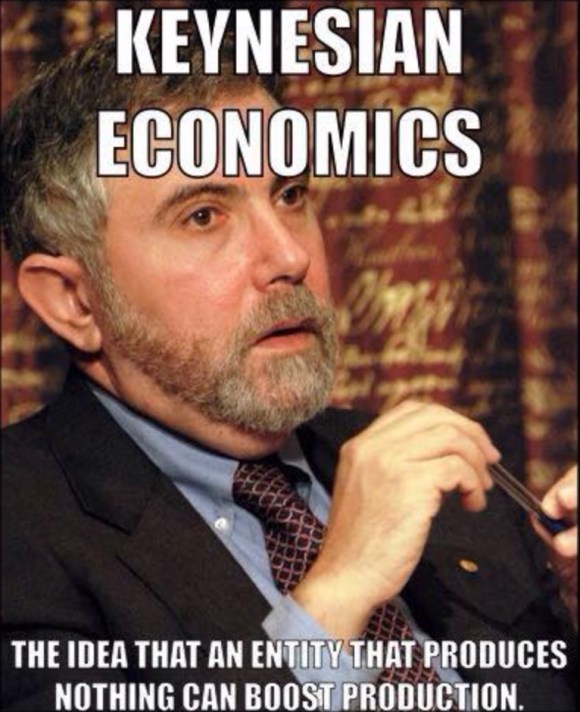
Keynesian economics

How ridiculously empty Keynesian theory is. But if you combine deficits with the promise of billions of dollars to businesses that lose money and individuals who don’t work, along with voting majorities for parties who promise never to reduce the level of welfare, it’s amazing how attractive these ideas become.

Attention Scott Sumner: Did you know that the Great Depression was a worldwide problem?

There’s a new book by Scott Sumner with the title, The Midas Paradox: Financial Markets, Government Policy Shocks, and the Great Depression. As is all too frequent, the view is restricted to the United States, where the Great Depression was prolonged by something like a decade until the 1940s because of Roosevelt and the New Deal. Australia reached its trough in 1932 and the UK and most of the world in 1933. The true lessons to be learned are found by not looking at the US. This is the blurb found at the link to the book.

Economic historians have made great progress in unraveling the causes of the Great Depression, but not until Scott Sumner came along has anyone explained the multitude of twists and turns the economy took. In The Midas Paradox: Financial Markets, Government Policy Shocks, and the Great Depression, Sumner offers his magnum opus—the first book to comprehensively explain both monetary and non-monetary causes of that cataclysm.

Drawing on financial market data and contemporaneous news stories, Sumner shows that the Great Depression is ultimately a story of incredibly bad policymaking—by central bankers, legislators, and two presidents—especially mistakes related to monetary policy and wage rates. He also shows that macroeconomic thought has long been captive to a false narrative, which continues to misguide policymakers in their quixotic quest to promote robust and sustainable economic growth.

The Midas Paradox is a landmark treatise that solves mysteries that have long perplexed economic historians and corrects misconceptions about the true causes, consequences, and cures of macroeconomic instability. Like Milton Friedman and Anna J. Schwartz’s A Monetary History of the United States, 1867–1960, it is one of those rare books destined to shape future research and debate on the subject.

With economics, it’s a “can’t-do attitude” that overwhelmingly works best. Leave it to the market is the answer, although there are some things governments can do. Making adjustment easier, diminishing regulation, pulling back on public spending and easing credit conditions are classical elements in a recovery program. None of these were followed by the US while all of these were followed by Australia and the UK. That’s why our economies recovered and the American economy didn’t. These are the lessons that ought to have been learned but the solipsistic approach to economic policy by American economists, where only the US economy is examined, means that the actual lessons that ought to have been learned never are. Keynes may have been British but it is Samuelson who spread the disease across the globe.

Where are the anti-Keynesian economists?

I have taken the quote below from Terry McCrann via Andrew Bolt who titles his post Economy lifts, but where’s the business investment? Trying to make sense of an economy by using modern economic theory to find your way is an impossibility. I say this often, but who can understand any of this if they have not read pre-Keynesian economics? It’s impossible to read J.S. Mill unless you are schooled in the classics, but you can read Henry Clay’s 1916 Economics: an Introduction for the General Reader, or even my own Free Market Economics: an Introduction for the General Reader (2nd ed 2014). If you do not understand the classical theory of saving and investment you will never be able to think through economic events. This is the excerpt from Terry.

THE “good” economic growth figures for the September quarter capture a simple, brutal reality about today’s, and even more, tomorrow’s Australia: after the resources boom we are getting poorer…

There’s a seeming contradiction or paradox in the GDP figures. We continue to record relatively strong growth in the economy. That’s, of course, “relative” to other developed economies which are barely staying out of recession….

Yet right now it’s become a sort of empty growth. In simple terms we are producing more but earning less; we are shipping off more and more of Western Australia to Japan and of course especially China and getting less per tonne and so more or less the same actual dollars overall…

But our incomes aren’t growing.

This shows up in all, sorts of places — like wages, which are now growing at their lowest pace in 60 years and barely keeping up with (very low) inflation.

If it’s not value adding it will not add to growth. If it requires a government subsidy – green energy, NBN, pink batts – it will lower our standard of living. You cannot make an economy grow from the demand side. The proportion of non-Keynesians in the profession is under 10%, and the proportion who are actively anti-Keynesian may be less than 1%. What to do about this I do not know, but you would think by now that there would be some kind of effort to overturn Keynesian macro, but near as I can tell, there is hardly a whisper of dissent.

The puzzle of low real interest rates and low investment is not really a puzzle

Arnold Kling raised an interesting question: The Puzzle of Low Real Interest Rates and Low Investment. He summarises the various possibilities into Keynesian and non-Keynesian:

The puzzle in macroeconomic data is that the real interest rate is low and investment is low. There are a number of stories, none of them fully convincing.

In the Keynesian category, we have:

1. Low “animal spirits.” As far as I know, no one has actually propounded this.

2. Accelerator model. That is, when other forms of spending are high, investment is high. So when spending by households goes down, investment goes down. I put Furman (and most Keynesians) in this camp.

In the non-Keynesian category, we have:

3. Real interest rates are actually high, because prices are falling. This is perhaps more plausible if you think about sectoral price movements. If the price indexes go up because of college tuition and health insurance, then prices elsewhere may be falling.

4. Real interest rates are actually high for risky investment. Interest rates on government debt and on high-grade private bonds are a misleading indicator of the marginal cost of capital.

5. Crowding-out can occur at low interest rates. That is, if financial intermediaries are gorging on government debt, they may not seek out private-sector borrowers.

The puzzle in my view is a result of thinking entirely in money and not looking at the real side of the story at the same time. See Chapters 16 and 17 of my Free Market Economics, but essentially the reason for low money rates creating a fall in the real level of investment is because the supply of savings diminishes, and then, because the price of these savings to those who can get the money is so low, many really low productivity and no productivity activities ended up being funded. The analysis may be faulty somehow, but the conclusions it reaches is what you see in the world around us today.

A classical economist looks at modern macro

This is the first draft of the conclusion of the paper I have finally finished on classical economic theory. The rest of the paper leads up to these conclusions. Whether it is published is, of course, not in my hands. But after the mess that has been made of economic management following the GFC, there is plenty of real world evidence that modern theory has a lot to answer for.

The one thing all sides can agree on is that there was a “classical economics” before Keynes published his General Theory and that modern macroeconomic theory is different from classical economic theory. Beyond that, other than a superficial gloss on what that classical theory consisted of, virtually no modern economist any longer knows what that classical theory was. This paper has therefore provided an explanation of the economics before Keynes, focusing as Keynes did on what we would today describe as the macroeconomic issues. What makes this paper particularly useful is that it has been written by someone who believes the economics of John Stuart Mill is superior to modern macroeconomic theory. Whether others will share this belief after reading the paper is neither here nor there. The actual intent is to allow modern economists to gain an appreciation and understanding of the economic theories of their predecessors.

Possibly the greatest obstacle for modern economists is that they assume a pre-Keynesian economist had no theory of involuntary unemployment. The quote from Mill at the start of this paper, plus recognition that there had been a detailed and intricate theory of the cycle that had developed for over a century through until 1936, should provide some incentive for economists to examine the great history of their own subject, not only with a sense of the grandeur and depth of understanding that has pervaded our subject since its origins in Adam Smith and The Wealth of Nations, but with a sense of adventure about finding out what they knew that we do not. As J.E. Cairnes (1888: iv-v) pointed out at the end of the nineteenth century, whatever mathematics may have brought to economic theory, it has not provided any additional insights into our understanding of the underlying dynamics of an economy. The broad features of the economies we live in today were evident even as far back as 1776. The belief that we know something a classical economist did not about human motivations, the potential for markets to bring prosperity, the need for government regulations to be properly crafted, or the pros and cons in relation to the provision of welfare are beliefs that cannot withstand a deeper understanding of classical theory. We may have better statistics and more sophisticated analytical techniques, but the theories a modern economist applies to make sense of it all are not obviously better than the theories that had prevailed before the publication of The General Theory in 1936. The argument presented here is that they are, in fact, actually worse.

Your thoughts would be welcome.

So, there’s been a fall in productivity – whatever might have caused that?

The more I look at commentaries like this, the more I come to the conclusion that modern economics is a complete wasteland. The subheading reads: “The global productivity slowdown will pose a huge challenge for Scott Morrison”. But what is truly bizarre is this:

The IMF has been troubled over the failure of world growth to meet its forecasts. Every time the fund has looked at world growth in the past five years, it has had to downgrade its forecasts. If the world economy had grown in line with the forecasts it made five years ago, the economies of the advanced world would be 14 per cent bigger than they are while those of the developing and emerging world would be 23 per cent bigger. But the forecasts of employment the fund makes for advanced countries have been much closer to the mark. Indeed, for a range of countries, including Germany, Japan, South Korea and Britain, employment growth has been better than the IMF predicted, although output growth has been worse. More workers are producing less output than was expected.

I don’t wish to be impertinent since, after all, the IMF is comprised of some of the most highly paid economists in the world, experts in the dark arts of econometrics and modern macroeconomic theory. Nevertheless, I feel compelled to point out that now, five years after the stimulus, when governments around the world commandeered huge swathes of their nations’s savings, the inevitable consequence has been a fall in productivity. Rather than our resources being used in truly value adding activities determined by the market, they were instead used by clunks in government and Treasury on such pieces of economic junk, like the NBN, Building the Education Revolution and Pink Batts. In the US there’s been Solyndra and everywhere you go there are the many, many green energy projects that have absorbed capital. The result today is that we have a dearth of the kinds of new investments coming on stream that would maintain productivity. Instead, we find it difficult even to maintain previous standards of living, never mind getting them to grow. Of course, the IMF, being such geniuses, has all the angels covered:

The IMF says weak business investment is partly responsible for the poor growth outcome but says that by far the most important issue is weak productivity on its broadest measure. It is not just output per worker that is disappointing. The additional output from every dollar of business investment also has been weak.

There is no settled explanation for this. The IMF says a shift in the composition of economic growth also may be contributing. Service industries are accounting for most of the increase in growth, rather than manufacturing. Output can be harder to measure in service industries, and they are often more labour-intensive. The IMF says it is also possible the revolution in information and communications technology is delivering fewer gains in productivity than was the case through the 1990s. It also speculates that the pay-off from additional investment in education may be diminishing.

Let us therefore take the NBN as the prime example of what has gone wrong. In every way most of the infrastructure construction might be listed in the national accounts as business investment. You could say the same for all of the desal plants that were built. But crony capitalism is not free enterprise, and the outcomes that are fed by public monies are duds no matter which way you look at it.

Economics remains wedded to C+I+G. It still believes SPENDING causes growth, with all those multiplier thingys hanging off the initial expenditure. It is a stunning failure of policy, although hardly anyone at all has noticed just how great a failure it has been. In the US they surveyed the nation’s economists and some massive majority have stated that the stimulus created additional jobs. With that kind of thinking so widespread, it should be no surprise just how dismal our economic prospects now are.

And for what it’s worth, the worst thing that the RBA should now do is lower rates of interest, which is probably the reason they are going to do it the next chance they get.

What does a modern economist think a classical economist believed?

I am writing a paper in which I begin by setting down what a modern economist would believe about “classical” economics. In reality, of course, virtually no economist today would have the slightest clue how an economist prior to 1936 would have looked at the operation of an economy or dealt with the problems it might have. I have pulled together my own summary and am putting up it here so that others can tell me what they think. I would merely emphasise that what I have below is such a misbegotten caricature that economists ought to be thoroughly disgusted with their own discipline if they really think their ancestors believed anything like this caricature. Because if this really were what economists once believed, even Keynesian economics would have been an improvement.

The more one knows about the economics prior to the publication of The General Theory, the less dogmatic one can be about the teachings of “classical” theory, especially since in the Keynesian version it covers the entire period from 1776 to 1933. Nevertheless, here is a summary statement that more or less captures the modern version of the essential beliefs of economists prior to 1936.

The economy was seen as a world of more or less instantaneous adjustment due to the flexibility of prices and wages. Such rapid adjustments were expected to lead to an almost instantaneous economic reconfiguration in the face of new circumstances. Theory was almost entirely devoted to the long term with short-term fluctuations of little interest since downturns were so brief and government policy would anyway have been unable to alleviate any of the problems that might arise. The economy was, for all practical purposes, in equilibrium because of virtually instant adjustment made through changes both upwards or down in the price level. The key concept was Say’s Law, which stated that supply created its own demand, which in turn meant involuntary unemployment would never occur. Laissez-faire was the core policy setting. Market adjustment could not be improved on, with regulation of business and industry seen as almost never beneficial, but virtually certain to cause harm. Regulation was kept to a minimum as were welfare payments to the poor and unemployed.

Consumption makes the world go around, world go around

My thanks to Tel for bringing this to my attention. I Want to be a Consumer, a Poem by Patrick Barrington. Henry Hazlitt, in his Failure of the “New Economics”, quotes this poem, which can be viewed as a critique of Keynesian economics. Hazlitt wrote:

The natural consequences of the Keynesian economic philosophy were vividly portrayed by Patrick Barrington (two years before the particular rationalization that apeared in the General Theory) in his poem in Punch [Issue of April 25, 1934]

Some ideas are just in the air. The poem was written two years before Keynes got around to showing how well before his time this young lad was. From a Keynesian point of view, what is really socially wrong with his ambition?

I Want to be a Consumer

“And what do you mean to be?”
The kind old Bishop said
As he took the boy on his ample knee
And patted his curly head.
“We should all of us choose a calling
To help Society’s plan;
Then what do you mean to be, my boy,
When you grow to be a man?”

“I want to be a Consumer,”
The bright-haired lad replied
As he gazed up into the Bishop’s face
In innocence open-eyed.
“I’ve never had aims of a selfish sort,
For that, as I know, is wrong.
I want to be a Consumer, Sir,
And help the world along.

“I want to be a Consumer
And work both night and day,
For that is the thing that’s needed most,
I’ve heard Economists say,
I won’t just be a Producer,
Like Bobby and James and John;
I want to be a Consumer, Sir,
And help the nation on.”

“But what do you want to be?”
The Bishop said again,
“For we all of us have to work,” said he,
“As must, I think, be plain.
Are you thinking of studying medicine
Or taking a Bar exam?”
“Why, no!” the bright-haired lad replied
As he helped himself to jam.

“I want to be a Consumer
And live in a useful way;
For that is the thing that’s needed most,
I’ve heard Economists say.
There are too many people working
And too many things are made.
I want to be a Consumer, Sir,
And help to further Trade.

“I want to be a Consumer
And do my duty well;
For that is the thing that’s needed most,
I’ve heard Economists tell.
I’ve made up my mind,” the lad was heard,
As he lit a cigar, to say;
“I want to be a Consumer, Sir,
And I want to begin today.”