When was economics not radical?

The History of Economic Thought online discussion forum has had this request posted:

I would be interested in your thoughts and reactions to this article: When Economics Was Radical. The article was published in The Chronicle of Higher Education [CHE].

My response is below.
___________

This is how I would summarise the point of the article, whose provenance is given away by its title, “When Economics was Radical”.

Economics had the opportunity to enter into radical economics during the late nineteenth century but missed the boat. Now the time has come again, when we can jump aboard by taking up Thomas Piketty’s call to arms over income distribution.

So here are my thoughts and reactions.

First, since I think economics has gone downhill pretty much since the time of John Stuart Mill, I’m not sure that we have missed many of the leftwards currents that have affected the political world that surrounds our studies. By the 1880s, laissez-faire had been long gone – pushed overboard by many including JSM. But what remained was a very robust subject that maintained the central role for free markets. The market mechanism had to be overseen and regulated by governments but the direction that the economy would take would and should be left to itself. Not sure anyone could say that about economic theory today.

Second, economics has remained outside the complete embrace of Marxist thought mainly because the labour theory of value remains an entirely empty theory of value, although no doubt there are still those who will come to its defence. It completely discredits Marxist thought since it is so indefensible. There are nevertheless many economists who have gone full Marx, but they have had to find other ways to reach these conclusions than through Das Kapital. I am well prepared to be corrected on this, but I cannot think how someone could use a modern first year economics text to explain what has happened to the Venezuelan economy. I imagine most of us can do it in an ad hoc sort of way, but not by using the latest editions of Samuelson of Mankiw as the guide.

Third, Piketty’s Capital for the Twenty-First Century tries to do today what Marx’s Kapital for the nineteenth century did not quite manage to do, which is to give central direction of an economy the imprimatur of economic theory. For Marx, it was to raise living standards or something by ridding us of the capitalist class. For Piketty, it is to achieve economic equality by taking from the rich and giving to the poor, and if I understand him right, it is not just to be done within individual societies, but to take from the rich capitalist nations and pass this wealth on to the less wealthy ones. As noted on Wikipedia, “Piketty offered ‘a possible remedy: a global tax on wealth’.” The authors of the article in CHE had this to say about Piketty, just in case you may think I am missing the point:

“[Piketty] had many harsh things to say about the field’s methodological narrow-mindedness and self-absorption and their cost: the absence of a convincing theory of rising inequality, downward social mobility, and resulting pathologies — and, in the absence of such a theory, a foot-stomping insistence that these phenomena either don’t exist or don’t matter.”

For myself, I don’t find this very hard to explain, but here is neither the time nor the place.

Fourth, there is no doubt that the juices of envy are everywhere. It has been a long-time red rag for the left to worry about income distribution and how unfair it is. As it happens, Piketty was in Melbourne about a month or so back and I was the fourth in line to ask a question. Unfortunately for me, there was only time for three questions so I missed out. So I will put my question down here:

We are meeting in the Melbourne Town Hall, built when Australia was the richest country in the world, and Melbourne was the richest city in the world’s richest country [around 1890]. Back then, no one had a car, a computer, a radio or TV. Few had indoor plumbing, hot and cold running water and electric lights. No one flew to London, went to the movies or surfed the net. Antibiotics had not been invented. What possible difference could it make to anyone whether income distribution in some measure that is invisible to everyone without a dataset and a computer happens to be more skewed in one direction today than it was at some moment in the past?

Fifth, as my question suggests, income inequality is not an economic question, it is a political question. There have been no mainstream laissez-faire economists since the time of John Stuart Mill. The need to find some means to assist the poor and disadvantaged has always been part of economic theory. We have a much larger surplus today than we did back then, so we are able to assist others to a greater extent. But the issue is not inequality but welfare. Inequality has nothing to do with economic theory, other than to point out that you either have a market system where individuals earn what they can by selling to others, or you have some kind of centralised system where income is generally disassociated from one’s contribution to total output and income distribution is determined by political will – “from each according to his ability, to each according to his needs”. Well, who decides that and how would they do it? There are no economic answers here.

It’s at times like this that economists need to be able to explain what went wrong in Venezuela. And if you cannot do it without saying that it was the fault of the capitalists and the rich, you are not an economist and your answers have nothing to do with economic theory. I find this kind of call to arms from the CHE article perfectly ridiculous:

“It’s hard to escape the conclusion that in exiling radicalism from the AEA and from mainstream economics, its practitioners attained enormous intellectual prestige and elite approval by sacrificing the disinterested search for answers to the most controversial questions in economics.”

Aux barricades, comrades etc.

And as a sixth and last point, I have to say this did give me some pleasure:

“A re-evaluation of classical economics has been proceeding in recent years, highlighted by the publication of Piketty’s Capital in the Twenty-First Century.”

Well, no one is more interested in seeing a re-evaluation of classical economics than I am, but the last place I would send you to is Piketty. J.S. Mill, J.E. Cairns, Simon Newcombe, Henry Clay, that is where I would send you. In fact, I have just had an article published on Clay if you are interested in these kinds of things, with the ultra-neutral title, “The Hundredth Anniversary of Clay’s Economics: the Best Introduction to Economics Ever Written”. You can find the article here if a re-evaluation of classical economics really is your thing.
There is a limited case for reading Keynes today

I am returning to the question of whether it is worth one’s while to read The General Theory since I may have been a little hasty in my previous advice. It is not to be read for entertainment, nor to understand how an economy works. But if you are interested in the history of economic theory, then that is a different story altogether. I have now replied again.

Thinking over what you had written, of course since you are an historian of economics you have to read The General Theory. You are not looking for enlightenment in the normal sense but to see how economics has “progressed”, and to understand in detail the steps along the way. Importantly, you will be reading it backwards in time, so that you are looking at it from now and trying to understand the origins of what we find in our texts. My original copy of The GT has become so fragile that I had to buy a second copy that I look at instead since the older one is disintegrating. And while I have probably read at one time or another every page of the book, I have not read them in order, from page 1 to the end. But I have read the index! And all of the footnotes. Never ignore the footnotes.

As for his definitions, Keynesian terminology is now so pervasive you will not stumble on a thing. Even his idiotic term “marginal efficiency of capital” is straightforward enough so that won’t be the obstacle it was at the start – his adoption of “marginal” concepts was a stroke of genius given when he was writing, although there is nothing “marginal” about mec and the mpc. The general problem will be that the presuppositions of the classical era will have evaporated so that it is less obvious what he’s going on about and why any of it matters. In it’s own way, because of my focus on Say’s Law, it was the first three chapters and then Book VI, which are the last three chapters, where I began and that led me to the rest. But since everything since 1936 has depended on acceptance of aggregate demand, which everyone now does accept, the book seems less idiotic to a modern reader than it did to Frank Knight and Henry Clay. And even then, since there was a consensus even among classical economists to increase spending to diminish the impact of The Great Depression, the radical nature of The GT remains in disguise. Seriously, can anyone really understand what this means and why it is so important?

“Say’s law, that the aggregate demand price of output as a whole is equal to its aggregate supply price for all volumes of output, is equivalent to the proposition that there is no obstacle to full employment.” (GT: 26)

This may be the least controversial statement in the entire General Theory over which literally no controversy of any serious kind occurred. Yet it is this statement that has made economics into the useless mess it is, wrecking our economies without hardly a soul understanding what’s involved and why it matters.

Keynes knew what he was up to. So once you understand that the entire book is aimed at demonstrating that Say’s Law as Keynes understood it is wrong, reading the book is then a walk in the park – at midnight in the midst of a hurricane.

Should you read The General Theory?

I have been asked by an economist friend, who is quite well versed in macro, whether it is worth reading The General Theory and if not, what should be read instead to get a sense of what Keynes wrote. This was my answer:

My view is that there is no reason that I can think of to read The General Theory cold without some specific purpose and question in mind.

Today, it’s a book for scholars alone, even more so than in 1936 when it was published. But then, all the presuppositions of classical theory were alive so that many of the issues and statements made were clear enough to everyone so that they knew what he was on about. A great deal of time of mine has been understanding the presuppositions of classical theory – the beliefs that were so entrenched that no one even bothered to state them – so that I can read what Keynes was saying against the background of a classical understanding of how things worked. Since that is basically what I do believe is true, I can read Keynes almost the same way as Frank Knight, say, and can see things as they might have.

But what has given me an entirely different perspective is that I came to Keynes not just with the presuppositions of the 1930s in my mind, but also with the presuppositions of the 1840s. It’s with the conceptual approach of John Stuart Mill that I read the GT, and from that perspective, the book is so backwards, so incoherent and so illogical, that it defies belief to me every time I open it. But the presuppositions of almost all economists today are founded on the Keynes-Hicks-Hanson-Samuelson axis which make Keynes seem sensible and Mill incomprehensible. For me, as for Mill, it is so unmistakably true that demand is constituted by value adding supply that I am amazed that no one else can see it or why it matters. And even though a Keynesian stimulus has failed on each and every occasion it has been applied, the belief in aggregate demand independent of aggregate supply remains so entrenched that it is literally impossible for an economist to understand why the latest attempts at a stimulus did not work, and must come to the conclusion that things would have been even worse had the stimulus not been applied. It is not that they are dishonest or lack the most intensive economics education we can provide today. It is that their professional deformation, that began with their first principles course, has never gone away.

What to read instead? All I can say is that I wrote my Free Market Economics at the start of the post-GFC stimulus because there was then no other economics text anywhere to explain why a stimulus would make things worse. The best I can therefore suggest is the second edition which is the economics of Mill brought up to date as best I could do it.

The clueless Janet Yellen discusses aggregate demand

But she’s only clueless because she takes mainstream economic theory seriously, like all the others. This speech was delivered way back in October but only reached me today: Macroeconomic Research After the Crisis. The first heading is, “The Influence of Demand on Aggregate Supply” for which I can give you the definitive answer. There is NO INFLUENCE WHATSOEVER of demand on aggregate supply. Not in the long term and not in the short term. There is none, which is why trying to explain recessions and unemployment by using fluctuations in aggregate demand will get you nowhere in just the same way that trying to induce recovery in an economy in recession by increasing aggregate demand will NEVER work. You want evidence? Just look everywhere around you. Now back to Janet, who wrote:

The first question I would like to pose concerns the distinction between aggregate supply and aggregate demand: Are there circumstances in which changes in aggregate demand can have an appreciable, persistent effect on aggregate supply?

Her answer is “blah, blah, blah, hysteresis, and more blah, blah blah. She grapples with the possibility that demand deficiency may be more than a passing storm and then, ever so gently, suggests that perhaps aggregate demand has nothing to do with it.

More research is needed, however, to better understand the influence of movements in aggregate demand on aggregate supply. From a policy perspective, we of course need to bear in mind that an accommodative monetary stance, if maintained too long, could have costs that exceed the benefits by increasing the risk of financial instability or undermining price stability. More generally, the benefits and potential costs of pursuing such a strategy remain hard to quantify, and other policies might be better suited to address damage to the supply side of the economy.

You know, we are heading back to Say’s Law. They are never going to acknowledge that I might have been right, because being right too soon never gets you credit. It takes time, but we shall see because there is now nowhere else for economic theory to go.

Make economics great again

There has been a thread on the History of Economics discussion forum under the heading “Progress and Death” which revolves around the origins of the aphorism that science advances funeral by funeral. It turns out that this was an observation by Max Planck which more fully reads:

“A new scientific truth does not triumph by convincing its opponents and making them see the light, but rather because its opponents eventually die, and a new generation grows up that is familiar with it.”

I do find it interesting that even in the natural sciences that a reluctance to embrace new directions among the older generation slows the shift, since I would have thought that in the natural sciences experiment and evidence-based reasoning would overwhelm such resistance. In the social sciences, of course, experiment and evidence seem to count for little. I therefore put up the following post of my own:

I am always somewhat reluctant to buy into these issues, but right from the heading – “Progress and Death” – there is an implicit assumption that the latest is better than the superseded, which I find completely unfounded. As someone who believes that Keynesian economics has been almost the paradigm example of regression in any of the sciences, I can agree with the notion that the mainstream in some body of scientific thought will bend towards the latest fashion that is accelerated by the deaths of its older generation. But the belief that this always entails progress is, in my view, deeply mistaken. You do not have to agree with me about Keynes to recognise that the deaths of the likes of Frank Knight, J.R. Commons and Allyn Young took from the economics profession some very articulate, interesting and established views that are very different from the ones we see before us in our economic texts today. I am more likely to accept this aphorism as relatively accurate for the natural sciences, that science advances funeral by funeral, but for the social sciences I think it is completely false. That is why I argue that economists need to study the history of economic thought to keep themselves in contact with these older ideas. Their authors may have gone from the world, but their ideas – even ones we end up not agreeing with – remain as alive and worthy of study as they were on the day they were first written down.

It’s been a day since this went up and so far no one has decided to enter into these issues, which are much more intense than merely to ask where a quote originated. If anything does show up, I will let you know.

The RBA is worried we are saving too much!!!

The only reason I still get The Oz is because it has two sudokus and as I was turning to these tonight, what should be on the front page of the business section but this: Are we saving too much? Weak spending a risk to our economy. Now just because the world is coming to an end tomorrow is no reason not to comment on such idiocy. These Keynesians are as bad as Democrats, probably because each is the same as the other. But really, what can you do with such stuff?

The weak state of household consumption is a key risk to economic growth with little evidence that people are cutting their savings to raise spending levels, as the Reserve Bank expects. . . .

The Reserve Bank’s essential thesis about the economy is that consumers will support growth during the current period of weak household incomes by running down their savings to support spending. Eventually, this will lift demand to a point where non-mining businesses will start to invest.

You know, this is so ignorant that it quite takes the breath away. Do they really believe such things? Does anyone? Have they not been paying attention for the past eight years? I will just say it again, not that anyone understands it, but no economy grows from the demand side. All momentum comes from value adding production. To depend on retail sales and consumer demand to provide an economy with its drive is to depend on what has never ever happened in history to happen for the first time. It really is amazing to me to find that I remain the only one in step. Say’s Law is the single most important principle in the whole of economics, precisely because it is the one principle that is not intuitively obvious. If they really think our economies are suffering low growth because we are saving too much they will never ever understand a single thing of consequence about how an economy works.

The editors feel that your paper is too specific for our readers

An exchange of letters with the editors of a journal that has rejected my paper on “Classical Criticisms of Keynesian Economics”. This is what they wrote to me:

After having carefully evaluated your manuscript, the editors came to the conclusion that your paper is not suitable for publication in our journal. Our rejection need not imply any judgment of the quality of your work. Rather, the editors feel that your paper is too specific for our readers. We think that a specialized journal on the history of economic thought would probably appreciate your contribution the most.

So this is what I wrote to them.

I am, of course, not arguing the toss with you, but I have to say that if you think a paper about how the entire universe of mainstream economists understood the nature of recession and unemployment prior to the Keynesian Revolution is “too specific” for your readers, then your approach is far too narrow. As I said in my covering note, this is not history of economics, it is economics. It is about how to understand why recessions occur, why public spending will never drive an economy into recovery and why our economies right now are not just experiencing slow growth, but are actually enduring a fall in living standards. John Stuart Mill would have been able to tell you. He would even have told you in advance that it would be certain to occur, just as I was able to do in 2008.

I will also say that if you reject a paper because it is “history of economics”, then you are cutting yourselves off from a very important vein of economic discussion. Mainstream journals now routinely do this, although why that is I am not entirely certain about.

I am disappointed in your response, but I cannot say I am exceptionally surprised.

And she can square the circle using her perpetual motion machine

Here’s someone who gets it: Clinton’s Pledge on Debt Emerges as a Risible Claim, In Light of Her Platform.

The economic triad of rule of law, property rights, and sound money — which counter the nemeses of cronyism, interventionism, and redistribution — regained currency in the 1980s as supply-side economics and became indelibly known as the miracle of Reaganomics (and, in Britain, as Thatcherism).

Partisanship stand in your way? Dispel it through its nineteenth-century nomenclature, “the law of markets,” that reached its explicatory apogee in political economists J.B. Say and J.S. Mill. Exchange means exchange was its ethos and the inexhaustibility of demand its engine; rebutting with finality and prescience the latter-day Keynesian fallacy of demand deficiency, which served only as cover for political intrigue and aggrandizement under the guise of eliminating poverty.

Economic growth is the route to eliminating deficits and debt, the route to employment and prosperity (and immigration reform). Any other path is the wrong one and, unlike Hillary Clinton’s pledge not to grow the debt, no laughing matter.

There are many forms of insanity but political forms are the worst and largely incurable. If you are able to believe that she really can lower taxes, increase benefits, create more jobs and raise living standards all at the same time, then you are as politically deluded as it is possible to be.

Say’s Law and the money economy

Let me begin with this quote from Tel in the comments on my previous post which was on the just published interview with me on Say’s Law. Tel begins with a quote from my post and then discusses the difficulty in dealing with savings in the form of money versus savings in the form of resources:

Say’s Law remains the single most important principle in all of economics.

Only because Keynesians need to insist they have disproven Say’s Law in order to perpetrate their price manipulation and power grab.

The problem being that there are methods to confuse a lot of people for a limited time, and give a convincing illusion that Say’s Law no longer applies. How long this illusion can be extended is questionable, but with sufficient power behind it, seems like quite a while.

That’s why I prefer the explanation, “Money is a veil over barter” which is easier to understand and contains within it the concept of two layers: the barter layer where every good or service exchanges for another good or service, plus the money layer which attaches prices to these things and (just like any “veil”) also hides something. Say’s Law in it’s pure sense applies to a barter economy and when all we have is a barter economy it becomes so obvious and irrefutable that it seems barely worth a mention. Once the veil is in place it’s possible to lose track of what’s happening underneath.

Say’s Law does, of course, apply to an economy in which money is the medium of exchange, a store of value and the unit of account. If it didn’t, there would be no point in mentioning it at all. And by coincidence, on the same day that Man and the Economy published my article on Say’s Law, Quadrant has published online my article on money and the real economy: That’s the Way the Money Goes. There is a lot in the article – it’s 4500 words long – but this is the core issue:

At the centre of a proper understanding of rates of interest is the recognition that when someone is looking to invest, what they borrow is money but what they are actually seeking are capital assets, labour time and other forms of input such as electricity and transport. There was therefore a dual focus [in pre-Keynesian economic theory] that was essential to make sense of what actually went on. One had to absolutely keep an eye on the market for money and credit, and at the same time to be completely mindful of the supply of real resources available for productive investment.

Money is more than a veil, of course. Things do not go on just as if it were all perfectly visible. The existence of money causes massive misdirection and distortions in the structure of production. You can barely make sense of anything unless you understand the role of money, but you also cannot understand the way money distorts economic reality unless you also understand Say’s Law which explains the nature of the actual reality the existence of money distorts.

A comprehensive summary of Say’s Law

canlorbe-conversation-with-steve-kates

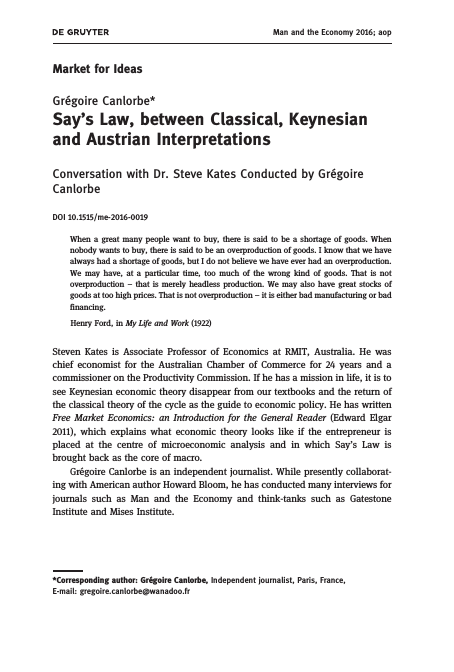
An interview with me on Say’s Law by the French journalist Grégoire Canlorbe has just been published in Man and the Economy, the journal of The Coase Society. It is the most comprehensive summary statement I have put together of Say’s Law – it runs to 31 pages – and I could not be more grateful to Grégoire who spent more than a year in discussing the relevant issues with me before we actually got down to the interview. You can download a copy of the article here .

Say’s Law remains the single most important principle in all of economics. Policy decisions that go against the grain of Say’s Law are guaranteed to fail, for which the evidence remains overwhelming. The obvious failure of every one of the stimulus packages that were attempted after the GFC, along with the failures that have been associated with attempts to stimulate investment by reducing rates of interest, ought to have at least made some economists consider that perhaps Say’s Law is valid. The reason this does not happen is that virtually no economist understands even what the underlying principle of Say’s Law is. My article will, I hope, at least create some interest in what had been the bedrock proposition of classical economic theory almost from the time of Adam Smith through until the publication of The General Theory in 1936.

The journal is itself attempting to redirect economic theory in a more fruitful direction. These are the journal’s published objectives.

When modern economics was born in the 18th century, Adam Smith made it a historical study of man and the rising commercial society. For Smith, economics is first and foremost concerned with wealth-creation, where the division of labor is the key organizing principle. In the next century, David Ricardo shifted the focus of economics from production to distribution. Over the course of the 20th century, economics has gradually metamorphosed into the logic of choice and taken mathematics as its language. These two transformations have together made economics a towering discipline in the social sciences. But this achievement comes with a heavy price. Economics has largely become a theory-driven subject, severed from the ordinary business of life. Rather than seeing this disconnection as a fatal flaw undermining the vitality of the discipline, many economists take pride in that economics is no longer confined to any subject matter, but stands as a versatile, subject-free analytical approach.

The Coase Society aims to reorient economics as a study of man and the economy. The human economy is a man-made, evolving complex system of cooperation and competition. The defining character of the market economy is its continuous innovation, churning out novel products from the constantly adapting structure of production. This dynamics is kept alive by entrepreneurship and the growth of knowledge. To understand how this open system works requires both empirical and theoretical efforts. But theory-building, unless informed and disciplined by facts on the ground, can easily degenerate into “blackboard economics”. Empirical work is most valuable only when it changes the way we look at the problem. The paucity of systematic interaction and mutual learning between empiricists and theorists and the lack of competition in research methodology in modern economics have severely sterilized the discipline.

Man and the Economy is not to replace the prevailing paradigm in economics with what the Society believes as a different and superior one. Such a paradigm simply does not exist yet. But economics as currently practiced ought to change. Working with students of economies across disciplines and all over the world, and bringing diversity and competition into the marketplace for economics ideas, Man and the Economy can help to make it happen. We welcome empirical (historical, qualitative, statistical, experimental) investigations and theoretical explorations that deepen our understanding of how the economy works and how it changes over time. Man and the Economy is keen to publish articles that examine how the market economy spreads throughout the globe and adapts to local conditions as well as studies that cross disciplinary boundaries and/or integrate diverse methods to shed light on the working of the economy.

A necessary journal for our times.