Keynesian theory is losing its grip

Here we have a very nicely turned argument about Keynesian economics. It even includes the need for value adding activity as part of the explanation which definitely puts it a cut above the rest of those paltry few and far between anti-Keynesian bits of writing I tend to see. By Martin Hutchison at Prudent Bear, titled, “The Non-Existent Keynesian Contradiction”. The supposed contradiction is explained in the opening para:

The Keynesian U.S. commentariat, which includes quite a high percentage of nominal Republicans, has been proclaiming a “contradiction” between the needs of economic policy. The need to cut government spending to reduce the deficit is supposedly balanced by ill-effects from declines in government employment—even the Wall Street Journal’s economics blog claimed that the U.S. unemployment rate would be 7.1% had governments (mostly state and local) not cut their workforce. In Britain, infinitesimal spending cuts are blamed for continuing economic stagnation, while the sharp rise in the value-added tax (VAT) is ignored.

I’m afraid even those who are trying to cut back on spending are only doing so out of the necessity of having to trim their outlays to what they can actually pay for, not because they see the economic value in a lower deficit. I am forever on about Say’s Law but unless you understand the Law of Markets, you are blind to what needs to be done and how one might gauge success. But here we have some good solid sense:

Only in the world of the FDR Keynesian Simon Kuznets, the inventor of GDP accounting, does an increase in public spending matched by a decline in private spending leave you in the same place, let alone push you forward.

In reality, much public spending is wasteful, producing output of lower value than the input, whereas private spending by definition only takes place if it produces a net gain in welfare for the spender or a profit for the investor. If a government hires an extra worker, that worker’s wages are included in GDP, whereas a private sector hire of a worker has no effect on GDP until that worker produces something. Thus even though the unproductive public sector worker produces a gain in reported GDP, he produces a loss in overall wealth, because productive private activities are sacrificed through higher interest rates to pay for his unproductive public sector existence. As I said, there are lag effects, the new hire will produce a GDP gain in the short-term because of the government-friendly way the accounting is done, but in the longer term the GDP losses will outweigh the gains. ‘Stimulus’ public spending over any but the shortest period produces a negative economic effect.

So what to do? Pure good sense:

The solution is similar in both countries. Britain needs more “austerity” not less, cutting spending in the unproductive sectors of the NHS, green energy and foreign aid. In addition to lowering the deficit, however, it should return some of the savings to the public through tax cuts, with a bias towards middle-income consumers, thereby renewing economic growth. At the same time, it should raise interest rates well above inflation, thereby reducing the subsidies to the banking system, restoring returns to Britain’s beleaguered savers, and increasing the availability of small-business finance.

In the United States, tax cuts are less necessary; the priority should be deficit reduction through public spending cuts, especially in eliminating the appallingly wasteful subsidies to agriculture, green energy and, through the tax code, to housing and charities, as well as cutting the country’s global defense commitments down to size. Again, interest rates should be raised, increasing the excessively low savings rate, closing the balance of payments deficit and deflating the dangerous bubbles in stock, bonds and commodities. The result will be a surge in GPP and, more important, in private sector employment.

As I said, there is no contradiction. Once the central functions of government have been carried out on a minimal basis, increasing public spending contracts true output and reducing it increases it. The contrary is an ideological shibboleth of the Keynesians and a statistical illusion of distorted GDP accounting.

It may not be until disaster finally overtakes us all that we will walk away from the Keynesian theory that surrounds us and economic theory will be able to break free of the grip that Keynesian theory has had on policy. But it must come since whatever it might say in our economic texts, the world behaves in an entirely different way.

The free press and the free market

An article by Boris Johnson, the mayor of London, on why a free press lowers the level of corruption and leads to a stronger economy.

OK, don’t take it from me. Listen to the voice of international business. Every year they do surveys, and they ask global executives to name the best place to do business – and every year London is named number one commercial capital in Europe, if not the world.

I could offer you all sorts of glib explanations. We have an outstanding financial centre; we have more green space than any other European city, more museums than Paris, less rainfall than Rome, twice as many bookshops as New York (and about a quarter of the murder rate). Crime has fallen 13 per cent in the past four or five years – to pick a period entirely at random.

We now boast a fast-improving transport network that includes the best bike hire scheme on earth, and a beautiful new hop-on, hop-off Routemaster-style bus. We have just put on a fantastic Olympic and Paralympic Games that showed off some of London’s opportunity areas, where the money is now piling in – as if from bullion-bearing spaceships that have been circling the planet for the past five years in search of the safest place to land.

All these are fabulous advantages, and yet I don’t think they quite explain the world’s confidence in London as a location to trade and invest. When the moneymen are deciding where to do a deal, there is something more fundamental that brings them here – a feature of our culture and society that has been true for hundreds of years.

They know that London is about as uncorrupt as any jurisdiction on earth. They know that the deal will be honoured. They know that the law will be clear, and that their security to title is good. They know that they will not be tipped out of their hotel beds before breakfast and detained by the emanations of the state. They know that they will not be imprisoned without trial. They know that to do a deal in London, you don’t have to cut some minister in on the action, or employ their half-witted relative.

You cannot hope to win a contract in London by sending some public official a Rolex or a midnight poule de luxe; and that is because that official would be too amazed to accept, too honourable to accept, and above all too terrified to accept. British business, and British politics – and the nexus between business and politics – have been kept cleaner than in virtually all other countries because for centuries we have had a free press.

It was in the late 18th century that the libertine MP and Mayor of London John Wilkes had his epic battles with the governments of George III, and vindicated his right to publish his scabrous views of that government, as well as an idiotic and pornographic poem. It was in the following decades that London grew into the richest and most powerful city on earth – the first since imperial Rome to be home to a million souls.

There can be absolutely no doubt that this rise to commercial greatness was partly made possible by those freedoms won in the 18th century – an independent judiciary; habeas corpus; freedom of assembly; the right of voters to choose their representatives; and above all the freedom of the press to speak truth to power: to ridicule, to satirise – even to vilify – and to expose wrongdoing.

Of course, not every businessperson or investor may personally relish the exuberance and ferocity of the British media. They may not enjoy reading about their salaries, yachts and subterranean swimming pools. But they also know – or should rationally accept – that it is the very boldness of the British press, and its refusal to be bullied or cowed, that makes those deals risk-free and helps them create the wealth they enjoy. Like any strong detergent, the work of the British media may cause a certain smarting of the eyes. But if you want to keep clean the gutters of public life, you need a gutter press.

Since the days of Wilkes, the media have been lifting up the big, flat rocks to let the daylight in on the creepy-crawlies; and in all that time we have never come close to the state licensing of newspapers. Not, that is, until today, when MPs must vote on the potentially calamitous proposals put forward by Labour and the Lib Dems.

Everyone accepts that the papers have behaved with vileness and stupidity towards the McCann family, and the bereaved relatives of Milly Dowler. Everyone wants to protect innocent members of the public from such bullying and abuse, and all would now accept that the old Press Complaints Commission was about as much use as a chocolate teapot.
Yes, as some of us have been saying since long before Leveson was even a twinkle in the PM’s eye, it would be a good thing if there was a beefed-up regulatory body that had the power to impose rapid and draconian fines and to demand apologies for the falsehoods and intrusions perpetrated by all contracting papers.

But if Parliament agrees to anything remotely approaching legislation, it will be handing politicians the tools they need to begin the job of cowing and even silencing the press; and what began by seeming in the public interest will end up eroding the freedoms of everyone in this country. It is a completely retrograde step, and will be viewed with bemusement by human rights organisations around the world.

All my life I have thought of Britain as a free country, a place that can look around the world with a certain moral self-confidence. How can we wag our fingers at Putin’s Russia, when we are about to propose exemplary and crippling fines on publications that do not sign up to the regulatory body? How could we have criticised the Venezuela of Hugo Chavez?

I wholly approve of the stance taken by my fellow Daily Telegraph columnist Fraser Nelson in refusing to sign up to any of it, and if I were editing The Spectator today, I hope I would do the same. It is time for Parliament to remember the commercial and political freedoms that made this country great. Think of Wilkes, and Liberty, and vote this nonsense down.

Maximising male incomes

An article by Meagan McArdle, “Why Do Economists Urge College, But Not Marriage?“, reaches this conclusion after having made the point that marriage is as good for one’s life prospects as a university degree:

All economists are, definitionally, very good at college. Not all economists are good at marriage. Saying that more people should go to college will make 0% of your colleagues feel bad. Saying that more people should get married and stay married will make a significant fraction of your colleagues feel bad. And in general, most people have an aversion to topics which are likely to trigger a personal grudge in a coworker.

There are lots of things worth saying that people don’t say because it will annoy someone else so they never get said at all and disappear from polite conversation. But for someone to get the benefits from marriage, the marriage must stay intact for otherwise it is a very bad bet for any male. The following is from an article titled, “Study of Men’s Falling Income Cites Single Parents“. The argument, basically stated is this:

The decline of two-parent households may be a significant reason for the divergent fortunes of male workers, whose earnings generally declined in recent decades, and female workers, whose earnings generally increased, a prominent labor economist argues in a new survey of existing research.

If we are looking at what will allow men the highest disposable incomes, avoiding marriage and university may be the best strategy of all as this comment at Instapundit makes clear:

I think most men would deny they’re in decline. Men are having just as much sex but without the legal liabilities marriage impose on them. All I’m hearing from women in these articles is that men need to grow up and take responsibility for their actions, meaning they need to legally sign a paper imposing government sanctions on them if said marriage dissolves. There is no question that men are getting the shaft from the courts financially when divorce occurs. Furthermore women are also more likely to get custody of any children as well as more decision making responsibility.

Men have wised up after hearing horror story upon horror story from their older friends and family when the court system utterly destroyed their lives and have simply decided to go galt from the entire marriage process.

Divorce courts have become the ultimate nanny state intrusion into the lives of men and the average man has decided that it simply is not worth the risk. Exactly how is that irresponsible to the man? This is the ultimate unexpected consequence Virginia slim gets.

Ten propositions that define Austrian economics

This is a list that was put together by Peter Boettke in The Concise Encyclopedia of Economics:

  1. Only individuals choose.
  2. The study of the market order is fundamentally about exchange behavior and the institutions within which exchanges take place.
  3. The ‘facts’ of the social sciences are what people believe and think.
  4. Utility and costs are subjective.
  5. The price system economizes on the information that people need to process in making their decisions.
  6. Private property in the means of production is a necessary condition for rational economic calculation.
  7. The competitive market is a process of entrepreneurial discovery.
  8. Money is nonneutral.
  9. The capital structure consists of heterogeneous goods that have multispecific uses that must be aligned.
  10. Social institutions often are the result of human action, but not of human design.

I will have to think about this since on my first reading I agree with each of these and yet they do not sum to my own structure of beliefs about what I think is important. Nor do they give me a sense of policy direction since I cannot see what in particular is prohibited to governments even if all of this is true.

I also have a list of five axioms and ten principles at the start of my Free Market Economics but they are very different in character since their focus is to explain why a market economy with limited direct government involvement is optimal. It is aimed at what should and should not be done and who should or should not do which parts of it. In looking at the list, since modern socialism doesn’t seek to expropriate the commanding heights of the economy, I do not see anything that a socialist in the modern mould or a John Maynard Keynes might not assent to in full and yet remain a socialist and a Keynesian. You can read Peter Boettke’s complete article at the link and see what you think.

I might note that the list came by way of a posting on the Austrian website in which the writer stated his own disappointment with the ten propositions, as part of a letter of resignation from further commenting at the website:

My own interests might or might not be contained in #9, but it is too vague to have any clear meaning. The rest of the 10 propositions are excess baggage, or worse. #6, followed by #2, may be taken to put an arbitrary blessing on the existing distribution of private property, however arrived at, and however property may be defined.

IMHO, the term ‘Austrian’ should refer back to ideas found in the Austrian pioneers: Menger, Wieser, EvBB, and Wicksell, especially their capital theory. Later writers have wrongly hijacked the term to mean the above 10 propositions. Most participants, however, apparent do subscribe to them, and would have no positive interest in my criticisms.

The major economic question of our own day and age is the role and worth of a government spending and regulation. Yea or nay, how much and when, where and what are the questions I think need to be resolved. The ten propositions do not seem to me to provide answers one way or the other for any of this.

The fallacious and absurd

Over at Macrobusiness we find the quite accurate statement by Rumplestatskin that “Say’s law seems to be making a resurgence”. He does not regard this as a positive step but nevertheless he does take note that there are a few of us around who seem to look on this development with favour. He even crosses to a post of my own which really only disappoints since nothing I have written seems to make the slightest dent. Such is life.

And to tell the truth I’m not all that keen to get into this yet again. How stupid these people must believe our ancestral economists to have been to make such obvious blunders that even they can see them. The things they say economists used to believe are quite incredible. But I am drawn back in because I received in the post today a book I had ordered that I didn’t even recall having asked for but how wise I was to make the purchase. It is a reprint of John McVickar’s Outlines of Political Economy, the first American text in economics, published in 1825. And the very first bit I read was about value added and the nature of the production process, the very thing I had been teaching my class today, having first noted that nothing like this is found in any textbook of the modern era. Economic theory has so regressed in the past 200 years that we are now more primitive than the mercantilists that Adam Smith used to make fun of. We disguise our ignorance by putting it all into maths.

Mt Statskin, of course, has no idea what Say’s Law is about so goes about comprehensively demolishing a construction of his own devices. But if he is ever to work out what the real meaning is, what he needs to do is recognise that the following two statements are 100% compatible and if you understand Say’s Law, 100% valid:

. a general glut is impossible
. recessions are not uncommon and when they occur last a long time.

Let me therefore quote a bit from Mr McVickar which seems relevant to economics today. Were he to have advised our political leaders it might have been possible to constrain their headlong rush into useless, unproductive spending, and we might have been spared the many years in the wildnerness we are about to endure. This is McVickar writing in 1825 (pages 167-68):

It is a fallacy and an absurdity to suppose that production can ever be encouraged by a wasteful consumption of the products of industry. A man is stimulated to produce when he finds a ready market for the produce of his labour, that is, when he can readily exchange them for other products. And hence the true and only encouragement of industry consists, not in the increase of wasteful and improvident consumption, but in the increase in [value adding] production. (Italics in the original)

Mr Statskin, whose beliefs are as fallacious and absurd as the rest of his crowd, seems to believe that such views represent an “ideology, because these writers cannot translate their beliefs into practice.” Oh but we can. Try this for some practical advice. Governments must reduce their spending, balance their budgets and never attempt to revive an economy from the demand side. Seems practical enough to me but no doubt everything Mr McVickar is trying to explain will fly right over Mr Statskin’s head. But nevertheless, Say’s Law will continue its resurgence whether he likes it or not, whether he understands it or not.

The PBS News Hour debate on Say’s Law

In reply to John Papola’s article on Say’s Law on the PBS News Hour website, there is an article also on PBS by an historian, John Livingston. I will leave John Papola to fight his own battles, but here would be my own response to Professor Livingston, I presume:

I often wonder when the actual events of the world will begin to make some impression on Keynesian thinking but the evidence from what John Livingston had to write makes it seem that such a time is a very long way away. Should we argue theory? Should we argue the empirics? What will make an impression is almost impossible to know since nothing so far has made any dent in present thinking at all.

We are in the midst of the worst recovery since the Great Depression. Employment levels and employment growth are abysmal. The economy is going nowhere, even having contracted in December some four years after the fiscal stimulus was supposed to have done its work. That is all obvious beyond argument and unless Livingston grabs for the it-would-have-been-worse-without-the-stimulus excuse there is really nothing for him to argue so far as the empirics actually go. There has been a stimulus and the economy not only remains extraordinarily subdued but there is a mountain of debt that now needs to be repaid.

But to enter into the realm of Say’s Law is to enter into the world of theory. Say’s Law is an abstract statement about the nature of the world. It says that at the aggregate level, demand is constituted by supply. A community can only buy what it has produced. It is production which simultaneously creates the incomes that are used to buy the output. If you pay people to dig holes and refill them they may have money in their hands but the economy has not produced anything that this money can be used to buy.

Meanwhile those on the Keynesian side argue that the subdued level of economic activity is because people choose to save rather than spend. It’s the saving that’s the problem. If only we had more consumption and government spending to soak up those savings all would be well.

But of course it was not an increase in saving that caused the recession. Whatever else one might say about the Global Financial Crisis and the recession that followed immediately thereafter, it would be implausible in the extreme to argue that the problem was caused by a sudden desire to save. Right up until the financial crisis began economies were in some kind of boom, racing ahead in every direction. There was no lack of demand, consumer or otherwise, when almost overnight the bottom fell out of the boom and a recessionary period began. I just say to Professor Livingston that if he wants to argue that the recession began because of a fall in demand as everyone suddenly decided to start saving instead of spending, he is welcome to try to defend that ground. Nonsensical though the notion may be, he is welcome to try to prove what is obviously untrue.

What did happen was that a boom that had run on speculative investment in housing financed by an excessive creation of credit ran headlong into reality. Lenders found that an increasing number of borrowers could no longer repay their debts and the homes they had bought were falling in value. The housing bubble burst, the industry and all of the feeder industries into the housing market collapsed and the financial system of the world teetered on a knife edge for six months before some kind of stability returned.

The problems were thus in no way due to a fall off in demand but to a problem with the structure of the economy. Vast areas of the American economy suddenly found that the products they were producing could no longer be sold at cost covering prices. If you asked these producers what the problem was, they would no doubt have told you that there had been a fall in demand. But while that would have been how they experienced the problem, that is not that the actual problem was. The problem was that they had been misled into producing a specific form of output – that is, they had been misled into producing housing – that could no longer be sold at prices that covered their production costs. This, of course, also affected the demand for the inputs into the industry, including the demand for labour.

Meanwhile the financial system, whose assets were bound up in an immense volume of mortgage backed securities – covered as hey were by a housing stock that no longer delivered the revenue stream expected and where the underlying assets could no longer be sold at the prices they were originally borrowed against – found their balance sheets quite unbalanced. They could not call in their loans and could not meet their own debt obligations. The world’s entire system of finance then unraveled as loans were withdrawn and finance fell away. We thus experienced a financial panic as described time and again throughout the classical business cycle literature that existed before Keynes wrote his General Theory, a literature which is unfortunately no longer consulted by anyone in trying to think through our present problems. To pretend that the GFC was caused by a fall in demand rather than a structural disaster in both the real and financial sides of the economy is to be utterly blind to reality.

So to come back to Say’s Law. Its most basic statement is that demand is constituted by supply. You must be able to produce, sell and earn money to spend before you can buy. Looked at from an economy wide perspective, there must be an increase in real value adding production before the real level of demand can increase. But as the level of value adding production contracted during the GFC, the real level of demand also contracted. To describe this as decisions to save would be ridiculous.

A Keynesian would, nevertheless, insist that the problem was too little demand and would therefore argue that the answer to a problem that had been caused by a fall off in value adding production would be even more non-value adding production. A classical economist on the other hand would argue that since the problem was the fall in value adding production, the only solution was to increase the level of value adding output through a shift in the structure of production away from activities that were no longer profitable towards others which were. Not an instantaneous process by any means, but a year or so would have seen recovery well in place had policies been adopted to encourage the private sector to look for and expand value adding forms of production.

But instead we had the stimulus which consisted of nearly a trillion dollars worth of unproductive expenditure that could only make things worse and of course did. There were also efforts made to hamstring the financial sector in its efforts to redirect savings into productive enterprises. And there were – and still are – efforts being made to raise taxation on just those businesses you need to encourage growth. Every one of these policy decisions is guaranteed to slow recovery, and so far as the economic direction of the United States is concerned there has not been a single major policy put in place that will hasten recovery.

Even low interest rates, which are supposed to encourage investment – another demand side solution – merely misdirects those savings that are generated while at the same time keeping the level of saving lower than it would otherwise have been. The one certainty with interest rates near zero is that there will be less saving than there would have been had rates been higher. Less saving inevitably means a lower standard of living.

So to consumer demand and recovery. Livingston’s argument puts the consumption cart before the production horse. To doubt that people would spend more if they could afford more is ridiculous. The cause of low consumer demand is low real incomes. The cause of low real incomes is the absence of growth in value adding areas of production in which people can be hired and earn an income.

That we are in the hands of someone with only a limited understanding of how an economy works when dealing with Livingston is shown by his use of the phrase “surplus capital”. You almost have to cringe at reading such words. The notion that there is capital that their owners would not happily see put to use if the risks were commensurate with the expected returns is quite astounding. To think in such terms is almost to have a death wish for the future of the American economy. There is never enough capital. Surplus capital is never a realistic problem – if only it were. There are always more things you can produce that others would gladly buy if they could afford them when they reached the market. To believe instead, as he seems to do, that there is a mass of capital being left to lie fallow that could not find a productive purpose if economic momentum were again restored is bizarre given just how desperate the unemployment situation is.

Livingston’s plain ignorance of Say’s Law as it was stated by the classical economists is painful to read. To act as if they had argued people were living in a barter economy without money is such a colossal evidence of a failure to have read anything at all about classical views is par for the course in modern economic discourse but is still a disgrace. If you want to discuss Say’s Law it helps to at least understand something about what classical economists actually said and not parrot the inanities spread by Keynes. Let me therefore take you to Say’s first statement of Say’s Law published in 1803 and we’ll see whether he was discussing a barter economy:

“It is not the abundance of money but the abundance of other products in general that facilitates sales. . . . Money performs no more than a conduit in this double exchange. When the exchange has been completed, it will be found that one has paid for products with products.” (Say 1803, quoted in Kates 1998: 23)

Products buy products through the intermediation of money. Demand is constituted by supply. One’s own products or one’s labour time are exchanged for sums of money and then the money received is exchanged for other products. Livingston’s conclusion, that “consumer spending rather than investment seems to be the key to growth,” is no more sound or coherent than his view that Say’s Law ignored money.

Classical economists understood something that modern economics does not. They understood that you cannot drive an economy from the demand side, only from the supply side. Consumption is the payoff from value adding production. If you want growth and employment, then you need to increase the level of value adding production first. To believe anything else, and to try to make an economy succeed in any other way, is the very fallacy that is creating the enormous economic problems that now exist, problems that will never be fixed unless unproductive public spending is reduced and value adding private sector production returns in its place. That is the conclusion that Say’s Law tries to explain. It is the great tragedy of modern economics that Say’s Law has disappeared as a guide to policy because without it we will surely continue to drive our economies into the ground in the belief that we are doing ourselves some economic good. That we are not doing so should have become very evident by now to all by those who are willfully blind to the dismal economic reality that is now found everywhere you turn.

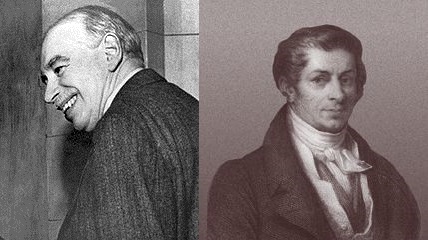
Keynesian follies make the news

An article by John Papola – you know, the chap who did the Macro Follies video and the Keynes-Hayek Rap – on the impossibility of consuming one’s way to prosperity. He has taken Say’s Law to places it has never been before, in this case into the PBS News Hour in the US. Many great observations but I will restrict myself to this:

As John Stuart Mill put it two centuries ago, ‘the demand for commodities is not the demand for labor.’ Consumer demand does not necessarily translate into increased employment. That’s because ‘consumers’ don’t employ people. Businesses do.

Since new hires are a risky and costly investment with unknown future returns, employers must rely on their expectations about the future and weigh those decisions very carefully. Economic historian Robert Higgs’ pioneering work on the Great Depression suggests that increased uncertainty can depress job growth even in the face of booming consumption. Consumer demand that appears to be driven by temporary or unsustainable policies is unlikely to induce businesses to hire.

Increased investment drives economic growth, while retrenched investment leads to recession and reduced employment — and it always has. John Maynard Keynes, like most business cycle theorists before him and since, paid particular attention to this boom and bust in investment, blaming volatility on the ‘animal spirits’ of businessmen. This observation about the importance of ‘confidence’ is surely true, if somewhat obvious.

Unfortunately, Keynes and his successors focus on aggregate levels of spending and often explicitly disregard the details of how money is spent and resources are employed. This led him and the profession down a dark road to the defunct underconsumptionist ideas of the early 1800s which haunt us to this day. Keynes repeatedly asserts throughout his famous tome, The General Theory, that even wasteful expenditures could increase the wealth of society.

Is it any wonder that so many of our policies are focused on consuming and sometimes even destroying wealth rather than creating it?

Do you ever wonder whether the mainstream economic establishment will ever begin to wonder whether this theory they have been peddling for three quarters of a century may be wrong.

Why aren’t the dissidents in the majority?

Having put up a post on Janet Yellen, the Vice Chair of the Federal Reserve in the US, I now find in today’s AFR that she’s hot favourite to become the next Chairman when Bernanke leaves. I, of course, expect nothing less from Obama. He has a knack for those kinds of things, but even so.

And while the article was naturally all about what a great choice her appointment would be, there were two very interesting side notes to give a bit of balance and perhaps some reason for second thoughts. First there was this:

Her record is not without fault. Yellen ran the San Francisco Fed – when it was right in the eye of the sub-prime storm – from 2004 to 2010, before Barack Obama promoted her to her current role as vice-chairman.

Two huge mortgage lenders – Countrywide and WAMU – collapsed under her watch.

Wow, she was the one responsible for overseeing Countrywide! Obviously just the person to run the entire show. And then there is a discussion of the other candidate for the Fed chair whose views seem to coincide with my own. From the article:

Yellen dismissed the views of dissidents such as Richard Fisher of the Federal Reserve Bank of Dallas who say [current] policies incite risky investing, distort markets and store up trouble for the future. . . .

Fisher is an emphatic opponent of QE and ultra-low rates. He argues they distort financial markets, defy an orderly exit and could fuel inflation.

This is the view of “dissidents”? It is surely the plainest common sense. The real worry is that central banks are now run by people who cannot understand what incredible risks are being run and just how badly it could all turn out.

Warring on aggregate demand

say and keynes

I have an article at Mises Daily today with the title, “The Errors of Keynes’s Critics”. I wrote it in reply to an article published a few weeks ago with the title, The Errors of Keynes. Goodness knows there are enough of such errors and it is a blessing to find someone else taking the Keynesian apparatus on. But if it is to be done, it needs to be done with care, and if you are going to invoke Say’s Law as this article did, it is essential in my view to get the central point right. The problem with this critque of Keynesian economics, which was a review of a book written in Spanish by Juan Ramón Rallo which had made the same points, was that it used Keynesian arguments as a means to refute Keynes. What I wrote was this:

Rallo thus attempts to controvert Keynes by confirming everything he wrote. People really do hoard, Rallo argues, and store money rather than spend. There really is a deficiency of demand in the short-to-medium term that may finally work itself out in the long run, in three-to-five years perhaps. Overproduction is impossible, but only ‘ultimately,’ and in the meantime it can occur. Involuntary unemployment does apparently occur because of some problem on the demand side of the economy due to hoarding. However, rather than this deficiency of demand being a bad thing, it’s a good thing, since the hoarding allows business to think about what to do next.

All very well, but as I pointed out, if you are Keynesian such as Krugman, once you agree that demand deficiency is a problem and people actually do hoard then it also licenses the government to come to the rescue with a stimulus package that will short-circuit the time period between income earned and income spent. Here is not the place to explain what’s wrong with the argument, but that there is something wrong with the theor is a conclusion that ought to have become more evident with each passing day as we bear witness to the immense damage the stimulus has caused. My conclusion:

If you want to get to the essence of Say’s Law you must never think in terms of aggregate demand and aggregate supply. Just drop it from all conceptual discussions of the economy and I think, although I can’t be sure, you will find yourself necessarily thinking about issues in the same way as the Classical economists. As I have argued in my Say’s Law and the Keynesian Revolution (Elgar 1998), if you want to defeat Keynesian economics, you need to wage war on the very notion of aggregate demand. Nothing else will do.

Really, nothing else will do. There are austerity packages in place but they are half-hearted and uncertain. There is little serious understanding of the economics that lies beneath the need to eliminate unproductive public spending if recovery is going to take hold. Maybe there is some other way to think it through and reach not just the right conclusions but also allow policy makers to explain with confidence why what they are doing needs to be done. Maybe. But to me unless you war on the very idea that demand for anything at all can help move an economy out of recession, I do not see how this Keynesian blight can ever be removed.

And let me finally express my gratitude to the editors at Mises Daily. Not everyone is as open to such discussions as they have very clearly shown themselves to be.

The deep deep incompetence of the American Federal Reserve

You really do have to wonder if the United States will ever get out of the economic problems it is now in if this presentation by Janet Yellen, the Vice Chair of the Federal Reserve, is an example of the best that economic analysis can provide. Depressing beyond words but let me take you to a couple of the lowlights just to get some idea of just how off the mark those in charge of policy can be. First this, on monetary policy:

The Federal Reserve typically plays a large role in promoting recoveries by reducing the federal funds rate and keeping it low until the economy is again on a solid footing.

Reducing the federal funds rate tends to reduce other interest rates and boost asset prices, thus encouraging spending and investment throughout the economy.

As it has before, the Federal Open Market Committee (FOMC) in 2007 started reducing the federal funds rate at the first signs of economic weakness and made sharper rate cuts as the recession deepened. As in some past recoveries that were disappointingly slow, the FOMC has kept rates low well after the end of the recession.

But unlike the past, by December 2008 the Committee had reduced the federal funds rate effectively to zero.

And to their astonishment, but not mine, this did not bring recovery with it so they have had to resort to other means such as flooding the economy with liquidity which again to their surprise, but not to mine, has also not brought on recovery. But why wreck only one arm of policy when you can wreck two. So here she is, musing about what has gone wrong in the American economy:

The greater amount of permanent job loss seen in the recent recession also suggests that there might have been an increase in the degree of mismatch between the skills possessed by the unemployed and those demanded by employers. This possibility and the unprecedented level and persistence of long-term unemployment in this recovery have prompted some to ask whether a significant share of unemployment since the recession is due to structural problems in labor markets and not simply a cyclical shortfall in aggregate demand.

Good question, is the problem structural – which it always is – or a shortage of aggregate demand – which it never is? Guess which answer she picks.

This question is frequently discussed by the FOMC. I cannot speak for the Committee or my colleagues, some of whom have publicly related their own conclusions on this topic. However, I see the evidence as consistent with the view that the increase in unemployment since the onset of the Great Recession has been largely cyclical and not structural. . . .

This and related research suggests to me that a broad-based cyclical shortage of demand is the main cause of today’s elevated unemployment rate.

Such hopeless ignorance and baseboard stupidity! When do you give up on a policy that has clearly not worked? When do you start wondering whether the theory you have been basing your policies on might just not be up to the task?

If the Federal Reserve were a business it would have looked to innovate or it would have died. But these people can outlast you and everyone else with their economic theories and whether they work or they don’t, on they will go and never stop expecting things to improve just around the corner. She can see that they are in the midst of the worst recovery since the Great Depression but cannot even begin to imagine that the Keynesian theory she learned as a young student might be completely wrong.

Well it is wrong, and the longer they persist with attempts to stimulate demand rather than with attempts to stimulate supply the longer the recession will run on. Not knowing the difference between the two and how policy would then be different if it’s a problem on the supply side of the economy, is inexcusable bordering on criminal negligence.

[My thanks to JA for sending me the Yellen speech.]