Who will audit the auditors?

The AFR had a very small article the other day written by Tony Shepherd that I wouldn’t have paid much attention to except that he is now going to run the Commission of Audit. One can only at this stage hope that the Commission does its job and raises the alarm about how our productivity is being wasted by governments in ways that lower our living standards and reduce employment. It is my strong belief after many years at the Chamber of Commerce and watching the ways of politicians, who respond to political rewards and not to economic, that governments should never allow themselves to think that anything they propose to produce will ever make the economy stronger, raise living standards or add to the number of jobs.

There are now a series of traditional areas for governments. National defence and roads which no one else will do. Schools, public transport and hospitals which may not be done to an optimal extent so we often find the private operators supplemented by the public. And there are a few natural monopolies that may require a more than usually heavy handed form of government regulation or even involvement. But after that, the governments should not involve themselves in any form of production whatsoever.

We have a market economy, and the plain fact is that most forms of production do not take place in the kinds of places politicians want to show up at to cut the ribbon when they are finally opened for business. You know, things like steel mills, mines, concrete producers, car washes, supermarkets, paint factories, paper clip and toothpick manufacturers. You know, the tens of thousands of small and detailed forms of production that are necessary to our wellbeing that spring to life as if from nowhere because there are profits to be made and which hire most of the people in this country who have jobs.

My article comments on a number of statements in Tony Shepherd’s own article which raise real concerns in my mind. Here are those statements:

“Governments and business and community leaders are increasingly united in recognising the merits of selling publicly owned assets to unlock funding for badly needed new infrastructure.”

“Contributing to a rethinking of privatisation is the opportunity to draw on superannuation funds as an alternative source of infrastructure investment.”

“The private sector can shoulder the lion’s share but governments will continue to have a substantial funding role when it comes to non-commercial or social projects.”

“We should be seeing a virtuous circle where governments funds get good projects started and, once the asset is mature, it is then sold.”

“Governments should be encouraging more private investment in green field projects by properly dealing with the problem of early market risk. There are ways to use the government balance sheet to do this.”

If these statements don’t raise dark thoughts in your own mind you should read my article. In fact, you should read my article anyway because there is likely to be a lot more of this up for discussion by a lot more people than myself in the years ahead.

Art Laffer and Say’s Law

laffer - us govt spending fall

There is an article by Arthur Laffer at The Spectator that you can find here here. And I only mention it because I want to point out that Laffer had himself tried to resurrect Say’s Law back in the 1980s. If you look at the original supply side revolution which is coincident with the Reagan Revolution, the literature is filled with Say’s Law, and even amongst the comments at the Spectator article, there is this:

Rubbish. Say’s Law (the formal name for the views in this article) has been refuted. I hope Krugman sees this article.

Me too. I hope he does see it. And I hope he does try to buy into this. He would for a change be taking on someone his own size in the heavyweight division. The cuts to public spending are the only way into resurrecting growth. Who knows, the sequester may yet make Obama an economic hero by having the American economy turned around on his watch. Not his doing but there you are.

And if you would like to see a bit more on Arthur Laffer and Say’s Law, this is the place to look. Jude Wanniski was the third in the triumvirate in the supply side revolution, along with the Great George Gilder.

Hating the rich

Theodore Dalrymple on the most destructive emotion of them all:

Still, hatred of the rich, which people do not hesitate to express as if it were a virtue to do so, rests fundamentally on two human connected emotions, both of them unattractive: envy and resentment. It also rests on the primitive notion of an economy as being a cake of a fixed size to be sliced up according to some plan, just or unjust as the case may be. On this view, a crumb in one man’s mouth is a crumb taken from another man. Poverty is the result, therefore, of wealth: which is true enough if you define poverty as being a certain percentage of the average or median income, as is all too often done. If you define poverty as the lack of subsistence or even physical ease, it is quite otherwise.

There’s much much more at the link.

A few scattered thoughts and questions

On Wednesday this week there was a small article on the editorial page of the AFR under the heading, “Sell Assets and Spend up Big”.

I wouldn’t normally have paid much attention to it except that it’s by Tony Shepherd who is about to head up the Commission of Audit. The headline is not a bad summary of the contents so let me do a bit of a review.

Governments and business and community leaders are increasingly united in recognising the merits of selling publicly owned assets to unlock funding for badly needed new infrastructure.

Here’s the problem which I will start with a question. How does the sale of assets translate into an addition to our resource base to allow us to undertake these projects? Looking separately at the financial side and the real resources side allows plenty of room for conceptual misjudgment. Sell up Medibank and Medibank is still there and operating. What resources have now been freed up? The Government now has more money to spend but has this sale increased the real level of national savings? I don’t see it but am willing to be convinced. But what must be done is to demonstrate that wherever these resources come from they are not crowding out other even more urgently needed and value adding investments. Selling assets won’t ensure that in any way.

Contributing to a rethinking of privatisation is the opportunity to draw on superannuation funds as an alternative source of infrastructure investment.

Those superannuation funds are not presently idle. They are not just sitting around doing nothing. They are invested somewhere, in whatever places the various trustees see as the place where the highest returns can be found. What will be different now? How will these funds become available to governments? What will happen to the projects that are currently being funded by superannuation? There is nothing new here, and if the government is in any way intending to divert these funds using some kind of guarantee or what will appear to provide a more certain monetary return, we are going to see our resources being used less efficiently and our growth rates diminish. Infrastructure is not a magic word that guarantees the money will provide a positive return or the resources used productively. See the NBN for a reality check.

The private sector can shoulder the lion’s share but governments will continue to have a substantial funding role when it comes to non-commercial or social projects.

There’s no doubt about that. No business will go anywhere near this kind of thing. The one certain province for governments is to invest in loss making projects. They do it all the time whether they intend it or not. But if it is loss making then it is slowing the economy and lowering our living standards. There may be equity and other considerations but do not confuse any of these with economic growth. This is four percent of GDP we are talking about, $760 billion on their own reckoning. Bad news to start wasting so much on government projects with no positive return.

We should be seeing a virtuous circle where governments funds get good projects started and, once the asset is mature, it is then sold.

Whatever this is, virtuous is not the word I would use. Governments have NO ability at picking value adding projects, none whatsoever. Before you start on something new, give us the list of previous projects, over the past fifty years let us say, where government money has built some kind of value adding profitable investment. There is no history this side of the Snowy River which may well have been done by the private sector had it been given the opportunity. Governments should never be allowed to choose projects and where they do they should start by admitting that the project will never be profitable but is being done for some other reason. Governments should stick to national defence and road building. Maybe schools and hospitals, maybe. But for the rest, they should leave alone. They have no history of getting it right and there is no reason to think this will change and every reason to think they will get it wrong.

Governments should be encouraging more private investment in green field projects by properly dealing with the problem of early market risk. There are ways to use the government balance sheet to do this.

Danger, danger, danger! The way to deal with early market risk is to leave it to the market. It is the only way. Every business would love to have its risks covered by some kind of government bail-out guarantee. That is the certain way to end up with sub-optimal projects, misdirected investment, slower growth and lower living standards.

But in the end, this is only one man’s view although it is the particular man who will be chairing the Commission of Audit. Hopefully by the time he has come to the end of this process and released his report he will see things in a completely different way.

What does it take to get the point across?

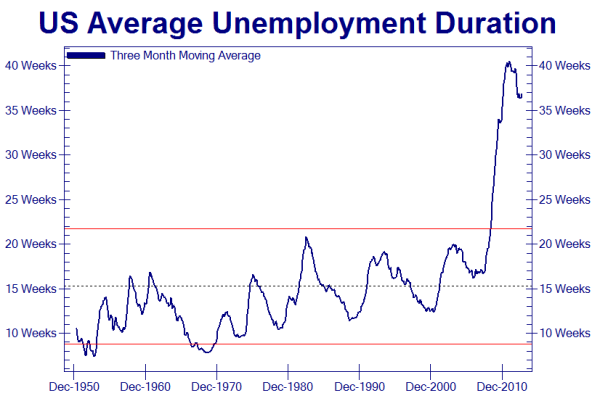
duration of unemployment - us average - 2013

There is something different about the years since 2009, that is, since the year in which the stimulus commenced. The US may never again open for business in the way it once did, and it certainly won’t without some profound change in direction for which there is no evidence of a will on anyone’ part to make that change of direction happen.

Keynes versus Hayek once again

alex on keynes and hayek

I suppose that’s one way to look at it: Keynesian economics as a make-work project for anti-Keynesians. On the other hand, if the notion that digging holes to fill them in again doesn’t strike you as the epitome of an insane economic policy then what hope is there for any of us other than for the hole-digging and hole-filling industries, along with businesses in shovel and overalls production. But Alex does get the nature of Keynesian economics 100% right. It is just what Keynes recommended and Krugman to this day supports.

[My thanks to Robert for sending this along. How could I have missed it?]

I’m not a Niallist

I read Niall Ferguson’s three posts on Paul Krugman which are generally summarised in this critique of Krugman and titled, “Much Bigger Than The Shutdown: Niall Ferguson’s Public Flogging Of Paul Krugman“. And you may be sure that nothing would be of greater interest to me than a proper take down of Krugman and the Keynesian theory that lies behind it. But while this critique may work in the world of non-economists it doesn’t work for me. There is nothing in it I feel I can refer to as an actual dissection of Krugman’s views. It certainly won’t affect any of Krugman’s own beliefs nor that of any modern economist.

Krugman’s position might really be brought down to three propositions:

1) To get out of our current recession it was, and is, necessary to have a full blown Keynesian stimulus.

2) Obama’s actual stimulus was too small. It was large enough to appear large enough but it was too small to actually achieve its ends and so will only discredit Keynesian theory and policy rather than demonstrate its effectiveness.

3) And for Austrian critics, where’s the inflation that is supposed to follow this wasteful expenditure since prices have been dead flat if not tending towards deflation? You may have pointed out that inflation that followed the spending of the 1970s but now there’s none so an Austrian analysis is completely wrong.

Ferguson made no headway on any of this. Instead, he stepped back and wrote:

I am not an economist. I am an economic historian. The economist seeks to simplify the world into mathematical models – in Krugman’s case models erected upon the intellectual foundations laid by John Maynard Keynes. But to the historian, who is trained to study the world ‘as it actually is’, the economist’s model, with its smooth curves on two axes, looks like an oversimplification. The historian’s world is a complex system, full of non-linear relationships, feedback loops and tipping points. There is more chaos than simple causation. There is more uncertainty than calculable risk.

Well great. This is not just Keynesian economics it is all economics that Ferguson takes aim at. By its nature, economics is about simplification, sometimes using smooth curves on two axes (e.g. supply and demand). And while I am a critic of economic theory along many dimensions, including the way in which the uncertain future is almost invariably swept away by many forms of modern analysis, this is so superficial and wrong headed that it leaves me absolutely cold. Krugman can ignore it because it in no way touches anything that matters in his economics and analysis. This is no answer at all.

But then to go on about how beastly Krugman is in how he attacks his opponents, and to praise Keynes as the contrast, is to show a fantastic ignorance of Keynes and the polemical nature of The General Theory. This is Ferguson attacking Krugman:

Finally – and most important – even if Krugman had been ‘right about everything,’ there would still be no justification for the numerous crude and often personal attacks he has made on those who disagree with him. Words like ‘cockroach,’ ‘delusional,’ ‘derp,’ ‘dope,’ ‘fool,’ ‘knave,’ ‘mendacious idiot,’ and ‘zombie’ have no place in civilized debate. I consider myself lucky that he has called me only a ‘poseur,’ a ‘whiner,’ ‘inane’ – and, last week, a ‘troll.’

Here Krugman is doing no less than Keynes did himself. Keynes famously initiated a slash and burn on the economics of his predecessors and attacked them not just intellectually but personally, most notably his own mentor at Cambridge, A.C. Pigou. Keynes said it was to ensure that attention was paid to his book since the issues were so important, but Pigou was clearly aggrieved and said so in the opening words of his review of the The General Theory:

WHEN, in 1919, he wrote The Economic Consequences of the Peace, Mr. Keynes did a good day’s work for the world, in helping it back towards sanity. But he did a bad day’s work for himself as an economist. For he discovered then, and his sub-conscious mind has not been able to forget since, that the best way to win attention for one’s own ideas is to present them in a matrix of sarcastic comment upon other people. This method has long been a routine one among political pamphleteers. It is less appropriate, and fortunately less common, in scientific discussion. Einstein actually did for Physics what Mr. Keynes believes himself to have done for Economics. He developed a far-reaching generalisation, under which Newton’s results can be subsumed as a special case. But he did not, in announcing
his discovery, insinuate, through carefully barbed sentences, that Newton and those who had hitherto followed his lead were a gang of incompetent bunglers. The example is illustrious: but Mr. Keynes has not followed it. The general tone de haut en bas and the patronage extended to his old master Marshall are particularly to be regretted. It is not by this manner of writing that his desire to convince his fellow economists (p. vi) is best promoted.

Alas, it did turn out that this was indeed the best way to influence his fellow economists and it is a template that Keynesians have followed ever since. Krugman’s style and form of attack – stupid, ignorant, incompetent bungler that he is (two can play at this game, I suppose) – is patterned after Keynes who was as arrogant as anyone who has ever written on economic matters as well as being amongst the most incompetent. An actual economic ignoramus who did his undergraduate degree in philosophy and notoriously, on Joan Robinson’s say so, never understood basic micro – “Maynard never spent the half hour necessary to learn price theory” – which is a pretty large gap in any economist’s knowledge base. That in trying to refute Say’s Law he fell right into the oldest fallacy in economics but then took the entire profession along with him is just one of those very unfortunate events that history is filled with. Every economist of his generation with no exception thought The General Theory was end-to-end nonsense. But the economics they knew has now disappeared as have those economists and is now replaced with the poisonous nonsense peddled by Krugman.

This is what Niall Ferguson does not discuss because he doesn’t understand it himself. But you would need a combination of an actual historical understanding of the development of economic theory up to the publication of The General Theory along with a reasonably sound understanding of why it was superior to what we find today. Alas, it is a relatively rare combination but some at least do have it. But if you try to say this to Keynesians in public, they will shout you down and threaten to remove your license to practise economics. Yet it is the Keynesians of the modern text – the people who think Y=C+I+G actually makes economic sense – who are the barbarians ruining our economies right before our eyes.

Debt by the numbers

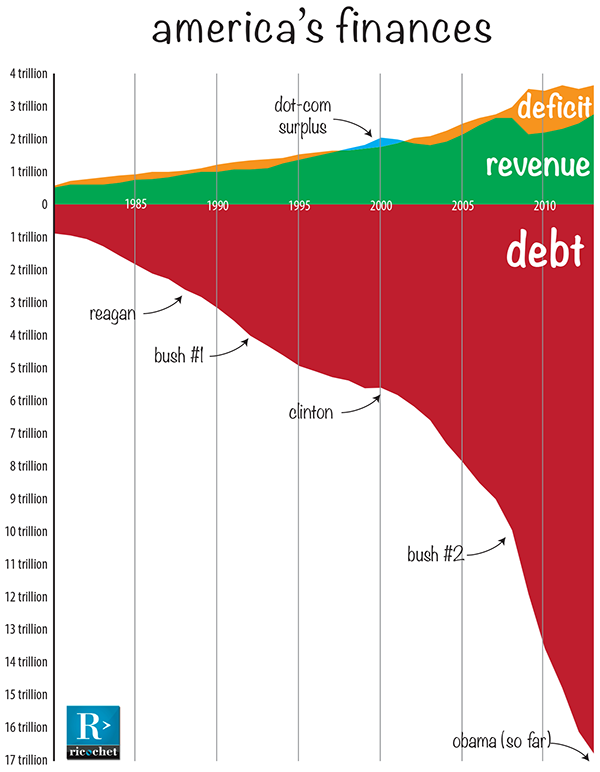
deb and deficits in the us

I wonder if this is related to this: In 23 Advanced Economies: U.S. Adults Rank 21st in Math Skills. The inability to even be frightened by these numbers, by the size of the debt, by the impossibility of ever repaying this side of inflation even some remote part of the total, by the rate of its current growth, all of these suggest a deficiency amongst large proportions of the American voting public requires an explanation. A deficient understanding of maths is not all that far from a genuine possibility. The voting population in the United States is much degraded from the informed public that had once existed.

Australia, by the way, was 13th in math, almost dead on the international average and 4th in literacy. There is hope for us yet. But with the US, I cannot see what the answer is.

The black knights of Keynesian economics

July Sloan has an article in today’s Australian she titles, “Robust views build better debate, so let’s have them“. I don’t mean to quibble but there is plenty of debate, just little engagement. No one who visits this site can be in any doubt that there are critics of economics around as not a few of us here bound into the various inanities that are prevalent everywhere.

I have written books and papers and blog posts about Keynesian economics but no one amongst those economists wishes to take me up on any of it or at least not for the past three years. Even Judy, in her article, never mentions Keynes and Keynesian economics although she lists “the wisdom of the fiscal and monetary policies implemented in the US since the global financial crisis” as her number one problem and uses Paul Krugman as Exhibit A of an engaged economist.

In fact, both so far as politics and policy are concerned, the Keynesians have been routed. I would be glad to hear from any of them who in 2013 would like to repeat in public all of that nonsensical “Keynes the Master” we not so long used to hear about ad nauseum. The stimulus has been an unmitigated disaster everywhere it has been applied with no exception. And slowly everyone is withdrawing the spending (except in the basket case economy of the US), even though all have high rates of unemployment, as they edge their way towards a return to prosperity. From Greece to China, in Australia and across the world, Keynesian theory is dead except in our economics texts.

And it’s not just in macro that the academic world of economics is fading. In my Free Market Economics I go after the marginal revenue-marginal cost analysis as shallow to the point of vacuous. I teach marginal analysis, of course, but heaven forfend that I should inflict any of that on my poor unsuspecting students. I also get not a little vexed about the term “perfect competition” which so far from being perfect (not to mention literally impossible as defined) is the kind of world in which no Microsoft, Apple or BHP could every exist. In my view I teach one of the finest economics courses in the world. But engagement from other economists over anything I write, never a word is said or written.

And then again re Keynes, I have written in a published article how he poached immense amounts from others in putting together The General Theory. No one has ever written a reply. I bring it up in conversations and no one even thinks even to attempt to rebut what I say. Try this on yourself if you are an economist. The term “Say’s Law” and the phrase “supply creates its own demand” are not classical in origin. Both are twentieth century, the first entering into common discourse in 1921 and the second first found in a book published in 1933 which Keynes is absolutely 100% certain to have read while writing The General Theory. So how did they get into the book? You tell me without having to acknowledge that there are things about how The General Theory was written that I know and no one else does or if they do know feel free to ignore.

And lastly, as far as individuals declaring themselves Democrat or Republican in the US, everyone registers with one side or the other so that they can vote in the primaries.

“I’d love to know more about what causes business cycles”

I was sent a copy of an interview with Eugene Fama, the newly minted Nobel Prize winner for economics, in which the covering letter implied that when I read it through I would see what a poor choice he had been. So I read it through and at the end I had an even higher regard for Fama than I had had before. Such is the nature of economics. But there was this one bit that jumped right off the page:

Q: What will be financial crisis’s legacy for the subject of economics? Will there be big changes?

A: I don’t see any. Which way is it going to go? If I could have predicted that, that’s the stuff I would have been working on. I don’t see it. (Laughs) I’d love to know more about what causes business cycles.

Now the depressing thought is that there actually might not be any changes, big or small. Economics is now in the hands of the public service who want nothing more from theory than an excuse for their own existence. An economics that leaves them with little to do does not have much of an appeal to heads of Treasuries and central banks. And since Fama just after he says what I quoted above then said, “I used to do macroeconomics, but I gave (it) up long ago”, makes me think that he’s not been in that part of economic theory for quite a while. And that, of course, is the area that needs to be explored.

The business cycle is where the work needs to be done but if Fama is anything like the 99% who know little of what came before Keynes then he knows too little about how to think about the cycle and its rich and detailed pre-Keynesian literature. Fama understands that you cannot beat the market, not just in terms of knowing more than anyone else, but you cannot beat the market as the way to generate economic growth and prosperity. It is the high table of economic management but we have instead handed over economic management to people whose highest personal achievement was getting high distinctions in game theory and math ec.

It used to be said it’s all in Marshall but no one meant that literally. I still say it’s all in Mill, and while I don’t mean that literally either, there’s more there than in Mankiw. But wherever it can all be found if such a place exists, it is definitely not in a modern text in macro. It’s time we all tried to know more about what causes the business cycle, because that is where the answers, if there are any answers, will be found.