Keynes view on deficits and spending


I have received a request from an old friend. He asked for passages that would be considered a compact summary of Keynes view on deficits and spending in Keynes’ own words. The following encompasses my efforts to put this request into effect.

#1

Here’s an article that I have run across, from The Guardian: Keynesian economics: is it time for the theory to rise from the dead? No direct quotes, however, but this is just the beginning of my hunt. It’s the standard nonsense you see everywhere today. Deficit spending assumes the existence of saleable goods and services that are not being bought because everyone prefers to save their money rather than spend it. 

Imagine this. In late 1936, shortly after the publication of his classic General Theory, John Maynard Keynes is cryogenically frozen so he can return 80 years later.

Things were looking grim when Keynes went into cold storage. The Spanish civil war had just begun, Stalin’s purges were in full swing, and Hitler had flouted the Treaty of Versailles by remilitarising the Rhineland. The recovery from the Great Depression was fragile. It was the year of the Jarrow march and Franklin Roosevelt’s second presidential election victory.

Waking up in 2016, Keynes wants to know what’s happened in the past eight decades. He’s told that the mass unemployment of the 1930s finally came to an end but only because military production was ramped up by the great powers as they came to blows for the second time in a quarter of a century.

The good news, Keynes hears, is that lessons were learned from the 1930s. Governments committed themselves to maintaining demand at a high enough level to secure full employment. They recycled the tax revenues that accrued from robust growth into higher spending on public infrastructure. They took steps to ensure that there was a narrowing of the gap between rich and poor.

The bad news was that the lessons were eventually forgotten. The period between FDR’s second win and Donald Trump’s arrival in the White House can be divided into two halves: the 40 years up until 1976 and the 40 years since.

Keynes discovers that governments deviate from his ideas. Instead of running budget surpluses in the good times and deficits in the bad times, they run deficits all the time. They fail to draw the proper distinction between day-to-day spending and investment. In Britain, December 1976 was the pivotal moment. Matters came to a head in early December when a divided and fractious cabinet agreed that austerity was a price that had to be paid for a loan from the International Monetary Fund, which was needed to prop up the crashing pound….

His General Theory says that the desire of the private sector to invest is affected by “animal spirits”. When animal spirits are low, governments should step in with public investment. They should do this even at the cost of a higher budget deficit, because the higher growth that will result will mean the investment more than pays for itself.

He is aghast to hear that apart from during a brief period of collective stimulus in 2009, this approach has not been followed. Governments quickly grew concerned about the size of their budget deficits and cut public investment. 

But weak growth meant deficit reduction took longer than expected. Ultra-low interest rates for the best part of a decade have led to asset-price bubbles. Measures of private indebtedness are rising again. All depressingly predictable, Keynes says. Time to return to 1936.

Before you go, he is asked, what advice do you have for policymakers in 2016. Keynes outlines three alternatives to the status quo. The tax-cutting and infrastructure spending plan proposed by Trump will lead to stronger growth in the short term, but Keynes says he is not especially impressed. He fears that there will be little extra investment in the public infrastructure that the US actually needs and that the stimulus will be poorly focused.

The second option would be to exploit exceptionally low interest rates by borrowing for long-term investment projects. Governments could do this without alarming the markets, Keynes says, if they followed his teachings and borrowed solely to invest.

Option number three would involve being more creative with quantitative easing, Keynes says. Instead of the newly created money being used for speculative plays, why shouldn’t governments use it to finance infrastructure? Building homes with QE makes sense; inflating house prices with QE does not.

There is, he adds, another escape route. We were building up to it in 1936 and it arrived three years later. Not recommended.


#2

What Keynes really said about deficit spending

What Keynes Really Said about Deficit Spending Author(s): Elba K. Brown-Collier and Bruce E. Collier Source: Journal of Post Keynesian Economics, Vol. 17, No. 3 (Spring, 1995), pp. 341-355 Published by: M.E. Sharpe, Inc. Stable URL: http://www.jstor.org/stable/4538449 .

First para:

It is commonly believed that Keynes’ primary policy prescription for economic stabilization and full employment is federal govenment deficit spending. As will be developed below, Keynes’ policy for promoting full employment or reducing economic fluctuations was the socialization of investment. Any connection between his policy proposal and deficit spending was related to the choice of financing such social investment. The policies pursued in the United States over the last forty years have not been consistent with Keynes’ proposals for economic stabilization and have caused ever increasing deficits and financial instability.

Quotes from the article.

Keynes believed the following three phases would develop at the end of the war. (i) when the inducement to invest is likely to lead, if unchecked, to a volume of investment greater than the indicated level of savings in the absence of rationing and other controls; (ii) when the urgently necessary investment is no longer greater than the indicated level of saving in conditions of freedom, but is still capable of being adjusted to the indicated level by deliberately encouraging or expediting less urgent, but nevertheless useful, investment; (iii) when investment demand is so far saturated that it cannot be brought up to the indicated level of savings without embarking upon wasteful and unnecessary enterprises. [CW, vol. XXVII, p. 321]

But not a quote from Keynes although very on the money.

In summary, Keynes’ budget policies and stabilization policies call for the following: 1. As the normal circumstance of a capitalist system would result in insufficient private investment, 2 where total investment is less than the amount of saving that would be generated at full employment, social investnent would be necessary to maintain full employment. Further, since fluctuations in private investment are likely to occur, the investment plans of public and quasi-public entities should be designed so that they could be varied in a countercyclical pattern.

2. Countercyclical variation in incomes via taxes and, therefore, spending should not be relied on to maintain full employment and thestimulation of private investment by lowering interest rates is not likely to be sufficient to maintain the level of investment necessary for full employment.

3. Public investment should consist of those projects that provide a real return over time, either in cash retums such as public enterprises, or indirect returnsuch as school buildings. Such investment should be done from the point of view of the public good rather than private return. The shortage of private investment is likely to be so large that required public investment could range from 7.5 percento 20 percent of net national product.

4. The government should not deficit finance current expenditures. Public investment expenditures should be financed by borrowed funds that are repaid over the service life of the project. Tax revenueshould be budgeted so as to meet these payments.

5. There should be no deficit in the current or ordinary budget. In economic downtums the automatic variation in the collection of social security contributions might result in a deficit in that fund. However, in prosperous times, the fund should automatically run a suTplus. No other type of deficit should be incurred in the current budget. It is possible, however, to reduce contributions to the sinking fund for repayment of outstanding nonproductive debt in periods of economic downturn.

6. The borrowing from the public for financing public investment is best done by the central government. This would reduce credit costs to local governmental entities. 

#3

Most famously and this is a quote. From The Economic Consequences of the Peace (Keynes 1920)

“Lenin is said to have declared that the best way to destroy the Capitalist System was to debauch the currency. By a continuing process of inflation, governments can confiscate, secretly and unobserved, an important part of the wealth of their citizens. By this method they not only confiscate, but they confiscate arbitrarily; and, while the process impoverishes many, it actually enriches some.”

We read this passage today with our definition of the term “inflation” understood in relation to Keynesian theory, which means more or less all economic theory following the publication of The General Theory in 1936. Before 1936, inflation was not something that passively occurred to the price level as we think of it today. Prior to 1936, inflation was an act of policy in which the money stock was artificially inflated at a rate of growth that exceeded the growth in the real level of output. A frequent consequence was a rise in the price level, but the inflation was the policy levers that were pulled prior to the rise in the price level, not the rise in the price level itself.

#4

From A Glossary of Political Economy Terms – the definition of “inflation” http://webhome.auburn.edu/~johnspm/gloss/inflation.phtml

In contemporary usage, a sustained rise over time in the general level of prices, normally measured by a weighted index of prices of a large and representative sample of goods and services (both consumers’ goods and producers’ goods) regularly traded in the economy under consideration.

(In 19th century usage, the term referred more specifically to any sustained expansion in the stock of money available within the economy under consideration — the eventual consequence of which would normally be a generalized increase in prices.)

#5

This is taken from Chapter 7 of Classical Economic Theory and the Modern Economy by Steven Kates (Elgar 2020). Chapter 7 is titled: “Keynesian Theory Overruns the Classics”. This is the link to the Elgar website on the book: 

https://www.e-elgar.com/shop/gbp/classical-economic-theory-and-the-modern-economy-9781786433565.html

An Unexpected Critic: Keynes on the “Classical Medicine” (1946)

Lastly, this from Keynes himself. He has notoriously been quoted as saying, “I am not a Keynesian”. That this may be in fact true, as his last, posthumous, article from The Economic Journal, may make clear. Keynes, by 1946, may have been the last of the classical economists. By the time this was published, Keynes had passed away which may be why it is not found in the thirty volume Collected Writings of John Maynard Keynes. He is discussing the forces at work that help bring economies towards an international equilibrium that will occur by leaving things to the market.

“I find myself moved, not for the first time, to remind contemporary economists that the classical teaching embodied some permanent truths of great significance, which we are liable to-day to over-look because we associate them with other doctrines which we cannot now accept without much qualification. There are in these matters deep undercurrents at work, natural forces, one can call them, or even the invisible hand, which are operating towards equilibrium. If it were not so, we could not have got on even so well as we have for many decades past….

“We have here sincere and thoroughgoing proposals, advanced on behalf of the United States, expressly directed towards creating a system which allows the classical medicine to do its work. It shows how much modernist stuff, gone wrong and turned sour and silly, is circulating in our system, also incongruously mixed, it seems, with age-old poisons, that we should have given so doubtful a welcome to this magnificent, objective approach which a few years ago we should have regarded as offering incredible promise of a better scheme of things.

“I must not be misunderstood. I do not suppose that the classical medicine will work by itself or that we can depend on it. We need quicker and less painful aids of which exchange variation and overall import control are the most important. But in the long run these expedients will work better and we shall need them less, if the classical medicine is also at work. And if we reject the medicine from our systems altogether, we may just drift on from expedient to expedient and never get really fit again. The great virtue of the Bretton Woods and Washington proposals, taken in conjunction, is that they marry the use of the necessary expedients to the wholesome long-run doctrine. It is for this reason that, speaking in the House of Lords, I claimed that ‘Here is an attempt to use what we have learnt from modern experience and modern analysis, not to defeat, but to implement the wisdom of Adam Smith.’” (Keynes 1946: 185-186)

 One cannot walk away from a text such as this without wondering what Keynes’s own judgement may have been on what “Keynesians” had done with his arguments.

“It shows how much modernist stuff, gone wrong and turned sour and silly, is circulating in our system, also incongruously mixed, it seems, with age-old poisons

Nor what did he mean when he wrote:

“I must not be misunderstood. I do not suppose that the classical medicine will work by itself or that we can depend on it. We need quicker and less painful aids of which exchange variation and overall import control are the most important. But in the long run these expedients will work better and we shall need them less, if the classical medicine is also at work. And if we reject the medicine from our systems altogether, we may just drift on from expedient to expedient and never get really fit again.”

This is no idle speculation given how badly the modern prescriptions of that Keynesian medicine have left our economies. Economies never get really fit again, using Keynes’s words, until the “Keynesian” prescriptions are reversed. Keynes seems to have recognised just how badly those who had supposedly carried his message forward had mangled the policy mix. Unfortunately, in the immediate post-War period, he was no longer there to explain just what those errors were.
Barely alive

Taken from Joe Biden’s Handlers Let Him Out, and Things Are Not Fine. There it says:

Earlier today, the Democrats in the Senate passed their COVID “relief” bill along a party-line vote. Not even Lisa Murkowski or Mitt Romney saw fit to break ranks this time because that’s how bad this piece of legislation is. In fact, only 9% of the bill goes to direct assistance for those who have suffered at the hands of government lockdowns. The rest goes to a smattering of special interests and payoffs, from the National Endowment of the Arts to bailing out blue states that were in dire financial straits long before the pandemic hit….

Biden truly looks barely alive at this point. His skin is taut, his eyes are squinty, and he once again shows an inability to articulate even the most basic points. None of his verbal fumbles are due to any supposed stutter. Keep in mind, there’s a teleprompter feeding him lines in a massive font right in front of him. How in the world is this guy ever going to do a State of the Union address if he can’t operate for ten minutes in an environment built to prop him up?

We are always in uncharted waters, but this time we are really really in uncharted waters. Where we end up four years from now is utterly unknowable, other than the name of the woman who will become president in name only, to replace the man who is now president in name only.

BTW there is at least one economist – up, down and sideways – that does not think you need to spend the money to grow the economy. In fact, if your interest is in growing the economy, not one cent of it should be spent. Just leave it alone, and the economy will grow back by itself.

Victoria is heading for financial disaster

Victoria is heading for financial disaster that will make the lockdown look like a minor incident along the road to Dan Andrew’s destruction of the state he has been overseeing. It’s only a small story, of course, but at least it is being mentioned: Building boom blamed for blowouts. It’s described as an “Exclusive” mostly because none of the other members of the Victorian media will go near it. You will never see this on the ABC for example.

VICTORIAN road projects are suffering big cost blowouts as the Andrews government battles to rein in the rising cost of labour and materials. The Sunday Herald Sun can reveal a series of suburban road upgrades have cost more than $50 million more than first planned, and some projects have blown out by nearly a quarter of the original cost…. Cost blowouts also affected works to strengthen bridges in regional Victoria, and just one of seven planned upgrades was completed last year because of changes to projects and rising costs.

It’s modern economic theory that is partly to blame, since everyone is now taught how public spending is necessary to create jobs. Absolutely wrong, of course, but everyone thinks it so that phenomenal amounts of money are poured into one wasteful project after another, projects that will never ever recover their costs in the value of their retunrs to the community. But it is possible that help is on the way, or at least a small modicum of coherence. I’ve emphasised the bits that need to be understood and then become the focus of attention, first for the Opposition and then for the rest of the community.

Opposition Transport spokesman David Davis said the government could not manage the finances of major projects. “Everywhere you look … costs have blown out and timelines are shot,” he said. “The community expects projects to be built on time, they don’t expect money to be wasted or squandered. “Many projects are delayed and its all down to the government’s own incompetence.”

The issue is NET costs, that is, the relative size of the return as against the costs of doing whatever is being done. Seems basic, but there is not a socialist government in the world that gets it right, with almost as many non-socialists as clueless as the socialists.

Marriner Eccles

Marriner S. Eccles was another of the early Keynesians of which there were quite a few. Keynes wrote the book but the ideas were in the air then as they remain today. This is from Wikipedia.

Marriner Stoddard Eccles (September 9, 1890 – December 18, 1977) was an American bankereconomist, and member and chairman of the Federal Reserve Board.Eccles was known during his lifetime chiefly as having been the Chairman of the Federal Reserve under President Franklin D. Roosevelt. He has been remembered for having anticipated and supporting the theories of John Maynard Keynes relative to “inadequate aggregate spending” in the economy which appeared during his tenure. As Eccles wrote in his memoir Beckoning Frontiers (1951):

As mass production has to be accompanied by mass consumption, mass consumption, in turn, implies a distribution of wealth … to provide men with buying power. … Instead of achieving that kind of distribution, a giant suction pump had by 1929-30 drawn into a few hands an increasing portion of currently produced wealth. … The other fellows could stay in the game only by borrowing. When their credit ran out, the game stopped….

Eccles was and is seen as an early proponent of demand stimulus projects to fend off the ravages of the Great Depression. Eccles was famously rebuked by Congresswoman Jessie Sumner (RIL) during a House of Representatives hearing on the increasingly liberal policies of the Roosevelt administration and the Federal Reserve, when she said, you just love socialism.” He became known as a defender of Keynesian ideas, though his ideas predated Keynes’ The General Theory of Employment, Interest, and Money (1936). In that respect, he is considered by some to have seen monetary policy having secondary importance and that as a result he allowed the Federal Reserve to be sublimated to the interests of the Treasury. In this view, the Federal Reserve after 1935 acquired new instruments to command monetary policy, but it did not change its behavior significantly. Further, his defense of the Federal Reserve-Treasury accord in 1951 is sometimes seen as a reversal of his previous policy stances.

Economic clowns at every turn

Fascinating title from an article in the Financial Times: Why economists keep being wrong on policy. It comes with a bit of interesting content in its description of the nature of economic theory and policy:

The abiding sin threaded through it all was that of certitude. Perfectly plausible but untested theories, whether about the money supply, fiscal balances and debt levels, or market risk, were elevated to the level of irrefutable facts. Economics, essentially a faith-based discipline, represented itself as a hard science. The real world was reduced by the 1990s to a set of complex mathematical equations that no one, least of all democratically elected politicians, dared challenge.

Thus detached from reality, economic policy swept away the postwar balance between the interests of society and markets. Arid econometrics replaced a measured understanding of political economy. It scarcely mattered that the gains of globalisation were scooped up by the super-rich, that markets became casinos and that fiscal fundamentalism was widening social divisions. Nothing counted above the equations.

And what is the conclusion?

And now? After Donald Trump, Brexit and Covid-19, it seems we are back at the beginning. Time to dust off Keynes’s general theory.

It does make me laugh. Donald Trump created the greatest economic upturn in American history but that remains completely invisible to these clowns. It would never occur to them to examine just what happened and why it might have worked. But the notion that Keynes and his General Theory have been absent from policy and need to be brought back may be the most stupid comment I have seen on economic theory and policy in a very long time.

“A perspective on the operation of an economy that has unfortunately entirely disappeared”

Here is a very nice review of my Classical Economic Theory and the Modern Economy in The History of Economics Review, written by Nathan Saunders, linked here. I can only say how grateful I am to find a review of the book written in sympathy with its aims and arguments. Here is his opening para:

The aim of Steven Kates’s latest book – Classical Economic Theory and the Modern Economy – is for readers to appreciate John Stuart Mill’s deep and broad understanding of economics along with the whole of the classical school from around the middle of the nineteenth century through to its final and complete disappearance with the publication of The General Theory in 1936. Moreover, Kates argues, it is our loss that we have primarily ignored the timeless principles embedded within classical theory. Presented between the covers are many arguments as to why Mill and his classical contemporaries should be front and centre within the economics discipline to this day. The following are five arguments from his book, presented in no particular order, with which I strongly agree.

He then goes through the five reasons why classical theory should be at the forefront of our understanding of how economies work. Of course the main reason is that modern economic theory, with its Keynesian demand management ethos embedded at every stage in the process, has never been able to provide a solution to a single economic downturn on even a single occasion since The General Theory was published. As discussed in the review:

Kates presents Mill’s fourth proposition on capital: ‘Demand for commodities is not demand for labour’. This proposition has not been refuted by the Keynesian revolution, nor by anyone else for that matter. Kates states: ‘The level of employment was unrelated to the level of aggregate demand … [and Mill] understood the errors embedded in any such attempt’ for policy-makers (221). Mill emphasized the harm embedded in such policies, an understanding that has disappeared, even as an issue to be debated. Mill kept all four of his propositions on capital pragmatic, commonsensical, and timeless. Moreover, Kates defends this momentous fourth proposition not only by drawing upon his knowledge of the history of economic thought, but also through a discussion of the many failed efforts to short-circuit recessions through increases in public spending.

Dead on. Let me recommend the book to you, but also might I suggest that you ask your local library to order a copy both for yourself to read along with others.

BTW the heading is taken from Nathan’s own text.

Educating people about the victims of capitalism

This is from Quora: How can I educate people about the millions of victims of capitalism?

Great question, this is easy! [Answered by Paul O’Brien, CEO of MediaTech Ventures found in Austin, Texas.] Here’s his answer.

First.

Explicitly define capitalism:

An economic and political system in which a country’s trade and industry are controlled by private owners for profit, rather than by the state.

Right? We have to be clear about what it is if we’re going to then educate people properly about something.

Second.

List some countries in which the country’s trade and industry are controlled by private owners…

Singapore, Hong Kong, and New Zealand are the closest we can get.

Shoot, this isn’t as easy as I thought.

Okay, back up… according to the The Heritage Foundation, which reports on this stuff, those are the only 3 countries in which trade and industry are almost entirely controlled by private owners.

From there, the ranking of that control drops quite a bit, with Australia, Switzerland, and Ireland next. Then it slides pretty rapidly from there.

The United States, troublingly argued by many to have these capitalists and respective victims, is actually way down the list at about 17. And when I think about it, I can’t think any example of anything in the United States that is controlled by private owners – the government is involved in every aspect of business and trade.

Still, let’s roll with what we’ve found so far; we can only educate given the facts, right?

So, 3 countries to which to refer.

Third.

Explain what each of these countries and their capitalists do, that’s terrible.

1. Singapore. Singapore has been ranked as the top city in Asia in terms of quality of living according to global human resource consultancy, Mercer. Singapore is also regarded as the ‘Happiest country in South-east Asia’ according to the 2018 World Happiness Report .

[crepe]… this isn’t starting out so well is it?

Its sustained extraordinary performance has resulted in one of the world’s highest per capita incomes and solid rates of GDP growth.

Singapore is one of the world’s most prosperous nations, with a business-friendly regulatory environment and a very low unemployment rate.

okay okay… okay. Let’s move on.

2. Hong Kong. Hong Kong is a world financial center with low taxation rates and free trade. The city is connected by a well-developed but cheap public transportation system and offers extensive international travel connections for its large expat community. Adding its ease of doing business, the free public wifi, high safety rating.

[frack]…

The ongoing political and social turmoil has begun to erode its reputation as one of the best locations from which to do business, dampening investment inflows.

A ha! SEE!!!!! Atrocities.

no, no… wait a second… that’s because of the incoming government and the transfer of power of Hong Kong to China.

Okay, moving on…

3. New Zealand. Alright, we have to have something here! New Zealand… right? Come on. That country where Lord of the Rings was filmed. Seriously, where did they get all those Orc extras if not for it being a terrible place to live. Let’s take a look…

New Zealand ranks above the average in health status, income and wealth, environmental quality, personal security, civic engagement, housing, subjective well-being, education and skills, jobs and earnings, and social connections but below average in work-life balance.

seriously?!?! you gotta be kidding me…

Let’s move on to the forth step and really get this message across

Fourth.

Go to the other extremes and give the counter point. In order to effectively educate, we:

  1. define and explain
  2. Give valid examples
  3. Give counter examples

So, counter examples.

Bottom on the list of economic freedom where private owners retain the liberty to control what they do and decide how it works… That is, the places LEAST capitalist:

North Korea, Venezuela, and Cuba.

*sigh*

Okay okay, let’s give it the benefit of the doubt and work further up the list, increasingly toward countries with more private ownership and control of trade and industry…

Eritrea, Republic of Congo (isn’t that where they recently wrapped up a civil war?), Bolivia, Zimbabwe, Sudan (wait, as in the Darfur genocide?!), Sierra Leone, Liberia, Iran…

screw it, I give up.

Fifth.

You make your point in summation.

And it seems that what we’ve learned is that the victims of capitalism are the people who have lost capitalism to increasing governance, regulation, and control.

How can I educate people about the millions of victims of capitalism?

I’d proceed by educating thusly..

Throughout the world, hundreds of millions of people lack private ownership and control. As a result, capitalism is the victim and people caught living in countries where capitalism has been taken from them, live in poverty, war, in horrific health conditions, and without civil liberties and human rights.

You can aid people. You can make a difference.

We see through countries such as Hong Kong, that the sacrifice of private ownership, the loss of capitalism, leads millions to protest, often violently; fearful of falling under the same governance and economic circumstances of a place like China.

Countries such as Singapore, New Zealand, Ireland, and Australia, Switzerland to the surprise of many perhaps, are the counties we might admire, are they not? Countries with few, if any, victims; where people are healthy, thriving, and prosperous.

What’s the difference? These are countries in which government and public ownership and control of people is severely restricted. Private ownership of trade and industry is near paramount, and capitalism is protected.

Fight back the loss of human rights and fight for private ownership. Start saving millions who are suffering from capitalism being lost to them.

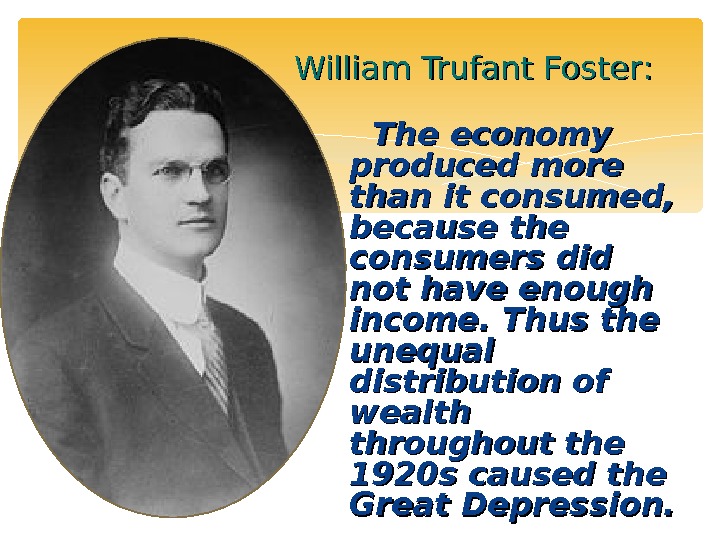
William Trufant Foster

Презентация great depression
William Trufant Foster - Wikiquote
The Social Emergency: Studies in Sex Hygiene and Morals (Dodo Press) by William  Trufant Foster, Paperback | Barnes & Noble®

Foster and Catchings wikipedia entry

Pre-Keynesian American underconsumption theorists.

In their undergraduate years at the turn of the century, William Trufant Foster and Waddill Cathings had been classmates together in at Harvard.  Foster went on to become an college educator, while Catchings had gone into finance.  In 1919, they came together again at the Pollack Foundation for Economic Research – Catchings providing the economic expertise,  Foster providing the expository rhetoric – and promptly set about addressing the post-war slump.

Foster & Catchings main theses were worked out in Profits (1925) and Money (1928).  They argued that insufficient consumer income is what leads to collapses in consumption and hence profits, prices and outputs.  They base their theory on a primitive but clumsy version of a multiplier-accelerator mechanism.   If retained company profits are hoarded (rather than being lent out), then consumer income is insufficient for consumers to absorb output. They argued that even if the firm invests this hoarded money itself (and thus pays the income out to workers), the problem is not solved: increased investment increases demand, yes, but it also pushes out output even further.  The imbalance between aggregate demand and supply, Foster and Catchings argue, will thus maintain itself. 

Their theory contains a fatal flaw in the “long-run”, but seen in a short-run, dynamic manner, it is reminiscent of that of Malthus during the General Glut controversy.  They publicly offered a cash award to any economist who could prove their argument flawed. Dozens upon dozens of people submitted proofs (e.g. Friedrich Hayek, 1929), but while they acknowledged minor errors, Foster and Catchings maintained that their central thesis remained correct.  Apparently, Foster and Catchings had early sympathizers in Paul H. Douglas and Charles F. Roos.

Robert Dimand Brief Bio of WTF

The educator and heterodox monetary economist William Trufant Foster was born in Boston, Massachusetts, on 18 January 1879, and died in Winter Park, Florida, on 18 October 1950. After his father’s early death, Foster worked his way through high school and Harvard University, graduating first in his class in 1901. After teaching at Bates College in Lewiston, Maine, he returned to Harvard to take an A.M. in English in 1904, followed by a Ph.D. from Teachers College of Columbia University. His exceptional success as a teacher of rhetoric and a textbook author, and the vision of an ‘ideal college’ presented in his doctoral dissertation (published in 1911), led to his remarkably early promotion from instructor to full professor at Bowdoin College in Brunswick, Maine, in 1905, and his appointment at the first president of Reed College in Portland, Oregon, in 1910. Foster served as an inspector with the American Red Cross in France after US entry into the First World War. Health problems from overwork, together with controversy over his pacifism, led Foster to resign from Reed College in December 1919. He then became director of the Pollak Foundation for Economic Research, founded in Newton, Massachusetts, by his Harvard classmate Waddill Catchings, an investment banker.

The economic consequences of Covid

Voters on the left are only slightly more stupid than the people they vote for. Ten months of lockdown and look what happens:

World witnessing greatest rise in inequality on record… Billionaires thriving as poor suffer…

Sharpest Rise in Poverty Rate in More Than 50 Years…

If you stop production [ie enforce lockdowns on our economies] you stop consumption, and that is the order in which things happen. And this is just the start of it.