It’s a matter of will

Getting things done is firstly knowing what you want to do and then doing whatever it takes to get them done.

Our new government has shown that so far as illegal migrants are concerned, where there’s a will there’s a way, or at least that’s been the case up until now and hopefully into the future. You really can stop the boats. But more importantly, it shows that if you are determined to find solutions, solutions that will work, you are more than half way towards solving the problem.

Would that I could say the same about the economy. I suppose we will eventually get a commission of audit report, around a year or perhaps more after the last election. But seriously, did we need a commission of audit to make a song and dance about the idiocies of Labor and the mess they made? Before the election there was something. Since then there has been hardly a word. And my question is why the Government has not gone in as hard on the economic side as it has on stopping the boats.

In The Australia today, there is a story on page 2 mentioned on the front page where it says:

Tony Abbott has made it clear that this will be the year in which he focuses on, and commits to economic management as never before.

On that same front page there is an actual story, that is also on the front page of the AFR, in which Bill Shorten “promises to fight for jobs in ‘middle ground’.” The AFR story is that “Shorten offers reform help”.

Why is Bill Shorten on the front pages about fixing the economy and not Tony Abbott or Joe Hockey? Where’s the plan, the strategy, the determination to fix things up?

I know it’s not the done thing to turn over these neutral public servants who run the various departments, but give me a break. These people pushed the stimulus and public spending because that is what their judgment told them was the right thing to do. Why are they still there? Why is their judgment still the primary advice the Government gets? There is not a chance in the world that they have changed their minds about the ruinous strategies they followed and therefore there is equally not a chance that they are capable of offering the advice that will bring the kinds of full scale recovery we had under John Howard and Peter Costello.

So here’s my advice. Get people at the top of our various economic agencies of government who really want balanced budgets and lower public outlays in the same way that Scott Morrison wants to stop the boats. It will make all the difference.
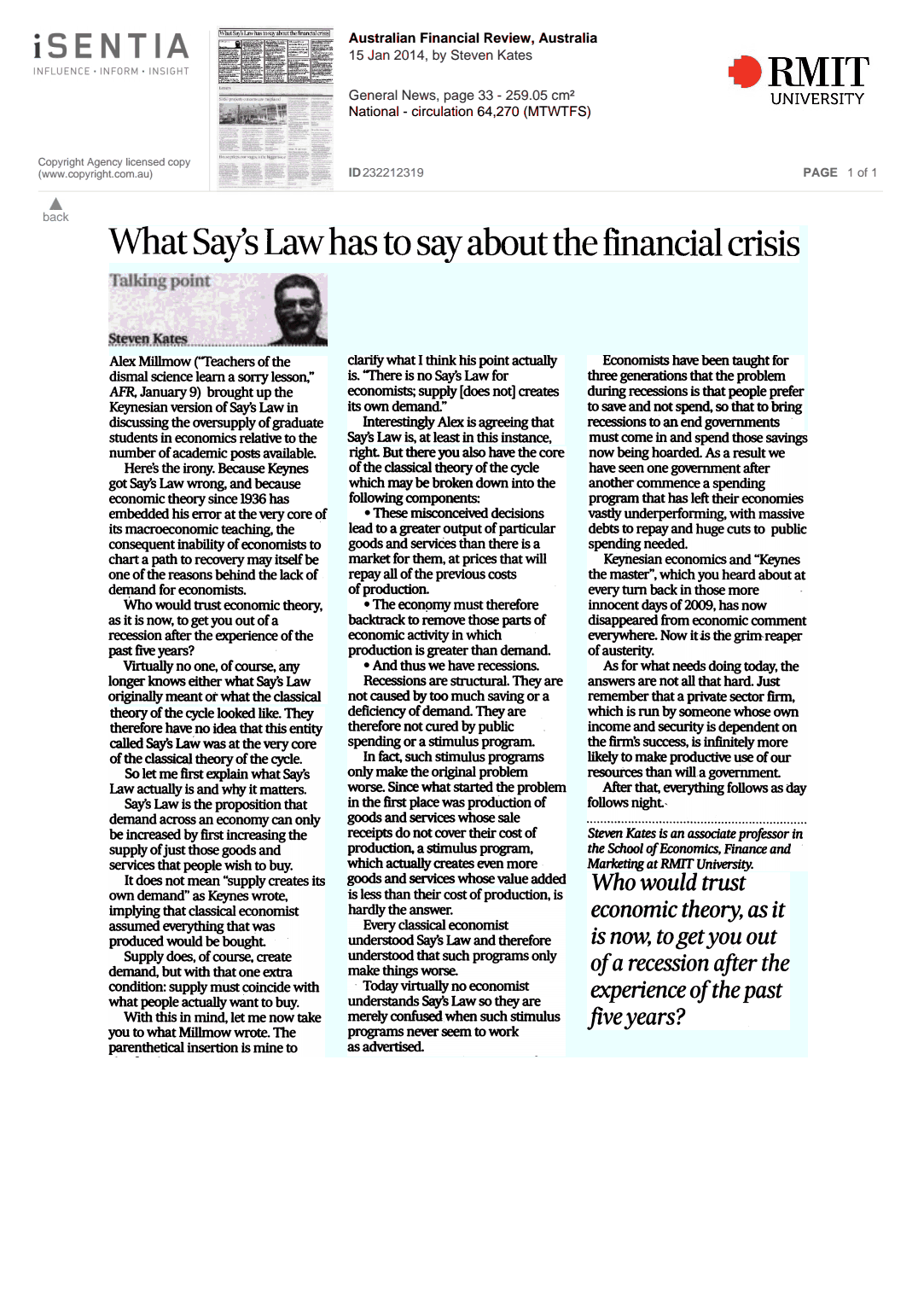
Say’s Law makes it to the AFR

afr - steve kates on says law

says law and the keynesian revolution

Is it possible that economic theory has regressed over the past hundred years. Well if you ask me, it’s a certainty. (For further confirmation, see Alan’s post on Larry Summers below.) An economist in 1914 knew more about how an economy worked than an economist in 2014. Less detail, fewer stats but a greater grasp of how it all fit together. How odd is that!

What’s the difference. Economics is now infused, both in it theory and in its practitioners, with socialists who simply refuse to believe that markets left to themselves will generally speaking produce the optimal economic outcome. The idea is now so outré that economics texts – aside from one or two that I am aware of – are no longer designed to explain how the market works. They instead start from the premise that markets will go wrong and that governments must take action at every turn to set things right.

Anyway, I have an article in the Financial Review today which is titled, “What Say’s Law has to say about the financial crisis” which really is, what pre-Keynesian classical theory has to say about the crisis.

There you have the core of the classical theory of the cycle which may be broken down into the following components.

• Misconceived production decisions are what starts the rot.

• These misconceived decisions lead to a greater output of particular goods and services than there is a market for them at prices that will repay all of the previous costs of production.

• The economy must therefore backtrack to remove those parts of economic activity in which production is greater than demand.

• And thus we have recessions.

Recessions are thus structural. Instead our textbooks teach Y=C+I+G and explain recessions as a result of too much saving and too little demand, the fallacious notions that Say’s Law was specifically designed to expose.

Macroeconomic theory is not just nonsense but dangerous nonsense. Using it to manage an economy will leave wreckage in its wake as it has consistently done everywhere and every time it has been used to solve some economic problem.

Economies are built up by genuinely value adding activities which most government forms of spending most definitely are not. That doesn’t say governments shouldn’t do them. It merely says they should not deceive themselves into believing that public spending is the road to rapid rates of non-inflationary growth. Public spending draws down on our productivity rather than building it up. If the last five years have taught us anything, hopefully at least it has taught us that.

The roll of profits

How seldom do you get someone even to notice that every business in a supply chain must make more money than it spends if the goods you buy are ever going to be produced. A particularly sensible article from someone called Captain Capitalism.

Leftist of a particularly idiotic and idealistic stripe contest otherwise. They often pine wistfully for a "world without profits." But simply ask yourself what kind of a world would that be?

Without profits not one single business would be started. Why would any would-be entrepreneur sacrifice his time, his money, and his labor NOT to make any money? And with no businesses who, precisely, would be producing all the goods and services you and all those lovey lefties need to survive? (just ask those Venezuelans about toilet paper and electronics). This goes a long way in explaining why there were lines for simple staples like BREAD in the Soviet Union.

Also without profits why would anybody go to work? I'm not allowed to keep the fruits of my labor? Forget the fact no companies are hiring because none exist because profit has been outlawed; people wouldn't show up to the work in the first place if they weren't getting paid.

What about all the suppliers, consultants, energy providers, accountants, lawyers, and other third parties that go into supporting a business? If they are not allowed to profit why would anybody provide internet access to the company, computers, legal services, etc. if there was no profit? What the left (and most non-accounting people on the right) fail to realize is that it isn't just the "evil rich business owners" that gets profits, but all his suppliers, vendors, employees, he pays. In other words ALL of his expenses are other people's profits.

Profits are not some static amount but roll their way through the economy.

The enduring legacy of Keynes

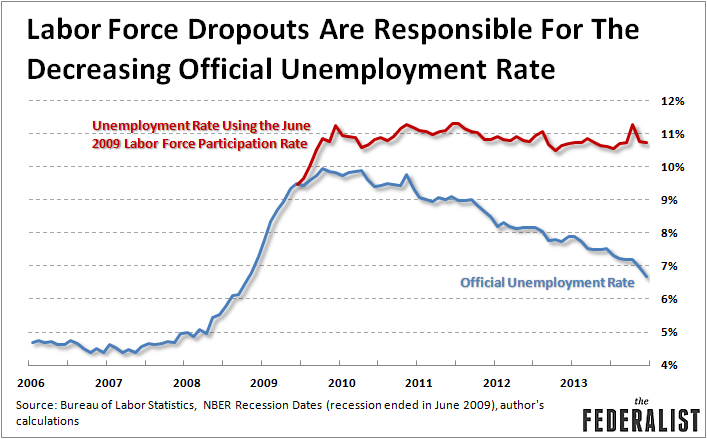
us unemployment jan 2014

After a while the dismal state of the world’s economies becomes merely background. We forget the better times and accustom ourselves to how things now are.

I am, however, in the process of putting together the second edition of my Free Market Economics and have just been through the Keynes versus the classics section. And let me tell you, there has been a lot to add based on our experiences over the past five years but there is nothing that needs to be revised. And the most interesting part that needs no revision is the way that macro continues to be taught which is Keynesian from end to end. How anyone can still think that a public stimulus has anything to offer in bringing recessions to an end after what we have gone through is beyond me. But they do, and Y=C+I+G remains in every text and is taught as the best explanation economists have for how economies work and what needs to be done when an economy is in recession.

Anyway, the data are from the US which is the epicentre of economic policy death. From an article on the last six years of the American Labour Market and picked up at Powerline. It’s a measure I often used to do myself since the labour market data only include as unemployment people who are actively looking for work. After a while you just give up so the unemployment rate falls even while the labour market remains stagnant. That’s what the picture all too clearly shows about the US.

There is more to it than just the deadly effects of the stimulus but most of it starts from there. It’s almost as if the US had never heard about free enterprise and the private sector the way they are going about things.

Meanwhile, at Drudge the main headline highlights a new record of sorts:

92 MILLION AMERICANS NOT IN LABOR FORCE

And those subheadings beneath add to the picture:

Record Number of Women Not In Labor Force…

Growth slumps…

Slowest in three years…

1,500 people camp out for chance to apply for job…

‘For Every One Job Added, Nearly 5 People Left the Workforce’

MSNBC: ‘Awful,’ ‘Very bad,’ ‘Ugly’…

If you are interested in finding out about Say’s Law and the classical theory of the cycle, or what a classical economist would do when an economy is in recession, so far as I know there’s only one place where you could find any of that out. I may, of course, be wrong but what I write is in accord with the way economists looked at things from 1776-1936 and that includes a very large number of very cluey people. If there really is such a thing as evidence-based policy as opposed to ideologically-based policy, you could do worse than to see what the book has to say.

Lies, damned lies and economic theory in the hands of politicians

Trickle-down economics, to put it crudely, is the argument that you help the poor by giving money, usually in the form of tax cuts, to the not-so-poor. Their spending will create a multiplier process in which the poor are benefited as the second and later rounds of expenditure by others. At least that’s how I would interpret it although, as Thomas Sowell points out below, it is a theory never taught to anyone, shows up in no textbooks and has never been advocated. As far as it goes, it is a theory that has been created so that the left can accuse advocates of market-based solutions of not really doing things to help the poor.

Yet from the way it is usually described, the theory, to the extent that there is an associated theory, seems about as Keynesian as any notion I can think of. Let anyone increase their expenditure and the poor will be made better off. John Stuart Mill was particularly scathing about such beliefs, and certainly it would not have been part of classical theory to suggest that demand side could have a positive effect on the supply side.

What makes Thomas Sowell so extraordinary is his ability to see things that are right in front of everyone’s eyes. This is from Sowell in an article titled, “The ‘Trickle-Down’ Lie”.

New York’s new mayor, Bill de Blasio, in his inaugural speech, denounced people ‘on the far right’ who ‘continue to preach the virtue of trickle-down economics.’ According to Mayor de Blasio, ‘They believe that the way to move forward is to give more to the most fortunate, and that somehow the benefits will work their way down to everyone else.’

If there is ever a contest for the biggest lie in politics, this one should be a top contender.

While there have been all too many lies told in politics, most have some little tiny fraction of truth in them, to make them seem plausible. But the ‘trickle-down’ lie is 100 percent lie.

It should win the contest both because of its purity — no contaminating speck of truth — and because of how many people have repeated it over the years, without any evidence being asked for or given.

Years ago, this column challenged anybody to quote any economist outside of an insane asylum who had ever advocated this ‘trickle-down’ theory. Some readers said that somebody said that somebody else had advocated a ‘trickle-down’ policy. But they could never name that somebody else and quote them.

Mayor de Blasio is by no means the first politician to denounce this non-existent theory. Back in 2008, presidential candidate Barack Obama attacked what he called ‘an economic philosophy’ which ‘says we should give more and more to those with the most and hope that prosperity trickles down to everyone else.’

Let’s do something completely unexpected: Let’s stop and think. Why would anyone advocate that we ‘give’ something to A in hopes that it would trickle down to B? Why in the world would any sane person not give it to B and cut out the middleman? But all this is moot, because there was no trickle-down theory about giving something to anybody in the first place.

The ‘trickle-down’ theory cannot be found in even the most voluminous scholarly studies of economic theories — including J.A. Schumpeter’s monumental History of Economic Analysis, more than a thousand pages long and printed in very small type.

It is not just in politics that the non-existent ‘trickle-down’ theory is found.

It has been attacked in the New York Times, in the Washington Post and by professors at prestigious American universities — and even as far away as India. Yet none of those who denounce a “trickle-down” theory can quote anybody who actually advocated it.
The book ‘Winner-Take-All Politics’ refers to ‘the “trickle-down” scenario that advocates of helping the have-it-alls with tax cuts and other goodies constantly trot out.’ But no one who actually trotted out any such scenario was cited, much less quoted.

One of the things that provoke the left into bringing out the ‘trickle-down’ bogeyman is any suggestion that there are limits to how high they can push tax rates on people with high incomes, without causing repercussions that hurt the economy as a whole.

DHT – a sensible review of the book

A review of Defending the History of Economic Thought by someone who is not involved in the issues and therefore sees the common sense point of the book and its arguments.

The Economic Studies Shelf
Defending The History Of Economic Thought Steven Kates
Edward Elgar Publishing
9 Dewey Court, Northampton, MA 01060-3815 http://www.e-elgar.com
9781848448209, $99.95, http://www.amazon .com

The principle focus of “Defending the History of Economic Thought” is the crucial importance of the history of economic thought in the study of economics itself; without its history at the core of the curriculum, academician and economist Steven Kates (School of Economics, Finance and Marketing, RMIT University, Melbourne, Australia) persuasively contends that economics is “a lesser subject, less penetrating, less interesting and of much less social value” . A 160 page treatise, “Defending The History Of Economic Thought” is organized and presented in five major chapters (Preliminary thoughts; Why study the history of economic thought; Debating the role of the history of economic thought; Teaching the history of economic thought; and Defending the history of economic thought. As informed and informative as it is thoughtful and thought-provoking, “Defending The History Of Economic Thought” is enhanced with an bibliography and a comprehensive index, making it an impressive contribution to professional and academic library Economic Studies collections and supplemental reading lists.

Dutch treat

When you’ve run out of other people’s money, things begin to change, specially when those other people are running out of money themselves. This is the new mood of welfare reform in Holland:

The Dutch have just announced a massive reform of their welfare system, designed to reduce dependency and put a new emphasis on work. For example, welfare applicants will now be required to prove that they spent at least 4 weeks actively searching for a job before they become eligible for any assistance. And once they begin to receive benefits they will either have to work or perform volunteer community service. Dutch welfare recipients would be required to take available jobs even if they had to move or commute up to three hours per day. . . .

Other reforms would reduce benefits by treating families as a single unit, rather than as separate individuals. For instance a mother with two children would receive a single payment rather than three separate payments. The combined payment would be less, based on the assumption of ‘shared expense.’

According to the Dutch government, the reforms will ensure that welfare is seen as ‘a safety net, rather than a right.’

And so it begins

This is in the UK. Hundreds of businesses to be paid to switch off to prevent blackouts.

Hundreds of businesses could be paid to switch off their power between 4pm and 8pm on winter weekdays as soon as next winter to prevent blackouts, under plans approved by regulator Ofgem.

Mothballed old gas-fired power stations will also be paid to come back to stand-by so they can be fired up to prevent the lights going out when demand is high.

There must be people who think that electric power is a form of magic that just comes through the wires and will always be there no matter what. But even this is just for now, “Ofgem said the margin of electricity supply capacity over demand could narrow to between 2pc and 5pc by 2015 and 2016.” And after that it will get better all by itself.

“Cheap money is not the sustainable path to prosperity”

How fortunate this country is to have Glenn Stevens running the RBA. From todays Australian:

THE government should focus on productivity-boosting reforms rather than rushing to bring the budget to surplus, Reserve Bank governor Glenn Stevens said yesterday.

At the second of his twice-yearly appearances before the House of Representatives economics committee, Mr Stevens suggested further interest rate cuts were unlikely to help lift economic growth.

Mr Stevens said monetary policy was stimulating activity outside the mining industry but weak confidence, the lacklustre pace of reform and a high currency were retarding the growth rate.

‘There are few serious claims that the cost of borrowing per se is holding back growth … monetary policy can’t force spending to occur,” he said in Canberra.

‘Cheap money is not the sustainable path to prosperity.’

Not only is it not the path to prosperity, it is the road to ruin. But like so much else with economic policy, unless one understands how and why these policies work, others won’t be able to repeat them. Just the same with Peter Costello and his near-immaculate management of the Australian economy, 1996-2007, years that coincide with sustained prosperity, rising real incomes and an almost continuous fall in unemployment.

And funny enough, this self same Peter Costello was in the news today as he is about to take on the Chairmanship of the Future Fund, at the moment on a temporary basis. Of course, a great appointment, but this in particular caught my eye:

But Mr Costello . . . said the fund should only pursue investments that deliver a return, playing down suggestions it could be used for nation-building projects.

“Nation-building” projects apparently mean “loss-making” projects, and that’s by definition! You know, the kinds of things Labor specialises in. That is, projects that lose money, make us poorer but give themselves a warm inner glow as they spend our money even faster than we can earn it.

It’s a great pleasure to see a return to sanity, and if it really turns out that both the Paid Parental Scheme and renewable energy targets are to be wound back, things might really start to look up.

Depression economics

If you want further reason to be depressed about our economic future, this article Janet Yellen and the Phillips Curve will supply it. If you believe this thing called the Phillips Curve relationship works, then you believe that higher inflation can bring faster growth and lower unemployment along with it. It is exactly this that Janet Yellen apparently believes. This is a direct quote:

“Each percentage point reduction in inflation costs on the order of 4.4 percent of gross domestic product, which is about $300 billion, and entails about 2.2 percentage-point-years of unemployment in excess of the natural rate.”

That is, reducing inflation slows growth and raises unemployment. If you want growth, inflation is therefore the way to go.

Yellen believes that the central bank should maintain enough inflation to prop up business activity, because ‘uncertainty about sales impedes business planning and could harm capital formation just as much as uncertainty about inflation can create uncertainty about relative prices and harm business planning.’ This approach extends the Fed’s mission beyond even the dual mandate of Humphrey-Hawkins and into the sphere of American corporate activity, a place that the business economist Greenspan was reluctant to go. Yellen, a disciple of predictive modeling, dismisses the notion that the Fed could go too far. To her the record shows that ‘tuning works even if it is not “fine.”‘

Here’s the article’s conclusion:

It isn’t just the 1970s, but the last few years, that show how money creation does not produce permanent employment gains. This was raised time and time again at Yellen’s recent Senate Banking Committee hearing, when several Democrats bemoaned the absence of any ‘trickle down’ effect from quantitative easing. Do we want the Fed to double-down on that folly with Janet Yellen at the helm?

This is not going to end well.