Economics a wasteland

The front page story in The Australian today comes with the title, Economics course is ‘beyond redraft’. The story begins:

THE national economics curriculum is unsalvageable, with ­errors in key definitions and omissions of fundamental concepts that make it “misleading, unbalanced, too imprecise to be useful and … beyond redrafting”, experts have concluded.

Griffith University economics professor Tony Makin and lecturer Alex Robson, in their advice to the federal government’s ­curriculum review, say the cur­riculum incorrectly defines some fundamental concepts including gross domestic product, ­effici­ency and productivity.

They argue that the curriculum omits key concepts, such as the difference between micro­economics and macroeconomics or between recessions and booms.

It also fails to include the great economic thinkers, including the father of economics Adam Smith and his coinage of the term “invisible hand” to describe the forces of the free market.

What can I say, and if you ask me, they may be a little light in their criticism. It is for this reason that I built my own economics course and wrote my own text to go with it, Free Market Economics, now in its second edition. You may think of this as an ad for my book (and my course), but really I am only about to point out the ways in which my own text exactly matches what Makin and Robson are looking for. There is more in the book than just this:

Definitions: The opening is a chapter with the very title “Definitions”. And rather than being at the end of the book as most glossaries are, it is the first thing you come to. Moreover, it is not alphabetic but thematic. If you go through the definitions in order, you are provided with an overview of everything the rest of the book will say but in a condensed form (and not all that condensed since it goes on for 24 pages).

Micro­economics and macroeconomics: I am surprised to find that other texts leave out the micro/macro division, but whatever others may do, I do not. It lays the foundation of the macro side by starting from the most micro of micro concepts, the role of the entrepreneur, a category, I might add, found in virtually no text on economics I am aware of other than perhaps for a sentence or two. If you want a reason to disqualify most courses on economics, leaving out the role of the entrepreneur would be high on my list.

Recessions and booms: My text is the only text anywhere in the world that discusses the classical theory of the cycle. And by being about the cycle, it’s not like that junk Keynesian rubbish which only discusses recessions and what causes them, it discusses why the cycle is actually cyclical. Downturns reach a trough and then economies turn up. Everyone once knew that, but it has been more than three quarters of a century since these have been discussed at any level, never mind within an economics text.

The great economic thinkers: There are two entire chapters on the history of economics which take you from the earliest times through until the Keynesian Revolution. I have written an entire book on how essential studying the history of economic thought is for an economist. It is, but virtually no one does it any more which makes economists less able to think through economic issues. Without a grasp of history, economics has no anchor in anything that truly matters.

The Invisible Hand: In studying Adam Smith, there is, of course, a discussion on the invisible hand. But the book is itself a discussion on the very essence of what a free market is based around the notions of an invisible hand. No economics book that I know of teaches the way a market economy works. The most you get is a bit on supply and demand and from that moment on it is all about how market failures of one kind or another are there at every turn. It is the nature of the way economic theory is presented. To take just one example, I go on myself about how inane calling the one form of market that by definition cannot exist “perfect” competition and how everything after that is described as “imperfect” competition. Not really all that subtle, but the basic point is there is much work for governments and economists to fix.

I am therefore pleased that Tony and Alex have taken on this monster. The failures of the Keynesian stimulus might, you would have thought, started some kind of soul searching within the profession about how badly served we are with the economic theory we now teach. But a billion dollars or more now tied up in textbooks which carry received economic theory into every classroom, wrong though they may be, misleading page after page, they will nevertheless continue onwards. I will merely mention the first of the quotes on the back of my book:

Free Market Economics is virtually a must read for serious economists. . . . Highly recommended.

The book is a synthesis of the economics that existed prior to the Keynesian Revolution. It is where economic theory must go if we are to salvage the study of economics.

General gluts and laissez-faire

The European Society for the History of Economic Thought has proposed the following as an issue that might be investigated during its next meeting in May:

First, over the issue as to whether a market-based economy tends naturally to use its resources in the best possible way without any State intervention beyond that of providing basic infrastructure and protecting property rights: a matter of concern from the times of the General Glut controversy that saw Malthus opposed to Ricardo down to the debates that have marked the evolution of macroeconomics since the publication of Keynes’ General Theory.

I suppose with the words “from the times of” they are not with absolute certainty suggesting that there is any relationship between the general glut debate and laissez-faire, but let’s face it, they are. And I realise that just because I stated in my Say’s Law and the Keynesian Revolution that “the issue in regard to Say’s Law is not laissez-faire” (p 16) doesn’t mean (1) that anyone interested in this issue read the book or that (2) even if they read it, that they had accepted my argument even if they noticed it.

The conclusion reached at the end of the general glut debate was that demand did not affect the level of economic activity and therefore did not affect the level of unemployment. That may or not be true but was accepted almost without dissent from around 1808 through to 1936, during which time the role of the state became ever more large. In 1935, no one thought of economic policy as laissez-faire but there was even so an almost universal denial of overproduction as a cause of recession and mass unemployment. Indeed, just how far apart the two concepts are may be seen in this comment by John Stuart Mill, the most relentless defender of the impossibility of a general glut amongst classical economists, in his volume, On Socialism. How much farther from the notion of laissez-faire could this be:

The kind of policy described is sometimes possible where, as in the case of railways, the only competition possible is between two or three great companies, the operation being on too vast a scale to be within the reach of individual capitalists, and this is one of the reasons why businesses which require to be carried on by great joint-stock enterprises cannot be trusted to competition, but, when not reserved by the State to itself, ought to be carried on under conditions prescribed, and, from time to time, varied by the State, for the purpose of insuring to the public a cheaper supply of its wants than would be afforded by private interest in the absence of sufficient competition.

Thus roping the two together only demonstrates how little is understood about the nature of the general glut debate – which in our own time being about whether the GFC was due to demand deficiency and a stimulus is the proper response is the central economic question of our time. If I argue that the poor economic conditions of the present are not caused by an absence of demand that makes absolutely no claim about whether there are a chain of government policies and interventions that might help to improve the state of the economy. The possibility of general gluts and laissez-faire are independent concepts.

That governments may base their interventions on the belief that they have to increase aggregate demand is something else. But even if governments finally eventually do reduce their own level of expenditure and did somehow balance their budgets, the notion that we would then be living in a laissez-faire economy would remain unmistakeably wrong. They are not the same issue and should not be confused.

Who would have expected that stagnation would continue so long?

I will, along with the rest of us, see what happens, but I am not, to say the least, encouraged. From The Australian:

THE global economy faces another five years of stagnation, the International Monetary Fund warned overnight as it cut its growth forecasts for the third year in a row and urged nations to ­reinvigorate economic reforms.

Releasing the fund’s updated economic outlook, IMF chief economist Olivier Blanchard ­described global growth as ­“mediocre” and, in a reference to the agenda Australia has set for the G20 members ahead of next month’s summit in Brisbane, said the difficult outlook underlined the importance of identifying economic reforms that could lift output.

Who could have expected such an outcome? The people who run our economies do not have a clue. This is all so unexpected for them, and they will therefore persist in running budget deficits and keep interest rates low until our economies finally tick up which means, of course, that is of course if you are a classically trained economist, that their very policies will continue to be the reason our economies refuse to grow. And if they still attribute the problems to the Global Financial Crisis of six years ago, they are seriously seriously out to lunch.

John Stuart Mill and the logic of economics

I have just been confronted by two articles I have refereed, both on the economics of John Stuart Mill, that I rejected because they have no idea what Mill is trying to explain or the logic of what he is getting at. Both, however, are likely to be published no matter what I might think. Here was Mill, the man with the nineteenth century’s highest IQ, the author of the book on logic that was used for two generations across the English speaking world, a book still eminenty worth reading to this day, yet both of these papers criticise Mill for contradicting himself and faulty logic.

Mill’s Principles of Political Economy is far and away the best book on economic theory ever written. My own book on Free Market Economics (now in its second edition) is Mill brought up to date with a few modern gadgets. Also brought into the text and heavily criticised are the various additions to economic theory that have made economics far worse as a tool of analysis and a basis for policy, most notably MC=MR and Keynes.

All I can say is how exasperating it is to read these critics of Mill who cannot even begin to understand the problems with their interpretations. But what is the peculiar bit is that in being possibly the only economist in the world who thinks of Mill as the best economist who has ever lived, there is not a soul alive who I can turn to for support. I am not the smartest person on the world today, but I do come closer to understanding Mill than anyone else writing on economics. The massacre of our economies by the modern doctors of economic theory is as obvious to me as it is invisible to them. So on it will go but the certainty is that if we keep up in the way we have, we will never ever generate a recovery worth having and living standards will continue to fall.

Why isn’t Keynesian theory dead, dead, dead?

obama gdp recovery v 1981

This comes via Powerline but is taken from a document put out by the Republicans on the Senate Budget Committee: The Obama Economy: a Chartbook. That 92% of American economists surveyed stated that the stimulus had lowered the unemployment rate below the level it would otherwise have been shows that 92% of American economists haven’t a clue which way is up. You really ought to look at the charts. There really is nothing left to say. Not that the American economy was doing all that well before Obama got his hands on it, but since then the decline has been unbelievable.

Yet the theory that has created this mess is still taught as the mainstream view in economics courses across the world. It’s all Keynesian aggregate demand all the time. But if you are curious about what went wrong, might I recommend you have a read of this.

It will also help to explain this, the incredible fall in median incomes.

obama economy median family income

What you are looking at here is evidence that the infrastructure that supports the American economy is crumbling. It’s not just GDP, which is a temporary measure that goes up and down, but the actual stock of capital that is falling to bits.

The great discontinuity in Keynes’s economic thought

This is an extract from a note I have written to an economist in the United States whose work I have only just come upon. I am beginning to become aware of the various attempts by a number of economic schools to abandon modern neo-classical theory which, in my view anyway, mostly means trying to rediscover what the classical economists already knew. Perhaps there is more to it but so far I cannot see what. The interest in this letter, however, is in the nature of the Keynesian Revolution. I have no in-depth knowledge of Keynes’s Treatise on Money although am reasonably familiar with it. But it was published in 1930 while my interest begins in 1932 with Keynes’s discovery of demand deficiency as the explanation of recession and involuntary unemployment.

The paper I am commenting on treats Keynes’s ideas as if there had not been the great disruption at the end of 1932 when Keynes came upon Malthus’s 1820 letters to Ricardo. It was these that instantly converted him into a Keynesian theorist which he had not previously been, even though he had always sought to increase public spending to reduce unemployment during recessions. That virtually all of his contemporaries understood how thin Keynes’s arguments are is now just of historical interest and of interest to hardly anyone at all. Only by going back to those moments of transition, and by understanding what economic theory was like before 1936, is there any hope for again turning economic theory into something useful for analysing economic events. This then is what I wrote:

I would have written back straight away but Tuesdays is my heavy duty teaching day and I also didn’t want to clutter your inbox until I had read your brilliant article on Keynes. You cannot imagine how similarly we see the world and what a treat it is for me to read something like what you wrote. I will, of course, include this paper in my Anti-Keynesian Reader, but I must also beg your indulgence if I explain to you the 1932-1933 shift in Keynes’s thinking which is my speciality. I have also ordered your macroeconomics text which I am looking forward to since it came after your paper and must therefore incorporate the same ideas.

You have also made me even more aware than I was before that I have not been keeping up with the literature as well as I should. I found the scholarship of your article exhilarating and finished it at one go. I just sat down and read it and was only sorry that after thirty pages it turned out to be so short. My own excuse for not being aware of the most recent literature is that I spent the years from 1980-2004 as the Economist for the Australian Chamber of Commerce and Industry. I therefore think that my economic interests were driven by an eclectic interest in arguments that could be used to explain economic issues from the perspective on an entrepreneur. It is why the classical economists so appealed to me since that was their aim. From the marginal revolution on, I find almost nothing of much value in framing issues, specially since post the marginal revolution economics went micro and into equilibrium analysis, both of which are utterly contrary to what I could see right before my eyes being the need to make sense of an economy in which every business decision is fraught with the uncertainty of spending tonnes of money before the outcome of each of those decisions could be known. And while I may have been feeding on the classics, nothing I ever wrote looked archaic to those to whom our submissions went. Classical economics makes perfect sense and is much more logical and insightful than the kinds of economic theory we find today.

But what started me on the trajectory I travelled was a minor issue in the National Wage Case of 1980. I was brought on to write the economic submission to our industrial relations court on behalf of employers. It was explained to me that every argument in a court of law must be controverted so I had to go through the union submission, identify each argument they had made and then explain why it was wrong. Believe me, this was the easiest task I have ever been given, but one of them was easiest of all. This was the argument that wages had to be raised as a means to stimulate demand. So I just pointed out that you could not stimulate an economy by making employers pay an extra $100 a week so that employees could then spend that extra $100 in their shops. And then, in 1982, I was reading John Stuart Mill’s Principles, for no other reason than because I was interested in what he might have to say, and came across his Four Propositions on Capital which literally, on the spot, ended my days as a Keynesian. (And now, 32 years later, I am about to finally have an article published on these four propositions.) From there, I continued reading more of Mill and found a passage in which he pointed out how ridiculous it was that people thought an economy could be driven forward by demand. And the example he gave of how ridiculous this argument is was of someone who might steal from the till of the business they are working in, go out the back door and come back in the front and spend the money, and that the more this was done, the faster the business would grow. This was so exactly my own argument that it completely dumbfounded me. And yet, it was probably not until another couple of years later that I worked out that the notions that Mill was discussing are the actual meaning of “Say’s Law”. It has been coming to terms with Say’s Law and what it meant and all of its implications that has been the pole star for all of my economic writing ever since. And so, my Free Market Economics, which is me trying to do in my own fashion right now what Mill had done in 1848.

I have tried to explain over and again that Say’s Law is the Rosetta Stone for understanding The General Theory, and is also the foundational principle for understanding how an economy works. For the second, you can read my text when it gets to you. But the first is what you have written your article about which has been in so many ways a revelation to me. My speciality is the Keynesian Revolution and know less than perhaps I ought to about The Treatise and Keynes’s original monetary theories. You have perfectly situated Keynes’s arguments for me and his original conception which fits into everything I already know and understand. It is a tour de force, and I have tried to read everything I can on the critics of Keynes. But this is what I can add to what you have written. I have, of course, published things on this but to say that it has been ignored is something of an understatement. It so badly fits the narrative others wish to promote, and truly undermines Keynes as an original thinker and an honest purveyor of ideas, that it just cannot be allowed into the canon. Perhaps, however, you will see my point.

Keynes was doing exactly what you write all the way up to the end of 1932. He was going to write a book about the Monetary Theory of Production, almost certainly along the lines you set out. Unfortunately, it was just then that he came across Malthus’s long-lost letters to Ricardo which had just been discovered by his best friend, Piero Sraffa. In updating his “Essay on Malthus” for inclusion in his Essays in Biography, he read through those letters and discovered demand deficiency, the issue of the general glut debate of the 1820s. He therefore stopped writing about the monetary theory of production and began to write about Say’s Law. And rather than requiring a form of disequilibrium analysis, he is forced by what he wishes to argue, to adopt the most rigid form of equilibrium analysis. This may seem a conundrum to others who work forward from Keynes’s previous writings, but working backwards from The General Theory as I do, it seems perfectly clear to me what he had done.

ACCI and deficit spending

I did manage to get through Q&A last night but what caught me right from the start was where Wayne Swan, former Treasurer, said to Kate Carnell, the newly installed CEO of the Australian Chamber of Commerce, that ACCI had NEVER sought balanced budgets. Never is a long time and having been the ACCI Chief Economist up until a decade ago, I can say with perfect assurance that at least in my time, ACCI, previously known as the CAI, had never sought anything other than balanced budgets.

Way back, as far back as the days of Bob Hawke as Prime Minister, I wrote an article for our newsletter titled, “An Australian Economic Miracle?” Not many things on the net from the late 1980s, but I did find this:

“An Australian economic miracle, a truly Lazarus-like recovery is now a clear possibility,” says the Confederation of Australian Industry (CAI) in a newsletter this month.

Following the 1987 share market collapse, everyone across the world got religion and more especially Paul Keating here in Australia who balanced the budget in 1988. This was then – and always was while I was there – CAI/ACCI policy. Balancing the budget by lowering expenditure was a near-on certain cure-all for me and so it proved. What then wrecked it all was the almost immediate concern that the economy was overheating that then required the administration of a ridiculously high interest rate regime which brought on the “recession we had to have”. I had to spend the next five years shouting at the government for ruining it all with its monetary policies but it was by then too late.

But in that brave moment in 1988, Australia was set for the most remarkable recovery you ever saw. The flack I took for saying what I said, along with the organisation, was prodigious. But the then Labor Government, having balanced the budget, was indeed overseeing an economic resurrection that at the time no one had noticed was in place. So I wrote the article, signed off by my CEO, and once the recovery became common knowledge, had to endure the idiocies involved in cooling down what had only just picked up.

Balanced budgets work, and deficits do only harm. The evidence that the policies of the classical economists were overwhelmingly better than the policies of every mainstream text of the time, and of today as well, was demonstrated to me, just as it would be demonstrated again when Peter Costello balanced the budgets in the period after 1996. I am therefore pleased to see that Kate Carnell has reiterated the long-term policy of the Chamber.

And if you would like to have a better understanding of the underlying theory, you could not do any better than have a look at my Free Market Economics. Strange to relate, it is to my knowledge the only book of its kind.

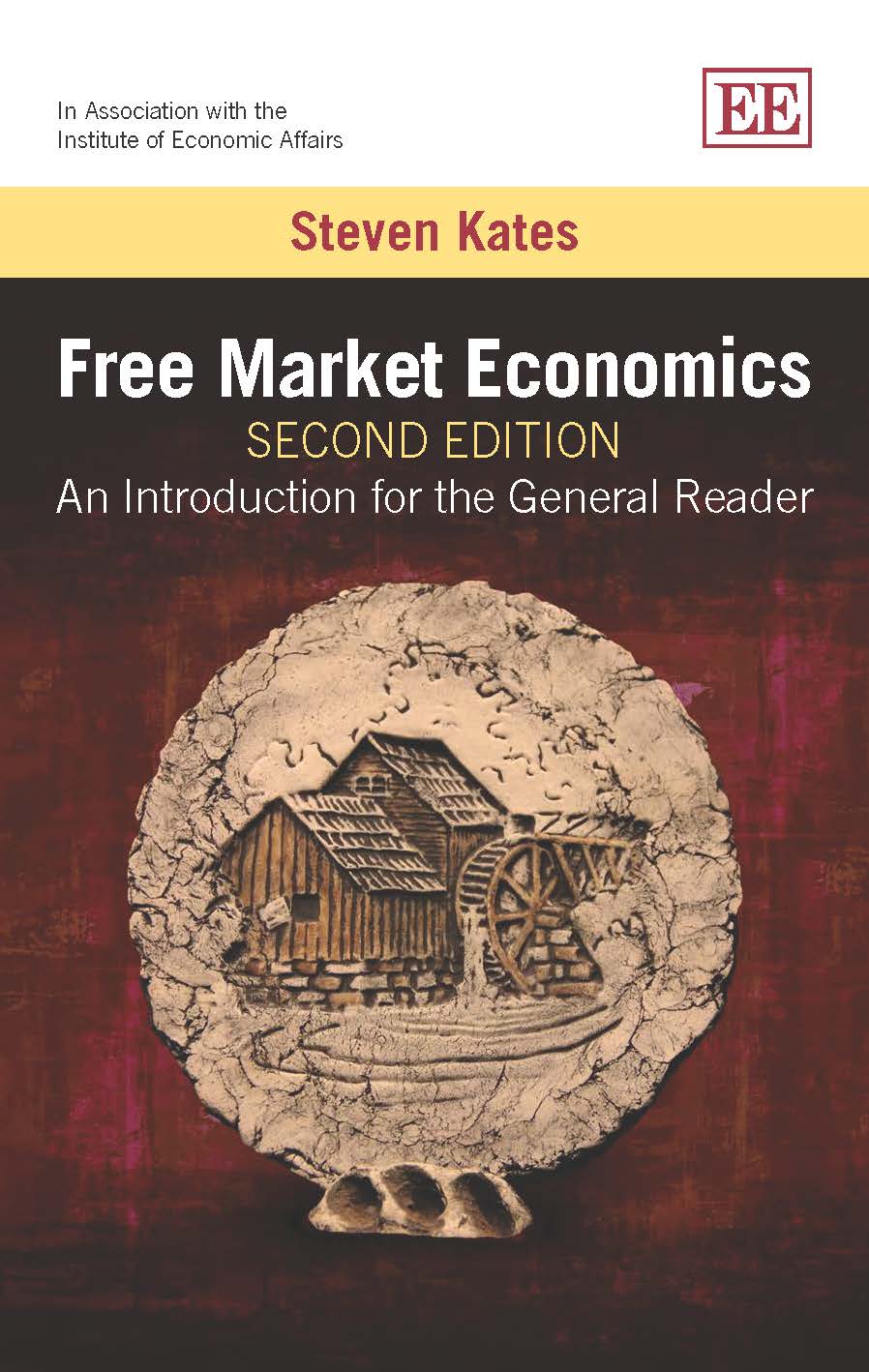
Free Market Economics 2nd ed

fme2 cover_Page_1

When I wrote the first edition of my Free Market Economics in 2009, I thought of it even then as the best introduction to economic theory anywhere. It combined five features that were unique to this book: an uncompromising anti-Keynesian core, a microeconomics that rejected the notion of an equilibrium, a focus on the role of the entrepreneur, a discussion of the classical theory of the cycle and the installation of uncertainty as the crucial element in any serious discussion of how an economy runs.

I also had no idea how much more I wanted to say until I came to write the second edition which to my eyes has transcended the first, having been fashioned out of what I learned by teaching the first edition for five years while watching how economic events unfolded following the stimulus. You may only have the author’s word for it here, but there is no book like it. If you want to understand how an economy works based on the English tradition in economic theorising that goes from Adam Smith to John Stuart Mill, there is literally only a single place you can go. The book reverses two “revolutions” in economics, not just the Keynesian of the 1930s, but the marginalist revolution of the 1870s as well. It is a companion volume to David Simpson’s wonderful The Rediscovery of Classical Economics, also co-published by the IEA. Reading the two will provide you with an understanding of just what is wrong with economic theory today. That traditional policy based on standard economic theory is ruining our economies is beyond any doubt, but the reason why that is so will nevertheless remain incomprehensible to anyone who continues to believe that aggregate demand is a valid concept in trying to make sense of economic events or that equilibrium has much if anything to do with how an economy works.

My Free Market text was written in a kind of white heat over twelve weeks as the text for the course I was giving during the first months of the worldwide introduction of stimulus packages pretty well everywhere. The absolute dead certainty I had was that public sector spending whose only aim was to create jobs would end in disaster, as it most assuredly has. Our economies are sinking under the weight of massive levels of unproductive public spending and debt levels that continuously subvert every attempt to wind them back. Yet you cannot go to any standard economics text even for an inkling of why that is.

To understand any of this you must first understand Say’s Law. Say’s Law was the bedrock principle of economic theory from the earliest years of the nineteenth century until swept away in a fit of distraction by the publication of Keynes’s General Theory in 1936. It is founded on recognising that only value adding production can create economic growth and add to the number of jobs. The most central chapter in the book is the chapter on Value Added, a chapter found in no other text that I know of. Yet without understanding value added, understanding that every form of production not just creates more goods and services but also at the same time uses up existing goods and services during the production process, it is impossible to think about public spending and economic policy correctly. Only if what is produced has greater value than the resources used up can an economy grow. Government spending seldom creates value. The stimulus was therefore doomed to fail as is so much of the policy matrix found today.

The strangest part about the book, however, was for me to discover my own beliefs on the nature of economic theory. There is not a chapter in it that would fit into a standard economics text. All of it takes you back to an earlier time and a different theoretical matrix. Space is too short to tell you much more but let me draw you to the cover which shows a water mill on a plaque made of clay. This is because the two most important influences on my own way of thinking have been two of the greatest economists England has ever produced, John Stuart Mill and Henry Clay.

I can do no more than encourage you to read this book. It is a defence of the market economy published at a time when there may never been a greater need for such a defence.

Paul Krugman has no idea what Say’s Law means

In the same week that the 2nd edition of my Free Market Economics has been published, which I began specifically in response to the stimulus that followed the GFC and the certainty that it would fail because of the principles that underlie Say’s Law, I have received copy of a review of a book titled, Seven Bad Ideas. The book is by Jeff Madrick while the review is by none other than Paul Krugman. And here once again we find Say’s Law, as the second worst idea in economics, just after the number one bad idea, “the invisible hand”. If you think the invisible hand is the worst idea economists have ever come up with, you are near enough not an economist, more a charlatan but then he has the Nobel Prize so who’s to argue. This is what Krugman thinks the invisible hand means amongst economists:

Today the phrase is almost always used to mean the proposition that market economies can be trusted to get everything, or almost everything, right without more than marginal government intervention.

What “everything, or almost everything” might consist of is a quite bizarre notion. The reality is that no one thinks an economy will run without institutional intervention at almost every facet of an economy’s operation. Every economist is perfectly aware of the absolute necessity of an institutional structure, much of it at the hands of government, and much of it based on legislation and regulation. There are debates about the sorts of regulation needed and the kinds of legislative penumbra that has to surround an economy. But the notion an economy requires only “marginal” intervention is nonsensical and straightforwardly untrue.

But so what if there are economists who think this. The absolute reality is that every economy has regulation up to its eyeballs. If some of us think less regulation would be better is hardly evidence that the economy is doing poorly because of its absence. You would have to be utterly out to lunch to think the regulation of any economy in the world could be described as light-handed. There must be quite a few gullible types out there if the kind of statement that Krugman makes can carry any weight at all.

But it is the second supposedly bad idea that is an old story. It is what is known as Say’s Law which in its micro form states that demand is created by value adding supply and in its macro form states that no economy ever goes into recession because of a lack of demand and that an economy in recession cannot be resurrected by a stimulus made up of non-value adding forms of expenditure. The macro version condemns just the kinds of expenditure every single stimulus has consisted of. The issue isn’t crowding out. The issue is that public spending uses up more value than it creates. If you waste your resources, your economy will shrink. That is what has happened universally since the “stimulus” and Krugman has not a clue in the world what has gone wrong. Here is what he wrote:

No. 2 on Madrick’s bad idea list is Say’s Law, which states that savings are automatically invested, so that there cannot be an overall shortfall in demand. A further implication of Say’s Law is that government stimulus can never do any good, because deficit spending by the public sector will always crowd out an equal amount of private spending.

But is this “mainstream economics”? Madrick cites two University of Chicago professors, Casey Mulligan and John Cochrane, who did indeed echo Say’s Law when arguing against the Obama stimulus. But these economists were outliers within the profession. Chicago’s own business school regularly polls a representative sample of influential economists for their views on policy issues; when it asked whether the Obama stimulus had reduced the unemployment rate, 92 percent of the respondents said that it had. Madrick is able to claim that Say’s Law is pervasive in mainstream economics only by lumping it together with a number of other concepts that, correct or not, are actually quite different.

Economists can say all they like that the stimulus lowered the unemployment rate but the fact of the matter is there cannot be any actual evidence one way or the other. That the models used by economists almost universally say that a stimulus will reduce unemployment is of itself the only “proof” that it has. The logic goes:

Major premise: a public sector stimulus will reduce unemployment below the level it would otherwise have reached

Minor premise: most economies introduced a public sector stimulus

Conclusion: the stimulus reduced unemployment below the level if would otherwise have reached.

That is, A causes B. There was A so therefore B. There is no evidence since there are no controlled experiments. All this is by assumption only. Well two can play at that game.

Major premise: a public sector stimulus consisting of non-value adding forms of expenditure will keep unemployment higher than it would otherwise have been

Minor premise: most economies introduced a public sector stimulus consisting of non-value-adding forms of expenditure

Conclusion: the stimulus has kept unemployment higher than it otherwise would have been.

And the fact of the matter is that the American labour market has not returned to the level it was at in 2008. Unemployment is a disaster without the slightest evidence that matters are on the mend.

Paul Krugman has not a clue. He is stuck in that Keynesian bunkum from which no actual evidence from the real world will ever dislodge him. The American economy continues to sink because of the straight out ignorance of basic economics of pretty well the entire economics profession (approximately 92 percent). Nothing can be done about it in the short term, but the smug smarmy superiority in the face of the immense harm that he and his likeminded colleagues have caused makes me very angry indeed.

Krugman is obviously a hopeless case. But I will simply state that economic theory will never provide useful guidance during recessions until Say’s Law is once again seen as the fundamental principle it is. And if you are interested in what it means and why it matters, the 2nd edition of my Free Market Economics is the place to start finding out.

Value added – a Q&A

I received this query from a student:

I was thinking about value added, the other day, and started thinking about second hand books.

Now, the process to get to a new book, has added value, from resources such as trees, ink etc, throughout the chain, to be sold brand new in a book store (for example). A person enters the store, purchases the book, with the intention to read the book.

They buy it for 10 dollars, then read it, fully consuming the value that they have purchased it for.

Then, they later choose to sell it again, at a price of 5 dollars. Is this value added? I mean… they have already consumed the full 10 dollars of value that they initially purchased the book for the purpose of. Now they are making an additional 5 dollars.

OR

Is it the creation of a new product, from new resources? Ie. In reading the book/consuming the book, the person has realised it’s value. What is left is now just a resource. They then sell this resource in the market for a new price.

OR

Is it value reduction, as they sell it for a lower price than they buy it for?

To which I replied:

Nice.

Adding value means moving resources into a position or into some form so that they can better add to someone’s utility. When you bought the book, there was no value added by you, although there had been by the bookseller in doing whatever was required to make the book available. Reading the book gave you whatever pleasure it might have done and when you had finished it, there it lay. However to earn that later return, the book had to be shifted from your bedside where you left it when it was finished and moved to a position where it could be bought by someone else. So taking the book to the bookseller to resell was your contribution to the value adding process for which you received $5. Upon resale again, the bookseller again gets the $10 you originally paid, indicating that another $5 of value has been added to the process. Had you left the book undisturbed by the side of your bed, it could not have provided this additional $10’s worth of additional value, which was split between you and the bookseller.

Note that the original production costs of the book at no stage fit into the story.

Classical economics is just so clear headed.