Art Laffer in Australia

At the end of Art Laffer’s presentation at the IPA tonight, John Roskam said there may never have been a presentation as good as the one we had just heard. And if I have misquoted John, let me apologise but whatever it was that John did say, I have never heard a presentation as good as the one I heard tonight. Lunching with Dick Chaney and Don Rumsfeld must have been the most fun group anyone has ever been part of. What a bunch they must have been [and for evidence, see the video above]!

Naturally, I think all of this because Professor Laffer said only things I could agree with instantly. And he said one thing in particular that I could not have agreed with more, and if you see what he is saying, you have to appreciate just how badly our economies have been managed. And what he said was this: “The Great Recession was caused by the stimulus package.” Imagine, my friends, what that means, not just about economic policy, but about economic theory, if that is true.

He then gave his six-point plan, not just for economic recovery but for maintaining strong rates of growth ever after:

  • introduce a low-rate broad-based flat tax
  • bring in genuine spending restraint
  • base monetary policy on a sound-money imperative
  • ensure free trade is the basis for international trade
  • keep regulation of industry to an absolute minimum
  • leave the market to itself to solve the problems businesses find themselves in.

And then at the end of the evening, there was one question that stood out only because it is has an answer that is still not easy for everyone to understand in our days of low grade macroeconomic knowledge: “Why”, he was asked, “didn’t the stimulus work?” His answer: “if you want production, you must reward production. It’s not consumption that does it, it’s production”. Seems clear enough to me, although, I fear, not to those who do not see the point.

And let me finally thank the ACCI for having had the good sense to bring Arthur Laffer to Australia.
A query on Keynesian economics

I have received a brief email from one of my students:

Dear Dr Kates,

First let me thank you for the emails guiding us through the course.

On a personal note, I am curious as to how and why you believe that we should beware of the Keynesian approach (theories that we all have been taught at some point). Is there a book or some articles I could read to in order to understand why the pre-Keynesian era is more relevant to our current economy?

Thank you.

Kind regards

This I can tell you is not an every-day occurrence in the life of an academic. I have now replied:

You don’t know how much you have gladdened my heart in writing to me with your query. As I try to emphasise, I do not ask anyone in an introductory course to choose which side is right and I teach both. You have no doubt which side I think is valid, but I also teach Keynesian economics as accurately as anyone I know, all the more so since I understand it so well since I have studied it for so long. Nevertheless, you may be in the only classroom in the world that is taught the other side as comprehensively as you will find in this course.

But you ask where you might find some literature on the non-Keynesian classical side. I have, as it happens, just completed an 1800-page, two volume collection of every article critical of Keynesian economics written since the publication of The General Theory in 1936. But if you are looking for what I think of as the best criticism available, the best I can offer are two articles I wrote myself, the first one written at the end of 2008 and published at the beginning of 2009 just as the various stimulus packages were getting under way. The second was a five-year review of the first article written in 2014.

This is what was published in 2009 under the title, “The Dangerous Return to Keynesian Economics”.

This is what was published five years later under the title: “Keynesian Economics’ Dangerous Return – Five Years On”.

Both somewhat long, but both are straight to the point and were written so they could be understood without an economics training. Given how things are going, I am not anticipating much improvement on things when I come to write the ten-year review in 2019.

Again, I thank you for your query and I hope these articles will provide you with the insight into the material you are being taught. And, let me remind you, there is also the course text which covers these same issues in greater theoretical depth.

With kind regards.

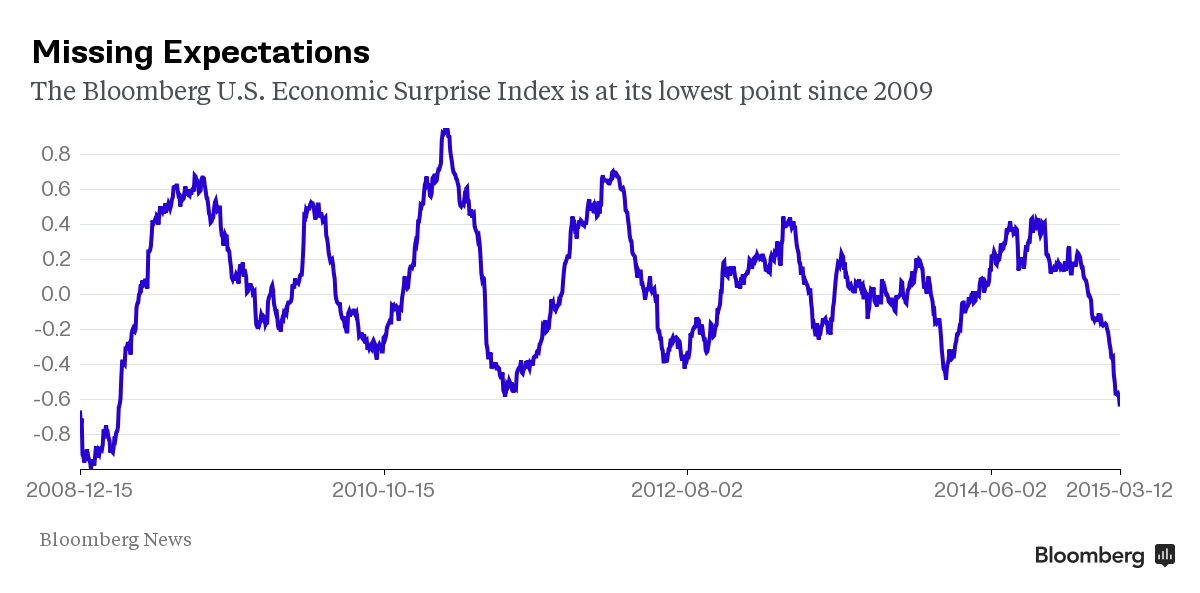
The American economy is a mess

us surprise index march 2015

Don’t ask me what the index actually measures, but it is the worst it’s been since 2009. There is no recovery in the American economy, none at all. It is a complete mess with neither the government, the American economics community nor our existing macroeconomic texts of the slightest use in getting things back on track. This is the first para of the story from which the chart is taken:

It’s not only the just-released University of Michigan consumer confidence report and February retail sales on Thursday that surprised economists and investors with another dose of underwhelming news. Overall, U.S. economic data have been falling short of prognosticators’ expectations by the most in six years.

They however give a pass to economic management because the labour market is doing reasonably well, in their eyes. So it is useful to be reminded of the actual reality once we adjust for falling labour force participation.

us unemployment march 2015 adj for participation rate

The worst part is not the outcome but the lack of insight into what the problem is. Keynesian macro is an economic wrecking ball, but there is not one economist in a hundred who even has an inkling that this is so, never mind why it is so.

Obama’s plan for peace in the middle east is comparable to his plan for dealing with the unemployed

us unemployment march 2015 adj for participation rate

The picture comes with the story, Here’s What The Unemployment Rate Looks Like If You Add Back Labor Force Dropouts. This is how it is described at Drudge:

92,898,000 Americans Not Working…
Labor Force Participation Rate at 37-Year-Low…
Record 56,023,000 Women Not in Labor Force…
Black unemployment rate nearly twice national average…

It is truly demoralising to watch. But the Democrat-media alliance is fully in charge so don’t expect things to improve any time soon.

The Australian School of Economics

There really is a different way of looking at economic issues in Australia, which is why we are still one of the most successful economies in the world. Two items from the news today, both of which go entirely against the world consensus on economic management. First, from The Australian, Rate cuts failing to bite: RBA. The opening paras:

INTEREST rate cuts are losing the ability to stimulate the economy, with the Reserve Bank warning that it is up to the government to take measures to help revitalise growth.

In a frank admission of the limits to the influence of central banks, Reserve Bank deputy governor Philip Lowe said consumers, businesses and governments were not responding to the extraord­inarily low interest rates that would once have sparked an inflationary debt boom.

The notion that interest rates can be too low is something almost no one can follow if you start with a standard macro model. Arbitrarily lowering interest rates will, in fact, make things worse but who any longer understands even why that might be the case. And if you are looking for what is truly unique about how we go about things, think about this, from the new Secretary of the Treasury, John Fraser:

[Fraser] declared to the Senate Economics legislation committee: “I do not resile from the point that I do not think spending our way out of lower economic activity is the way to go.”

Once, such a view was uncontroversial. Today, practically every international economics organisation preaches the opposite.

How against the consensus grain is all of this. If you want to find your way out of recession, keep interest rates up and lower public spending. And if you are looking for a theoretical explanation of why this is so, there is nowhere else to go other than the second edition of my Free Market Economics. And if you would like some idea of just how unique this book is, this is from an article I am in the midst of writing on the role of the entrepreneur in economic theory:

I have examined each of the following introductory texts because they happened to be on the shelf in our library, and there is either no reference to the entrepreneur found in the index, or the text contains only a perfunctory mention, never continuing for more than a page: Abel and Bernanke (2005); Blanchard (2006); Lipsey and Chrystal (2007); Mankiw (2007); McConnell and Brue (2008); McTaggart, Findlay and Parkin (2006); Parkin (2008); Samuelson and Nordhaus (1995); Sloman and Norris (2010); Stiglitz and Walsh (2006). It is clearly possible to discuss the operation of a modern market economy without mentioning the single most important function in allowing the economic system to work. There is not the slightest doubt that even if the most recent editions had been to hand, nothing would have been in any way different.

The Australian School of Economics can explain the role of higher interest rates, balanced budgets and the entrepreneur and with these concepts in hand explain how an economy works and what needs to be done to get recovery firmly in place.

What’s the point of a forecast 40 years out?

From the only economy with no deficit and no debt, this is where we are only ten years later:

The forecasts are a central feature of a new Intergenerational Report to be released tomorrow showing that federal deficits were on track to reach almost 12 per cent of the total economy by 2055 under Labor policies.

Preventing that outcome, Coa­lition policies will instead cut the deficits to 6 per cent of GDP by 2055 as a result of tax increases and spending cuts that have ­already been legislated.

But what really is the point of looking at things in 2055, about which we can know nothing. A report in 1975 about Australia today would have been just as meaningless.

No one has learned a thing

From an editorial in The Economist (14/2/15) with the title, “The German Economy. No new deal”. If you think anyone has learned anything from the past six years, please see below:

A first mistake is to insist that troubled euro-zone countries such as Greece not only make structural reforms to their economies, but simultaneously cut spending and borrowing (depressing demand). But a second is domestic. Given low interest rates, now would be a golden opportunity to borrow and invest more at home, boosting the economy and providing a Keynesian stimulus to the entire sluggish euro zone.

Their advice to the one European economy that has come out of the GFC relatively all right is to start copying every one of the idiocies perpetrated by the others.

“There’s no improvement in the economy!”

The story is about how the hosts at CNBC were stunned by having the truth told to them about the state of the American economy. The truth may not set you free, but at least it might get you to start doing what’s needed, assuming that anyone any longer knows that that is. Here is what they were told:

“There is no acceleration in underlying economic activity.”

“There’s this wrong concept that I keep on hearing about in the financial press about the acceleration in economic growth… It isn’t happening!”

“We had a horrible retail sales number, we had a horrible durable goods number, we’re likely to have a very disappointing retail sales number coming forward, this month we have a strong payroll number we say everything’s great – it’s not great….it’s been the same thing for the last five years, there’s no improvement in the economy!”

“After a string of dismal data on durable goods, retail spending, and inventories, we get a good jobs number and everyone saying the economy’s good – it’s not good!”

For me, this is perfectly in keeping with this story today: US budget deficit running 6.2 percent higher than last year, with actual spending up 8.3%. But for the rest of you, how can it possibly make sense?

It all depends on who you mean and what you mean by dead

An article on “Why we should listen to dead economists”, which I do agree with in principle, but it all depends on who you mean and what you mean by dead. I posted this comment just because, not that anyone who has gone through the scientology-based economic-theory teaching framework of the modern day will understand:

In the long run, every economist is dead. But in the meantime, you have to know which amongst those dead economists to choose. The problem, though, with Keynes is that while he has gone to his great reward, his theories are very much alive and continue to plague us still. But if we are going to look back even at the economists of Martin Wolf’s choice, it is Bagehot we should look at. Chapter 6 of his Lombard Street – “Why Lombard Street is Often Very Dull, and Sometimes Extremely Excited” – is a straight up account of the classical theory of the cycle, and incomparably better than anything you will find in a macroeconomics text today.

Choosing Keynes as a dead economist whose views we should examine, as if he were some obscure entity from the distant past, now known only to specialists, is a particular kind of peculiar. Chapter VI of Lombard Street, however, is as modern as the GFC.

Keynesian plunder

What our elites like most about Keynesian economics is that the wealthy get to plunder everyone else while the government can pretend it is trying to generate recovery. As the title says, For Most Of Us, There’s No “Recovery”, us in this case being in the US.

From 1820 through 2000, real (inflation-adjusted) gross domestic product grew at an average annual rate of 3.6 percent. Last year was the ninth consecutive year in which the economy grew less than 3 percent.

Real GDP has grown 13.6 percent since the recovery officially began in June 2009. The average rate of growth at this point in the recoveries from the four recessions since 1975 was 21.9 percent.

If it weren’t for gains made by the well off, there wouldn’t be a “recovery.” Five years after it began, the top 1 percent of earners (more than $366,623 a year) had garnered 81 percent of its fruits. The incomes of the top one-tenth of 1 percent (about $8 million a year) grew 39 percent.

The incomes of the bottom 90 percent declined, according to University of California-Berkeley economist Emmanuel Saez. Real median household income was $54,417 in December, 5.1 percent lower than in January 2008 ($57,317).

Most of us get nearly all our income from our jobs. Only 44 percent of adults work 30 hours or more a week, according to Gallup’s survey of the work force. Ten million fewer are working now than when Barack Obama became president.

It took until last March to create as many new jobs as were lost during the Great Recession. For every person who’s found a job, two have left the labor force.