Tom Woods on Say’s Law

This is a podcast of me talking to Tom Woods about Say’s Law. I think of it as the single most important economic issue of our time, because if we don’t finally work it out that Keynes got it completely wrong, we are going to create for ourselves a permanently lower standard of living and a widening underclass of the unemployed and under-employed. You cannot make an economy grow from the demand side. It is so rare to find someone who understands the point, making this an almost unique and quite exceptional place from which you can discover what the issues are and why they matter. Most of it is found in great detail in my Say’s Law and the Keynesian Revolution but there are some things I have discovered since, many of which are found in the Liberty Fund discussion on the Economics of John Stuart Mill for which I wrote the lead article. But the podcast gives a summary of everything that matters, which can only happen when the person asking the questions understands the issues himself.

My endless thanks to Tom Woods for doing this podcast and for recognising the importance of Say’s Law.

Five years too late

It is so depressing to read such stuff. From The AFR today:

Dr Banks suggests with monetary and fiscal policy no longer able to spur additional economic growth, it is time for other changes that can spur activity.

This was the former head of the Productivity Commission lamenting that we have run out of the ability to use monetary and fiscal policy to generate higher levels of economic activity. The depressing part is, of course, that anyone ever thought we could. What we are seeing today is the end game in having wasted our resources in various loss-making stimulus projects. But he is the same as the rest of the economics fraternity. They are genuinely mystified by the deepening downturn that should have gone away with all their public spending.

Possibly even more irritating is to find the former Secretary of the Treasury, Martin Parkinson, on the front page of The OZ discussing Slow growth the reason to reform not delay. He was not just the Secretary when Labor was in government creating the problems, he continued as Secretary well into the present government’s period in office. Tell me again, Joe, how reformist you are. Well, now, way too late, we hear this:

“You will never be able to ­increase the potential growth rate without increasing productivity, and at the moment our performance on that is terrible. That is the starting point for the argument on reform.”

Is that so? So tell me, Martin, about all the public spending you signed up on as part of our stimulus and all the cuts that were never made.

Then there’s this: Labor takes aim at Malcolm Turnbull as NBN cost blows out by $15bn. The subhead:

The Labor leader, Bill Shorten, says communication minister ‘hasn’t been doing his day job properly’ as negative polls hint at Coalition leadership change

At least someone is pointing out just how bad a Minister he’s been. And with no little thanks to Malcolm, Bill Shorten is now preferred PM.

Is it still the GFC from 2009, you numbskull kidders?

It it is hard, indeed it seems impossible, to get across the message that using up resources to produce loss-making forms of output causes an economy to slow, lowers the standard of living and reduces employment. Keynesian economics is driven by C+I+G; whatever you spend on makes no difference. So here’s an interesting story, about which Malcolm Turnbull has had an important role to play:

The company building the National Broadband Network could blow its budget by as much as $15 billion after revealing that revenue flow will slow and the costs of construction are far greater than it first expected.

The government-funded company revealed that its peak funding will now come in between $46 billion and $56 billion, up from the $41 billion assumption it previously held.

The company is aiming to complete the build — which will pass eight million homes by 2020 — for $49 billion, which is 20 per cent more than its original forecast. A worst-case scenario would see costs blow out by 36 per cent or $15bn.

The increased funding has smashed the rate of return that the project will generate for the government, which will now come in the range of 2.7-3.5 per cent. The previous rate of return was around 5 per cent. Despite the low return the project will remain off the budget.

The funding increase has been brought on by increases in the capital and operational costs of the build as well as increases in the costs to roll out of fibre to the node technology.

This is the final para of the story, which for some reason did not mention Malcolm.

The NBN received another $4.7bn of government funds in the past year to take its total equity to $13.2 billion in equity at end of financial year 2015. Total government equity contributions are capped at $29.5 billion.

This is just one example of the worldwide waste of resources in one government stimulus project after another. No modern textbook, other than mine, can explain to you why our economies are heading over the cliff. As the latest news has it, Aussie stockmarket tumbles amid growing fears over health of global economy. You’ll have to remind me again what it is that has caused all these problems? Is it still the GFC from 2009, you numbskull kidders? Meanwhile, a bit of whistling by the graveyard:

Treasurer Joe Hockey said that while markets would fluctuate, the fundamentals were still good for the global economy, particularly the US.

He said several factors would cause volatility in the markets in the next few months, particularly any decision by the US Federal Reserve to move on interest rates in September.

“If they do increase their interest rates, then you will see movement of money from equity markets, probably into bond markets,” he said.

He said such volatility would hit confidence in Australia and that’s why the government had to keep reminding people that their economy is one of the fastest-growing in the world right.

The fundamentals are disastrous in the US and not so good here either. These Treasury advisors do not have a clue.

Using the failure of anti-market policies as evidence markets don’t work

Now here’s an article I find really gets the point. By Per Bylund on Mises Daily with the quite nice title, Economics Is Dead, and It Is Being Killed Again. It’s hard to pick a best bit since you really do need to read it all. But to find someone as on the money as this is a rare event and needs to be brought to the attention of others. Here he is pointing out that the stimulus – as anti-market a policy as there has ever been – made us worse off which the left now uses as evidence that markets don’t work.

You have to applaud the anti-economics left for this rhetorical masterpiece. They have struggled for decades to sink the ship of economics, the generally acclaimed science that has firmly stood in the way of their anti-market and egalitarian policies, hindered the growth of big government, and raised obstacles to enact everything else that is beautiful to the anti-economics left. The financial crisis is exactly the excuse the Left has been waiting for. It is a slam dunk: government grows, Keynesianism is revived, and economics is made the culprit for all our troubles.

We see this now in education, as students demand to be taught (and professors demand permission to teach) a more “relevant” economics. Relevance, apparently, is achieved by diluting economics with a lot of the worst kinds of sociology, post modernism, and carefully structured discourse aimed to liberate us from our neoliberal bias. And, it turns out, we must also teach Keynesian ideas about how government must save the market economy.

We see this same agenda at academic research conferences, where it is now rather common to hear voices (or, as is my own experience, keynote talks) claiming that “it is time” for another paradigm: post-economics. The reason is always that economics “has failed.”

If this weren’t so serious, it would be amusing that the failure of Keynesian macro-economics (whether it is formally Keynes’s theory or post-Keynesian, new Keynesian, neo-Keynesian, monetarist, etc.) is taken as an excuse to do away with sound micro-economic theory to be replaced with Keynesian and other anti-market ideas. But it is not amusing. If most of the discussions heard are to be believed, the failures of central planning is a reason for central planning, just like socialism is a reason for socialism. The success of the market, on the other hand, is not a reason for the market.

It is incredible that economists in general don’t get it, but there is at least one who does.

A rare debate on Keynesian economics

You cannot imagine how rare a moment it was last night to be debating Stimulus versus Austerity. No one takes these things on, from the austerity side because hardly anyone actually understands what’s wrong with Keynesian economics as a theoretical issue, and from the Keynesian side because it is almost impossible to defend based on its theory. From the nature of the discussion, Keynesian theory is now defended only on sentiment and reflex. People want to do something, and raising government spending is in all the textbooks so we keep on doing it. Raising demand just seems obvious, which is why economics once explained why it was a terrible mistake. It is not obvious why public spending is bad for growth and jobs. And of course, infrastructure is a good thing so we should have more of it and therefore government spending is essential, whether you can afford it or not.

As for my own presentation, when in a public forum, you basically say what comes into your head, and you hope that what actually comes to mind is appropriate to the mood of the room and the case you wish to make. The one thing I told myself before I began is not to argue in the way it used to be done by John Stuart Mill, which was to point out how absolutely ridiculous the position held by other side was. He was particularly scathing on anyone who actually thought Keynesian economics had any merit at all – the carrier in his day being Malthus who had argued that demand deficiency (a general glut) was the cause of recessions, therefore requiring a stimulus to bring them to an end. But alas, in the midst of it, I found I was no better than JSM. The notion that we can wilfully waste our productive potential and that this will create jobs is so ridiculous that I just had to point it out just like that. What kind of a profession is economics if such obvious nonsense can sit at its very core?

But it’s not just theory we are dealing with. I have been on about this since the start of the stimulus packages in 2009, not one of which has brought recovery, and every one of which has had to be abandoned. They are economic poison, so why doesn’t our economic theory explain why they don’t work, rather than encouraging governments to try these experiments which inevitably fail? For me, I have no answer; you would have to go to a social psychologist to work it out.

But as I said at the start, it seems partly reflex, since this is all we have taught for 70 years, and partly sentiment, since we think we should do something. If it comes to that, I think we should do something too, but since lowering taxes on our businesses is so contrary to the anti-capitalist ethos that pervades more than just the left (but the left almost root and branch), the cure to many such people is worse than the disease. Better people should live in poverty, remain unemployed and individuals remain dependent on the government than that business profits should go up.

Anyway, a very interesting night demonstrating just how completely empty Keynesian economics is. Since the defence of the stimulus as presented was to show how the Greek economy had collapsed after international support had been removed, and that in Australia, although the data show that consumer demand ought to be rising by four percent but is only rising by two and a half percent – demonstrating apparently that we are being overly cautious and saving too much. It was also argued that capital spending is lower than expected given what it ought to be, and that real growth in incomes is flat! I can only say, that these seemed to be the kinds of things I wanted to get across. How that amounts to a defence of the stimulus I have still not been able to work out. What I do understand is that you need a heavy dose of classical economic theory to see why the economy remains flat. What will continue, I expect, is that we will teach what we teach in our economics classes, and governments will keep doing other kinds of things which are described as austerity. I just say again, that you won’t make sense of what is going on if you still think that Y=C+I+G gives you any insight at all into how an economy works.

My thanks to Joe Dimasi and the Economic Society for setting this up and to Alan Oster for his presentation of the other side.

Keynes vs the classics

A reminder that there will be a debate – more I suspect sequential talking points – between Alan Oster, the NAB’s Chief Economist, and myself on “Stimulus versus Austerity”. This is taking place on Wednesday August 19 @ 5:30 pm at the Imperial Hotel on the corner of Spring and Bourke Streets in Melbourne. If you are interested in coming, email joe.dimasi@monash.edu to let him know.

Of course, the reason I’m coming along is because I cannot actually think of how to defend the stimulus at this late stage. Back in 2008-09, even though a Keynesian stimulus had never worked anywhere else, not ever, we might have ended up lucky this time. It’s in all the texts, everyone learns Y=C+I+G, so how could every single economics text in the world have been wrong? But that was then. So I have been tossing around various thoughts on what Alan might say, what I might try to argue if I were defending the stimulus. This is kind of a Paul Krugman/Ken Henry version of all the lame things that might be part of such an argument. And I emphasise, the bailing out of financial institutions is not on the table. The financial crisis was over by May 2009. I am only interested in the public spending side of it. Here are my thoughts:

1) The stimulus worked a treat – we would have been back in the Great Depression if nothing had been done. As dismal as things seem, it is a better outcome than the alternative would have been had nothing at all been done.

2) The imperative was to use up those unused savings. No one was investing. The bottom was falling out of our economies. Savings were going to waste. This is still a problem as can be seen from all those unused bank accounts. People still aren’t spending so the government must do it for us.*

3) The theory was all right but the execution was badly done. A stimulus could have worked but the money was poured into the wrong kinds of activities.

4) We didn’t spend enough. A half-hearted stimulus would not only fail to solve the problem but would discredit the very idea of a stimulus.

5) The problems run even deeper than we originally thought. We are into a secular stagnation, not just a temporary fall off in demand.

6) Let me show you the stats to prove how fantastic things turned out relative to our forecasts at the time.

7) Fiscal policy might have been relatively weak but monetary policy has made a major difference by keeping rates low and encouraging investment.

Have I left anything out? Anyway, come along on Wednesday. For my part, I am going to present a short version of my Liberty Fund postings on “Reassessing the Political Economy of John Stuart Mill”, that is, real classical economics versus Keynesian inanities. We each get twenty minutes and then it is thrown open to the floor. And being Policy in the Pub, there is alcohol as well if that’s your sort of thing.

* Just today, in the AFR, Saul Eslake was arguing more spending is needed to put “idle” capital and labour back to work.

The wages of economic sin

The disconnect between the stimulus and our subsequent problems seems ever-present. You spend money on waste – school halls, pink batts, NBN, green technologies – and the result is a draining of productivity into the swamp. Real wages cannot rise if you do not increase our ability to produce the goods and services those wages are intended to buy. Here’s the latest news:

The growth in wages in the private sector is at a record low and is forcing workers to lower their expectations.

The 2.2 per cent increase over the past year recorded by the Australian Bureau of Statistics will not surprise those workers experiencing real wage cuts because employers have imposed temporary pay freezes or granted below-inflation salary rises.

The funny bit about wages is that no one has to do anything in a market economy to raise real earnings when the economy is going well. The competition for good employees does all the work for them. Unions can raise wages in some areas by killing off parts of an expanding industry, but overall wage rates remain almost entirely untouched. It is national productivity that matters, and we haven’t seen it grow in a while.

It may make everyone warm and fuzzy to pretend to be doing something about unemployment by some kind of Keynesian stimulus or helping the environment by promoting green (ie very expensive) energy. But reality is all too real. We have squandered billions and now cannot afford the incomes we once did.

It was the stimulus that did us in not the GFC

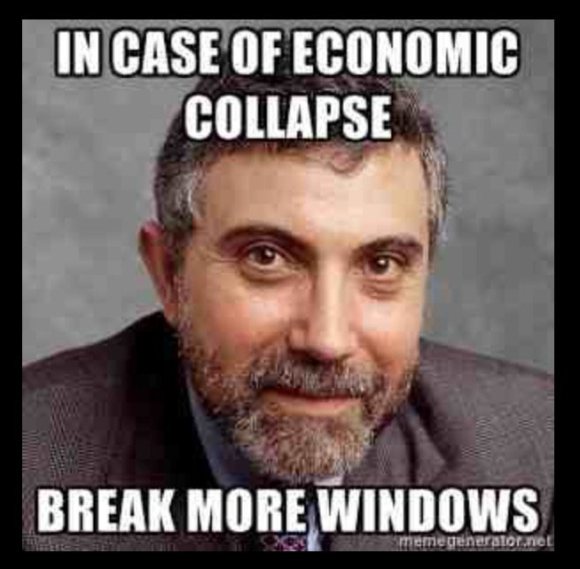
krugman Break-More-Windoes-copy

It’s only the headline writer, but it is the most common of all economic illiteracies. From The Australian: Growth rates slashed as GFC fallout lasts decade.

Normal economic growth rates won’t resume until at least 2017, the Reserve Bank declared yesterday as it slashed its growth forecast for next year, leaving Australia with weak growth for almos­t the entire decade since the global financial crisis began.

The Reserve Bank’s vision, outlined in its quarterly review of the economy released yesterday, now stretches for another 18 months, with a 0.5 percentage point downgrade in growth estim­ates for next year, to 2.5 per cent, casting a shadow over budget forecasts.

Let me couple this from Drudge today:

Record 93,770,000 Americans Not in Labor Force…
Participation Rate 38-Year Low…
Record 56,209,000 Women Not Working…

The only relationship between the GFC and the dismal economic outcomes today is that the GFC led one government after another to put in place a Keynesian stimulus. As I said at the time, we will be lucky to get out of the problems created within a decade. If you would like more of the same, Policy in the Pub on Wednesday the 19th.

Going Dutch

“It is one thing to have free immigration to jobs. It is another thing to have free immigration to welfare. And you cannot have both. If you have a welfare state, if you have a state in which every resident is promised a certain minimal level of income, or a minimum level of subsistence, regardless of whether he works or not, produces it or not. Then it really is an impossible thing.”

Milton Friedman

The AP story is obliviously written by an American who still thinks European countries are run by royalty. Nevertheless, he gets the point well enough to see the future everywhere in countries that, amongst other things, have been invaded by non-productive sponges and drones. We are back to a modern version of the ancient Marxist maxim: those who do not work, do not eat.

King Willem-Alexander delivered a message to the Dutch people from the government in a nationally televised address: the welfare state of the 20th century is gone.

In its place a “participation society” is emerging, in which people must take responsibility for their own future and create their own social and financial safety nets, with less help from the national government.

The king traveled past waving fans [!!!] in an ornate horse-drawn carriage to the 13th-century Hall of Knights in The Hague for the monarch’s traditional annual address on the day the government presents its budget for the coming year. It was Willem-Alexander’s first appearance on the national stage since former Queen Beatrix abdicated in April and he ascended to the throne.

“The shift to a ‘participation society’ is especially visible in social security and long-term care,” the king said, reading out to lawmakers a speech written for him by Prime Minister Mark Rutte’s government.

“The classic welfare state of the second half of the 20th century in these areas in particular brought forth arrangements that are unsustainable in their current form.”

The cradle-to-grave welfare state will go. Dependence on the government, other than occasionally and in small amounts, will disappear. If you are not self-supporting, no one else will be obliged to provide for you what you cannot earn yourself. We shall see if there is enough support for such measures in Holland in 2015. By 2030, it will be on its way to being universal since the welfare state can no longer be sustained.

Productive and unproductive labour

This is an online conversation I had with the editor at the Liberty Fund that helped me clarify even in my own mind some of the concepts that had remained free floating and had not been nailed down.

Q: Steve, let me ask you something. I’ve never been clear on the classical distinction between productive and unproductive labor. If a menial servant (in a free market) doesn’t add value to something, why is he paid? Did Menger, Bohm-Bawerk, or Mises reject the Smithian distinction? Maybe this would be good to address in a comment. . . . Why doesn’t the menial servant add value?

A: What do you think of this which is the point I think Smith and Mill were trying to make?

“It might be argued that economists are productive. But the reality is that if we heard that entrepreneurially-driven construction activity with no government subsidy was to double over the next ten years we would all agree that the economy would be bigger and stronger at the end of that time, more jobs would be created and real incomes would rise.

“But suppose, instead, we heard that over the next ten years there would be twice as many meetings of the Economic Society and that the number of journal articles would double. What then would be the effect on output and employment, do you think?”

I do think I contribute in a longish-term sort of way to productivity by building the human capital in my students. But it is not what makes the economy stronger, but in fact, the incomes of menials and others draws down on the productivity of the existing capital structure. If that doesn’t work for you, I will think about it some more. But the stimulus drew down without building back up which is why things are falling apart in so many ways.

Q:It still seems that everyone earning an income must therefore be productive.

A: Many earning an income are subsidised by the state, which the stimulus entirely consisted of just about everywhere. But even going past that, every private sector job will hold its place in that its production costs are met in full, but only some forms of economic activity allow real incomes to expand over time. Someone who carries someone else’s bag adds value and can be paid out of existing productivity which is the income of the owner of the bag being carried. But the economy does not become larger as a result. Only activities that add to a nation’s capital, including human capital, can do that. That is the distinction that they were trying to make. They would never have thought that the effects of C, I and G had identical effects on an economy which is what we now do.

Q: Does someone making consumer goods “allow real incomes to expand over time”?

A: I don’t see how incomes can expand unless there is some kind of capital expansion under way somewhere.

Q: In other words, isn’t someone who makes a car more like a valet than like someone who makes capital goods?

A: Mill’s not trying to be judgemental. He is only pointing out that some of the productive effort going on adds nothing to future growth while some does. And he is pointing out that all activity, both productive and unproductive, drains productivity which must be replaced. A machine breaks and so maintenance must take place just to stay where you were. Without some part of the economic structure first maintaining and then adding to the economy’s capacity to produce, the economy goes backwards. Those parts of the economy that are working to increase future productivity he describes as productive employment. I think the inferred insult is what must have annoyed so many. A Supreme Court judge might not like to think of himself as unproductive labour, but in Mill’s sense, unless his work makes the economy more capable of producing goods and services in the future, that is what he is. I have tried to replace the concept with the term value added, but I am beginning to think that I have overloaded this one poor word with two aspects of the issue under discussion.

I can also see that I didn’t explain completely why I had chosen the bag carrier as an example. I chose it because there is no capital required for someone to lift a bag and carry it somewhere else. But that is beside the point anyway. I can see that an enterprise earning profits above the level required to maintain the business’s capital structure also contributes to the flow of saving in a very minor way, if the owner reinvests those profits into productive forms of output. Nevertheless, most of the saving that matters is in the form of the accumulated capital that has been built up through economic activity over the past. It is not the flow of newly-produced capital that constitutes saving but the stock of assets that have been built up over the past.