US economy going nowhere, but some parts are doing better than others

The title, for Powerline, is Census: Economy is Going Nowhere. But what may be true for the economy in general is not true for various parts in particular:

The Asian-American population is now approaching 20 million, and their household incomes are now 23% higher than whites’, on the average. This is a rather stunning statistic. Why is so little attention paid to this income “gap”? Is it the result of discrimination against whites? If not, what could the cause possibly be?

I think the reason for the media’s silence on these numbers is that there is no good way to fit them into the narrative.

So just imagine what the stats would be like for the non-Asian parts of the population on their own.

The sad state of economic theory

us household income

The title of the article is The sad state of the American worker but what it really underscores is the sad state of economic theory and the economists who come with it. Read the article if you must, but the author has no idea what went wrong. Let us therefore start with the statistical facts he raises:

Start with the jobless rate. Yes, unemployment is down to 5.1 percent officially. Raise your hand if you believe that number is even close to accurate. The real unemployment rate counting labor force quitters and those forced into part-time jobs is, according to Mr. Obama’s own Labor Department: 10.5 percent. That number is actually down from more than 15 percent recently, but these still feel like recession rates. Nearly 90 million Americans over the age of 16 are out of the full-time workforce, and many millions of them are plopped in front of the TV watching “Seinfeld” reruns and living off food stamps or their parents because they have given up looking for a good job.

There is then the fall in household incomes which has occurred in spite of the fact that so many of our children are still living at home with their parents:

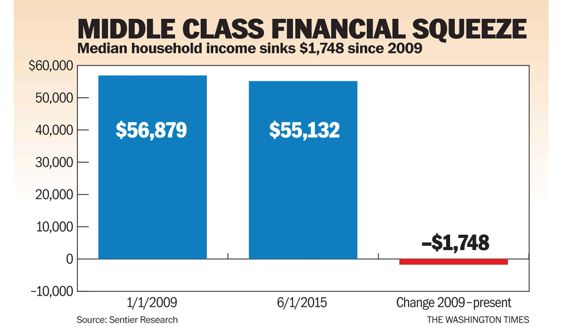
The Census Bureau has released the latest data on family income, and it has been analyzed by the statisticians at Sentier Research. Through this past June, the median income family has lost $1,700 in real income since Team Obama took the reins (see chart).

All that is true, and more, but you will look through this article for any suggestion on what went wrong, other than the anti-business environment that businesses have to contend with or the rises in the minimum wage which did not cause the problem and are peripheral at best. Frankly, he sees there is a problem but if you ask me, he has no idea what ought to be done. And the reason for that, in my view, is that economic theory is itself so misguided that economists in general might even be willing to endorse everything Obama has done to try to put the economy back on the rails.

More on Samuelson and the damage he has done to economic theory

I received a note from a friend and colleague on the note I did on the most damaging graph in the history of the sciences. He wrote:

Thanks for your blog on Samuelson. Only about twelve months ago did it dawn on me just how much damage Samuelson has done. I was thinking then of the Foundations, but of course you are right: his introductory textbook has been much more influential. Because his first degree was in physics, I don’t suppose he ever encountered a course in the History of Economic Thought in his life.

Samuelson’s first degree was in physics! This was news to me. So I did a bit of hunting, and now I am not sure that my colleague wasn’t right, and that Samuelson’s Foundations may have done as much harm as his introductory text and the Keynesian-cross. None of the standard online biographies mention physics, but there was then this on Paul Samuelson which is an entry in the online Encyclopedia of Human Thermodynamics, a link I shall certainly preserve. This is part of what it says about Samuelson:

In hmolscience, Paul Samuelson (1915-2009) (CR:89|#52) was an American economist noted, in economic thermodynamics, notable for his circa 1940 to 1970s efforts to derive economics via what he refers to a “mathematical isomorphisms” of the thermodynamics of Willard Gibbs, as communicated to him via his mentor Edwin Wilson and the so-called Harvard Pareto circle.

Economic stability | Equation 133
In 1938, Edwin Wilson, amid various letter communicates on his steam engine/physical chemistry based “mathematical economics” course, he was teaching at Harvard, wrote the following to Samuelson with critical comments on a paper by Samuelson:

“Moreover, general as the treatment is I think that there is the possibility that it is not so general in some respects as Willard Gibbs would have desired. [In] discussing equilibrium and displacements from one position of equilibrium to another position [Gibbs] laid great stress on the fact that one had to remain within the limits of stability. Now if one wishes to postulate the derivatives including the second derivatives in an absolutely definite quadratic form one doesn’t need to talk about the limits of stability because the definiteness of the quadratic form means that one has stability. I wonder whether you can’t make it clearer or can’t come nearer following the general line of ideas [that] Gibbs has given in his Equilibrium of Heterogeneous Substances, equation 133.”

The very impressive mention of “equation 133”, from Gibbs’ subsection “Internal Stability of Homogeneous Fluids as indicated by Fundamental Equations”, is the following:

U – TS + PV – M_1 m_1 – M_2 m_2 … – M_n m_n \,

Wilson, in other words, is suggesting, as it seems to be, to Samuelson that he use the Gibbs fundamental equation to formulate a theory of economic stability. Very hilarious indeed. Even the best of the best top dozen of the three dozen or so known human free energy theorists have been barely able to get a handle on this very intricate problem. No wonder Samuelson, into the 1970s, would become so irritated when people queried him about entropy and or sent him entropy-based economic papers to look at.

And where does all this lead:

Samuelson’s general economic model, in particular, was influenced by Gibbsian equilibrium criterion. His 1947 book Foundations of Economic Analysis, from his doctoral dissertation, is based, in theme, on Gibbs’ 1876 On the Equilibrium of Heterogeneous Substances. [1] Samuelson was the sole protegé of the polymath Edwin Wilson, who had himself been the sole protegé of Yale’s great physicist Willard Gibbs. During these formative years, Gibbs’ theories on equilibrium and chemical thermodynamics influenced them both in their ideas on the equilibrium of economic systems. In his seminal Foundations, Samuelson suggested, for example, that variation of the demand for a factor with a change in its price was analytically similar to thermodynamic variation in the pressure, volume, and temperature of an ideal gas. [9] All of this is pure Gibbsian. In fact, one may argue that the terms “foundation” and “variation” were plucked directly from the first page of the abstract to Equilibrium, wherein Gibbs states:

“Little has been done to develop the principle [of entropy] as a foundation for the general theory of thermodynamic equilibrium, which may be reformulated as follows: for the equilibrium of any isolated system it is necessary and sufficient that in all possible variations of the state of the system which do not alter its energy, the variation [δ] of its entropy shall either vanish or be negative.”

In short, Samuelson seemed to have adopted the variational logic of differential equations employed in thermodynamics, where variation goes by the mathematical name of “derivative”, to be applied in economics. Samuelson, however, maintains that his borrowing of thermodynamics to application in theoretical economics is only as “mathematical isomorphisms” between the maximum-minimum structures of thermodynamics and the cost-profit-utility systems of economics.

A very interesting idea in 1947, certainly worth pursuing. That we now can see it is a dead end is neither here nor there to all of world’s economists who have taken the trouble to learn maths rather than looking at the way an economy works.

Pedro Schwartz discusses Keynes and Say’s Law

Pedro Schwartz is the President of the Mont Pelerin Society so you will not be surprised to find that he has just written an article criticising Keynes, with the lurid title, Keynes as Lucifer. But what we also have in common is our interest in John Stuart Mill. In 1973, he wrote one of the few books ever written on Mill’s economics, The New Economics of John Stuart Mill, which I am now re-reading. That I had read it perhaps two decades ago is why it feels so fresh. Everything had fallen from my mind about the book, but I have in the meantime re-discovered Mill for myself. But here we are discussing Schwartz on Keynes, and he begins by trying to explain what cannot be doubted, the grip that Keynes continues to hold over the economics profession.

A number of circumstances and coincidences explain this everlasting fascination with Keynes. First and foremost is the failure to foresee, account for, and remedy the Great Depression of the 1930s—and the same with the Great Recession of 2007-11. Secondly, his own seductive personality fits in supremely with the new morality of the progressive elites. Thirdly, people of progressive intent feel a crying need to find some excuse for continued government intervention in society, after Marxism, socialism, economic planning, imposed egalitarianism, public schooling, and state welfare have signally failed to fulfil their promises or are threatened with impending failure.

Keynes’s rejection of the classical model opened a door to the many who were unhappy with the orthodox belief that supply created its own demand; that unemployment was self-righting; that the gold standard was the best monetary system; that investment could be left in private hands; that the stock market, despite temporary episodes, reflected the fundamental values and trends of the productive system; and in general, that laissez-faire was the best possible social arrangement.

And yet, I fear, I will have to disagree with him when he comes to discuss Say’s Law. Here he writes:

Say’s Law, which holds that supply always find its demand, was the bugbear of Keynes. The classicists founded on it their belief that full employment was the natural state of a free economy and there could be no involuntary unemployment in a competitive labor market, barring the frictional unemployment of people changing jobs. On the contrary, for Keynes, the engine of growth was aggregate demand (the sum of consumption and new investment): and the normal situation of a free economy was one where that aggregate demand was insufficient to guarantee the full employment of resources. This shortcoming was due to the tendency of consumption always to lag behind income, leading to excessive saving; and investment depending capriciously on the animal spirits of entrepreneurs. It was necessary for the state to use those excessive savings to top up flagging investment. Laissez-faire was not the best policy.

This is not Say’s Law as explained by Mill. The very reason for this issue even entering into economic discourse at the time was because economists in the 1820s were debating whether demand deficiency was the cause of the recessions they were observing and came to the virtually unanimous view that demand deficiency did not cause recessions even while many other factors did. It is with a heavy heart I see that even someone who has studied Mill as intensively as Pedro Schwartz does not get Mill’s point. Keynes’s ability to beguile and mislead is extraordinary and apparently never-ending.

A disgrace to the economics profession – the single most damaging graph in human history

Which has been the most damaging single diagram in the entire history of the sciences? There is not even a contest? The graph is, without any doubt, the Keynesian-cross diagram invented by Paul Samuelson which has been depriving economists of the ability to make sense of economic events since first published in the first edition of his Economics text in 1948.

keynesian cross

The idea for honouring this diagram has occurred to me with the publication by Mark Steyn of his just published book, “A Disgrace to the Profession” which he describes as “the story of the 21st century’s most famous graph and the damage it has done both to science and public policy”. Ah, but the present century is still young and although the harm the hockey stick has undoubtedly caused may well already be calculated in the billions, the harm Samuelson’s 45-degree diagram has done may be calculated in the trillions, and the damage it is doing is far far from over.

For those unfamiliar with the Keynesian-cross, it shows an upward sloping aggregate demand curve which reaches equilibrium where it crosses the 45-degree line at a level of national income well below the level of production that would employ everyone who wants a job. The answer, therefore, is an increase in public spending which pushes the line upwards and therefore pushes the equilibrium level of production along the horizontal axis to the right which then allows everyone to find a job.

The policy has, of course, never ever worked, but the trillions of dollars of public sector waste have drained our economies of astonishing levels of wealth that have kept our living standards well below their potential now for seventy years.

I have written my own book on the disgrace to the economics profession Free Market Economics which is now in its third edition. It takes apart Samuelson’s piece of beguiling illogic which has mesmerised the profession since it was first published. It is itself the very height of junk science, which has never on a single occasion given advice that has allowed an economy to raise its level of production and return an economy to full employment. It has, instead, led governments to pour their trillions into one wasteful project after another, of which green energy is only the latest, and while wildly expensive is for all that far from the most expensive example.

Economists who use any of these Keynesian diagrams starting with Samuelson’s are throwing sand in their own eyes. Profoundly shallow it is almost impossible to explain to someone who has been taken in by these graphs why they have been so badly misled. But there you are. No stimulus has ever worked but we still teach the diagrams that say public spending will bring our economies out of recession and give us strong and balanced growth. Do you believe that after what has gone on since 2009? Does anyone? A disgrace, but what is even more disgraceful is that the entire profession continues to accept a theory that has never worked. And there is the diagram that has corrupted the understanding of more individuals than any other diagram in human history.

Look Joe, let me put it this way

Managing an economy is not easy but there is one single simple principle that should guide those who make policy. The only policies that will work are those that make an entrepreneur more willing to invest and employ. Everything else is nonsense and irrelevant. You must do things that make employers more willing to employ and investors more willing to invest.

Where are such policies? Name a single change that has been brought on through economic policy that has made life easier for an entrepreneur, for those who run businesses. If you listen to those characters in Treasury who were brought up on C+I+G and don’t know any better, you will continue to manipulate the level of aggregate demand or fiddle with interest rates. These are more than useless; they are actually harmful. They make you worse off.

Here’s what to do. Invent in your mind a representative entrepreneur. Conceptualise someone running a business of any size with employees of any number. Then try to work out the kinds of conditions that would have to change if they are to increase production. And if you think what they need is an increase in demand, you have already failed the test since an increase in demand can only follow from an increase in value adding production.

Here’s the program.

You must cut business taxes, not personal taxes, or at least not yet.

You must diminish the regulatory burden on business.

You must minimise union interference in business decision making.

You must allow labour costs to adjust to the existing level of business productivity.

You must reduce government spending since such spending only competes with business for the community’s small stock of savings.

You must balance the budget as a matter of priority.

You must leave interest rate determination to the market for funds.

You must be able to distinguish between public spending which is genuinely value adding and public spending on welfare.

You must encourage competition to the fullest extent possible.

Not easy, but that’s what you need to do. Remember 1996-2004. That’s what we did then. Why don’t we try it again?

Why don’t economists get it?

China, India, Japan, US and Europe have weakening or underperformaning GDP growth. And by no coincidence at all, these are all economies that have tried a Keynesian expenditure program to end recession. The thing that is most astonishing is that there is virtually no economist of the mainstream who could even explain it. And as the article points out, this is even happening as the price of oil has plummeted.

Here’s a clue about what’s wrong with modern theory. Our economies are not saving too much. Our economies are being plundered of their savings by our governments who are wasting our resources on projects that will never bring a positive return. Go back to the stimulus packages and other government-directed expenditures of 5-6 years ago – some of which were even ludicrously described as infrastructure investment. What you are seeing today is the absence of the private sector projects that were forestalled back then. We are ruining our economies, and the economics profession is at the heart of the problem. Aggregate demand does not make an economy grow. Economies only grow if there is value adding investment. Seems obvious. Why don’t economists get it?

Waffle Street and Say’s Law

In re Waffle Street, Jimmy Adams has himself put up a comment in the comments thread.

While Steve may be unwilling to take an ounce of credit for it, allow me to publicly recognize his “little red book” as being the most influential of all the economic literature that I referenced in writing “Waffle Street.” Say’s Law is the transcendent and ironically, least appreciated, principle of economics. And no one explicates it better than Prof. Kates. Thanks again, Steve.

says Why is it my “little red book”? That’s why. The most astonishing part is that around once every decade or so some economist ends up stumbling onto Say’s Law and realises what it actually means and then tries to tell everyone else. The list is not that long, but includes Benjamin Anderson, Henry Hazlitt, William Hutt, Thomas Sowell, Art Laffer and Murray Rothbard. Once you see it, everything about how an economy works suddenly changes shape, and most importantly, Keynesian forms of economic management seems utterly insane. No one who understands Say’s Law is ever surprised that some Keynesian stimulus didn’t work, or that the rise in public spending ever does anything other than pull an economy down. And each of us has tried to explain as best we can why Say’s Law is so important but no one gets it. They don’t even get it to the stage where they could really answer that I see what you mean but I disagree. They do not even understand this enough to be able to explain what it is they disagree with. If you think that “supply creates its own demand” covers it, you have to ask yourself why no classical economist ever said it. The phrase comes from a book published in 1933 by a critic of Say’s Law which was then purloined by Keynes in the General Theory published in 1936. Say’s Law is not even all that hard to understand: all economic activity is driven from the supply side; none of it is driven from the demand side. What is true for an individual product is not true for the whole economy. If there had actually ever been a single Keynesian success story, there might be some case for the continuation of Y=C+I+G in our texts. But a Keynesian stimulus has failed, and failed spectacularly, on every single occasion it has been tried. Yet Keynesian macro persists in our texts. If you would like to understand the entire sordid story, my little red book will explain it, and is also the only place you can find out how the Keynesian Revolution came about.

Clueless

Economic theory as it is now constructed is a wrecking ball. From an article titled, Time to Reform the Fed ─ Because It Doesn’t ‘Have a Clue’. It starts here with an assessment of the dire straits of the US economy, where any such thing is typically denied, but for a change someone feels the need to point it out.

Since the Great Recession ended in 2009, the recovery has been slow and painful. Wages have been so stagnant that the average American family earns $1,000 a year less in income than it did in 2008. That’s why some two-thirds of people believe that their children won’t be better off than they were — a reversal of the American Dream.

How could they be better off since the wealth creation process has been diverted into government waste-creating schemes of one sort or another. Fiscal policy in its modern Keynesian disguise, insists it doesn’t matter what you spend on, but if you believe that, you ought to have your licence to practise economics taken away. All that may be found in my Free Market Economics, the most relentlessly anti-Keynesian text available anywhere. There are a handful of others, but this is where you will see it all laid out based on the classical economic reasoning that was completely displaced by Keynesian theory in 1936.

What you will also find (Chapters 16 and 17) is a classical discussion on why low interest rates will wreck your economy about as comprehensively as unproductive spending. This is also nothing different from the classical theory that existed before Keynesian theory took over. Where’s all that investment that low interest rates were going to bring? You would have to read the book to find out. Meanwhile, the article continues:

A growing number of people believe the Federal Reserve has hurt rather than helped the recovery. It has pursued zero-interest-rate policies that have perversely made it impossible for many businesses to get credit to expand. The Fed and other central banks have injected trillions of dollars into the global economy; according to the New York Sun, the result is that “the world is now afflicted by a public-sector debt bubble that could rupture in any of a number of countries.”

Even more to the point, which is exactly as described in my text, we find this:

In the Bank for International Settlements’ most recent annual report, Claudio Borio analyzed the negative impact of low interest rates, concluding: “Rather than just reflecting the current weakness, low interest rates may in part have contributed to it by fueling costly financial booms and busts and delaying adjustment. The result is too much debt, too little growth, and too low interest rates. In short, low rates beget lower rates.”

Even this is too benign relative to the harm that low interest rates have done and are continuing to do. There are so many ways we are wrecking our economies, but the fallout when the Fed finally decides it cannot maintain zero interest rates forever will show once again how interesting the times we live in actually are.

Some positive news about the Chinese economy

Here’s the story: China likely to drag the world into global recession, Citigroup says. Here’s how it begins:

China is sliding into recession and the leadership will not respond quickly enough with large-scale fiscal policies that could avoid a major slowdown and stimulate demand, Citigroup’s top economist Willem Buiter said.

The only thing to stop a Chinese recession, which the former external member of the Bank of England defines as 4 per cent growth on “the mendacious official data” for a year, is a consumption-oriented fiscal stimulus program funded by central government and monetised by the People’s Bank of China, Buiter said.

“Despite the economy crying out for it, the Chinese leadership is not ready for this,” said Buiter, the man who coined the term “Grexit” during the Greek debt crisis.

So what is positive about that, you might ask. If it is a deliberate decision not to reflate but to go through the adjustment that is obviously required, there will be about a year of mess, possibly not even that, and growth will resume on a stronger basis. It will also be a sign that the Chinese leadership understand how useless Keynesian economic theory is and are now biting the bullet and will endure the pain of the next twelve months. This is all speculation from both Mr Buiter and myself, but it will be interesting to see how things do unfold. If there really is a recession and no stimulus and the Chinese economy comes out of it in 2016-17 stronger than ever, we will be re-writing our textbooks without any doubt.