
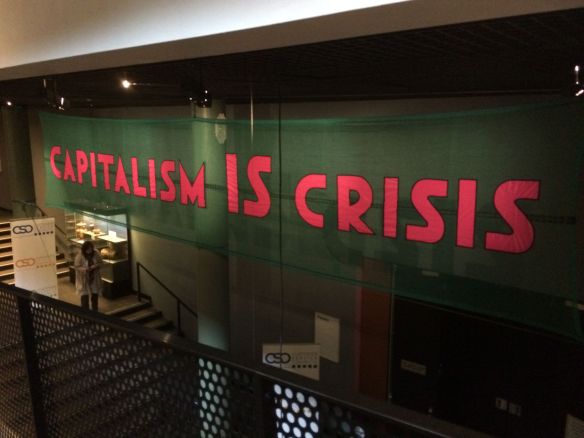
The crisis of capitalism is caused by ignorance of history

capitalism is

The photo is from The Powerhouse Museum which I took this afternoon where they are having an exhibition on protest. And it was in the museum cafe that I read Maurice Newman’s article on Malcolm Turnbull’s agile nation must avoid politics of envy. The article is about the kinds of thing that people in the second half of their lives are prone to understand, which are why the kinds of things they may have believed in the first half are so stupidly wrong. As he writes:

Why then, in this postmodern world, when we know that free enterprise has so spectacularly raised living standards and prolonged life for all, do we demonise it as uncaring, unfair and outdated?

Free market capitalism, like nature, may favour the resilient, the ambitious and the fleet of foot, but rather than celebrate self-interest and see wealth creation as a positive contribution to all society, we are conditioned by the Left, from school days on, to believe that social goals and the collectivist vision are more important than private choices; that without government intervention, most will be left behind.

This is our world. A top-down social-democratic state where elites are patronised, competition is controlled, where private initiative is stifled, free speech is abridged and where the electorate is increasingly state dependent. Here, big government colludes with big labour and big business to socialise losses at taxpayer expense.

Precious productive capital is wasted on school halls, pink batts, the National Broadband Network, futile subsidies and ordinary political aggrandisement. Loose fiscal and monetary policies give the rich relatively risk-free profits from speculative assets, while winner-take-all returns see a new breed of innovators and disrupters building tax- sheltered fortunes.

The media are filled with people who are the least likely to understand any of it but are most likely in a position to influence the rest of the community about the supposed evils of the market system. For those with few skills of an entrepreneurial nature, making their fortune as critics of the only society that has ever created wealth and freedom may give them a great sense of self-fulfilment and se;f-importance, but there are many societies that have been laid very low when people just like these have taken power. See Venezuela for a recent example.
Economics as physics

J.E. Cairnes back in 1888 stated that there was nothing that an economist could learn by using maths that they could not think through in words. I thought of this looking at a recent post from The Grumpy Economist on Open-Mouth Operations, that is, a discussion of the way comments by the Chairman of the Fed of themselves shift markets. This is the lead-in para to the model:

Our central banks have done nothing but talk for several years now. Interest rates are stuck at zero, and even QE has stopped in its tracks. Yet, people still ascribe big powers to these statements. Ms. Yellen sneezes, someone thinks they hear “December” and markets move.

And these are the maths behind his words.

Use the standard “new-Keynesian” model

xt=Etxt+1−σ(it−Etπt+1)
πt=βEtπt+1+κxt

Add a Taylor rule, and suppose the Fed follows an inflation-target shock with no interest rate change

it=i∗t+ϕπ(πt−π∗t).
i∗t=0
π∗t=δ0λ−t1

Equivalently express the Taylor rule with a “Wicksellian” shock,

it=î t+ϕππt
î t=−δ0ϕπλ−t1.

In both cases,

λ1=(1+β+κσ)+(1+β+κσ)2−4β‾‾‾‾‾‾‾‾‾‾‾‾‾‾‾‾‾√2>1

Yes, this is a special case. The persistence of the shocks is just equal to one of the roots of the model. Here δ0 is just a parameter describing how big the monetary policy shock is.

Now, solve the model by any standard method for the unique locally bounded solution. The answer is

πt=δ0λ−t1,
κxt=δ0(1−βλ−11)λ−t1
it=0

cochrane

This is how policy is now discussed and determined. But do note the equilibrium that comes out of it. Just don’t ask me to explain what you have just read so which is why I will let the author do it:

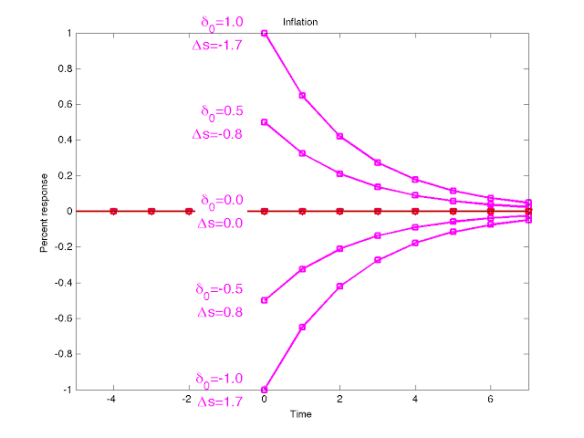
And here is the path of output. In each case δ0 in the graph gives the size of the monetary policy shock. It’s also the size of the inflation jump at time zero induced by the monetary policy shock.

Watch this mom, no hands… Interest rates do not budge throughout the episode. The Fed announces a monetary policy shock, and inflation moves just enough so that the systematic part of monetary policy offsets the shock, and Fed doesn’t end up actually doing anything! We get the traditional results of monetary policy — lower inflation and lower output, for example — based just on talk!

If you’re inclined to this sort of model, you might want to pursue this sort of solution as a model of our current “open-mouth” regime.

This is too far for me to go. It gives up on traditional “monetary” policy. “Monetary” policy is here pure “multiple equilibrium selection” policy. The Fed makes a different set of off-equilibrium threats and we jump to a different one of multiple equilibria. Interest rates are completely irrelevant to the standard effects of monetary policy here.

So I view the calculation as an indication of fundamental problems with the model I wrote down above, a reductio ad absurdum. But others may want to take it seriously. Hence the “thesis topics” tag.

Granted, the standard view of open mouth operations is that Fed statements change expectations of future interest rate paths — actual, observed, equilibrium interest rate paths, not these shocks which are offset by inflation. But sooner or later rational expectations have to kick in — you can’t endlessly promise interest rate changes that never happen. So the open mouth operation is an interesting limit, in which statements about interest rates matter, but the Fed never has to actually do anything about interest rates.

Also granted, I don’t have a better model of why markets move so much on Fed chatter.

The Δs numbers index how much fiscal policy must cooperate in each case. If there is a jump down in inflation, that means greater value of government debt, and fiscal policy must raise surpluses by the indicated percentage. For the fiscal theory of the price level, these paths are then paths that happen when there is a pure change of fiscal expectations, and the Fed does nothing about monetary policy. I find that a much nicer interpretation.

Reserve Bank of New Zealand Governor Donald Brash coined the word “open mouth operations,” observing that he seemed to be able to move interest rates by simply talking, without conducting open market operations. This is a second level of open mouth — here the Fed can move inflation itself just by talking.

So do statements by the Chairman of the Fed affect the inflation rate, and if so how, and if not, why not? But more to the point here, whatever you personally believe, do you need the maths and the model to explain your conclusion?

Wondering where all the productivity has gone

From John Cochrane, where he begins by setting out the problem to be solved:

Sclerotic growth is the overriding economic issue of our time. From 1950 to 2000 the US economy grew at an average rate of 3.5% per year. Since 2000, it has grown at half that rate, 1.7%. From the bottom of the great recession in 2009, usually a time of super-fast catch-up growth, it has only grown at two percent per year. Two percent, or less, is starting to look like the new normal.

Small percentages hide a large reality. The average American is more than three times better off than his or her counterpart in 1950. Real GDP per person has risen from $16,000 in 1952 to over $50,000 today, both measured in 2009 dollars. Many pundits seem to remember the 1950s fondly, but $16,000 per person is a lot less than $50,000!

If the US economy had grown at 2% rather than 3.5% since 1950, income per person by 2000 would have been $23,000 not $50,000. That’s a huge difference. Nowhere in economic policy are we even talking about events that will double, or halve, the average American’s living standards in the next generation.

And then he makes the central point:

Over long periods of time, economic growth comes from one source: productivity, the value of goods and services each worker can produce in a unit of time. . . . Nothing other than productivity matters in the long run.

All good, and probably known to all. But then there is trying to identify the nature of what has been holding productivity back, and here I’m afraid he doesn’t quite go as far as he needs to. He has a list of also-run issues, in which he includes “fiscal or other stimulus programs”. If these are not part of the weed patch he describes, I don’t know what are.

Here is what I think the problem is. Governments think they can direct our resources more productively than businesses can, and what’s worse, that public spending will encourage business and business growth. It is surely not all of it but it is much of it. Public spending has a role to play, but governments are now spending our economies into the poor house. If you want to raise productivity, no answer that does not include cutting back on public spending will work.

One thing you do not learn in economics school

This is from 101 Things I Learned in Engineering School dealing with “equilibrium is a dynamic, not static, state”.

When two chemicals come in contact and react, the reaction often appears to stop after a period of time as an equilibrium is reached. Some portions of the chemicals will have combined into a new chemical product, while other portions appear unaffected. But even in equilibrium, the mixture often remains active, as portions of the product “uncombine” into the reactants and reactants continue combining into new product. However, the overall crossover rates balance and there is not net change in the system.

A structural equilibrium is similarly dynamic. A structural element, even though at rest, works quietly and unceasingly to resolve the various forces acting on it into an overall force of zero. Without the zeroing of forces, an object will accelerate, decelerate, or change direction.

This is how economists ought to teach equilibrium, as an ongoing market tension with forces of all kinds continuing to attempt to reshape everything you see. Equilibrium should not be taught as stability. It should not be taught as a position of rest, whatever might be the appearance at some superficial level.

Economists teach equilibrium as a state of rest. We do it in micro with supply and demand. We do it in macro with aggregate supply and aggregate demand. The following video – which perfectly states the economist’s view – shows how equilibrium is taught in discussing a single market for a single product.

We say, of course, that all other things must be equal for the equilibrium to be maintained, but we do not go on to say that in no market are other things ever actually equal, that the entire notion of equilibrium is a fiction, perhaps a useful fiction, but a fiction all the same. In economics we stress stability when the actual world is anything but.

Experimental economics – a case study

I’ve often thought about an experiment by asking students if they feel that incomes should be shared, and then asking after that whether the students with the highest marks would like to give some of their marks to students with the lowest marks. Not really practical, never mind the problems with an ethics committee. But this, on the other hand, did the same thing in a much more effective way.

An economics professor at a local college made a statement that he had never failed a single student before but had recently failed an entire class. That class had insisted that Obama’s socialism worked and that no one would be poor and no one would be rich, a great equalizer.

The professor then said, “OK, we will have an experiment in this class on Obama’s plan. All grades will be averaged and everyone will receive the same grade so no one will fail and no one will receive an ‘A’”… (substituting grades for dollars — something closer to home and more readily understood by all).

After the first test, the grades were averaged and everyone got a ‘B’. The students who studied hard were upset and the students who studied little were happy.

As the second test rolled around, the students who studied little had studied even less and the ones who studied hard decided they wanted a free ride too so they studied little. The second test average was a ‘D’!

No one was happy.

When the 3rd test rolled around, the new average was an ‘F’.

As the tests proceeded, the scores never increased as bickering, blame and name-calling all resulted in hard feelings and no one would study for the benefit of anyone else.

These are possibly the 5 best sentences you’ll ever read and all applicable to this experiment:

1. You cannot legislate the poor into Prosperity by legislating the Wealthy out of prosperity.

2. What one person receives without working for, anotherperson must work for without receiving.

3. The government cannot give to anybody anything that the government does not first take from somebody else.

4. You cannot multiply wealth by dividing it!

5. When half of the people get the idea that they do not have to work because the other half is going to take care of them, and when the other half gets the idea that it does no good to work because somebody else is going to get what they work for, that is the beginning of the end of any nation.

Whether it is a true story I cannot say, but no one would doubt that things would work out more or less just like it says.

[My thanks to Peter S. for passing this along.]

A classical economist looks at modern macro

This is the first draft of the conclusion of the paper I have finally finished on classical economic theory. The rest of the paper leads up to these conclusions. Whether it is published is, of course, not in my hands. But after the mess that has been made of economic management following the GFC, there is plenty of real world evidence that modern theory has a lot to answer for.

The one thing all sides can agree on is that there was a “classical economics” before Keynes published his General Theory and that modern macroeconomic theory is different from classical economic theory. Beyond that, other than a superficial gloss on what that classical theory consisted of, virtually no modern economist any longer knows what that classical theory was. This paper has therefore provided an explanation of the economics before Keynes, focusing as Keynes did on what we would today describe as the macroeconomic issues. What makes this paper particularly useful is that it has been written by someone who believes the economics of John Stuart Mill is superior to modern macroeconomic theory. Whether others will share this belief after reading the paper is neither here nor there. The actual intent is to allow modern economists to gain an appreciation and understanding of the economic theories of their predecessors.

Possibly the greatest obstacle for modern economists is that they assume a pre-Keynesian economist had no theory of involuntary unemployment. The quote from Mill at the start of this paper, plus recognition that there had been a detailed and intricate theory of the cycle that had developed for over a century through until 1936, should provide some incentive for economists to examine the great history of their own subject, not only with a sense of the grandeur and depth of understanding that has pervaded our subject since its origins in Adam Smith and The Wealth of Nations, but with a sense of adventure about finding out what they knew that we do not. As J.E. Cairnes (1888: iv-v) pointed out at the end of the nineteenth century, whatever mathematics may have brought to economic theory, it has not provided any additional insights into our understanding of the underlying dynamics of an economy. The broad features of the economies we live in today were evident even as far back as 1776. The belief that we know something a classical economist did not about human motivations, the potential for markets to bring prosperity, the need for government regulations to be properly crafted, or the pros and cons in relation to the provision of welfare are beliefs that cannot withstand a deeper understanding of classical theory. We may have better statistics and more sophisticated analytical techniques, but the theories a modern economist applies to make sense of it all are not obviously better than the theories that had prevailed before the publication of The General Theory in 1936. The argument presented here is that they are, in fact, actually worse.

Your thoughts would be welcome.

Is government spending consumption or investment?

I return to an issue raised by Sinclair at the beginning of the day in his post on Welfare is consumption not investment. This is the confused notion economics now has about the nature of value adding and the role of saving. It goes further. Would modern economists recognise saving if it came and hit them in the eye and are they able to distinguish saving from public spending? It ought to be straightforward but it is not.

This is a knotty issue I find myself trying to resolve as I finish off a paper. It’s not that I don’t know what I think saving is. It’s whether there is a truly solid definition of saving so that economists will know what saving is. Is government spending officially part of consumption or is it part of investment, or is there a division, and if there is a division, how is the dividing done since most public “investment” is not market tested? That is, can government investment still be called investment even if there is no positive return or must it at some stage pay a dividend? This is the definition for “saving” that comes up first on Google:

According to Keynesian economics, the amount left over when the cost of a person’s consumer expenditure is subtracted from the amount of disposable income that he or she earns in a given period of time.

That is S=Y-C. Nothing new. Here’s the second one:

The portion of disposable income not spent on consumption of consumer goods but accumulated or invested directly in capital equipment or in paying off a home mortgage, or indirectly through purchase of securities.

Once again, it is S=Y-C. The third one, though, is from The Britannica and there’s a name you can trust. This is more along the lines of what I am looking for since it begins to grapple with the actual issues:

Total national saving is measured as the excess of national income over consumption and taxes and is the same as national investment, or the excess of net national product over the parts of the product made up of consumption goods and services and items bought by government expenditures. Thus, in national income accounts, saving is always equal to investment. An alternative measure of saving is the estimated change in total net worth over a period of time.

It seems to bring in the notion that saving is a form of value adding spending which appeals to me. Which brings me to the passage I am trying to get right.

In a modern macroeconomic model, saving is enumerated in money terms and is seen as a negative, an absence, a failure to spend. National saving is defined as current money income in total less total money spent in the current period in non-value-adding ways. Saving can be seen as the difference between income and the level of unproductive demand, that is S=Y-(C+G), with Y, as usual, representing total income. The level of saving is then equal to the level of investment.

But this does not quite get to the Keynesian conception. First, C+G is made up of actual items of consumer goods and services plus government purchased goods and services. Perhaps complicating these issues further, saving traditionally is restricted to Y-C, with G net of transfers not entirely defined one way or the other, perhaps intrinsically conceived of as being as productive as business investment. It is possible that to properly make sense of modern economic theory, saving should be defined as Y-(C+G). It seems unclear where government spending fits into the notion of savings in a modern macroeconomic model.

Almost everything governments do seems to cost more than their return so I almost automatically think of saving as Y-(C+G). The more government spending there is, the less private investment. The notion that welfare spending is now even conceived in some quarters as part of industry policy seems to hasten us along the road to ruin. Is that now part of what all economists are taught to believe. Not my students, of course, but the rest? If that is how it is, economic theory is in an even worse state than I thought.

Alan Kohler on central banks and Keynesian economics

This is Alan Kohler explaining why “Central Banks Are Destroying The World”. There’s no doubt they are doing everything they can, and there are not a lot of people around who will say this in public. But I mention his comments since it is nice to see myself mentioned in despatches.

These days our “patrician overlords” are central bankers, benignly manipulating our behaviour (“aggregate demand” they call it) by adjusting the price and availability of the thing we all so crave – credit.

The question for this week is: what should they, and you, do instead? Bearing in mind the old joke that if you wanted to get to Dublin, you wouldn’t start from here.

Well, there’s no doubt in my mind that “they” – the Fed, ECB and Bank of Japan – need to start raising interest rates pronto, and stop worrying about inflation being too low. It’s caused by technology reducing costs and debt suppressing consumption and investment – not by a shortage of demand that can be reversed by monetary policy. Specifically they should allow the market to set interest rates, just as the market sets most other prices. But these are not, to say the least, mainstream opinions.

As an old friend of mine, Steve Kates of RMIT University, wrote in his book Free Market Economics:

“Today, there is no aspect of an economy’s structure that governments do not believe themselves capable of making a positive contribution towards. … Such actions are not undertaken with a sense of dread at the possible unintended consequences. They are undertaken with a confidence that is simply unwarranted…”

“To believe that some central agency can plan ahead for entire economy is one of the major fallacies often associated with economic cranks. No single person, no central body, no government agency can ever know anything remotely like what needs to be known if an economy is to produce the goods and services the community wants, never mind being able to innovate or adjust to new circumstances.”

In my view, those “goods and services” include credit. Our patrician overlords at the central banks believe themselves capable of determining how much of it we need and at what price.

The Keynesian economic central planners went into hiding after the Berlin Wall came down in 1989 and the failure and corruption of Soviet style Marxism became evident. After that, and after the recession of 1991, the world had 10 years of spectacular growth due, in part, to interest rates being left to find their own level. However after the tech crash of 2000, the real Fed funds rate was taken negative – what Keynes called “the euthanasia of the rentier” – on the basis that wealth creation through rising assets prices would lead to economic growth.

Charles Gave of GaveKal Research calls this “one of the stupidest ideas ever put forward in economics”. It led to an explosion in debt and speculation on housing, which led, in turn, to the 2008 credit crisis, and Great Recession.

Instead of learning from this mistake, the central bankers then went all the way – reducing nominal rates to zero and keeping them there for six years.

To a large extent the current thinking is based on the proposition that we face “secular stagnation” a phrase rediscovered by former US Treasury Secretary Larry Summers (it was originally coined by Alvin Hansen in 1938, in a book called “Full Recovery or Stagnation?”).

Those promoting this idea today don’t remember that it’s the same incorrect argument that was floated towards the end of the 1930s, and they don’t believe that if left to its own devices the economy would go back to normal. Instead they think the world’s entrepreneurs, business people and consumers would somehow remain comatose if central bankers et al didn’t poke at them to wake up. Central bankers have never run a business themselves but are totally confident in their ability to goad businesses and consumers into action and then distributing the proceeds.

These are the misguided vanities of what Lewis Lapham calls our patrician overlords. Economic growth is failing to recover because central bank actions have increased the stock of debt, which is weighing on the world’s economy like a heavy blanket. It needs to be cleared, through being priced correctly and borrowers and lenders recognising their losses. In other words, the free market must apply.

As Steve Kates wrote: “The problem lies in the belief that that the natural state for an economy is for it to be growing with unemployment low, when the reality is that the natural state for an economy is that it is adjusting to new circumstances during every moment of every day.”

The greatest of all Keynesian disasters was to promote the idea that economists have any idea on what to do to make economies grow. As it happens, our growth over the past sixty years has been in spite of our economists, but I think the economic cranks are now in such control that they are pushing our economies backwards at unprecedented rates.

So, there’s been a fall in productivity – whatever might have caused that?

The more I look at commentaries like this, the more I come to the conclusion that modern economics is a complete wasteland. The subheading reads: “The global productivity slowdown will pose a huge challenge for Scott Morrison”. But what is truly bizarre is this:

The IMF has been troubled over the failure of world growth to meet its forecasts. Every time the fund has looked at world growth in the past five years, it has had to downgrade its forecasts. If the world economy had grown in line with the forecasts it made five years ago, the economies of the advanced world would be 14 per cent bigger than they are while those of the developing and emerging world would be 23 per cent bigger. But the forecasts of employment the fund makes for advanced countries have been much closer to the mark. Indeed, for a range of countries, including Germany, Japan, South Korea and Britain, employment growth has been better than the IMF predicted, although output growth has been worse. More workers are producing less output than was expected.

I don’t wish to be impertinent since, after all, the IMF is comprised of some of the most highly paid economists in the world, experts in the dark arts of econometrics and modern macroeconomic theory. Nevertheless, I feel compelled to point out that now, five years after the stimulus, when governments around the world commandeered huge swathes of their nations’s savings, the inevitable consequence has been a fall in productivity. Rather than our resources being used in truly value adding activities determined by the market, they were instead used by clunks in government and Treasury on such pieces of economic junk, like the NBN, Building the Education Revolution and Pink Batts. In the US there’s been Solyndra and everywhere you go there are the many, many green energy projects that have absorbed capital. The result today is that we have a dearth of the kinds of new investments coming on stream that would maintain productivity. Instead, we find it difficult even to maintain previous standards of living, never mind getting them to grow. Of course, the IMF, being such geniuses, has all the angels covered:

The IMF says weak business investment is partly responsible for the poor growth outcome but says that by far the most important issue is weak productivity on its broadest measure. It is not just output per worker that is disappointing. The additional output from every dollar of business investment also has been weak.

There is no settled explanation for this. The IMF says a shift in the composition of economic growth also may be contributing. Service industries are accounting for most of the increase in growth, rather than manufacturing. Output can be harder to measure in service industries, and they are often more labour-intensive. The IMF says it is also possible the revolution in information and communications technology is delivering fewer gains in productivity than was the case through the 1990s. It also speculates that the pay-off from additional investment in education may be diminishing.

Let us therefore take the NBN as the prime example of what has gone wrong. In every way most of the infrastructure construction might be listed in the national accounts as business investment. You could say the same for all of the desal plants that were built. But crony capitalism is not free enterprise, and the outcomes that are fed by public monies are duds no matter which way you look at it.

Economics remains wedded to C+I+G. It still believes SPENDING causes growth, with all those multiplier thingys hanging off the initial expenditure. It is a stunning failure of policy, although hardly anyone at all has noticed just how great a failure it has been. In the US they surveyed the nation’s economists and some massive majority have stated that the stimulus created additional jobs. With that kind of thinking so widespread, it should be no surprise just how dismal our economic prospects now are.

And for what it’s worth, the worst thing that the RBA should now do is lower rates of interest, which is probably the reason they are going to do it the next chance they get.

What does a modern economist think a classical economist believed?

I am writing a paper in which I begin by setting down what a modern economist would believe about “classical” economics. In reality, of course, virtually no economist today would have the slightest clue how an economist prior to 1936 would have looked at the operation of an economy or dealt with the problems it might have. I have pulled together my own summary and am putting up it here so that others can tell me what they think. I would merely emphasise that what I have below is such a misbegotten caricature that economists ought to be thoroughly disgusted with their own discipline if they really think their ancestors believed anything like this caricature. Because if this really were what economists once believed, even Keynesian economics would have been an improvement.

The more one knows about the economics prior to the publication of The General Theory, the less dogmatic one can be about the teachings of “classical” theory, especially since in the Keynesian version it covers the entire period from 1776 to 1933. Nevertheless, here is a summary statement that more or less captures the modern version of the essential beliefs of economists prior to 1936.

The economy was seen as a world of more or less instantaneous adjustment due to the flexibility of prices and wages. Such rapid adjustments were expected to lead to an almost instantaneous economic reconfiguration in the face of new circumstances. Theory was almost entirely devoted to the long term with short-term fluctuations of little interest since downturns were so brief and government policy would anyway have been unable to alleviate any of the problems that might arise. The economy was, for all practical purposes, in equilibrium because of virtually instant adjustment made through changes both upwards or down in the price level. The key concept was Say’s Law, which stated that supply created its own demand, which in turn meant involuntary unemployment would never occur. Laissez-faire was the core policy setting. Market adjustment could not be improved on, with regulation of business and industry seen as almost never beneficial, but virtually certain to cause harm. Regulation was kept to a minimum as were welfare payments to the poor and unemployed.