Keynesian policy in three pictures

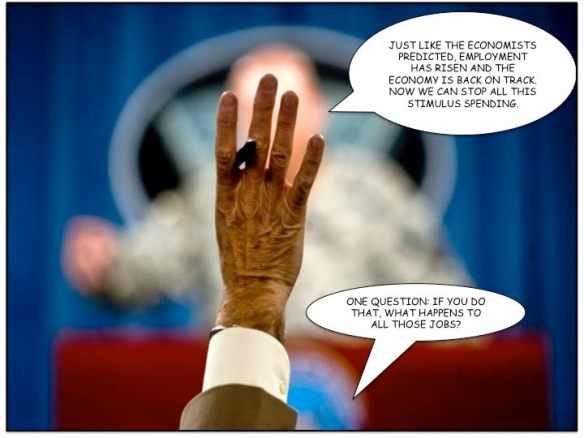
It’s my birthday, and my younger son has given me a present. You can see whose house he was brought up in. And while it may spoil the joke a bit by adding some commentary, you never know in this day and age what others will and will not see. The first picture is straightforward, however. You hear the equivalent said all the time in every economy.

josh keynes 01

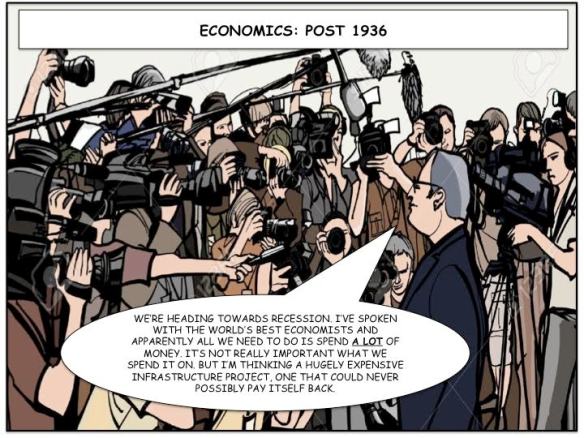
The second is the subtle one. The government has chosen projects that will never repay their costs which means that the economy, so far as these expenditures go, will end up less well off at the end than it was before. Other projects, almost invariably from the private sector, will usually make up for this loss. But non-value-adding projects pull an economy backwards. If you are getting fewer units of output back compared with the number of units used up in production, living standards must contract. But as the picture shows, lots of people are employed. They are just not employed in projects that create net wealth, which includes those employed in industries supplying inputs.

josh keynes 02

Because Keynesian economics is all aggregates, the structural problems created by this expenditure is invisible both in theory and in relation to the actual circumstances of the economy. People are, to all appearances, working and producing. The problem remains that what is produced has less value than the resources used up. One day, as the debts pile up and deficits grow, the expenditure must be withdrawn with the result that the entire structure of production must then be reconfigured in a way that allows productivity to grow. That reconfiguration is infinitely more painful than things would have been had you let the economy adjust in the first place.

josh keynes 03

My son is neither an economist nor a graphic designer. The message is nevertheless sound and coherent with the presentation clarity itself.

And the world is changing. I have just been sent this from The Spectator: The one thing most people think they know about economics is wrong with the subheading, “Keynesian deficit spending makes sense – but over and over again it has not worked”. My What’s Wrong with Keynesian Economics? was sent off for production on Friday. Most people, especially economists, do indeed still think Keynesian theory “makes sense”, they just cannot work out why it never works. If they actually understood how an economy does work, they would understand why Keynesian theory is complete nonsense.

And because the manuscript has now gone off, I am heading off and away for my version of lying by the beach. Blogging may therefore be more intermittent than usual.

NO Keynesian stimulus has ever succeeded in bringing about a recovery

Some ideas just will not die, no matter how much damage they do. Keynesian economics is one of those. So let me say it again: NO Keynesian stimulus has ever succeeded in bringing about a recovery. Not one, not ever. Go on, you Keynesians out there. Name one, anywhere, any time. Name a single occasion when an increase in public spending brought a recession to an end and returned an economy with high unemployment to full employment. The General Theory was published in 1936. Since then, there is not a single occasion when an increase in public spending led to an economic recovery. Every pre-Keynesian economist would have understood not just this fact, but also why it was so. But such is the dead hand of received ideas, that economists continue to push for an increase in public spending to bring recessions to an end.

So here is the latest set of economic instructions, this time from Canada. The headline reads Economy needs bigger deficit spending with the sub-head, “economist tells Ottawa now is the time to spend, not worry about balanced books”. And this is how it begins:

Ottawa should not be afraid to spend a lot of money it doesn’t have quickly in order to give the economy a shot in the arm, an influential economist says.

That was the gist of a note Thursday from David Rosenberg, the chief economist and strategist at Toronto-based money manager Gluskin Sheff Inc.

During the recent election campaign, the Liberals ran on a pledge to run “modest” deficits in the $10-billion range for the next few years, in an attempt to stimulate the economy.

Debt-to-GDP can come down even with deficits, economists say
But Rosenberg says more drastic measures are warranted, noting that Ottawa could run deficits of up to $24 billion a year all the way until 2020 and still be below the average 70 per cent debt-to-GDP ratio among OECD nations.

Canada’s debt-to-GDP ratio currently stands at 31 per cent.

“What is Ottawa waiting for?” Rosenberg wrote.

“If the government wasn’t spending years strengthening our nation’s balance sheet to use it as a weapon against downside economic risks as is the case today, then what was the point of it all?”

Rosenberg says it is time for the federal government to get off the sidelines and start “fighting the economic forces” instead of leaving the heavy lifting to the Bank of Canada, in the form of monetary policy.

This is identical to the advice that Ken Henry gave Kevin Rudd, with the usual disastrous results. But it’s advice that has an older pedigree than that. Let me take you back to my 2009 classic, The Dangerous Return to Keynesian Economics, where you will find the identical advice offered to Japan in the 1990s.

Stanley Fischer, who in 1998 was the First Deputy Managing Director of the IMF, was very clear on the need for the massive increases in spending. Addressing a symposium in Tokyo in April that year, he said:

Japan’s economic performance is of course a matter of grave domestic concern. But given the prominent role of Japan in the world economy, and especially in Asia, it is also a legitimate matter for concern by Japan’s neighbors and by the international community. There is little disagreement about what needs to be done. There is an immediate need for a substantial fiscal expansion …

On fiscal policy, the recent suggestion of a package of 16 trillion yen, about 3 per cent of GDP, would be a good starting point. But, unlike on previous occasions, the program that is implemented should be close to the starting point. The well-known reservations about increases in wasteful public spending are correct: that is why much of the package, at least half, should take the form of tax cuts. Anyone who doubts the effectiveness of tax measures need only consider the effectiveness of last year’s tax increases in curbing demand.

The IMF is not famous for supporting fiscal expansions. And it is true that Japan faces a long-term demographic problem that has major fiscal implications. But after so many years of near-stagnation, fiscal policy must help get the economy moving again. There will be time to deal with the longer-term fiscal problem later.

Another example of the same kind of advice is found in a February 28, 1998, editorial in The Economist under the heading, “Japan’s feeble economy needs a boost”:

The [Japanese] government says it cannot afford a big stimulus because its finances are perilous. It is true that Japan’s gross public debt has risen to 87% of GDP, but net debt amounts to only 18% of GDP, the smallest among the G7 economies. The general-government budget deficit, 2½% of GDP, is smaller than its European counterparts’. Rightly, the Japanese are worried about the future pension liabilities implied by their rapidly ageing population. But now is not the time to sort the problem out. Far better to cut the budget later, when the economy has recovered its strength.

I need hardly point out that Japan’s “lost decade” has continued for more than twenty years yet in all the investigations over what had gone wrong, the increase in public spending has never even been glanced at. Modern macroeconomics is a disaster continuously in wait for its next victim. If you would like to understand why, once again I cannot suggest anything written more recently than 1936, other than, of course, this.

[My thanks to SMc for alerting me to the advice being offered to the Canadian PM, who will, no doubt, now take it.]

You must recognise the core problem – economic theory will only make your problems worse

I am forever being told that Keynesian economics has disappeared and has been well and truly transcended. But I am told this by people who have no idea what makes a Keynesian model Keynesian. So let me make clear what the essential feature of a Keynesian model is. It is the argument that economic growth and employment are determined by the level of aggregate demand. The more demand, the more production. Supply will follow along if demand can set the pace. The aim of a Keynesian policy is to raise the level of aggregate demand.

What comes with Keynesian economics is a concern with the level of saving. According to Keynesians, over-saving is the greatest single problem an economy can face, since it means that those with money choose not to spend as much as they could. Policy everywhere is designed to encourage more spending and less saving. Buried as I am for most of my time in the pre-Keynesian classical literature, it always comes as the greatest imaginable surprise to come across modern macroeconomic thought and its aim to increase the level of spending. There have been many such examples of late, such as the CSIRO having recently bought into the superannuation debate. From the AFR: Researchers at the CSIRO believe we have a problem:

Because most super earnings are tax free and most retirees receive the age pension, policymakers would prefer super savings to be spent rather than saved to pass on to children.

This report was followed by an editorial, When savings are for spending too, where again the preference was for spending rather than saving. The notion that saving are spent – common ground among economists from Adam Smith right through to 1936 – is now a concept as dead as it is possible to be. Yet as foreign to modern economic thought as it is, the crucial importance of saving remains as paramount for economic success as ever.

But the worst example of this spending mania I have come across was found just the other day in an article in the Financial Times by its Economic Correspondent, Martin Wolf, an article which was also reprinted by the AFR. Its headline title ran, Japan’s weak private demand is the dominant challenge for Abenomics but its sub-head was beyond the pale: “The country saves too much, but higher wages and taxes could help eliminate the surplus.”

This is not merely economic illiteracy but falls into deep incoherence. Savour this if you will:

Shifting Japan’s excess corporate retained earnings into wages and taxes would go a long way towards eliminating the structural savings surplus. One could slash depreciation allowances, for example. Reform of corporate governance might also increase the distribution of corporate earnings. Yet another possibility would be to force up wages.

It is, in brief, “not the supply, but the demand, stupid”. The structural savings surpluses of the private and, in particular, of the corporate sectors have driven the government into its deficits and growing debts. Abenomics does not recognise this underlying reality. Japan must offset the private surpluses, export them or eliminate them. This is the dominant challenge.

Did you follow that? The refusal of the private sector to spend has driven the government of Japan into that painful necessity of having to blow away those accumulating savings even before any wealth has been produced. That industry has gone into a shell in the face of reckless government spending is no surprise. But the real problem goes well beyond mere business confidence. The core of the problem is that you cannot use the same resources in two places at once. Either the government chooses what to produce, or industry does it. Either the government uses the economy’s productive resources to fulfil its own agenda or business uses those resources. But no matter how you try to manage an economy, a brick can only be laid in one place, and once it is in one wall, it cannot be placed in another.

If that’s too metaphorical for you, then try this. Households, he argues, have been running a financial surplus year after year which has driven the government to increase its spending since the private sector has not borrowed the funds. A “counterpart borrower” to do the necessary spending has therefore been required.

The counterpart borrower has been the government. The ratio of gross public debt to GDP jumped from 67 per cent in 1990 to 246 per cent in 2015, while the ratio of net debt increased from 13 to 126 per cent. Yet, despite sustained fiscal deficits and near-zero short-term interest rates, the mild deflation has not been durably eliminated.

This is madness, insanity, economic vandalism. That such an outcome would with certainly slow your economy would have been as obvious as the noonday sun a generation or two back. That the advice is not to immediately slow the rate of public spending and go through the necessary readjustment, as painful as it will surely be, only shows how lost in modern theory Martin Wolf now is. But he is hardly alone since the whole of the profession is filled with just this kind of advice. Economists know no better. Here is the final sentence of the article that tries to focus on what Martin Wolf sees is the problem to be solved. It is a sentence that would be hard to beat for its dangerous inanity.

The first step is to recognise the core problem — one of insufficient private demand. Only then can it be solved.

Any policy maker who starts with insufficient private demand as the central problem will only ever do harm to any economy it is trying to fix.

Saving the worst for last

Modern macroeconomic theory is designed for the intellectually challenged, structured so that it can be understood by everyone and anyone. With a seems-reasonable level of 9, no one gets away without coming to terms with the idea that higher demand means higher employment. So obvious is this that the only way you can miss it is if you actually watch demand management in action, or read absolutely any economics text published before 1936. There you would find the very notion of raising demand as the route to higher growth as the most basic fallacy of them all. Only the most desperate could believe anything so dumb. The true mark of an economic illiterate.

And in that same pre-Keynesian literature there was universal recognition that the higher the level of saving, the greater the future rate of growth. As they used to say in the Orwell household: more saving, good; less saving, bad. Even now, in our less enlightened economic times, we can still get the occasional recognition that I=S. Once it was understood that the more S, the more I. Now, through various Keynesian deformities, we argue the more S, the less I. That is the difference, and it is no more deep than that.

So here is the problem that has just been uncovered. The older one becomes, the less one spends and the more one saves. In a pre-Keynesian world, that would have been seen as a good thing. But that is not our world. So, to go to yesterday’s editorial in the AFR, When savings are for spending too. And there we find the problem that has been identified. Those who are retired and sitting on their superannuation are not spending their money at a rate fast enough to suit the government.

CSIRO findings this week showed many have as much money when they leave this mortal life as on the day they retired.

Since no one’s date of departure is pre-ordained, it is mere prudence to ensure that the money lasts. So, in the mind of researchers at the CSIRO (at the the CSIRO!!!!!!!! for heaven’s sake), we have a problem:

Because most super earnings are tax free and most retirees receive the age pension, policymakers would prefer super savings to be spent rather than saved to pass on to children. Government research has found that even in the last five years of their life many pensioners either increase or maintain the value of their assets.

Is there no one around to set the government straight? Is this really the kind of advice they are depending on? Do they really want to diminish our already depleted national savings? The government wants that money for itself so that it can blow it, rather than leave these savings in the hands of the elderly who not only don’t blow it themselves, but spend less than they earn. And although they want the money, they dare not raise taxes on inherited super, which would at least fix the particular problem they are worried about.

Bizarre world we live in, made all the more bizarre by the economic theories used to explain how things work.

Government waste and the economics profession

Government waste is the greatest scourge every economy must face. The Chinese economy is trying to reverse the effects of its Keynesian stimulus, whose diabolical effects can no longer be denied. The projects of 2009-10 are showing up dead and the debts created cannot be repaid. Fixing what has gone wrong first requires you to understand what has gone wrong. The following “analysis” is mesmerising for its inanity:

China’s economic and financial market management credentials are drawing international criticism after a weak inflation result raised the prospect Beijing will be forced to slash interest rates to boost growth. . . .

Beijing reported at the weekend that China’s consumer price index rose by just 1.4 per cent over the year compared to the 3 per cent objective the government had put in place for the economy in order for it to achieve its annual growth target.

It’s real growth we are looking for, right? The inflation rate is just the difference between the nominal growth rate and the real growth rate. How inflation is supposed to give an economy faster real growth is the great conundrum. Perhaps they mean that higher inflation would be a sign of higher demand. But if that is the way it is being thought about, Keynesian economics has reached even lower depths than I had thought possible.

Still, that’s not all there is on the economic inanity front. There is also this: Turnbull needs community of believers for northern growth which begins as follows.

The Turnbull government has announced plans to boost growth and development across northern Australia, including the possible use of commonwealth loan guarantees for infrastructure projects.

As soon as this was hinted it was decried in certain corners as yet another example of misguided “industry assistance” — just an attempt by government to pick winners. I have been as critical as anyone about the perils of government winner-picking. It’s a fool’s errand at best, and a colossal waste of taxpayer money at worst.

If after years of pink batts and BER, never mind the NBN, doesn’t convince economists that governments have NO role in guiding our resources productively, then who will do it? There are many reasons for government spending, including some limited levels of infrastructure outlays. But grand visionary projects that absorb billions are idiocy of the highest order. They will make us poor. The Chinese have at least recognised that Keynesian-type expenditures are a menace to public finances and economic prosperity. Would Malcolm only do the same. Apparently, such expenditures on developing the North “is supported by very modern and very sound economics.” Modern it may well be. Sound, I’m afraid not. I will restrict myself to merely the first of the points made.

Australia is suffering from “secular stagnation”, a phenomenon recently popularised by former US Treasury Secretary Larry Summers.

Summers postulates, and unfortunately the evidence supports his view, that the potential rate of growth of advanced economies has fallen so that GDP growth in the 2 per cent range is the new normal. The economic speed limit of advanced economies has almost halved.

This is because there is a huge surplus of global savings chasing too few productive investment opportunities. Just think about sovereign wealth funds along with all those billionaires looking for something to do with their money.

No doubt Malcolm is thinking about nothing other than our sovereign wealth funds, so if you are worried about your financial future, this is the time to make it clear that the government is to keep its hands off our money. Loan guarantees – that is, a promise of making good every losing market bet – will bring Solydnra-like projects out of the woodwork in such vast numbers that it will make you dizzy to watch.

But to believe that there is a massive pool of saving available that no one is tapping into is the very essence of Keynes. Our problem is an absence of saving. We do not have enough. I cringe when I see such arguments, but if you start with Y=C+I+G, you have no explanation for recession and stagnation other than deficient demand caused by over-saving. And as long as you believe that, you will never understand what to do to make an economy grow.

Economics for Infants

IMG_1982

My granddaughter had her first birthday today. I therefore wrote for her an instructional on all things economic, which I have titled Economics for Infants. There will be a new one every year and one for all siblings and cousins as they arrive. But so far, there is only she. Although really quick on the uptake, I didn’t wish to make it too complicated. But while she will never hear from me on the existence or otherwise of Santa, this is part of what I wrote since it is never too young to find these things out.

Most importantly, you must never think of the government as the same as your parents.

The government is not there to give you things although they might pretend that they do.

You cannot look to the government to feed you, to give you clothes, to keep you warm, to give you presents.

The government doesn’t even care about you, not even a tiny bit.

It may be a bit early to say to someone who cannot even walk that a satisfying life comes only if you are able to stand on your own two feet.

My son thought that I should have written something more story-like, along the lines of Animal Farm. And so I shall, but not until she is two when she will be more able to follow the analogy and see the ironies of life. In the meantime, I thought I would set the early scene for more to come.

You want crazy, I’ll give you crazy

Trump’s protectionist beliefs are old news but this has shown up on Instapundit today: Trump wants a 45 percent tax on Chinese imports.

“I would tax China on products coming in,” the Republican presidential front-runner told the New York Times. “And the tax, let me tell you what the tax should be … the tax should be 45 percent.”

The savvy [!!!] New York businessman released a policy paper on U.S.-China trade reform in early November that detailed his plans, as president, to take action against China’s currency manipulation and intellectual property theft, and to strengthen America’s negotiating position with the potential U.S. adversary.

Until now, however, none of Trump’s rhetoric on U.S.-Chinese relations has included any mention of a 45 percent tariff on Chinese exports to the U.S.

I know history is bunk and all that, but do we really want to bring back Herbert Hoover and the Great Depression? The story inserts the mildest, virtually non-existent criticism of such an idea, that makes you worry that this may well be an idea whose time has come, even if it will be a idea whose time will have gone a year after it would be put in:

According to David Dollar, a senior fellow in the Brookings Institution’s China Center, Trump’s suggested tariff could open the door to negative implications for both countries, if instituted.

“Negative implications” – that’s really nailing it. On top of everything going on already, to stop international trade in its tracks would be a policy as devastating as it is possible to have. Even the comment at Instapundit – “As Tom Nichols tweets, ‘I bet this sounds awesome to people who have no idea how much stuff they buy from China.’” – gives the impression that they have little idea what the effect would be. In so many ways, this is the 1930s all over again.

My best paper published in 2015

This was my self-nomination for the Best Paper Award in the history of economics published during 2015. There are many other excellent papers that were also published so it is a very low probability entry. All the same, I believe the paper has genuine merit, as discussed in the note I sent to the Committee. I should mention that Mill’s Fourth Proposition on Capital states that “demand for commodities is not demand for labour”. If Mill is right, all modern macro is completely false.

Although my article is found in JHET and will therefore be automatically considered for the 2015 Best Paper award, I thought I would call attention to it since there are a number of aspects to it that may not be fully appreciated. The article is:

Kates, Steven. 2015 “Mill’s Fourth Fundamental Proposition on Capital: a Paradox Explained.” JHET. Vol 37, Number 1, March 2015, pp. 39-56.

Purely in terms of HET, the article explains in a completely natural way an issue that had been dealt with by some of the greatest economists of the past who could not fully make sense of what it meant. The proposition was first stated by John Stuart Mill in 1848, was never challenged in his lifetime and was described by Leslie Stephen in 1876 as “the best test of a sound economist”. Yet only fourteen years later, Alfred Marshall could not explain it, nor could Friedrich Hayek in 1941, both of whom tried to defend it in their own way. The proposition was attacked relentlessly by others. Keynes, for example, raises it twice within five pages in The General Theory (359n, 364n). It had last been looked at with any depth in HOPE in 1975 where the sub-title was “A Paradox Revisited”, emphasising the difficulty in making sense of the words. And yet, once the proposition is viewed within the context of the General Glut debate and within a classical understanding of Say’s Law, its meaning is apparent, indeed I would say obvious. It is thus not often that an issue that had remained unresolved since 1876 has been finally brought to an end. I compare Mill’s Fourth Proposition in the article to Fermat’s Last Theorem which, for economists, it is.

Second, the article does what I think HET ought to do – not exclusively, of course – but what it ought to do, at least where it is relevant, is use the economic theory of the past to illuminate economic issues of the present. The question whether increases in aggregate demand will lead to improvements in production and employment is a crucial issue in economics, never more so since the stimulus packages following the GFC have not led to a return to full employment and rapid growth. One does not have to agree with Mill to at least recognise that he has something to add to our contemporary debates. What if it is the case that an increased demand for goods and services does not lead to an increased demand for labour? This was not just Mill’s view, but was repeated as the “Treasury view” as late as the 1930s. Merely because macroeconomic theory today has rejected this conclusion does not mean that it is therefore certainly wrong. Some of the greatest economists who have ever lived accepted this conclusion. What this paper does is revisit this conclusion and puts the alternative perspective back into consideration.

It was also not my only paper published last year since I published two others, both on the role of the entrepreneur in economic theory. But this one was far and away the best.

Ptolemy and the modern economy

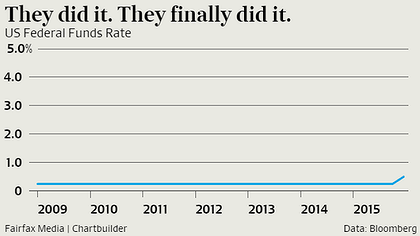
us interest rates 2009-2015

If you want to know why the American economy is going nowhere, that is a very good place to start. Here is some of the text that goes with the picture: US Federal Reserve lifts rates and that is a good thing. The following is the kind of epicycle analysis that Ptolemy might have given his blessings to:

A quantitative easing programme that accompanied the Fed’s global crisis interest rate cuts meant the US central bank added about $US4 trillion to its balance sheet as it bought bonds, injecting cash into the financial system in the process.

It intends to charge banks and other money market institutions a quarter of a per cent more for short-term funding, and pay them a quarter of a per cent more for surplus cash they deposit overnight with the Fed by way of “reverse repurchase agreements” that commit the central bank to sell bonds for cash, and then re-buy them.

The immediate danger is that demand for the higher deposit rate will be so strong that it pushes down on short-term rates again. The Fed’s solution is to massively increase the maximum size of its reverse repurchase kitty, from $US300 billion to an eye-popping $US2 trillion.

Well that’s clear enough. The US economy stays as dead as it’s been for the past seven years.

Financial markets are surprised by the most surprising things

Financial markets may have rules of their own, but even there it has to be that the value of financial products can only rise if the real value of the assets beneath them are also rising. In an economy in which the actual quantum of productive assets has deteriorated, nothing can make the real value of financial assets increase. Why is this a puzzle to anyone?

The idea behind asset allocation is simple: when one market struggles, it’s OK because an investor can jump into another that is thriving. Not so in 2015.

In fact, if you judge the past year by which U.S. investment class generated the largest return, a case can be made it was the worst for asset-allocating bulls in almost 80 years, according to data compiled by Bianco Research LLC and Bloomberg. With three days left, the Standard & Poor’s 500 Index has gained 2.2 percent with dividends, cash is up less, while bonds and commodities are showing losses.

If green energy is your idea of economic growth, to take just one example, the world of finance is going to be a very disappointing experience. It fits in perfectly with this: Debt distress level at highest since recession.