
The OECD and IMF are economic cranks

In February 2009 Quadrant published my article on The Dangerous Return to Keynesian Economics. There you will find the following:

Just as the causes of this downturn cannot be charted through a Keynesian demand-deficiency model, neither can the solution. The world’s economies are not suffering from a lack of demand, and the right policy response is not a demand stimulus. Increased public sector spending will only add to the market confusions that already exist.

What is potentially catastrophic would be to try to spend our way to recovery. The recession that will follow will be deep, prolonged and potentially take years to overcome.

I also immediately began work on my Free Market Economics which I am now about to complete its third edition. Here is how the second edition is described:

The aim of this book is to redirect the attention of economists and policy makers towards the economic theories that prevailed in earlier times. Their problems were little different from ours but their way of understanding the operation of an economy and dealing with those problems was completely different. Free Market Economics, Second Edition will help students and general readers understand the economics of that earlier time, written by someone who believes that this now-discarded approach to economic thought was superior to what is found in most of our textbooks today.

Nothing that has occurred in the seven years since the GFC has been anything other than what I expected. As certain as I was then that Y=C+I+G is the road to economic disaster, nothing I have seen since has done anything other than strengthen my belief that Keynesian theory is wrong in every particular. All of which is brought to mind by this article dealing with those crackpots at the IMF and OECD: As jobs go, global economy falters, says G20 report. How is this for evidence that no one learns from history:

Scott Morrison will come under pressure at his first G20 meeting in Shanghai this weekend to use the budget to launch a new round of stimulus spending — the first since the global financial crisis — as the IMF warns finance ministers that the world is at risk of a new downturn.

In a bleak report prepared for the meeting — and against the backdrop of thousands of new job losses in Australia after the closure of the Dick Smith retail chain — the International Monetary Fund says the global economy is faltering and governments have done too little to boost demand.

“The global economy needs bold multilateral actions to boost growth and contain risk,” it says. “The G20 must plan now for co-ordinated demand support using available fiscal space to boost public investment and complement structural reform.”

Idiotic and ignorant. Impervious to the lessons of our recent past. Uncomprehending of what happened during the Costello years when budget deficits disappeared and Australia had zero debt – the absence of debt being unique across every country during the entire Post-War world. The economics profession seems incapable of learning a thing.
The first example in modern history of a science actually going backwards

It is now regularly stated that we have to take the larger denomination bills out of circulation to combat crime. Makes no sense, but on the other hand, this seems very plausible. From Steve Hayward: KOMPULSORY KEYNESIANISM?.

What’s the idea behind negative interest rates? A hidden subsidy for mattress manufacturers perhaps? Nope: given that the various monetary and fiscal stimuli haven’t generated much growth either here or in Europe, negative interest rates are intended to enlist everyone as involuntary Keynesians—spend your money or we’ll take it from you. So who wants to keep their money in a bank—even a Swiss bank. Another example of a liberal idea so good it has to be made mandatory.

That is to say, the smaller is the largest note, the more difficult it is to merely hold money so everyone is forced to spend. Nothing has worked so the efforts to get people to spend will be re-doubled. This is that same crackpot Keynesian theory as ever, that economies are made to grow by increase in spending. This comment that followed the article captures the central economic idiocy of our time:

Monetary and fiscal “stimuli” are the same old economic frauds perpetrated over and over again. They’ve never worked in the past, and there is no chance they will work in the future. The only thing they have going for them is that they’re excuses for more government spending and government control of the economy.

The amounts of fiscal and monetary “stimulus” applied during the Obama years have exceeded all past efforts, with the result that we’ve had the worst “recovery” since the 1930s with no end in sight. As always, the Keynesian economists’ excuse is that we just haven’t taken enough of their poison.

Economic science is the first example in modern history of a science which is actually going backwards. Classical economists knew more about how to stimulate an economy 100 years ago than Keynesian economists know today.

Indeed it is so but how are you to find out?

Donald Trump and international trade

A comment from the thread in this case dealing with Donald Trump on free trade:

Heads explode all over these days. Note the outrageous claims, lots of personal invective and total lack of balance. Lowenstein was (is?) in the employ of the ferociously anti-Trump Murdoch vehicle, the WSJ. The same outfit who love their cosy relationship with the current political apparatus, and who run bogus ‘agenda polls’ to undermine Trump. RL is a shock jock journo. So think of this:

‘As someone who lived 27 years in East Asia, I know what a rich seam Trump is tapping into as he focuses on America’s trade disaster. For two generations already, increasingly pathetic American trade officials have turned a blind eye to the blatant barriers facing American exports in key foreign markets. One result has been a tragic roll-call of factory closures in the American heartland. Another result, as Trump has insistently pointed out, is that other nations literally laugh at the United States. They think of the U.S. government as idiotic where it is not corrupt.

The problem with free trade is not just that other countries cheat but that they see no reason not to cheat. Cheating confers several key benefits that American officials and commentators consistently sweep under the rug: just the most obvious is that it forces the transfer of American production technology.

Perhaps the most telling evidence of how formidably the Japanese car market is protected has been the performance of the Korean auto industry. At last count the Koreans had less than 0.02 percent of the Japanese car market.

Even Hyundai, Korea’s largest auto maker, sold a mere 1,700 cars a year in Japan in the first decade of the twenty-first century. Repeated efforts to surmount Japanese trade barriers yielded so little that in 2009 Hyundai shut down its Japanese car sales division.’

I post regularly on this subject since I check out each of DJT’s claims. Technology theft from the engine of innovation is extremely well documented as are the methods of coercion in US-China trade relations.

I suspect Trump knows a good deal more about the realities of business dealings national and international than virtually any of those who comment in the press.

These people are charlatans

Having looked at how out to lunch The Economist is I picked up The AFR over lunch and found this: OECD blasts reform fatigue, downgrades growth and calls for more rate cuts. They called for more than that, and this being the OECD, is the collective economic wisdom of the West. It is no wonder we are heading so deeply into recession.

Warning that global growth is faltering so fast there now needs to be a fresh wave of budget spending and interest rate cuts, the OECD demanded governments spend more money on investments and infrastructure, and get serious about productivity-boosting reform.

Officials at the Paris-based organisation also described the risk of another financial mishap on global markets as “substantial”. . . .

In the absence of fresh economic reform momentum, the OECD acknowledged there was now an urgent need to raising government spending on investments such as infrastructure, which they said would generate a strong growth dividend.

“Quality infrastructure projects would help to support future growth, making up for the shortfall in investment following the cuts imposed across advanced countries in recent years.

“A commitment to raising public investment collectively would boost demand while remaining on a fiscally sustainable path, the OECD said, pointing out that governments in many countries can borrow for long periods at very low interest rates.

“Many countries have room for fiscal expansion to strengthen demand.” . . .

“A recovery in private sector investment and wage growth is needed for global economic activity to accelerate.”

Anyone educated in economic theory before 1936 would think such advice was insane. Today it is mainstream and almost unquestioned anywhere in policy circles. And if this were still 2009, there might be some reason to experiment with a Keynesian stimulus. But now, after what we have seen, how can they keep pushing economic policies that have unmistakably failed! It’s the supply side, and only the supply side, that will bring recovery, which means recovery must be private-sector driven with no handouts to business of any kind by governments.

MR RUSTY AND HIS LIBERTY LINE OF APPAREL: The things you find when you go into the comments! The image is part of a T-shirt made with just the right sentiments for our stressed economic times. No one should be without one. Here is where you can order:

keynes wrong

Which comes with the text:

Author of the second worst economics textbook of all time and Chief wrongologist John Maynard Keynes has sadly influenced many Treasurers, economists and politicians who have adopted Keynesian economics in the mistaken belief it will grow economies.

And might I say, I can only hope this becomes a prime example of how supply [which must always come first] is able to create demand [which then follows someone’s putting some good or service up for sale].

The don’t get it, they really don’t get it

From The Economist, Out of Ammo. The replacement of “despite” with “because of” is, of course, my own editorial intervention:

Despite Because of central banks’ efforts, recoveries are still weak and inflation is low. Faith in monetary policy is wavering. As often as they inspire confidence, central bankers sow fear. Negative interest rates in Europe and Japan make investors worry about bank earnings, sending share prices lower. Quantitative easing (QE, the printing of money to buy bonds) has led to a build-up of emerging-market debt that is now threatening to unwind. For all the cheap money, the growth in bank credit has been dismal. Pay deals reflect expectations of endlessly low inflation, which favours that very outcome. Investors fret that the world economy is being drawn into another downturn, and that policymakers seeking to keep recession at bay have run out of ammunition.

And if you don’t think these people are completely beyond reality, try this advice out from the same story:

The time has come for politicians to join the fight alongside central bankers. The most radical policy ideas fuse fiscal and monetary policy. One such option is to finance public spending (or tax cuts) directly by printing money—known as a “helicopter drop”. Unlike QE, a helicopter drop bypasses banks and financial markets, and puts freshly printed cash straight into people’s pockets. The sheer recklessness of this would, in theory, encourage people to spend the windfall, not save it.

And if you don’t like that, you can try this:

Elsewhere, governments can make use of a less risky tool: fiscal policy [Do these people never ever learn from experience?!?!?!]. Too many countries with room to borrow more, notably Germany, have held back. Such Swabian frugality is deeply harmful. Borrowing has never been cheaper. Yields on more than $7 trillion of government bonds worldwide are now negative. Bond markets and ratings agencies will look more kindly on the increase in public debt if there are fresh and productive assets on the other side of the balance-sheet. Above all, such assets should involve infrastructure. The case for locking in long-term funding to finance a multi-year programme to rebuild and improve tatty public roads and buildings has never been more powerful.

As an afterthought, they mention deregulation of various markets, which is the only sensible idea in the piece. Economics has been a pseudo-science since the 1930s with this the latest example of just how far gone it is.

The difference between value added and waste

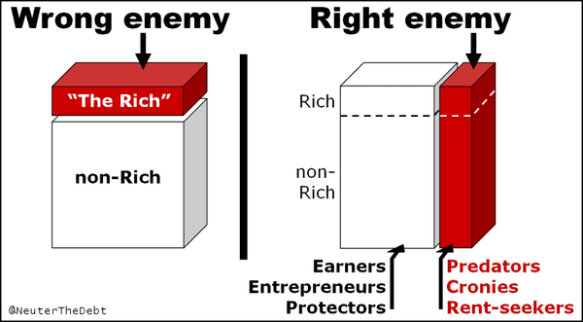
wrong enemy right enemy

From a very insightful post with a very insightful diagram: The Right Kind of Class Warfare: Workers vs. Looters.

What makes this image so helpful is that it’s true. If you look at the “right enemy” part of the image, the rich in the red zone are the cronyists who get Ex-Im subsidies, the Wall Street crowd that fed at the TARP trough, and other well-connected folks (like Warren Buffett) who use government coercion to line their pockets.

It’s the difference between value adding and waste.

[Via Instapundit]

“Say’s Law need to be revived, pronto, if we are ever to recover from the Great Recession”

j.-b. say

What might interest you more than the words is that I didn’t write them, although I do, of course, agree with them completely. They are from an article in The American Spectator, Demand for Economic Growth by Bob Luddy.

Jean-Baptiste Say theorized that the growth of economies is not demand-driven, but growth is created by new and lower cost products and services. McDonald’s created huge demand in 1955 with a 15-cent hamburger, and now dominates fast food worldwide. As a result, a new, trillion-dollar industry has been created — eating away from home. We eat at grocery stores, fast food restaurants, at work, and from food trucks.

In 1925, Bell Labs made enormous investments in telephone technologies, resulting in international phone service at a modest cost. Today, electronics have improved service and lower costs, so virtually anyone can communicate worldwide.

Casual observation helps us validate Say’s Law. The big-box retailers have provided low-cost goods, stimulating demand for all types of consumer goods. We now have on-line vendors offering every product imaginable at even lower cost, delivered to your door by none other than FedEx, which did not exist when I was in college.

America has the opportunity to take full advantage of Say’s Law, and to create new demand and growth from investment and innovation. The requisites are: lower taxes, reduced regulation, and leaders to innovate. We must also focus on education, as innovators must have enormous knowledge to create the future world of ideas.

Small business, which creates the majority of new jobs, is especially challenged by government regulation, because financial and management resources are very limited.

This month marks the 80th anniversary of the publication of the second most destructive book in the history of economics. It actually requires concentrated mis-education to believe that buying things, rather than producing things, is the basis for growth and employment. I remain very uncertain about when Say’s Law will again return to the centre of economic policy, but I am absolutely certain that until it does, macroeconomic policy will do mostly harm and seldom do an economy any good.

[My very great thanks to Autumn Baroque for sending this article along.]

What’s the plan this time if the economy crashes?

The latest from Drudge on the gathering economic storm.

FEARS OVER NEW FINANCIAL CRISIS HAUNTS MARKETS…
Selloff in European banks ‘ominous’…
Russia shuts two more…
CREDIT FEARS GROW…

They do not have a clue what to do or why what they have done doesn’t work, but I can give them a hint: the problem is not a deficiency of demand. Just cut spending and ease up on regulation. It’s not easy, specially since large proportions of the population have come to believe that being subsidised by the state is a human right. And the reason an increase in GST won’t work is because you would then be making the recipients of welfare pay for the welfare they receive every time they go into a shop. There may be an economic logic to it, but the political logic is by now completely impossible.

The study of the history of economic thought is a crucially important part of economics

First there was a notice posted at the History of Economics online discussion thread advertising a conference to be held later this year on “The Relevance of Keynes to the Contemporary World”. So I wrote a note which read:

I would like to note a concern I have about this conference.. I will concede that I do not know all of the scholars who have been invited to speak, but what strikes me as a serious problem is that none of the invited speakers whose views I do know can be described as a critic of Keynesian theory. Whatever anyone might think about what makes Keynes “Keynesian”, and which has kept his name alive today, it is this:

“Keynes’s insights for the management of domestic economies in the times of a global recession and European crisis”

One would hope that after the universal failure of the Keynesian stimulus after 2009 that there might at least be some effort to examine the flaws in the Keynesian system. Not a single economy has returned to full employment and robust rates of growth, and we are now seven years since the stimulus packages were first introduced. Debt and deficits are the central problems every economy is now having to deal with. By all means examine Keynes’s work, but at the same time in looking at its relevance, there should surely also be some attempt to look at its irrelevance, indeed at the strong likelihood that Keynesian policies are harmful and destructive.

Later this year a volume I have edited will be published presenting the views of a series of modern critics of Keynesian economic theory and policy. The most astonishing aspect in editing this book was to find how few vocal critics of Keynesian economics there are. They exist, but are very rare. I would think that for this conference to be a proper evaluation of Keynesian ideas, at least some of its critics should be invited to speak as well.

After a brief flurry of discussion, there was a note put out by the moderator of the discussion thread.

I distributed a few messages on the fiscal stimulus and hoped the discussion would die a natural death, but I am now getting quite a few messages, pro and con.

I would like to remind everyone that this is a history of economics list, so I do not think it is appropriate for a discussion of current economic policy. In addition, a list such as this is a poor vehicle for such a conversation, which we all know will end badly, with much more heat than light.

If you wish, I would be happy to send everyone who is interested in this discussion a list of like-minded folks and you can continue this conversation in private. Judging from the replies, there is really is great interest in this question, but I repeat that it is not within the bounds of our list.

Yours in moderation

To which I have now replied.

I complete agree with our moderator that this list is not the place to debate the merits of Keynesian economic theory and policy. I did not seek to open such a debate, but only meant to comment on the nature of a conference that looks at only one side of the issue, which its organisers are perfectly entitled to do. It is noteworthy, all the same, that there is an interest in just such a debate, but more interesting is that there is nowhere that it can be held. I do, however, also believe that this kind of debate is part of the history of economic thought. I go further and argue that one of the most important purposes in studying the history of economic thought is that we economists have a forum in which such issues can be discussed. This does not mean that an examination of Keynesian theory is only part of the history of economic thought. What I take this to mean is that a study of the history of economic thought is a crucially important part of economics.

And there, for the moment, things now lie.

“We know what to do but we don’t know how to get re-elected after we do it”

I used to say often during the great Peter Costello years that everyone would see what was happening but never understand why it worked. Public spending would come down – even in the midst of the Asian Financial Crisis – and the economy would simply go from success to success. Falling unemployment and falling taxes just followed year on year. Not just a zero deficit but ZERO public debt. And on we would roll. Why it would work you cannot find in a single modern economics text (well, there is one). What you saw before your eyes was specifically ruled out by the economic theory everyone, including everyone at Treasury, is taught. Peter Costello did what he did in the face of Treasury opposition and set a standard for performance that no one is ever again likely to match.

So we have this from the paper today: on the Government trying to think through what to do on the economy.

As Coalition MPs speak out against a GST increase, Malcolm Turnbull and Scott Morrison are examining other ways to pay for an ambitious agenda centred on tax cuts designed to encourage workers and lift economic growth. . . .

“The only realistic option for very significant income tax cuts is by changing the tax mix, and that is why a number of people have advocated increasing the GST for the purpose,” Mr Turnbull told parliament.

The strategy is to increase the goods and services tax to pay for a fall in personal tax. The Peter Costello option, of cuts to spending, is off the table, not even being considered. How this change in the tax mix would create growth seems incomprehensible to me, since no matter how you slice it, no cuts to public spending are involved so no additional space for the private sector is opened up. But there was also this I found quite interesting.

The Prime Minister insisted yesterday that he had not made up his mind on a GST increase”.

Is this to be a captain’s pick? Is it not a cabinet decision? Are we to understand that an increase in the GST rate is up to Malcolm alone and the rest must merely fall into line?

I was given a great quote yesterday apparently from some European Prime Minister:

“We know what to do but we don’t know how to get re-elected after we do it.”

The problem here is I don’t think these guys even know what they need to do. If they think raising the GST is the answer, they have lost the plot.