The very model of a modern econ-illiterate

Joe Stiglitz, that is. Here the article is on What’s Wrong With Negative Rates? But first, this admission.

I wrote at the beginning of January that economic conditions this year were set to be as weak as in 2015, which was the worst year since the global financial crisis erupted in 2008. And, as has happened repeatedly over the last decade, a few months into the year, others’ more optimistic forecasts are being revised downward.

So even he can see that our economies are going nowhere. But why is that, you may ask?

The underlying problem – which has plagued the global economy since the crisis, but has worsened slightly – is lack of global aggregate demand.

I’m afraid that is a capital-F Fail. Wrong, wrong, wrong!!! These Keynesians don’t get it, since it never seems to dawn on them that aggregate demand can only rise if there has first been an increase in value adding aggregate supply. It’s the value adding bit in particular they don’t get, whose absence in their analyses renders everything they say about the economy completely wrong and nauseating. The are creating the poverty they say they wish to end. Hopelessly wrong on every aspect of how an economy works.

But as it happens, the article is about interest rates in particular. And as I have tried to explain time and again, as every classical economist understood, keeping interest rates unnaturally low will SLOWS THE ECONOMY AND DOES NOT SPEED IT UP. This, too, he doesn’t know, so he cannot make sense of what he sees right before his eyes. And this is what he sees right before his eyes:

In many economies – including Europe and the United States – real (inflation-adjusted) interest rates have been negative, sometimes as much as -2%. And yet, as real interest rates have fallen, business investment has stagnated. According to the OECD, the percentage of GDP invested in a category that is mostly plant and equipment has fallen in both Europe and the US in recent years. (In the US, it fell from 8.4% in 2000 to 6.8% in 2014; in the EU, it fell from 7.5% to 5.7% over the same period.) Other data provide a similar picture.

He never said don’t do it before, but now that it hasn’t worked, here it comes. He has only an ad hoc explanation for why low rates haven’t worked, but it is such nonsense that it is painful to read. You know, I do despair at such stuff. If you want to understand these things more clearly, you should go to my text, now in its second edition. If nothing else, you can at least find out what Joe doesn’t understand, why expenditures must be value adding and interest rates need to rise.
Mantoux and his criticisms of Keynes

The issue of Keynes’s complicity on the road leading to World War II has been raised in another post. So I have now added my own contribution.

At this stage, there is no point discussing the rights and wrongs of the Treaty of Versailles. But there is no doubt that Keynes’s The Economic Consequences of the Peace was one of those Al Gore-type treatises of incontrovertible truth that brought out into the open a particular variety of criticism. The book was, as you would expect, a non-starter in France but a runaway best seller in Germany. It helped solidify grievances inside Germany that did help foster World War II but how far you can go is impossible to say, although I would say it was close to none at all. On how much Keynes mattered, the book that has had lasting significance was an attack on Keynes by the French economist, Etienne Mantoux, in his Carthaginian Peace: the Economic Consequences of Mr. Keynes, which you can download here. Mantoux had also published a trenchant attack on The General Theory right after its publication, whose English translation can be found in Henry Hazlitt’s The Critics of Keynesian Economics.

What is indisputable is that The Carthaginian Peace made Keynes an international superstar so that by the time he published The General Theory in 1936 he was far and away the most famous economist in the world. Without the first book, the second book would likely have been a nine-day wonder, about as influential as any of the other Depression-era texts written at the time.”>a post that has brought my name into the issue.

The classical theory of the cycle explained

I received an email yesterday from someone in America who had read my Say’s Law and the Keynesian Revolution who was then proposing to write a blog about what he had found. And lo and behold, that he has now done: How Keynesian Economics Has Distorted Economic Thinking (Somewhat wonkish). It never occurred to me that all this stuff is for the more studious types, but there you are. Looks natural and straightforward to me. It’s this Keynesian nonsense that requires the effort. You can read the whole of his post at the link, but here’s how it ends:

Contrary to popular belief, Keynes and many of his followers have misrepresented classical economics. This has led many to renounce classical theory without realizing that it not only offers logical explanations for the business cycle, but that the classicalists were well-versed in and rejected Keynesianism before it became known as Keynesianism. And that’s a fact that merits more attention.

I, of course, go beyond the notion that these ideas merit more attention. I am along the lines that Keynesian theory should go the way of the labour theory of value and the textbooks that carry this debilitating infection should be consigned to the furnace. But that’s just me.

Finally, I will just mention the list of labels he has attached to his post:

Labels: Classical Theory, David Ricardo, Jean-Baptiste Say, John Maynard Keynes, John Stuart Mill, Keynesian Economics, Say’s Law

There they are, almost everything you need to know about what makes an economy go, specially that John Stuart Mill fellow, and Say’s Law.

Stagnant economic thought

This is Paul Kelly writing on Staying smart in dangerous post-GFC world. Doesn’t look all that smart to me, but this is what he writes:

The world suffers from what former US Treasury secretary Larry Summers brands “The Age of Secular Stagnation”, the failure of economies to recover from the 2008-09 global financial crisis, the upshot being weak growth, low or negative interest rates, rising asset prices, more inequality and poor investment.

That is, the failure to recover has been caused by the failure to recover. Hard to argue with, but also not much guidance either. Secular stagnation is the ultra-version of Keynesian economics – as Alvin Hansen said, “secular stagnation is just another name for Keynes’s underemployment equilibrium”. We are all so satisfied with our living standards or something that no one wants to spend on anything any more. So the economy just vegetates. Here’s the Summers’ version:

Secular stagnation may be a reason that US growth is insufficient to reach full employment: “Suppose then that the short term real interest rate that was consistent with full employment . . . had fallen to negative two or negative three percent.”

And then Kelly quotes something else:

The former governor of the Bank of England during the crisis, Mervyn King, in his recent book The End of Alchemy, argues that while the 1930s Depression produced a robust policy response this has not been replicated in the years since the GFC.

“Without reform of the financial system, another crisis is certain and the failure to tackle the disequilibrium in the world economy makes it likely that it will come sooner rather than later,” King says. “Since the end of the immediate banking crisis in 2009 recovery has been anaemic at best. There was a continuing shortfall of demand and output from the pre-crisis trend path of close to 15 per cent.” . . .

There is, moreover, no sign of any substantial recovery, with King warning that “markets do not expect interest rates to return to normal for many years”.

Actually quite scary. More on Summers, and just as scary:

Summers fears a recession, after a weak post-GFC recovery, “would strongly suggest that the current stagnation is secular — that is, indefinite — rather than merely cyclical or temporary”. That is, instead of moving ahead to a period of normalisation the world might be only part way through a slow growth era “shaped by previously unthinkable and far-fetched policies” like negative real interest rates.

The idea is that there is an interest-rate policy that will get us out of this mess is probably the most far-fetched idea of the lot. But what makes this such an interesting column is how Kelly is able to sum up in a single para where we stand and what we urgently need to do.

The core need is for policies that recognise the real problems and priorities, making the 2016 election a plus, not a minus, for the nation and keeping the destructive populists at bay.

The destructive populists are Donald Trump and Jeremy Corbyn. Corbyn wouldn’t know one end of a balance sheet from the other. Trump, however, is the only person running for high office anywhere who has actually run a productive value-adding business for many many years. Why you would trust him to get an economy going when we have Hillary or Bernie Sanders sitting in the wings instead is completely beyond me.

Charting our Keynesian disaster

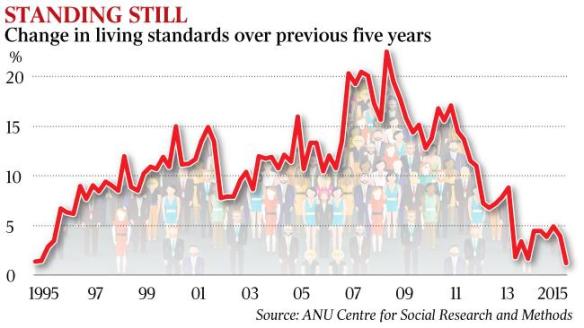
aust living standards fallen

Quite an amazing story, Living standards at a standstill for five years: report. The peak was reached in 2009, at which moment those Keynesian incompetents decided that what was needed was a Keynesian stimulus, and the results are now there for anyone to see. They won’t believe that they caused it, of course. Economists across the world will be united in the belief that things would have been even worse had they not taken the actions they took. Nothing can be proven, but there was, of course, my own forecast from February 2009.

Just as the causes of this downturn cannot be charted through a Keynesian demand-deficiency model, neither can the solution. The world’s economies are not suffering from a lack of demand, and the right policy response is not a demand stimulus. Increased public sector spending will only add to the market confusions that already exist.

What is potentially catastrophic would be to try to spend our way to recovery. The recession that will follow will be deep, prolonged and potentially take years to overcome.

Every classical economist understood this. Now only a handful do. But if you won’t take my word for it, how about listening to Sir Winston Churchill in his budget speech from 1929.

“Churchill pointed to recent government expenditure on public works such as housing, roads, telephones, electricity supply, and agricultural development, and concluded that, although expenditure for these purposes had been justified:

‘For the purposes of curing unemployment the results have certainly been disappointing. They are, in fact, so meagre as to lend considerable colour to the orthodox Treasury doctrine which has been steadfastly held that, whatever might be the political or social advantages, very little additional employment and no permanent additional employment can in fact and as a general rule be created by State borrowing and State expenditure.’”

And I emphasise that this was in 1929 before the Great Depression had even begun. The world is heading towards a disastrous downturn, and in spite of everything, we still only have Keynesian clowns stationed in every major economic post across the globe. Yet I am encouraged by our Treasurer, who gets this exactly right:

Mr Morrison said the key to raising household incomes was to improve productivity and this required business investment.

“You don’t get that from taxing and spending as Labor proposes; you get it from encouraging enterprises to innovate,” he said.

You also don’t get it by building massively loss-making very fast trains, which are really very fast drains on our productive capabilities. It should be no mystery why the Treasurer doesn’t get on with his PM, who still thinks the NBN was a great success.

You can’t break the law of markets without being punished

Consider this a joint post by myself and Spartacus. He came across the article but for obvious reasons passed it on to me. And the article is Another Volcker Moment? Guessing The Future Without Say’s Law which was posted at Zero Hedge in March. What I find so interesting is not that the phrase “Say’s Law” comes up, which it often has in the past as an anti-Keynesian meme, but this is actually an accurate use of the concept (even though they call it “laws of the markets”). So what did they write?

The explanation for most of the failures behind modern macroeconomic thinking is the substitution of market-based economics by economic planning.

The fact that today’s macroeconomics dismisses the laws of the markets, commonly referred to by economists as Say’s law, explains all. Subsequent errors confirm. The many errors are a vast subject, but they boil down to that one fateful step, and that is denying the universal truth of Say’s law.

Say’s law is about the division of labour. People earn money and make profits from deploying their individual skills in the production of goods and services for the benefit of others. Despite the best attempts of Marxism and Keynesianism along with all the other isms, attempts to override this reality have always failed. The failure is not adequately reflected in government statistics, which have evolved to the point where they actually conceal it. So when an economist talks of economic growth being above or below trend, he is talking about a measure that has no place in sound economic reasoning, and that is gross domestic product.

You would almost think they had been reading my text, since in it you will find not only quite a bit on the vandalism behind low interest rates which is what the article is about, but also quite a bit on the nonsense intrinsic to using the national accounts. More realistically, once people start to wonder what went wrong with the stimulus, they wander back into the economic archives to see if there are any clues to the present that are available from the past – which is why economics remains the only science in which its own history is an important part of the subject itself.

FURTHER NEWS ALONG THE SAME LINES: This, too, has been forwarded to me which fits into the same story. ECB will do ‘whatever is needed’ to raise inflation. These central planners who will make their mates very rich but put the rest of us into serious bother are not about to stop. Really, there is no “theory” for any of this; they just make it up as they go along.

Pushing back against critics who argue he has backed too much stimulus, European Central Bank head Mario Draghi says the top monetary authority for the eurozone will do “whatever is needed” to lift dangerously low inflation.

Draghi’s remark Thursday underlines the bank’s willingness to step up its stimulus efforts — even though they were increased as recently as its last meeting on March 10.

His speech indicated a readiness to rebut criticism from some media and politicians in Germany, the eurozone’s biggest member, who say the ECB’s stimulus is excessive, hurts savers and risks destabilizing the financial system.

Draghi coupled that statement with a call for national governments to take steps to make their economies grow faster, producing more demand for goods and services and raising inflation and employment.

Other than that everything along these lines has already massively failed, what’s the problem?

Were the Classical Economists Right After All?

This is the first draft of an abstract I have put together which relates to my previous post on production versus consumption. I would be interested in any thoughts you might have.

Political Economy in Crisis:

Were the Classical Economists Right After All?

There are, generally speaking, five streams of macroeconomic thought that compete for allegiance in the modern world.

Keynesian which comes in many varieties all of which argue recessions are due to failure of aggregate demand and which deny the validity of Say’s Law

New Classical based on rational expectations but with no embedded theory of recession

Austrian which typically ignores aggregations, where activity is driven by marginal utility and which builds a theory of recession based on structural imbalances caused by financial dislocation

Marxist and other forms of socialist theory whose aim is to centralise economic decisions and whose main focus of analysis are exploitation of the working class and concern with inequality

Classical which emphasises the supply-side of the economy, focuses on the role of the entrepreneur and sees recessions as due to structural imbalances which may come from a variety of causes.

The aim of the paper is to argue that economic theory reached its deepest and most profound level in the writings of the late classical economists which flourished over the period from the publication of John Stuart Mill’s Principles in 1848 through until the publication of John Maynard Keynes’s General Theory in 1936. The paper will discuss the classical framework and contrast this approach with the alternatives that today compete for the allegiance of economists.

“What a country wants to make it richer, is never consumption, but production”

I have an aversion to virtually every form of modern economic theory. Whether it is based on aggregate demand or marginal utility, they all seem to think economies are driven from the demand side. And no level of failure built on such policies ever gets the profession to recognise that an economy is driven by value adding production and nothing else. If you want to understand how things work, you must return to classical economic theory. It is what drove Reagan’s revolution which was described as supply-side economics but was explicitly based on a return to classical economic theory and Say’s Law. Which brings me to this, an article Mill Power, which has as its sub-head, “‘Trumponomics’ from a classical perspective”. This is by Stephen MacLean writing in the Quarterly Review of Canada’s Disraeli-Macdonald Institute.

Foregoing the legitimate question about the efficacy of U.S. fiscal dictates that induce home industries to take advantage of tax structures in foreign lands — and penalise them when they try to patriate capital — what policy should a possible Trump administration advocate for congressional legislation?

The answer lies in entrepreneurship and innovation. As Mill explained, ‘What a country wants to make it richer, is never consumption, but production.’

What can you find in all of your modern texts that makes as much sense as that? And oddly, just today, this showed up: What has Trump Wrought by Pat Buchanan. And there, right in the middle, we find exactly the same argument:

Economists who swoon over figures on consumption forget what America’s 19th-century meteoric rise to self-sufficiency teaches, and what all four presidents on Mount Rushmore understood.

Production comes before consumption. Who owns the orchard is more essential than who eats the apples. We have exported the economic independence Hamilton taught was indispensable to our political independence. We have forgotten what made us great.

In dwelling on all this, you might contemplate which side of this issue those crony capitalists are lining up on, the ones who would find their massive lashings of government money shorn away as a more economically literate business-like administration took over.

And just in case you are wondering where you can find a modern version of Mill’s Principles, might I suggest this, now in its second edition.